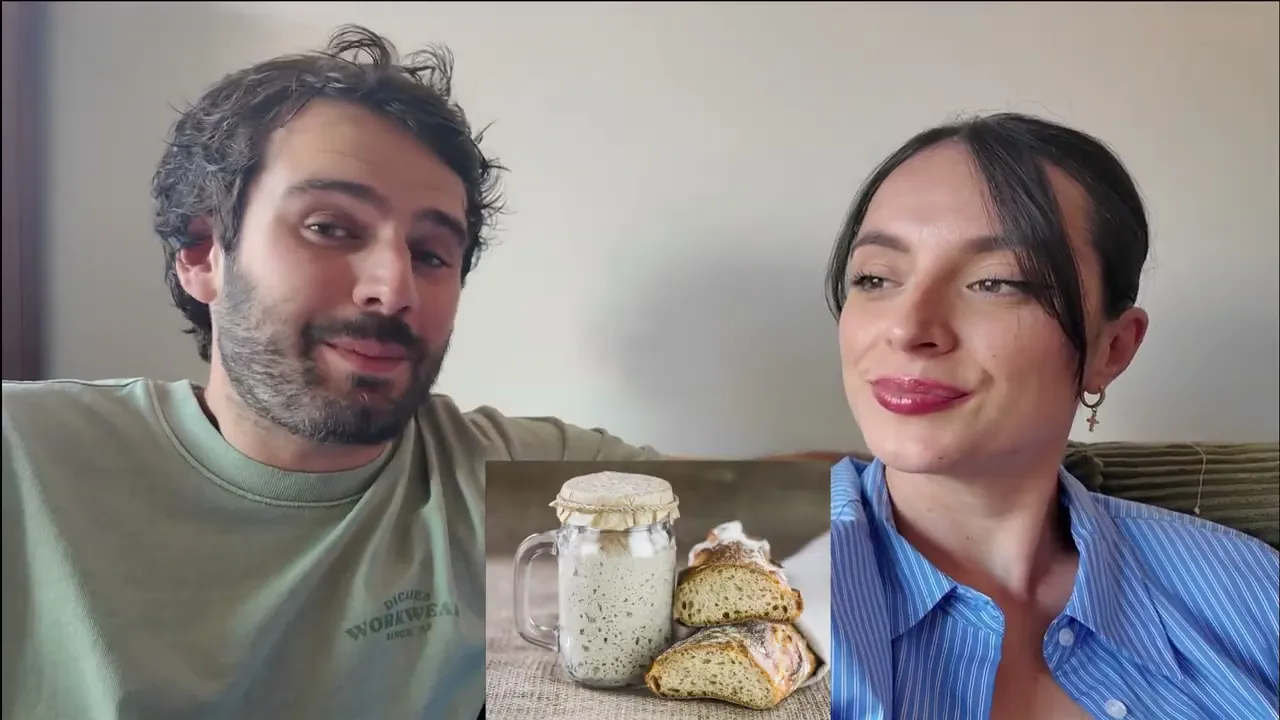
Nathan: In France, there are few things we agree on. But there is one thing: the baguette. Violaine: And bread has made us French happy for centuries.
Today, we're telling you everything about bread, when and how to eat it. Nathan: And we'll give you lots of advice on how to enjoy it when you go to France. And you'll see, after the video, you'll be a real expert.
Violaine: Right, are we going to have breakfast ? Nathan: So, Violaine, here we are, we're sitting down for breakfast. We have toast in front of us.
We put butter and jam, apricot jam on it. We're going to have breakfast. It's like this every morning.
Violaine: Yeah. And it's true that it's still very rare for the French to start their day without bread. It would be a bit of a tragedy.
We've already said that in a video. It's true that we often eat toast in the morning. And you know I saw a study: 95% of French people eat bread at least once a day.
So basically, if we want to summarize, all French people eat bread every day. Nathan: Are you part of this stat(istic)? Of the 95%.
. Violaine: Yeah obviously, obviously I'm part of this, this stat. To come back to breakfast, I still want to point out that Nathan has a phobia.
You still have a phobia for breakfast, it's melted butter on hot bread. That disgusts you. Nathan: It's true, it's true.
It doesn't disgust me, but it frustrates me to see, you know, when the bread is burning hot and very very hot, to put the butter directly on it and realize that it has, that it has melted. Then it runs, you know? Violaine: But you know you're not the only one who hates the taste and smell of butter, melted butter.
But that still means that in the morning you toast your bread. In the toaster. Nathan: Oh yeah.
You're right to point that out. Yeah, I toast it. You never do that?
Violaine: It depends. Well, you see, we didn't do it this morning because we got super fresh bread. We just went to the bakery to buy it.
So in the morning, no, I don't toast it. But on the other hand, if it's from the day before, yeah, I toast it. Nathan: Violaine, is it a baguette that you always have in the morning?
What kind of bread do you eat for breakfast? Violaine: Baguette, so baguette or traditional, but we'll maybe see the difference later in the day. On the other hand, I don't really like sandwich bread in the morning.
It can help out sometimes, but honestly. . .
pff yeah no. I don't really like it. Nathan: Same.
Same, never sandwich bread, never in the morning anyway. And jam Violaine, also important to remember, are you more of an industrial jam or homemade jam person? Maybe made by grandmother, as we often say.
Violaine: Well, I would like to be homemade jam, or I would like to have jars of homemade jam, but right now, in today's life, more of an industrial jam person. But it's true that we French have a lot of memories linked to jam during childhood. Either because our grandparents made it.
And then even, it's something we've been eating since we were little. So when we have this breakfast, it's true that every morning before starting the day, we fall back a little into childhood. Nathan: Violaine, bread, do you eat it with every meal?
It's been said at least once, for the French, at least once a day. But I'll give you the answer, I eat it at almost every meal. Except for snacks, but I eat it for breakfast, lunch, and dinner.
Violaine: Yeah, and it's the same for all French people. That is, except for dessert during dinner, for example, we don't eat bread, except obviously French toast. But it's true that it's kind of the only time when there's no bread at the table.
It's when we're having dessert. Nathan: That's it. For dessert, I make an exception.
Yeah, but for starters, eh. When we eat a salad, there will be bread. A main course, it depends.
But if there are vegetables, etc. , I eat bread. And then cheese, obviously the cheese that we eat before dessert, between the main course and dessert.
Violaine: Yeah, and also to mop up a dish. Obviously, it's very well-known, but it's very, very true. So bread is there all day.
And you're going to see that with us. Nathan: But by the way, do you know what the difference is between a classic baguette, a traditional baguette, and a ficelle baguette? I'm going to ask Violaine.
Violaine, what's the difference between the three? Violaine: The baguette. Obviously, it's the most common bread in France.
Inside, if you open it, you'll see that the crumb is quite white. And in fact, it can be made with additives, which makes it not very expensive, as bread goes. In France, we'll say it's between 90 cents and one euro 10 (€1.
10). No? Do you agree?
(That's it). Traditional, my favorite. Lots and lots of flour, but its production is regulated by a decree.
So there are no additives in it. The crust is super crispy, the crumb a little uneven. Since it can't be made with additives, it 's a little more expensive.
We'll say it's between one euro 20 (€1. 20), one euro 40 (€1. 40).
Nathan: And the last one Violaine: And the children's favorite, I think, especially for snacks. I used to eat it all the time. String bread.
It's half the size of a baguette, but it's basically the same as a baguette. It's a baguette for children. What did you have?
Nathan: A chicken sandwich and a tuna sandwich. Violaine: (There) was no more ham and butter sandwich? Nathan: There was no more ham and butter sandwich.
The person right in front took the last one. That's how it is. Violaine: Well, even during lunch breaks, bread is present.
What sandwich did you have? Nathan: It's always present in my daily life. A chicken sandwich with peppers, red, green.
What else? Tomatoes, sundried tomatoes, and then salad, a little lettuce. This is actually a very colorful sandwich and it's delicious.
I'm finishing it. And you? Violaine: I had a Niçois sandwich, so inspired by the pan bagnat and with tuna, black olives, tomato, salad.
Honestly, very, very good, a little dry, but I'll make do with it. And you know that half of the French eat a sandwich for their lunch break, and the French's favorite sandwich is the ham and butter sandwich, but unfortunately there were none left in the bakery. Nathan: There were none left.
What time did we go to buy the sandwich? At 1 p. m.
too. In fact, we went there at 1 p. m.
Violaine: Well, not even. I think we went at 12:30. Yeah, about 12:45, quarter to 1.
Nathan: And the person right in front of me took the last one. When he took the last one, I was disgusted. And so that's how people are, given that people leave work, work at 12 p.
m. At 12:45, everything is gone. Violaine: And it's funny, you know, we're talking about the ham and butter sandwich, but also the pan bagnat.
And it's two dishes or at least two sandwiches that, before, were considered poor people's sandwiches, poor people's food. I know that the pan bagnat was used to reuse stale bread. So the bread that became hard.
And it's funny because now, well, it's in all the bakeries you you will find, you will find these sandwiches. Nathan: And when you think about it, the price of bread, the price of the baguette Violaine, it allows us, in France, at least, to know the degree of inflation. And I say to myself, I don't know what you think, but in my opinion, bread is one of the last foods whose price will increase.
Because, in my opinion, we don't touch bread. And so we will prefer to increase the price of everything else. But in the end, the price of the baguette or the price of bread will remain correct, so to speak.
Do you see what I mean? I can't imagine the price of a baguette at €1. 50, for example, it remains around one euro, one euro 10, go on one euro 20, it depends on which baguette.
We've already said that. Violaine: Yeah yeah no of course, even if there has been a big increase in the price of bread recently. But yeah, I think we won't touch it, otherwise maybe the French would go out into the street.
Nathan: Probably. Violaine? How do you recognize good bread from bad bread?
A good baguette from a bad one? For example, this one, you know it, you see it, it's a completely industrial (industrial) baguette and this one which is a little better, which is artisanal. How do you, do you feel the difference?
Violaine: I think you can already see it in the color. When you look at the industrial baguette, it 's much duller. Nathan: So it's true that it's lighter.
It's less cooked, maybe, it's whiter. Yeah. Violaine: And the crumb is a little compact.
You see. It's much less airy than a traditional baguette. Nathan: And I also want to tell you, the smell.
When you smell it, there's a smell. It's hard to explain (industrial) but industrial. And then the taste.
If I taste the crumb, the bread crumb, it's super salty. You actually feel only, only salt in your mouth. Me personally.
. . and then it's true that it's not crispy at all.
It doesn't make any noise. You see? Violaine: No.
Exactly. Nathan: The difference with that one. You see?
It's still higher. You can see the difference. The price isn't the same either.
Violaine: No, it's almost half as expensive. Nathan: How much did we pay for the industrial baguette? Violaine: I think it cost 89 cents.
Nathan: Oh yeah? So it's under a euro. It's still cheaper at the supermarket, but yeah, it's not good.
I think it's disgusting. Violaine: But we're not going to throw it away? So she's going to help us out when we don't have bread or when all the bakeries are closed.
Nathan: Yeah Violaine: Okay Nathan, what advice could we give to people about bread in France? Nathan: I would advise choosing a traditional baguette over a more classic one because it's 10 times better, right? The taste is 10 times better.
Same goes for sourdough bread. It's better. It has more flavor.
The smell is incredible too, right, sourdough. That's it, and it's better for your health. So I would recommend that.
You? Violaine: I would advise, if you're invited somewhere in France , never to turn the bread over on the table because it brings bad luck. And also a quick mention of the fact that you should never pay for bread in a restaurant in France.
Nathan: Ah, that's right, that's forbidden, let's say, when you order at a restaurant, bread is free. It's included. Each time, the server must bring a small basket of bread and place it on the table.
Whatever the dish, you can ask for it once. Also ask again a second time, perhaps avoid a third. But there you go, bread is always included and free at restaurants.
Violaine: Okay, I think we've covered the subject. Leave us a comment to tell us what you thought of this video. Subscribe, of course, if you haven't already.
And we'll see you soon for the next video.










![[in French w subs] What every French person does in January](https://img.youtube.com/vi/5-Gtv07y-qc/mqdefault.jpg)