[Music] You would think the country that invented the compass, gunpowder, and paper would continue on its path of innovation in the 21st century. But to the contrary, in recent decades, China has earned an international reputation as a copycat. Not only does China operate fake Apple stores and manufactures knockoff watches and phones, but it also builds replicas of entire European towns like Paris.
But that's nothing compared to communist China building clones of advanced American military equipment. In this example, they got almost everything right except for putting the tail upside down. In 2013, the Washington Post reported that Chinese hackers had obtained designs of more than two dozen US weapon systems, including the Eegis ballistic missile defense system, the F-35, the latoral combat ship, and electromagnetic rail guns.
Today, cyber attacks targeting the American defense industry are a common occurrence. But what's more worrisome is that China has made backroom deals with various countries that use American military hardware in order to reverse engineer them. It's for this very reason that the Department of Defense decided not to export the Loheed Martin F-22 stealth fighter.
Although to be fair, China did produce some original stuff in the past decade like the Corona virus. But how intellectual property theft is built into the Chinese society? What are some elaborate schemes of Chinese industrial espionage?
And why China stealing American tech has unintended benefits is not what you [Music] think. The Chinese call knockoff products Shanzhai, a very specific word that recognizes the nature of what they're doing. It's not just underground factories that produce counterfeit products, but everyone, including government officials, who are completely fine with acquiring blueprints of products through theft and industrial espionage.
Even Confucious said that imitating is a quicker path to learning. This allows China to remain competitive on the world market as they save on precious time and money required for R&D. Ironically, copying answers on a university entrance exam comes with a 7-year sentence in China.
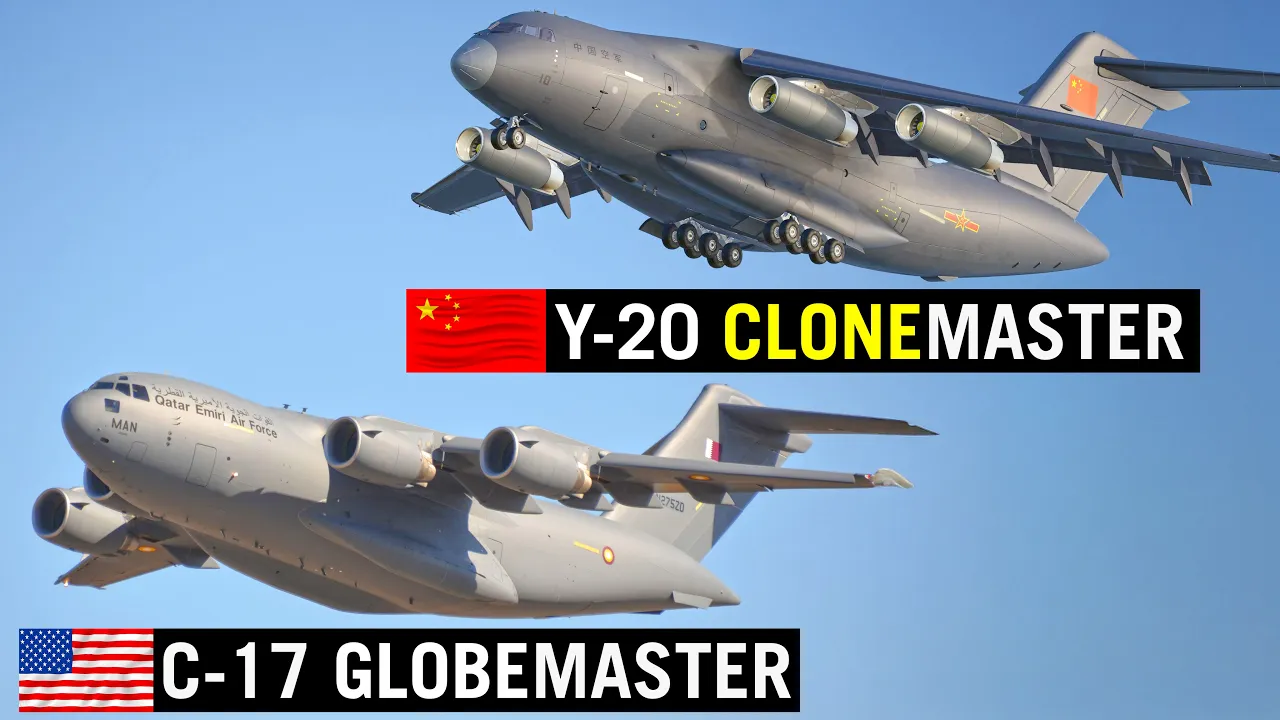
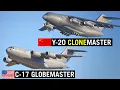
Meet Chubby Girl, which is the Chinese nickname for the Xian 120 Kang large military transport aircraft. In the United States, they call it the G17 Clone Master because of its remarkable resemblance to the Boeing C17 Globe Master and the fact that it's public knowledge that China stole the aircraft designs from the US. But it gets better or worse.
Not only is Chubby Girl at least partially based on the American design, but it's also powered by Russian engines. You see, building high performance, reliable jet engines is one of the most complicated things that a country can achieve. It took the Russians, Brits, and Americans several decades to perfect this.
So, as a stop gap measure, China relies on the Russian Solv D30 engines to power this transport aircraft. This is why there's a lot of comparison between the Y20 and the Russian IL76 cargo plane. [Music] That said, the Russian engines are not powerful enough for chubby girl to achieve her maximum cargo capacity of 66 tons.
And so, for over a decade, China has been developing the domestically produced WS20 engine, which has increased thrust. But they kept running into issues over and over again, and only recently they began testing it on the Y20. But by far the most striking example of Chinese military cloning is the Harben Z20 helicopter.
An absolute copy of the American Sakorski UH60 Blackhawk helicopter. Back in the 1980s, China bought 24 American Blackhawks for $140 million. But those helicopters were getting old and became difficult to maintain due to sanctions imposed on China after the 1989 Tienman Square protests.
To circumvent this, in 2004, China smuggled two Blackhawk engines through two Korean nationals who had falsified documents stating the engines were bought for the South Korean army while in fact diverting them to China. Later, four more engines were ordered, but the scheme was uncovered by federal prosecutors. As a result, in 2006, China began reverse engineering the Blackhawk into the CCP coph.
I know it's annoying when people copy your hard work, but remember, imitation is the sincerest form of flattery. The Blackhawk is just a really good design and it was much easier, faster, and cheaper for China to copy it than design it from scratch. And while it's almost a perfect copy, there are several differences, including the use of domestic engines, having five blades instead of four, and the use of a flybywire cockpit.
But it's not just the American toys that the Chinese are after. It's anyone who has better equipment than them. Case in point, Russia.
After the collapse of the Soviet Union, China acquired a few dozen Sukcoy Su27 fighters and later signed a deal with Russia to produce those jets under a license in China with imported components from Russia. But only a few years later, China cancelled the contract and debuted their domestically built Shenyang J11B, which by now wouldn't surprise you, was an identical copy of the Su27. Russia was furious.
Nevertheless, Russia, which desperately needed money, kept selling China their military equipment, only for the CCP to produce it domestically and sell their own replicas of Russian military hardware to other countries. At that point, Russia realized that they're getting played and stopped sending single examples of their most advanced systems to China on a trial basis. But the SU27 was not the only reverse engineered Soviet design.
In 2001, China acquired an unfinished prototype of the SU33 carrierbased fighter jet from Ukraine and reverse engineered it into the J15. The first Chinese aircraft carrier was also bought from Ukraine in 1998. the unfinished Khnitsu class aircraft carrier Vyog.
The Chinese rebuilt Very Yog and commissioned her under the name Leaing. It shouldn't be difficult to guess what they did after. Yes, they reverse engineered that ship and produced an improved version known as type 002 aircraft carrier Shandong.
Now, looking at these images, you think that this Chinese fifth generation stealth fighter is a copy of the American Lightning 2 fighter, right? Well, the Chinese aren't even trying to hide it since both fifth generation stealth multiroll fighters share the same name, J35 and F-35. Here is what probably happened.
Can I copy your homework? Sure, but change it up a little bit so it doesn't look too obvious. But here is the thing.
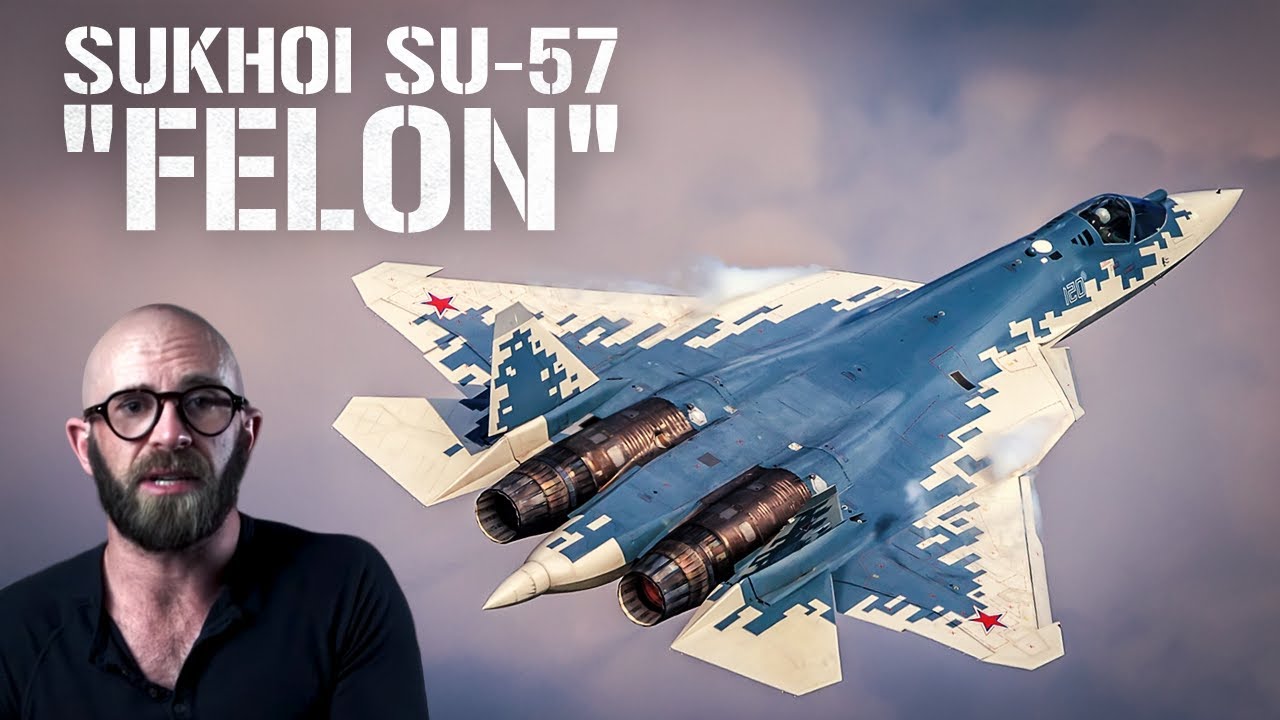
The Shenyang J35 is not a copy of the Loheed Martin F-35. It's true that China did steal 50 tab worth of F-35 design files back in 2007, and it definitely helped them in building their own version. And yes, from the front, both aircraft look remarkably similar, but that's where the similarities end.
The first major difference is that the Teu J35 is not entirely stealth. The panel gaps, the canopy frames, and the rear features suggest that its stealth is directional. This is unlike the F-35 which has 360° stealth optimization allowing it to avoid detection from any direction.
Word on the street is that the F-35 stealth is so good that even the pilots don't know where it's parked. Secondly, the Chinese fighter has twin engines instead of one. The F-135 engine on the American stealth fighter delivers 43,000 lbs of thrust and demonstrates superb reliability.
Meanwhile, China uses WS13 or the older AL31 engines which are a stop gap measure. That's because the one thing that China has not managed to copy exactly is the American jet engines. But the Chinese cracking the domestic engine production is a question of when, not if.
As it stands, we don't really know how good the Chinese J35 is in real life. So, we would most likely have to wait until Pakistan acquires them. Now, you might not still be convinced that the J35 is not a copy of the F-35 because both aircraft look so incredibly similar.
How do you explain that? It's simple. Once you consider convergence of [Music] design when it comes to certain things, say aircraft carriers, there are only so many ways to make them work.
If you look at China's latest aircraft carrier, class type 003, and compare it to the American Ford class, you would notice many similarities, like electromagnetic catapults, a resting gear, an island, and an angled flight deck. But that's just how aircraft carriers work. Just because two things look similar doesn't mean that they're identical.
for example, the Chinese Type 726 hovercraft, which looks incredibly similar to the American ELCAC. But upon closer inspection, they're quite different. For example, the ELCAC uses steerable thrusters to control the direction of the vessel, while the Chinese hovercraft uses puffer ports to steer.
Sure, there are differences, but how do you explain all the similarities? A somewhat classic example is the case of the Soviet space shuttle Buran, which looked a lot like the American space shuttle. At one point, an American engineer pointed out the obvious similarities to his Soviet counterpart, who in response simply shrugged it off and said, "It's physics.
" Now, if you were to design a stealth fighter, there's only so many ways you can do it. That's why in many cases engineers from different countries would come to the same conclusion. Physics dictates how stealth aircraft should look.
Just look at the South Korean KF21 and Turkeykey's conjet. In order to keep the radar cross-section to a minimum and the aerodynamics as efficient as possible, a certain form factor always comes out ahead. And that's why fifth generation fighters all look the same due to the convergence of optimal stealth fighter geometries.
The reality is that the Chinese J35 stealth fighter is a mix of both imitation from other militaries and domestic innovation. Some believe military espionage to be fair game. If someone steals your military secrets, it just shows your incompetence.
Countries steal from each other because it gives them a shortcut to a long and expensive process of research and development. It wasn't that long ago that Americans copied German technology, followed by Soviets engaging in espionage against the United States. Then came the Japanese who copied all the American stuff.
In the 1970s and 80s, everything that was made in Japan was considered a cheap knockoff. No wonder this circuit failed. It says made in Japan.
What do you mean, Doc? All the best stuff is made in Japan. Unbelievable.
Today, the exact same thing applies to made in China. But how did China manage to steal the design files of various American military hardware? For some of you, War Thunder forums come to mind.
But that's peanuts when you compare it to Bill Moo, a Chinese covert engineer who in 2006 tried to buy an F-16 engine, an AGM129A cruise missile, as well as UH60 Blackhawk engines and AM120 air-to-air missiles. Another example was Sue Bin who was indicted for cyber espionage for the Chinese government hacker scheme in 2014. Ben resided in Canada and was a businessman who specialized in aviation and aerospace products.
He got involved with several defense contractors and through his relationships he managed to gain insight into classified technologies that those defense contractors specialized in. Ben instructed Chinese government hackers on the companies and individuals that should be targeted and even helped to translate stolen data from English to Chinese. All in all, between 2008 and 2014, Bin helped China steal more than 630,000 files from Boeing on the C7 cargo aircraft alone.
His hackers also targeted the F-22 and F-35 programs. Another elaborate scheme was run by the Chinese spy Yanjun Zu. Yanjun would fly employees of aerospace companies into China under the pretext of giving presentations at universities while covering all their expenses.
It seemed harmless. But when these employees were taken out for dinner, Yanjun's associates would break into their hotel rooms. They would then hack their computers and steal information on things like the General Electric Aviation's composite aircraft engine module, something that no other company in the world could produce.
In other instances, Yanjun converted employees into assets. I wonder how. Who then planted malware on defense contractors computers?
Yanjunhu was eventually caught and sentenced to 20 years in prison in order to deter similar action by others. I hear he's doing all right in prison. I wonder how.
But what if I told you that all this copying and pasting of American technology is not all bad? The surprising benefit of the Chinese copying military hardware is that the United States knows their capabilities and vulnerabilities since they're the ones who designed it. Furthermore, decades of stealing western technology and shortcutting their own research and development means that to a degree, China has lost the ability to innovate.
You see, when you steal a design, you don't always understand why some of the engineering choices were made to begin with. And this alone leaves you perpetually behind. For example, in the 1980s, the Soviets adopted the Western x86 computer systems, which worked great in the short term, but in the long term, this prevented the Soviets from developing their own semiconductors, which eventually set them and consequently Russia decades behind.
Now, some of you would say that China is certainly capable of designing their own stuff and that it's a perfectly normal strategy to shave off a few years of development by engaging in industrial espionage. And why wouldn't China do that since the international response is generally a wimper? But reverse engineering a product still requires a good understanding of the technology.
Also, it's one thing to design something, but having the ability to mass-produce it is a whole other ballgame. And China has shown that it can definitely do this given that it has an established defense industry. For China, copying military hardware is not as easy as C andrlv.
You also need to know how to save as Mandarin.