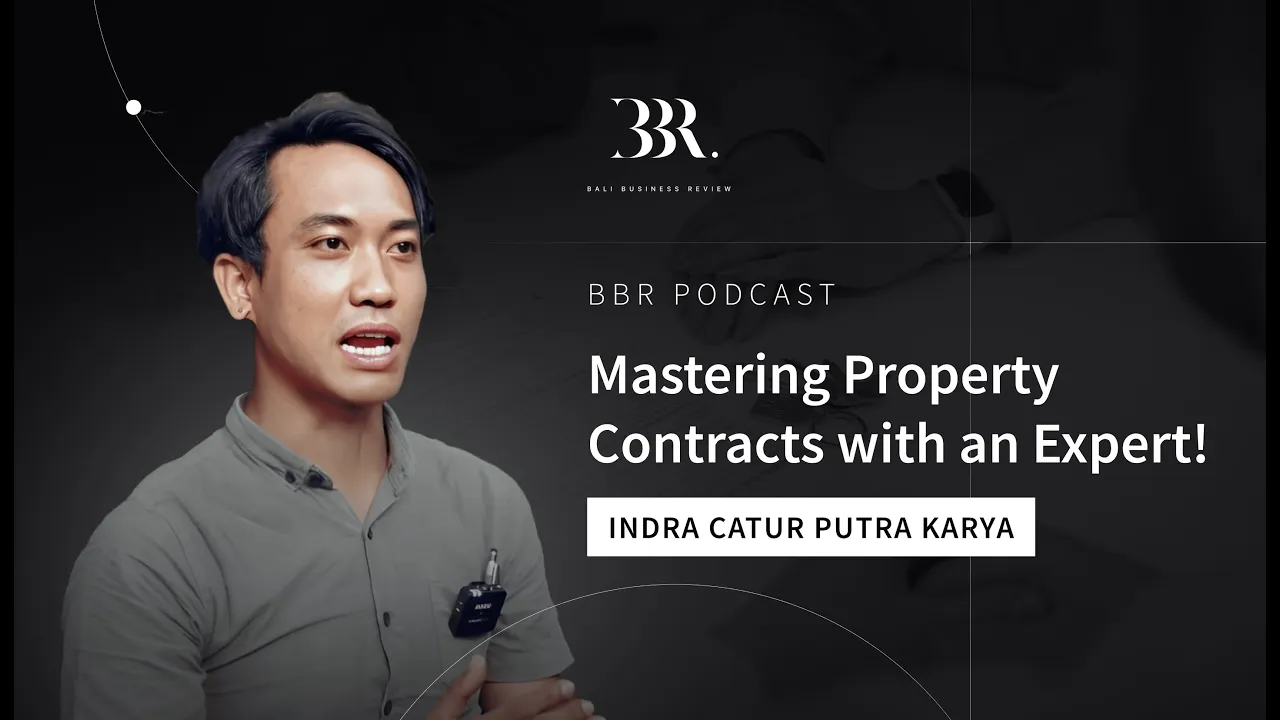
I'm Indra, the owner of Catur Putra Karya. I'm also the construction director at Catur Putra Karya. I have been in the construction field for almost 18 years And it's been 5 years in my own construction company.
From the moment I graduated, I was a junior supervisor on a project. Slowly from there on, until finally I was a project manager. The first project I handled was Iswara, a five star hotel in Ubud.
Several villas in Tabanan, Pentejani also villas. Villas in Ubud, and several government agencies like roads, bridges, private houses, offices. Those are in Tabanan too.
My projects involved almost all types of field. In every meeting with clients, I always had minutes of events. It's some kind of note that records everything I discussed with clients.
What they want, what they changed and all that. That's been the flow from the start. When we start, we sign the contract.
I happen to be working with a notary. So, we have clear laws. Well, in some cases, with my notary, In a building, for instance, a villa There must be several permits from the government.
Which we have to deal with such as SLF, PBG. There is something called ABT, underground water licensing. We prepare the data and we work with a notary to take care of those Until everything is settled.
Each region charges differently because it is affiliated with BAPPEDA. It's different between Jimbaran and Ubud. To be specific, it's around 80 million Rupiah for Jimbaran.
SLF, PBG, ABT. That's for a two bedroom one villa with a standard area. Around that much.
Nearly six months. We happen to be the ones who build. If it is managed by someone else, especially PBG.
That's about building structure, strength and quality of the concrete. If it's handled by the contractor, it is more efficient. Because they understand what's within the building.
If it's not handled directly by the contractor, There's usually a challenge. The contractor has a lot of knowledge. Say, they have as-built drawings.
So, the building size is accurate. If it's handled by another party, we might have to re-measure. Re-drawing the sketch.
At Catur Putra Karya, We put emphasis on having as-built drawings. It is different from shop drawing. As-built drawings are an entire different thing.
Shop drawing is a detailed plan drawing. Sometimes, the client wants some changes during a project. Like, "Can you please move this?
" "Shift this a little bit" "This is not what I want, can you widen it by 20cms? " Sometimes we can't make changes quickly in the shop drawing. Finally, we double check.
We make a drawing of the cumulative changes in that building. I don't have a problem with that. I'm always be open to change.
Because there are some clients who don't understand the drawings So, halfway through they would say, "Oh, this is not what I wanted" Or they want some changes. That's normal in projects. But, if things have been worked on, we have an addendum.
Including things that haven't been done yet, we have an addendum to the contract. The contract is attached together. Addendum.
First addendum, second addendum. For me, The client can do anything to me. For example, they can complain about my work results.
I'll accept that. Complaints in terms of time of implementation, In terms of quality, In terms of work methods. They can complain.
However, we will continue to provide what is in accordance with the contract. Therefore, in every project I work on, contract is the most important element. We put everything in the contract.
So clients can understand anything. What is the schedule like, and the project specifications The quality as well. Everything is clear, including the pricing.
Clients can monitor the process every day. It's valid in my opinion, because we are building what's theirs. And for clients to ask for some changes, that's normal.
Change this, change that. That's a complaint, so it's fine. For example, there is an item that's not quite okay.
One of the brands which quality is not par. Even though it really is the original brand. But then it is a reject item.
The client has the right to complain about that. At Catur Putra Karya, We have what we call quality insurance. These people are responsible to maintain quality.
Every material that we use, Whether they are materials or equipments, Someone has to ensure quality. I would say it's the culture in our company. That stood out the most.
From the initial meeting, From the planning stage, I will set a standard for a good communication. In other words, we are open questions. Whether it's just for the sake of it.
We are very open. We are also open for consultations on building issues. Oh, this is better.
Use this, it's better. I'm very open. I also direct my teams to be communicative.
So, if there are clients that reach out to us, For a meeting, for example. To discuss about buildings, we are open. We take notes at every meeting.
We have clear minutes of meeting. Everything are recorded for the project. Why Catur Putra Karya?
Firstly, We have to explain from the initial stage That the contract is definitive. Everything including the schedule and the work plan has to be clear. Everything is arranged based on facts.
Then we can start to accommodate the workforce. Timeline of material arrival. I have everything on a schedule.
Labor schedule is also included. I schedule everything well, including material schedule. Because planning is the most important aspect in the project.
Flow of planning, like drawing is finished, or we've started. I elaborated things like that in the contract. Up to the payment schedule.
Because the client must have prepared when they have to pay. It has to made known from the beginning. So, they have an idea.
The payment schedule is based on my work schedule. A week prior to payment, we will send a progress reminder. "This is where we are at", based on things at the site.
We demand payment every 20% of the project. Down payment, 20%, 40%, 60%, 80%. Everything in accordance to the schedule The payment dates will fit.
One week before, we will report to the client. That our schedule is at surplus, or we are at minus. If it's a minus, we're going to be honest and fair while stating the cause of it.
However, adding more schedule is also not favorable. So it takes a contractor to find out how does the project get back on track. Within the given schedule.
Because even in Bali, there are several problems. Weather problems like rain has to be taken into account and to be prepared for. Reporting is another forte of Catur Putra Karya We do reports, weekly, Daily reports, and monthly reports Clients will always receive them.
With which they can monitor the construction development In every one of my schedules, seasons like rain are always considered. Even in the dry season, we always spare some days in case there's rain. Although the intensity might not be as huge.
However, in my opinion, the rain itself is not what's important. Because even if it rains, we do have a solution. Instead, the most important thing in construction is the method.
Which comes first? What can we delay? Take as an example, I often finish the structure up to the roof.
The roof is my priority. Because when the building has a roof, and it's finally the rainy season, We will be able to work inside to do finishing, and all sorts. We can work on the first floor, second floor, and stairs.
Everything would be possible. That's why I often prioritize the main structure up to the roof. So when it rains, we can work inside.
If it rains during the construction of the structure The solution is a portable roof, to keep things running. Cleaning continues. I often use work methods like this in my projects.
So far, none of our projects went out of schedule yet In fact, we always finish earlier than scheduled. There is another section in the schedule where We have to prepare up to three months. The final inspection checklist before the project is handed back to the client.
Usually, when handling projects, The project, including interior, is concluded. Yeah, there are some projects that include interior work. When everything is concluded, The quality insurance team in my company Also the team that handles handovers, they will run through a checklist.
Together with the project manager and the project supervisor. They will discuss potential missing elements. After that process, there's a week to submit correction feedback Especially when there's an issue.
Thereafter, If the project owner has appointed someone from their side Or if it's a team, to run through the checklist, they are very welcomed. Final checks by the owner themselves is also welcomed. To check whether or not everything is according to plan.
We are open to that. And, we will fix that. The checklist is always prepared together with the contract.
For example, the term is 360 days. A month before the project is concluded, we start the crosscheck. Because time is needed for any improvement.
Revisions and improvements are included in the initial schedule. We always have to prepare like that, so that the client could say "Oh, we really finished, perfectly, it does really take one year," for example. We have to finish projects based on the agreement, including repairs.
And the owner also has to check everything personally. Whether everything is up and running, and if there are no defects. One year agreement is going to take one year to complete.
There will be a penalty if the project is beyond schedule. All my projects have a clear schedule. Trust is what I always want to give clients.
"I can finish this. " Therefore, I poured everything out in the contract. "If there is a case of delay.
" For delays, there will be a daily penalty, Some are weekly, some are monthly. And the values also vary. Sometimes, 1-2% per day or per week, per month.
That's usually the range. Even if the project takes an extra day, The penalty is quite significant. The reason why each of my contracts has a penalty clause Because it is what I always want to convey to my clients, that "I am taking your project seriously, and I commit to its completion" Within the time I have given.
" And when it's not on schedule, we as construction professionals must be able to do it no matter what. The schedule must be precise, it can't be more. Based on a percentage of the contract value.
If value of the contract of the villa was 5 billion. For a daily penalty rate of 1%, that's probably 50 million a day. In building villas, Construction-wise, it is more difficult to find a method That is saying we are protecting Bali's culture Because it is not related at all.
However, architecture-wise, it is possible. Due to it's designing nature, they could design to fit Bali's culture. How we do this in Catur Putra Karya is We work together with several teams, Some suppliers that are truly Balinese MSMEs This is what we usually develop.
For example, in lighting decorations and all kinds of things, We supplied those directly from the craftsmen in Ubud Also if our client really wants to build, but they lack a concept, We can help with that. Since we take part in design, we will try practice sustainability And use materials that are in reflection to Balinese culture. Those that suitable with Balinese culture.
We also try to always elaborate to clients. About some uses of materials that can be recycled and stuff like that. That's always the case.
We would always try to disclose from the beginning. What are the stuff that's out here. Specifically their effects to the environment.
To all clients, I always advise them especially the don'ts, such as Unethical waste disposal. One of the most important. Which is why we always prepare A structured waste disposal within the project.
Such as septic tank, clear infiltrations, so The waste does not damage the environment. That's our way. Firstly, they must be young.
Must be with young people. The reason? Older people in the industry actually has an extensive experience.
However, the people in construction are required to be strong, very strong. Because as a contractor, you have to have a strong physique. New and agile thinking.
That's the first thing. Secondly, unambiguous. Schedules, payment schemes, and the contracts are evident.
Everything is structured. Thirdly, They always have a good plan. And have good problem solving.
This is very important because When something happens on the project, It can be handled quickly. Fourth, they are able to face changes. Fifth, the most obvious one, Documents, legal, and experiences are a must.
However, being young, very important, because They are efficient thinkers and doers that has short respond time. Firstly, what needs to be asked to the contractor is their method. When you have a one-year project, What methods do you involve?
Inquire them question related to the weather. "How are you going to solve it? " Building on where there could be a potential landslide, do you know what foundation to use?
Those are what we can ask the contractor. That's where we can judge, "Oh, they are capable of this". It's not just, “Okay, I am can handle problems and all kinds.
" Rather, they are familiar with processes and what to prioritize Things that should come last as well. In order for that one-year project Actually be realized and completed. Giving out warranty is also something to be considered.