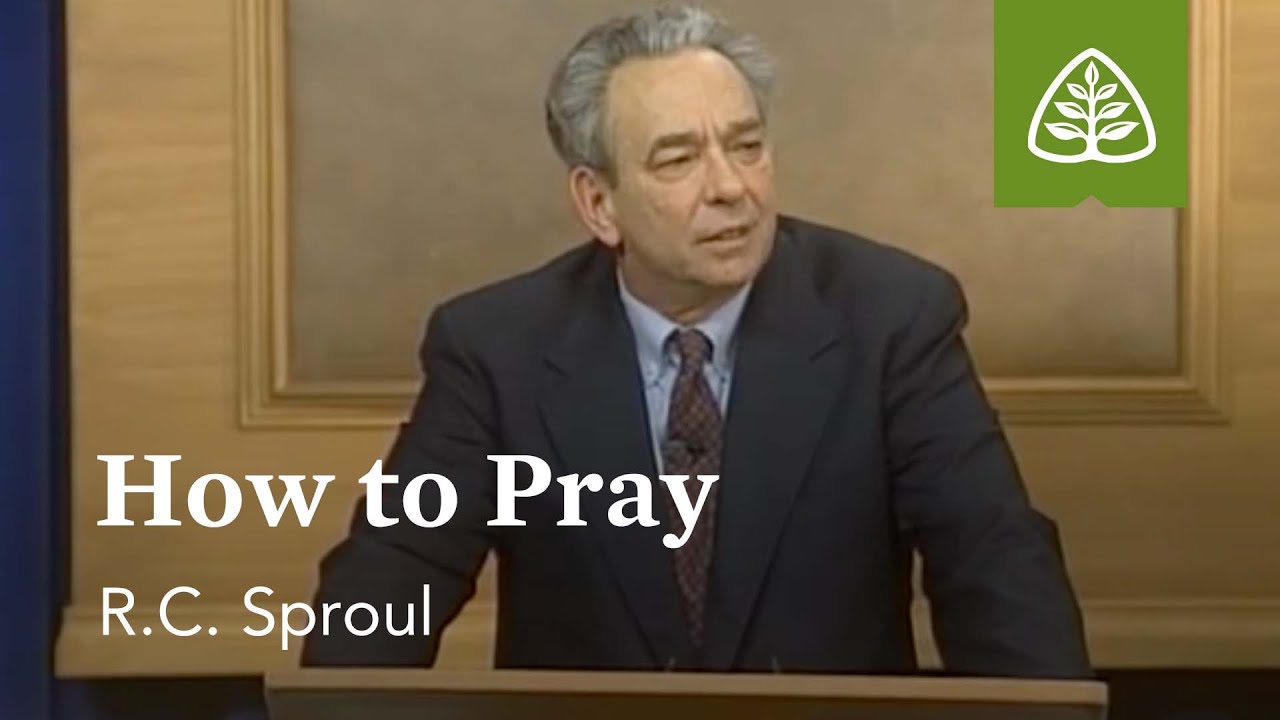
SPROUL: People that know me, particularly my students in the seminary know that I love to play trivia games. And today, as we continue our series on people who came face to face with Christ, I have two trivia questions that I want to ask you. The first one has to do with famous movies.
Everyone has heard of Cecil B. Demille's famous production of the Ten Commandments. And no, I'm not going to ask such an easy question as who played Moses.
We all know who Moses was. In fact, we sometimes we wonder if Charlton Heston is Moses, he so identified with that role. And I can ask you who the Pharaoh was, or the task master, Edward G.
Robinson, and so on, Sal Mineo. My question is this: Do you remember who played the role of Joshua? Joshua was Moses' chief lieutenant.
And you recall that at the end of Moses' life, that God in a celebration with all of the people, had Moses turn of the reins of authority to lead this nation to Joshua. And Joshua was one of the most important military leaders of the entire Old Testament. I like to think of him as the Stonewall Jackson of Israel.
So important was he, because he was the military commander that led the people of Israel in the conquest of Canaan. Now, who played Joshua? Okay.
If you don't remember, I will give you a hint. He also starred in a movie called Saturdays Hero, where he played a college football star. If that doesn't ring a bell, probably not; it wasn't a B movie, it was a C movie.
Nobody's heard of that movie. He's perhaps more known not for what he did, but for whom he married. He married a woman whose number is ten.
Now, does that ring a bell? Yes, I'm referring to John Derek who's the husband of Bo Derek. John Derek played the role of Joshua.
That's the first trivia question. The second trivia question is this: Who was the first person that ever came face to face with Jesus on this planet in human history? Now, on that question, I cheated, because one of the rules of trivia is that you are not allowed to ask somebody a trivia question to which you don't know the answer yourself; that's cheating to do that.
And that's just what I did, I just cheated you, because I don't know the answer to that question. I don't know who the first person was in human history to meet Jesus. It could have been Adam.
It could have possibly been Abraham. Perhaps it was Moses, I'm not sure. The reason I'm not sure is that, because there is an aura of mystery about some strange encounters that are recorded for us in the Old Testament that are very difficult for scholars to get a handle on.
On the one hand, we are familiar with these episodes in the Old Testament where men or women encounter the living God in what is called a "theophany. " A theophany, as I mentioned before, is a visible outward manifestation of the invisible God. The word "theophany," T H E O, comes from the Greek, theos, which means God.
And the root of the word "phany," phaneto, means to manifest, to make clear, to make plain. And so a visible manifestation of the invisible God is called a "theophany. " The burning bush that appeared to Moses in the Midianite wilderness, where in that bush, God was present speaking to his servant Moses is called a "theophany.
" Well, in addition to the presence of theophanies in the Old Testament, Old Testament scholars as well as New Testament scholars are interested in what can be called "Christophanies," which refer to a pre incarnation appearance of the second person of the Trinity in human history prior to the birth of Christ in Bethlehem. Now, we know that there are such Christophanies. For example, in the famous episode recorded for us by Isaiah in the sixth chapter of Isaiah, when he sees the Lord high and lifted up seated upon the throne, the New Testament says, unambiguously, that what Isaiah saw was Christ seated upon the throne, the second person of the Trinity prior to his descending into this world and living among us as an incarnate human being.
So it shouldn't surprise us that there are other occasions in the Old Testament, perhaps, when Christ, as the second person of the Trinity, made a cameo appearance. There is great mystery, for example, that attends the person of Melchizedek in the Old Testament. Who was called by the name Melchizedek, or "Malki Tzedek," which means king of righteousness.
And he is described as the king of Salem or the king of peace. His name and his title, King of Righteousness, King of Peace, sounds very much like the titles that are ascribed to Christ in the New Testament. We are told of Melchizedek that he had no parents, no father or mother.
Now, that simply may mean that there was no record of his genealogy, and that this was an ordinary earthly king or priest, but it is very strange that so much dignity is ascribed to this person that Abraham himself subordinates himself to Melchizedek. And in the New Testament, Christ's priesthood is called "after the order of Melchizedek. " And there are scholars who believe that in that encounter that Abraham was meeting the pre incarnate Christ.
I don't know. But there is another such episode of a person who came face to face with Christ that I do believe is clearly a Christophany, and that takes place in the fifth chapter of the book of Joshua. But before I look at that passage, I want to jump ahead to the beginning of the sixth chapter of Joshua where we read these words: "Now, Jericho was securely shut up because of the children of Israel; none went out and none came in.
And the Lord said to Joshua, 'See, I have given Jericho into your hand, its king and the mighty men of valor. You shall march around the city, all you men of war, you shall go all around the city once, do it for six days, and seven priests shall bear seven trumpets of ram horns'"; you know the rest of the story. God commands Joshua to lead a siege against the stronghold, this fortress city that guarded the promised land of Canaan, the city of Jericho.
It's been immortalized in song, we all know the song "Joshua fought the battle of Jericho, Jericho, Jericho," I'm not going to sing it for you; I already did, but, you know, the song. "And the walls came tumbling down, down, down, down," and it's been a part of the joy of Christian heritage to sing that song about that military conquest in the Old Testament, but to understand what happened in Jericho, we have to flip back even earlier than the fifth chapter. And you have to go to the first chapter of Joshua's book where God speaks to Joshua.
In the very beginning of the book of Joshua, in the first verse, "After the death of Moses, the servant of the Lord, it came to pass that the Lord spoke to Joshua, the son of Nun, saying, 'Moses my servant is dead. Now, therefore, arise, go over this Jordan, you and all this people, to the land which I am giving to them, the children of Israel. And every place that the sole of your foot will tread upon I have given you, as I said to Moses, from the wilderness and this Lebanon, as far as the great river, the river Euphrates, all the land of the Hittites, to the Great Sea toward the going down of the sun shall be your territory.
'" Now, listen to this: "No man shall be able to stand before you all of the days of your life. As I was with Moses, so I will be with you. I will not leave you nor forsake you.
Be strong and of good courage for to this people you shall divide as an inheritance that land which I swore to their fathers to give them, only be strong and very courageous. " This call, this commission, this divine mission that is handed now to Joshua requires strength and it requires courage. And so God assures his servant at the beginning when this awesome responsibility is transferred from Moses over to Joshua, God said, "Joshua, every place where you put your foot I will give to you, and I will be with you, and I will not forsake you.
" And here is the key: "no man shall be able to stand against you. " What a promise. Now, keep that promise in front of you, as we now turn our attention to the events that are recorded in the fifth chapter, beginning at the 13th verse of Joshua's book.
"And it came to pass when Joshua was by Jericho, that he lifted his eyes and looked, and behold a man stood opposite him with his sword drawn in his hand. " Now, let's try to get in the skin of Joshua for a moment. Joshua has to go up against the toughest fortress that he will have faced up to this point in his life.
The reputation of the warriors of Jericho is such that they were men of valor and of strength, powerful, powerful soldiers. And now, as Joshua is making his plans to lay siege to Jericho, to launch an attack against this fortress, as he's looking over the site, suddenly he sees a man that he's never seen before, and the man has his sword drawn. Now, I don't know what this man looked like, but, you know, how women are when they meet each other for the first time?
They are sizing each other up in terms of their competition; is this woman going to be competing for my husband? Is she prettier than I am? Does she have a nicer figure than I?
I presume that women do that, because women tell me they do that. I'm not a woman, so I don't know. Of course, men don't ever do anything like that.
No two men in the history of the world have ever met each other for the first time without unconsciously, if necessary, saying to themselves, "Is this guy a threat to me? Is he a possible ally? Do I have to watch out for him?
" There is an unconscious evaluation that goes on every time, and this is certainly true with athletes. Watch in the warm up session before a football game or before a basketball game, and watch the members of one team sneaking peeks against the opposition. I remember when I used to play ball, I would come out on the basketball court, and I would watch the other team come out, and I was looking, who is the tall one?
Who is the one that looks the quickest? Who is the one that's going to be the most difficult adversary in this game? The same thing before football games and baseball games, and so on.
I mean, look at the way baseball players warm up, and see how they throw the ball just in warm up practice, and you make an assessment. That's men, that's the way men are. And Joshua was a man among men, Joshua was a warrior.
He was the leader of the nation, and all of a sudden he sees a soldier he had never seen before in his life, and he can tell just by looking at him that this is a formidable person. He can tell by the way the man holds the sword that he's not a novice with a sword, this is no rank amateur that has suddenly appeared, but he can't see his name on the program. Where did this ringer come from?
Is this reinforcements that have been sent to help me, or is this a gun slinger that's been hired by the people of Jericho to help them in the midst of this battle? And then all of a sudden I think Joshua, who still has the words of God ringing in his ears that "I will be with you. I will not forsake you.
Be strong, be of great courage. No man shall be able to stand against you. " I know that Joshua is looking at this guy and thinking, "Well, what about this one?
This guy looks awfully formidable to me. " You sometimes hear interviews of somebody who had just won the heavyweight championship of the world. And you see a man who is a champion, and the press will say to him, "Well, what do you think?
You beat all of the contenders. You are number one in the world. " And invariably, they'll say, "That's true.
But my daddy always said to me, 'No matter how good you are, there's always somebody out there better, and there are lots of people out there that want to kick you off this hill, as king of the hill, so I can't get too cocky about this, even when you are the world's champion. '" They may say, "I'm the greatest," and all of that, but even Ali lost and he lost more than once. I wonder what would have happened if he would have fought Marciano, but that's another story.
Joshua is wondering. So Joshua went to him and said to him, "Are you for us or for our adversary? " He sees this formidable soldier standing in his path, and he goes over to him, and he asks him the question that's on his mind.
At least I have to give credit to Joshua that he just comes right out and asks the question, because he wants to know, "Whose side are you on? Whose team are you playing for? Are you on our team or are you fighting for the people of Jericho?
Are you with us or for our adversaries? " You hear the answer that the warrior gives. The first part of the answer I will tell you without reading it from the text.
The answer to Joshua's question, "Are you for us or for our adversaries? " And the answer is, "No. " No?
What kind of an answer is that? I mean, that would be cute when you are in a restaurant, or in the store, where somebody says, "Will this be cash or charge? " And you say, "Yes.
" And they give you a look, and you know what they are going to say, "Smart aleck, don't be playing games with me. Obviously, it's got to be one or the other. " And that is what is happening here.
Joshua asks a question that's an "either or" question. There is no neutrality here. This is a war of conquest.
Who in the world is going to be standing around with a sword that's on nobody's team? Now, so Joshua says, "Are you for us or are you for our adversaries? " The answer is, "No.
" Why? Look at the rest of the statement. "No, but as captain of the Lord of Hosts, I have now come.
" Now, another translation reads it this way: "No, but as commander of the army of the Lord, I have now come. " "Joshua, I am not from your army, and I'm not from the armies of Jericho. I am the captain of the Lord of Hosts.
I am the commander of the army of God. " Well, doesn't that mean you are on our team, that's what Joshua wants to say. But what is he saying?
He's saying, "Joshua, it is not a question of whether I am with you or with the people of Jericho,” but really what the captain of the Lord of Hosts is saying to Joshua, is, "Joshua, I'm your commander in chief and I am taking over, I'm assuming the leadership of this conquest. This battle is mine. And the question is not, 'Am I for you,' but the question is, 'Are you for me,' because I'm the captain of the Lord of Hosts.
" An interesting title, the title ascribed to Christ in the New Testament as our archegos (ἀρχηγός), our champion. The one who is the leader of the people of God. The one who is the author and finisher of our salvation.
The champion who brings his people into the promised land in the New Testament, goes before the people of God in the Old Testament as he takes command over his name's sake. Because the New Testament name "Jesus" is just another name for Joshua. And Joshua meets the ultimate Joshua here on the plain of Jericho, and he knows now that he is not talking to a soldier from Jericho.
Listen to the reaction of Joshua: "And so Joshua fell on his face to the earth and worshiped him. And said to him, 'What does my lord say to his servant? ' And then the captain of the Lord of Hosts said to Joshua, "Take your sandals off your feet, for the place whereon you are standing is holy.
" The Holy One of Israel has come, not in his Incarnation, but in a Christophany. The second person of the Trinity. The one who will deliver his people and lead them out of bondage and into the promised land appears.
We know this is not an angel, the host of heaven are called the angelic army, this army of angels that surround the presence of God, but no angel, not even an archangel is permitted to be worshiped and will not receive worship from any creature, but when Joshua sees who is standing before him with this sword that is drawn, he falls on his face and he worships him, and he calls him "Lord. " And his worship is accepted by the captain of the Lord of Hosts, which means it can't possibly be an angel. It can only be the Lord himself who becomes present for his people to give them courage and strength to conquer the city.
One of the things that bothers me as a Christian is the language that emerges as part of the customs and the jargon of our religious talk. So often we say to each other, "Do you know Jesus? " Or, "Have you accepted Christ?
" I don't like that language. And, the reason I don't like it is that because it suggests that Christ is an option for us and that the lordship that He might manifest in our lives is somehow dependent upon our acknowledging Him or our accepting Him. Now, I know there's a sense in which the New Testament speaks of receiving Christ and all of that, but fundamentally there's something much deeper here.
The issue is not, do we know Christ, but does He know us? And the question is not, do we accept Christ, but does He accept us? I want us to turn the tables of our thinking just as Christ here in His encounter with Joshua made Joshua think from a totally different perspective, a totally different level.
"Are you for us or against us? " and Christ said, "No," I'm taking over. And you're asking the wrong question, Joshua, and it's a question you need to ask.
Not is Christ for you, but are you for Him? Do you fall on your face? Do you worship before Him?
Do you obey Him and draw your strength and your courage from His presence? He's your Captain. He's your Commander as He commands the entire hosts of heaven.