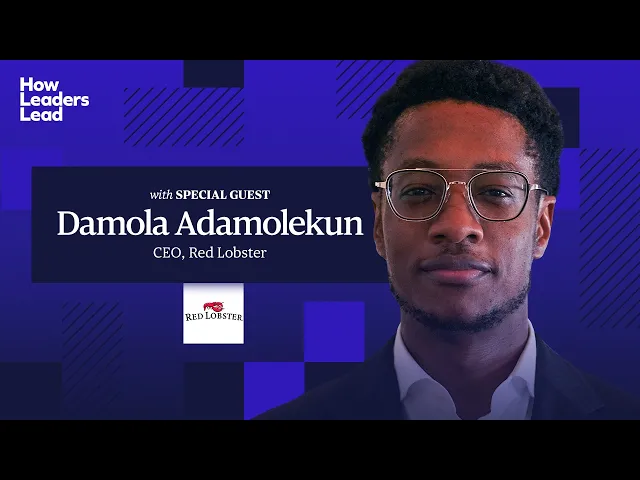
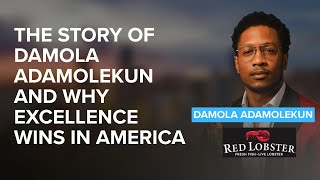
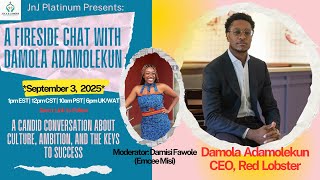
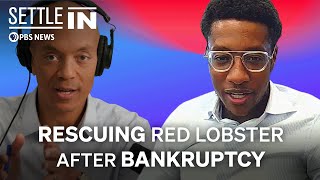
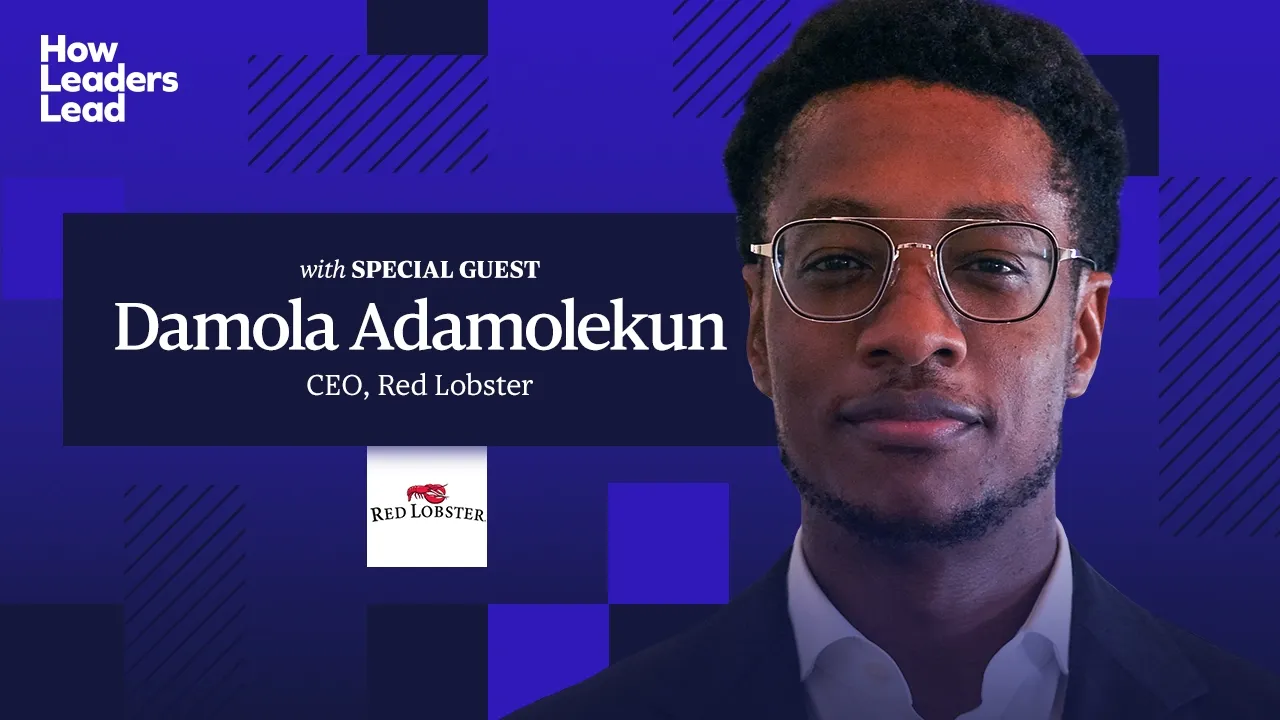
Hello everyone and welcome to another episode [music] of how leaders lead. Today David sits down with Jamola Adam who is the CEO of Red Lobster. At just 30 years old he took over a CEO of PF Chains during co and at 36 years old he has taken on one of the most challenging turnaround situations in restaurant industry history as he seeks to be the guy who returns Red Lobster to all of its glory. And if he is successful, he Believes it'll be the greatest turnaround in the history of the restaurant industry. So enjoy this conversation
between David and Demola, and I'll see you at the debrief. >> With pressure in general, if you're too worried about the pressure, it takes away clear thinking. You can recognize pressure and not let it affect your day-to-day or your mentality, right? You don't want pressure to force you into a mental corner where you're making bad Decisions. You need to make decisions calmly regardless of mistakes. I'm going to get into Red Lobster, but right off the bat, I got to ask you, do you still have those Cheddar Bay biscuits? >> We have them today and we'll
have them forever, my friend. Yes, we do. >> Signature item. >> You're 100% right. That's a That's a classic and uh it's a fan favorite. So, those aren't going anywhere. [laughter] >> That's good to know. I'm I'm glad you've got good judgment. you know, uh, you know, as I understand it, you played football at Brown, which is a great Ivy League school, and and you were a defensive back. Which NFL receiver do you think you'd have the hardest time locking down these days? >> Either Jamar Chase or CD Lamb. They're both insanely quick over short
distances. They're great acceleration, and they'd be they're shifty. They're Hard to keep up with. So, I'd say one of those two. [laughter] >> That's good. You sound just by the way how you describe that, you had to be pretty good back then. Well, you know, my my my strengths are I'm tall and I'm fast in a straight line, but these little guys that go side to side incredibly quick. You know, you have to you have to stay low center of gravity and do your best to try to keep up with them, but they're [laughter] they're
Difficult. >> What was your welcome to college football moment? You know, that that one hit play or mistake that you'll never forget. >> You know, I was a uh a wing back in high school and corn and I and a safety, but I was playing against high school players. When you get to college, you start trying to hit college running backs, some of whom are trying to go to the NFL and you're 165 playing deep Safety coming up to tackle a 200 50 pound running back sometimes. That's that's your welcome to the to college football
moment, you [laughter] know. Go low, try to take some legs out and and survive the hit. >> Yeah. And and stay away from those concussions. I hope you didn't have any. >> Exactly. Exactly. Exactly. Well, Damola, I can't wait to hear about your leadership journey and and you know, going deeper into what you're doing to Turn around Red Lobster. Uh, but what's a story uh from your childhood that's that shaped the kind of leader you are today? >> Yeah, you know, I'm I've got a something of a unique uh background and upbringing. Yeah, I was
born in uh in a small town in Nigeria, so I had an international background. I was uh born in Nigeria in a town called Elle Epha. lived abroad um in Nigeria and Zimbabwe and in the Netherlands through my Childhood and then moved to the states when I was nine to Springfield, Illinois first and then Columbia, Maryland before I went to college at Brown. So uh for me I had a a childhood that required a lot of adapting from place to place, country to country, different types of people, different languages uh which taught me how to
um do well in any situation and very widely varying varying situations. I think I learned a lot about people. Obviously, the Differences in these places, but more importantly, the similarities across uh geographies and cultures and people and what uh what kind of the threads that that humanity kind of have in common no matter where you are, which I think is an important part of leadership is being able to connect to a wide range of types of people. And then finally, I'd say I learned that, you know, the best way to to to do well in
any place that I went was just to be good at stuff, right? So, I learned that excellence travels. If you're a good athlete in Zimbabwe or in Springfield, Illinois, you're going to make some friends, right? So, I learned to I learned to try to be good at stuff that I did, and that was always the best way to fit in. >> I love that. Excellence travels. That is so true. No matter where you go, if you can take excellence with you, it it it definitely gives you a head heads up, you know, and and I've
heard you say When it when it comes to excellence that your parents set a real high bar. uh what's something they did or or said that still plays in your head today? >> Yeah, you know, I think for me it's um it's all about expectations. So, uh you know, my parents always when we got to America, the what they my my father said was, you know, in in America, um it doesn't matter what you do because you'd look at uh you know, we had a barber that was driving an S-Class Benz because he had the
biggest barber shop in the town in in Illinois in Springfield. And my dad would say, "It doesn't matter what you do. If you're a doctor or a barber, if you're the best at what you do, you can do well in this country." Right? So, it was never about forcing us to do anything in particular. It was all about whatever you do, aim to be the best and let your work speak for itself. So, that was the ethos uh within my family. And uh you know, I remember I'd complain because I'd get all A's and one
B and my dad would want to talk about the B. And I say my friends would be you know, they'd get uh they'd get money if they got one C on their report cards and my football friends. [laughter] my dad uh you know say look when you have a child that's doing 99% perfect and you see one thing that can be better we're going to work to make it better right so that was always the mentality And it was all about doing the best you can and striving for excellence and perfection in everything you do
>> yeah that's like my dad I remember I could hit three home runs and if I let that ground ball get by me at third base [laughter] that's what we talked about after the game so it's great having the parents that raise the bar for us like that you know and so you moved to you know the United States from Nigeria How did that move to to the United States compared to what you thought it was going to be like? I mean, I know you're only 9 years old, but you I'm sure you had some
anticipation. Was it about the same or different? You know, what what was your impression? >> Well, I don't I'm not sure Americans appreciate just how important America is to everybody else in the world and how much uh people how much the culture of America influences all the far corners of the world, including the town that I Grew up. Right. So I was a I knew about Michael Jackson. I knew about Michael Jordan uh and some of the big movies that uh made it to to where I was, right? So there was an element of fascination
with American culture. I remember I watched the Atlanta Olympics in 96 and got to see Atlanta, which is a place my dad had been before, so asked a million questions about it. So uh yeah, you look, American culture is is uh drives world culture. Um, so there's a Level of anticipation and excitement about coming to to to America. I'd say it lived up to all of my uh all my best expectations at nine years old. I really enjoyed uh my t my time in Springfield and my time in in Maryland. And I was really excited
to be uh to be in the country. And you know, you you know, you obviously did well in school, great football, and I understand you you got an internship at at Goldman Sach when you were 19 years old. How'd you pull That off? Yeah, look, I was uh you know, I was ambitious and bold as at that age and you know, I think it's uh I had big goals and I there was nothing in my world at the time that told me that these dreams were unachievable. So, I just sort of went for everything that
I that I wanted. Um whether that was football and trying to play in college, which wasn't a given, but you know, I had to kind of work to make that happen. When I before I went to college, I won uh $10,000 for a speech contest for uh extempiraneous speaking. It was a scholarship, but they gave me a check. So, what I did is I opened an account to start investing. Um so, I learned about finance via reading Mly Fool and reading Warren Buffett letters and doing my best to to be a stock picker. And so,
when I got to Brown, I had an interest in finance already based on my kind of self teaching. Uh, and when I got to Brown, I Joined the Brown Investment Group, which taught me a more formal understanding of finance and investment banking and all the different elements of of the capital markets. So, for me, freshman year, I kind of had an idea. This is what I wanted to do. So, I applied for an internship at Goldman and I was fortunate to get that and jump right into the to the deep end uh working on Wall
Street. >> Yeah. You're obviously a great Communicator. Does that come naturally to you demolish or have you spent a lot of time working on it? >> It comes naturally to a degree, but you can also improve on anything. I believe the things you're good at or the things you're you're not so good at. So, it certainly improved based on practice. I think being in speech and debate in high school was was uh was great for me. Now, I was I joined the team because my English teacher asked me to join because She noticed the way
I spoke. So, I had a talent before that, but she helped me refine that and improve it. And I think that's what you do with all of your gifts. And you know, I'd say stepping into leadership roles early in my life, you have to speak. No matter what you lead, you're going to speak to the group. You're going to communicate ideas. You're going to debate, defend ideas. So stepping into leadership positions early, there's a lot of Benefit, but one of them is you learn to communicate your ideas and defend them and explain them. Um, which
is, I think, a critical skill for whatever you do in life. You know, besides having high standard parents, you know, we have another thing in common. I was on the debate team, too. So, what did you learn about what did you learn about, you know, taking the affirmative and the negative side? >> Well, you learn to be a flexible Thinker, right? Because, as you know, in Lincoln Douglas style debate, you don't know what side you're going to get. And I don't know if they still do this, but back then, they were controversial issues, right? And
they'd give you a side, and you'd have to argue whichever side they gave you. So, you had to walk into the day prepared to argue either side of an issue, which mean which means you needed to understand both sides. It's a good practice and a habit because You know when you take one side of an issue, it's not that everybody on the other side is necessarily dumb or crazy or stupid. It's like they have a different perspective. And that exercise forces you to take both perspectives, understand both perspectives and it makes for I think a
better uh communication style and better understanding of issues as you go down the line. And you know in debate you you have to get fact-based evidence and you You go to your evidence and support your your points. H how fact driven how fact- driven are you in your process of leadership? as much as you can be. But the pro, you know, the the the reality is a lot of our decisions, especially in the restaurant business, are subjective by nature. And it's about things that people uh want or will like, right? And you can measure that
to the best of your ability, but to some level, it's a subjective question, right? Like what's The right uh color? What's the right uh uh scheme? What's the right design on a plate? Uh you test it, but a lot of times it's it ends up being kind of some people like this and some people like that, right? right? And you try to do your best to solve for what the you know percentages might say or what the best uh outcome is relative to your to your guest. So uh we try to be data driven but
you recognize you can't get 100% answers on everything and where you Don't have 100% answers you uh debate you discuss and you make do your best to take the right decision. >> You know back to communication just for a second what what advice could you give other leaders on on how to develop that skill for themselves? practice, you know. Um, and I think there's different forms of communication. There's, uh, formal sort of written communication where you have a speech and you need to deliver it. That's one thing. But I Think what's most important is what's
called extemporaneous communication, which is discussion, debate, thinking on the spot. So, engaging in conversation, engaging in debate, engaging in broad-based discussion, um, these are things that will help your your extemporaneous speaking, which is what you use the most in real life and in leadership. What's the most stimulating conversation you've had in the last few weeks just on the business itself where It really opened up your eyes or everybody really got super engaged? >> Yeah, look, I think uh you know, discussions with with my board are always really interesting. They're very intelligent people with a lot
of different businesses and a lot of different perspectives they bring to the board. So, you know, some of those conversations, you know, without getting into the topic, but discussions with my board around strategy, marketing, menu Even. So there's a lot of good, you know, it's the restaurant business, as you know, everybody has a point of view, whether they're in the company or outside of the company, they have a point of view on the business. So it's always uh there's always great conversations to be had. >> Hello friends. I hope you are loving this conversation with
Damola. I know I am [music] loving it and I am also quite inspired to go get some bee cheddar Biscuits at Red Lobster for dinner tonight. Be sure to stay tuned to the very end of the episode. So David and I, as we always do, are going to debrief this conversation so that you can take away some real practical, tangible [music] tips that you can apply to your leadership, and to your life, to your work, to your relationships. You'll get David's take on some of the themes that he and Tamola discuss during this Conversation. [music]
So stay tuned to the debrief, and we'll see you soon. >> You know, and back to Goldman Sachs for a second is when where you were an intern, what was the biggest lesson you learned at Goldman Sachs that you carried with you? You know, I joined Goldman right before the crisis and I did my summers there in uh ' 07 and '08. So, I got to see the boom times and I got to see when it all crashed down and Uh that was informative and um it was it was in in a way a perfect
way to start my career because and I'm I'm not saying that because it was a good thing that happened to the country. Obviously created a lot of issues and pain, but from a strictly professional standpoint, I got to see both sides of the coin, right? and when things are good and when things can go south and what that can look like and how you deal with crisis. So that was uh an informative way to do My first couple internships and I think shaped my view first on investing and then also in managing businesses uh through
various cycles. >> Now and after college and after you know Goldman you got a job in private equity you went to business school then started working at a hedge fund and the story that I've heard is that while you're at this hedge fund uh you saw PF Changs was for sale and you went after it. Tell us that story. Mhm. I'd spent my career in These places as you said mostly focused on consumer retail businesses, right? So Goldman I was in the consumer retail group. TPG I was a generalist but I mostly did consumer retail
deals. Um at Pollson I did a lot of things but again covered retail and consumer for John. So that was kind of my my niche already. Um, and PF Chains came up for sale and the person who was leading the sale process was a gentleman I'd worked with at at Goldman who at this point had Moved to Bank of America. So, um, in catching up with him, he told me about the company that was for sale. You know, he wasn't quite sure it'd be a good fit for us, but, uh, but wanted to share it
with me. So, we did a bunch of work and found that we thought it was an interesting deal. Um, and I pitched it to to John and to the uh investment committee at Pollson as uh an interesting opportunity for us. A bit different than what we've done, but you Know, these they're they're flexible thinkers and they're uh open to new ideas if they think it's going to be profitable. So, we were able to I was able to get approval to do the deal. I chased it down. We ended up winning the the process and we
we bought PF Chains in uh beginning of 2019. >> So, how did you get how did you get these smart guys to say yes? I mean what was it you know how did you think about you know that presentation and that Pitch you know what what was the key that made it that made it work yeah look I think it's um it's different depending on the firm you work for you need to understand the style of the people that that are making the investment where where I worked was an arbitrage uh dribb based shop you
know John Paul also started his career in merger arbitrage and then expanded to a bunch of different things so there was an arbitrage opportunity I saw with the Delivery business specific specifically where it hadn't been developed, [clears throat] but it was a business that should have a delivery business, Chinese food. Um, all the systems were available and it could be built relatively quickly. So, you could buy a business at a certain price without the delivery business, build it quickly and change the value of the company completely, right? So, that was kind of the baseline thesis
around Delivery, which proved fortunate given it was 2019. But, of course, I didn't know COVID was coming. But even before CO, the delivery thing made a lot of sense and formed the crux of our thesis. And then there was other things that we thought were upside opportunities. Remodeling the restaurants and getting that to be in a state where you could drive the dining business and improve trends there. Various things around um technology improvements and efficiency And simplification. So we're able to build a pretty comprehensive point of view that we could get the business at an
attractive price, make some improvements, uh drive traffic, drive off-remise dining business, and get to a good outcome. >> Makes sense. And you know, as I understand it, uh, you then made the shift and you actually became the CEO of PF Chens. You know, how did that happen? >> Yeah, look, like I just described all These things we wanted to do, right? So when I get the green light, there's a list of stuff that's expected to get done. And, uh, and when the deal closes, uh, you know, we brought in a CEO who was wonderful, named
guy named John Antiako, um, who used to run a number of different businesses, including 7-Eleven and and Blockbuster back in the day. And so he's a very good CEO but operationally oriented primarily. And so When we started he wanted to focus on the operational work and we were eager to get going on all these strategic initiatives. Let's call them these growth initiatives. Building a delivery business, building the app, building the portal, signing up with the third party partners, remodeling the restaurants. I'd say we were moving slowly on that stuff. And uh you know the bosses
at Pollson were you know they c they asked me right what's how are we doing on This? what's the status on that? So, at some point when you're making phone calls from New York to headquarters, it's hard to get a good sense of how things are moving and how you can uh accelerate them. So, I started going to Scottsdale and just spending time there to understand where things were and try to move things along. You know, the CEO we hired, Antioch, appreciated me being there. I was able to take some things off his plate and
help him focus on core Operations and I just moved forward with some of these initiatives. So, you know, he effectively asked me to to step in as as chief strategy officer to help him uh with some of these strategic initiatives. So, he proposed that went to we went to Paulson. Paulson said, "Okay." So, I ended up working at both for about 12 months. I'd fly out to Scottsdale every week and fly back to New York every every weekend. And uh so I did that for a year with with Antioch. And um it worked pretty well.
We made a lot of progress. We got the delivery business really built up that year. And then COVID hit. All the restaurants got shut down. Antioch stepped back. You know, the travel was going to be too much for him during COVID. He was older. We were left without a CEO in the middle of COVID. And the only part of the business that worked was the part that I had just built, which is the delivery business. So, um, ultimately Pollson Asked me to step in as CEO in COVID and Taco recommended me versus hiring. So, I
stepped in in April 2020 as CEO and I I took over from there. And you got that job when you were 30 years old. And and I've noticed, you know, as I as I've done my research, you know, almost every time your name is mentioned in the media, it also lists the age that you're so young. You know, how do you think about that? You know, I don't much. I recognize look when I when I uh in Anything you do, you need to recognize your strengths and your uh weaknesses. And um you know I have
a lot of strengths but there in this situation experience is clearly a weakness right there's people who've done it for 20 years and I had I had not so long as you can't be a perfect candidate for anything. There's always going to be some area where you're you're weaker. So for me it's about recognizing that and accentuating your strengths and shoring Up your weaknesses. So for me I had a ton of experience at the restaurants. I had a ton of experience at the headquarters. I had a great COO. So I had experience around me. So
long as you're willing to listen to that that can become your own experience, right? so long as you're willing to engage with these people. So, I never felt like there wasn't information, you know, if I didn't have it myself, it was around me. And so, my job was to align the team, Build a strategy, motivate people, uh get things moving, uh empower the right people, promote the right people, and uh so long as I was able to do that, we built a great team and were able to move the business forward. >> You know, when
you're the CEO, the the job doesn't care how old you are. You own the results. What's the moment early on that made you feel the full weight of that responsibility? >> Yeah, I mean I knew the responsibility From the beginning. You know, I spent a lot of time in the restaurants and you see a lot of people's livelihoods are dependent on you know making successful decisions at headquarters. Um so you understand the scale of it uh from you know I did at least from the beginning with with pressure in general if you're too worried about
the pressure it takes away clear thinking because you become stressed. So, you can't I think maybe a benefit of playing sports, you can Recognize pressure and not let it affect your day-to-day or your mentality, right? You don't want pressure to force you into a mental corner where you're making bad decisions because you're freaking out about the stakes. You need to make decisions calmly regardless of the stakes. So, um, so I recognized it, but I don't I wouldn't say that it I tried just to make clear, uh, common sense decisions, think through what we knew, what
we didn't know, get Information, use data, and, uh, and just execute as well as we could regardless of the stakes. You know, almost every leader who's on a fast track will tell you one of the most difficult challenges they have is is to learn how to manage people that are older and and more experienced than than they are. you know, what kind of coaching you can you give people on on how to do that because you've obviously been able to navigate it. >> Yeah, look, I'd say that people have followed young leaders since the beginning
of time. It's not like a new thing. You know, Alexander the Alexander was 28. Julius Caesar was young when he was a leader. Like this has been young leaders and people are fine with it if they respect the person. So, a lot of it is about do they respect the person? If a person's young but they feel like is capable um intelligent makes good decisions had has good judgment they They will follow right because they respect the person. So a lot of leadership no matter your age is self-improvement. It's becoming the best version of yourself
so that people are willing to follow you is number one. And then number two I'd say if you're defensive people feel that and they wonder why you're not confident in yourself. it sort of betrays um that you might be lacking, right? Because they wonder if you don't trust yourself, why Should they trust you? So, defensiveness or blatant self-doubt will make it harder for people to follow you. So, you need to sort of develop um confidence. The final thing I'd say is um is include people and empower people. If you come in and you're young and
you don't have a ton of experience, but you're listening to people, you're including people, you're incorporating people, they feel heard, they feel like they're helping shape the direction, it's a lot easier To lead that way and you you still own the decisions, you know, and so you have to but you're confident that you own the decisions. So you're not afraid to be debated or to debate or listen to people. So you engage, you incorporate them and ultimately you take the decision because that is your role. you know, was there is there one mindset or habit
that you have that you really think helped you rise above all the noise of age? I mean, you just gave some Great coaching there, but if you had to look at yourself and you said, "Okay, what's the one thing you did to really demonstrate to people that you were you you you may not be the oldest guy in the room, but you were the right guy to be able to lead the company." >> Yeah. Look, I'd say that um number one, I I never felt like I was the right guy. I did it out of
necessity. The business was failing. It was it was middle of COVID. The restaurants were shut down. It was my deal and somebody had to go save it and I was best positioned to do that, right? So, I went in there not out of some like I'm here to save the day because I'm anointed by God, but it needs to be done and I'm the only one that can kind of do it right now. So, [laughter] I'll I'll come in here and we'll get it done. So, you know, that was my perspective. Um, and so I
think because of that, I wasn't coming in to like have People worship me. I came in and put, you know, put the hard hat on and we were in the trenches right from day one. So, you know, I was in the trenches with the team. We're trying to survive. We're trying to make decisions quickly. Um, so there wasn't there was never a moment where I had to like convince people. I just came in and people were ready to go to work. And they knew me to be fair. I'd spent a year there almost every week,
so they knew I was, you know, a Serious person and a capable person. Um but uh but at the same time it wasn't there wasn't a lot of time. So it was you know you get in you roll up your sleeves you go and uh you know people get on board and if they don't then you know you have you have to just address that too right like there's not a lot of time to um have people not following you but it's easier when people want to follow you. So coming in and incorporating people is
the best way to Do that. >> And you were at CEO of PF Chain for almost five years. You had excellent success there. How'd you How did you find your way to Red Lobster? What was that process? >> I I'd uh I wanted a more difficult challenge. I found it the hardest one possible is is is what it ends up being. >> That's that's what everybody's told me when I say I'm interviewing you today. Exactly. I mean, who who would even take That job? >> Yeah, it's exactly. No, it's it's a difficult challenge and I'm
not um I don't want to under uh state the the difficulty that the company was in when when we took over but you know for me after the the success with PF Chens um you know I went back on the investing side and you know was approached by the folks who owned Red Lobster and uh and you know what I saw was a sit a company that was in worse situation than Chang For sure. Uh it was in bankruptcy. Um sales had tumbled during the bankruptcy. uh lease issues from the sale lease back, some bad
stores, you know, etc. Everything, you know, you've you've been here, everything you can imagine on on the on the on the negative side. But it had a couple positives, right? It had a brand that people loved, um that was iconic, that had a ton of history. It had a followership that wanted to see the company succeed, and I thought it Could be an opportunity to do something, uh, you know, incredible and save this company that's mattered so much for so many people. You know, when I took the job, I wasn't under an impression that it'd
be it'd be easy. and it hasn't been, but we've made a lot of progress and uh we'll try our best to to make this a successful outcome. >> Did the fact that a lot of people see Red Lobster as a as a as a dinosaur, did did that just really motivate you and Want to take the job even more? >> No, not more or less. I'd say that um I look it it's um there's a lot to be done to improve the guest experience when you're starting at a place where not much has been done
recently. So there was a lot of opportunity to be better and a lot of low-hanging fruit to improve the guest experience for sure because not much had there hadn't been a lot of emphasis placed on that by the people who owned This company before us. That's an opportunity but at the same time that's uh you know it's it's a it's a challenge because of how much there is to do right and where do you invest your time and where do you start and how do you organize the the sequence of things that need to be
done right so yeah it's a you know blessing and a curse in a way but we've been able to kind of chip away at it and make some improvements and uh we'll keep doing that >> and you you have to you know figure out where you're going to spend your time and you know the the problem with a lot of leaders when they get turned turn around situations, there's a temptation to try to fix everything at once. You know, what's been your approach to to how to prioritize what you can actually do and execute? >>
Yeah, look, I mean, I start with the guest experience. You know, as you know, you you come from Young, which is a Place that has done a tremendous job focusing on the guest um over time. You know, you start with the guest experience, understanding what's most important there and what you can most affect quickly, right? So for for us uh there was a lot to fix but service and hospitality was an area where we could make a change quickly and we did some things at change that were very effective and my COO who came from
Brinker did some things there that were Very effective. So we were able to build a plan around service and hospitality quickly and roll that out quickly which uh was a tremendous win. We call it red carpet hospitality. Red being recognized, engage, and delight. You know there's somebody greeting them at the hostand to recognize them, right? or or you walk past a guest instead of just kind of putting your head down and shuffling your feet, you wave at them if they're within a certain distance. We Say 10 foot roll, you greet them and four feet you
speak to them. Hello, how are you? Anything I can help you with? Right? So trying to just make it more hospitable, make it feel like you're taking care of guests in your home. Um so it's recognized, engaged when you're at the table, serving a table, engaging with them, understand is it their birthday, what's going on, and speaking with them, engaging with them. And then delight, right? finding opportunities to Go above and beyond, right? When you recognize there's something you can do that's going to make their day. So, you know, we we rolled out a program
around that. Um, some stuff on the menu we're able to do quickly. Rolled out some cool new items like the seafood boils which launched in June. So, yeah, but there's still lots to do. We got to remodel the restaurants. They're still old, right? That's that's a capital question and a time question. Um, we've got to uh do More with uh I want to get more value on the menu. It's a hard-hit consumer and value matters a lot and we can do better there. So, there's we've done some things, there's lots more to do, but you
try to just uh rank them in terms of importance and ease of execution. >> Can you tell us a story about a decision you've already made that was really really hard to do and wasn't necessarily the the most popular thing to do? >> Well, I'll say that the menu decisions Are always tricky because you're trying to keep the menu simple and innovate at the same time. So, anything you possibly want to uh simplify is going to affect some people. So, you try to just make the best decisions you can there. But, I'll say what's rewarding
is on the flip side is when you come in with an with an item that you're not sure how well it's going to perform and it performs out of the out of the out of the box well, right? Like our seafood boils that we Launched in June. So, the trade there's always trade-offs with menu. If you just add and never subtract, it gets large. But anything you uh consider is going to be it's going to be a tough decision, right? Because it's on there for a reason. >> Yeah. Now, you you're predicting and and this
is a bold one, you know, but I I read where you're predicting that this will be, I quote, the greatest comeback story in restaurant history, you know. >> Yeah. They always take that part of the quote, but they forget the first part. I said, if we're successful. >> Oh, if we're successful. Okay. >> If we're And I say that just because of where the company started, right? It started in in such a depressed state that uh that if we're successful, I think it would be. I've never read about a company that would have come back
from the situation it was in to be successful. >> Yeah. And why did you why did you go public with with a statement like that because people do cut off maybe that little uh the little caveat. >> Well, it's it's it's true. I just live in the world of truth. You know, I don't mind saying things that are true. Um and I've said that to the team, too. If we can succeed here, uh then it'd be the greatest comeback in restaurant history, as far as I'm aware. I think that's true. So, you know, that's all
but but It's no guarantees of success. We have to work hard. There's a lot of things to do. You know, these are the other things I I say that aren't as quotable perhaps, but it's [laughter] day by day. And uh that is the goal. That is the prize, right? So, it's about uh taking it one day at a time. >> You know, I I've been in turnaround situations before and and it can feel a little lonely obviously and and there's a lot of weight on your shoulders. I And But you got to go in every
day energized, you know, and giving people a sense that, you know, you can actually get this done. What do you do to do that? Is that important to you or or >> Yeah, people it is important. You know that because you've let some you've led some great companies, but people watch you every day as you know. Um and the attitude you come in with, the demeanor you come in with is is noticed, right? So, what I try to do is be even keel Because if I try to come in like high energy, you can't sustain
that. So, some days you'll succeed and some days you'll look like you dropped off. So, I don't try to be any different, but I try to come in even. I try to come in as myself. Um, I try to be positive, but I also try to be realistic and honest about difficulties and challenges, right? So, um, that way you're you're kind of moving at at even versus spiking super excited one day and then down the Next day because you can't maintain every day uh some super hyped up positive energy. You got to be you got
to be yourself and you have to be even. >> That's a great insight. And you know, uh, and anytime I've ever gone into a turnaround situation, I've always found the morale is usually down and people lack belief. How do you get people to believe again? >> Well, you show a path, right? And again, I I try not to guarantee victory because It's not guaranteed and this this was a super challenged company. So, there's a lot of ways where things could go wrong, but at the same time, you show a path to success, right? Like, how
could things go right and how could we win, right? And that's the that's what you try to zero people in on is how to win, right? And it's not simple. It's not, you know, it's not without risk. It's not um straightforward in a situation like this, but there is a path to victory. And you show them that and you try to walk that path, right? Um and when things go wrong, I think you got to be honest, right? And say there's we have to make these changes and there's a challenge and we have to uh
make some adjustments. So, you try to communicate honestly uh but at the same time keep on a path towards uh a potential win and um and then celebrate the small wins, right? Because it's hard to wait till you're at the end of the mountain. If Something small goes well, I think it's good to celebrate that and let the teams uh feel good about it. >> Absolutely. Can you give an example of when you've done that? >> Yeah, look, I mean, I think the seafood bowls were a really good win and I wanted the culinary team
to to take pride in that. So, in my town hall, I shouted them out and all the work that went into it. um and how well it performed, right? So, um that's one Example. And then then there's, you know, it's not all it's it's not a it's not a straight line up, right? And it's a lot of times it's jagged. There's wins and there's setbacks. And so, you want to acknowledge the setbacks and correct course and you want to celebrate the wins where you can. So, people feel like there's progress. Um so, you have to
you have to do both. You know, everybody knows how important culture is, the work environment is, not only in every Restaurant you have, but within your restaurant support center. And you know, you're as a CEO, you're you're building this culture. What's the what's the single biggest thing that you're really trying to drive from a behavioral standpoint within the company uh to turn the business around? >> Well, I think in this company, one of the things we can do better is is be more is be scrappier, uh be quicker. Um, you know, it's it's a company
that came From a large large company, right? This used to be part of Darden. Um, and it was the biggest brand in Darden. So, there was a, you know, when you're at that scale, there's a certain bureaucracy that takes hold. And we're just not that company anymore, right? This company's been bankrupt. It's shed a lot of locations. It's shed a lot of value. It's small now relative to what it used to be. Um, so now it's time to act like a smaller company and do things More quickly to try to create value and create uh
momentum. you know, that's a cultural shift as much as it is uh any sort of directive. So, it takes time and I think we're better now than we were a year ago, but it's always uh you know, it's always progress. >> How much of the past do you feel like you have to hold on to to go into the future? >> Well, you need to you need to hold on to what's made the company great over time. You know, you can't overnight try to change what the company is. There's a lot that you hold on
to. You started the interview with the Cheddar Bay Biscuits. Yeah, >> we'll hold on to that, you know, we'll [laughter] hold on to the things that the things that made the company great that people love, right? And try to innovate where we can while maintaining the core. >> And you innovated, as you mentioned, With the seafo seafood boils this summer. You know, what did that roll out teach you about, you know, listening to and then, you know, responding to customers? >> Yeah, look, we had a big viral roll out, right? And it was again not
by accident. And it's a really great job by our culinary and marketing teams to identify the opportunity and execute against it. We tested it of course, but what we didn't test or anticipate is how many New guests came in that weren't part of our customer set before. So we attracted a brand new guest of people who like love seafood boils and try them in all their local places. So the expectation level there is just different. And so we noticed that quickly and there was people that wanted it to be more spicy for example. So I
pushed the team to deliver on what we could quickly to uh to satisfy these people, right? This new guest that we had brought in. So we made Some changes a few weeks later just to give people options. The spicy option and the extra spicy option. We did that within two weeks, right? So you know that was a quick reaction to what we the feedback we got right away. And you can't always do that of course, but um when the moment calls for it and it's uh important enough and we can move quickly enough, then you
know we try to we try to deliver that. Well, that's a great example of your uh scrappy culture that I I commend you guys on that. That's fantastic. You know, something else happened this summer and and I know you're reputed to be an avid learner and and you know, Cracker Barrel got a lot of people's attention trying to re reimagine their brand. They had to pull back after getting so much backlash. What were you thinking and what were you, you know, observing as you watched all that go down as it relates to to What you're
going to be doing at Red Lobster? >> I mean, a lot a lot, right? We watch that. Um, you you watch you watch the competition closely. You watch uh others and what they're doing, what's working, what's not. But um you know and that I think uh it it appeared to us from the outside and of course I don't have all the facts but from the outside it appeared to just be a bit of a disconnect with the core consumer in Terms of what they were expecting and what uh the direction the leaders wanted to take
the brand and perhaps that's the right end point but perhaps they moved too quickly and uh weren't considerate enough about how people might react to it. So it seemed like a slight disconnect um or maybe more than slight based on the on the backlash but you know they course corrected. Now, I'd say leading up to the course correction, there's perhaps some communication that Could have taken place to ease the the backlash, but eventually they got there and they pulled back and it seems to have all quieted down. So, you know, they seem to have managed
it well at the end. But yes, lots to learn. How how quickly do you want to move? How much change do you want to impose? And how much are you listening to your guest in the inter room to make sure that you're doing things the right way? Did you and your team get together and talk about That and and try to codify the learnings or is this just something you kind of packed in the back of your head? >> No, we talk all the time, right? So, we talk about it, you know, not just the
bad but the good people are doing things well. Um, so no, this is part of ongoing observation and communication. So, it's yeah, we uh we we we we're constantly watching and learning where we can >> and everybody these days is talking about AI. What's something about AI that That has made you maybe stop doing as you've you're leading the brand and maybe something that it's allowing you to start doing? >> AI is going to change the world. I mean to a large degree it has already so it'd be silly to ignore it. For us um
I encourage people to use it in their day-to-day work. We um we we have a license via our technology provider. So um people should use it to be better at their jobs. It helps with a a variety of Things that you do day-to-day for everybody. Um, so I'm I'm heavy on encouraging people to use it. We haven't implemented a organizational use case for it in terms of what's a thing that we do as a company that AI could replace, but there's a lot of people working on that. A lot of our partners are working on
that. Inventory management, labor scheduling, guest uh comment management. So there's a lot of use cases that I expect in the in the Near term AI will become more and more a part of. I think a lot of that will happen through our partners and they'll provide solutions for us to use um versus us developing it in in house. But nonetheless, I think it's going to be more and more of a part of of our business. >> And for you personally, uh how are you using AI right now to make you more effective? >> Yeah, like
I said, you can use you can It can help you with a variety of tasks. I think a lot of administrative and and organizational tasks it's good for a lot of research. It's good for um to you know pull comb the internet and pull research on a particular topic. it's good for. So, I use it. I think uh most people that I know use it in some capacity and uh it's a it's a I think a wise thing to do because it's here to stay. >> Demo, this has been a lot of fun and and
I want to have some more with my lightning round of questions. Are are you ready for this? >> So, rock and roll. >> The three words that best describe you. >> Bold, empathetic, decisive. >> If you could be one person for a day besides yourself, who would it be? >> You know, Tom. Let's go Tom Brady. >> What's your biggest pet peeve? I don't like dishonesty. I think uh not Accepting truth is a is a mistake and when I see it, I try to tell people to live in the truth. >> Who would play you
in a movie? [laughter] >> I don't know. Uh let's do Will Smith. He played the stock broker in that one movie. >> What's something you miss the most about Nigeria if you if you remember it since you left at 9 years old? Or do you go back? >> Nigerians generally are just a very kind of warm uh culture. Uh it's very connected. Um and uh you know it's uh it's uh it's a it's a nice thing to be a part of. If anybody has a chance to visit Lagos, I'd encourage it. You'll be welcomed. People
are very kind and very loving and uh it's a great culture to be to be surrounded by. >> What's your personal record for Cheddar Bay biscuits eaten in a single setting? >> I mean sometimes I'm there for a long time all day with the with the team. So, if I count that as one setting, it's going to be a big number. It's going to be, let's say, it'll be over a dozen across a couple meals. It'll be it'll be in the dozen couple dozen. [laughter] >> Do we have a Cheddar Bay Biscuits uh a national
contest coming? Like Nathan's hot dogs. >> Okay. I think that's a good idea. We're going to we're going to name it after You. We're going to roll that out. I like >> I had to I had to [laughter] give you one idea. You know, what's something you've been curious about lately that has nothing to do with work? You know, I'm curious about uh I think we have uh a lot of uh difficulty in certain segments of the consumer and this has to do with work, but it also has to do with the uh socopolitical climate
that we live in, which I think is tied to the Economic climate. So, understanding what young people are living through right now and people, you know, call me young, of course, and I'm talking about the people graduating from college now and what their opportunities are and how it's affecting them uh sociopolitically especially uh to try to understand what it means for our future. So that's a curiosity that that I think it's it's workrelated but not totally. >> What's the one thing you do just for You? >> I work out every morning. Um and so I
think that's for me that's uh that's uh you know you say how do how do I come in every morning with energy by staying trying to stay fit, stay active, and you'll have more energy. I >> agree with that. Besides your family and friends, what's your most prized possession? >> I don't think much about possessions to be honest. I like my house. My house is Great. >> If I turned on the radio in your car, what would I hear? jazz music these days. I'm again they say I'm young but I'm an old man. Just listen
to my jazz and relax. That's kind of most most of what I'm listening to. >> You're wise beyond your ears. What's something about you few people would know? >> For me it's just uh I like to just make it clear to people that I had a normal Um high school pre high school upbringing. I like to make it clear that anybody can achieve anything. So not that they would know or wouldn't know but I like to be clear that I didn't come from any sort of special background in terms of what I'm aside from good
parents and a good household. But people should feel like anything's possible and what I'm doing is available to them and uh and uh the world is their oyster. >> Besides your workout, what's one of your Daily rituals that you you you you never miss? >> This isn't daily, so don't send a a group to have an intervention, but I like to smoke cigars and uh probably most days I'll have a cigar. [laughter] >> I can't handle that. That's one thing I can't do. I'm happy you can, but I'm not I'm not man enough for the
cigars, you know. >> That's my That's my thing. I know. [laughter] >> We're We're out of the lightning round. Good. Good job. Appreciate. I got a few more questions now. You said uh yes to to PF Chens and now you're doing it at Red Lobster. You're you're celebrating the small wins, but you got you've admittedly said you got a ways to go and it's not going to be easy. What do you like so much about doing things that are hard? because you're not taking it the easy way. >> Well, I like challenges, you know, and
There's no uh there's no way to live like a super impactful life without going through hard things. I just don't I just don't I don't think there's ways to make impact without subjecting yourself to some degree of difficulty because by definition, the most impactful things are the hardest things. If they were easy, everybody would do them. So, I don't mind um if there's a upside case or reward to it, I don't mind I don't mind putting myself through Something difficult. Um and you're not guaranteed to win either. And people need to recognize that you're not
guaranteed anything in life. So you do your best. You try your best to win. It's not a guarantee, but you take on the challenges and you sub you let it turn out as best as it can. You know, would you know if you had to summarize and you're in the process of of turning the business around at L Red Red Lobster, you know, And PF Chains was no piece of cake either, you know. What are the top two or three things you've learned leading a a business in distress that others can apply to to their
own situation? >> One of the most important things is when you take over a business that's performing badly, assume the downside conservative case to start. And not because you want to be a pessimist, but you want to prepare the company to be ready in case things don't improve as Quickly as you want them to. So in all of your planning and forecasting and budgeting, assume a downside case as a baseline and then try your best to beat it is what I advise. In addition to that, I think it's important to uh to make sure everybody
understands the difficulty of the work that's required, but then lay out a path to victory. Right? So that's two things. You don't come in and say everything is great and it's going to be just fine. and you say, "We're in a really challenged situation and here's all the problems and there's no guarantee of success, but here's how we're going to win and here's how we're going to try to find a way through it and here's the strategy and here's the path." Right? So, getting people on the same page, not being over optimistic on your your
forecasting will prepare you to grind your way out of the situation that you're in. >> You take over Red Lobster. Red Lobster Has a great history and was a leader in its category and you know had its glory days. What is it that you've learned that brands like that do that that take him down the rat hole? >> They take their eye off the guest. That's the number one thing I've seen is uh things are going well and maybe it becomes more about optimizing margins. Maybe it becomes more about, you know, expanding the tent. they
take their eye Off the core guest and do some things that make the core guest unhappy and come visit less. And if it's not if that's not corrected quickly, it can snowball and you can start to see the traffic declines. And in our business, traffic is king. You know, if traffic starts to decline, uh you know, the whole business will start to struggle. That's the number one thing. And uh if people can stay focused on on the guest and on driving positive traffic, they Tend to do well for a long time. And and what do
you do to make sure that as you lead the company that the the company stay the company stays front and center focused on the on the on the customer? >> Yeah, that's that's a lot of my job, you know, and it's a great question because you have a lot of competing priorities. So, you just have to make that decision that that's going to be your number one priority. Um, and it's not always easy because there are trade-offs, right? But, uh, but if if you make the decision you're going to prioritize that, then the team will
will do the same. And last question here. What's one piece of advice you'd give to anyone who wants to be a better leader? >> Leadership is self-improvement. Understand yourself and what your strengths are and where you can be better because uh the stronger you are as a person, the more people are going to want to follow you. So if you want to Be a better leader, become a better person. That's my advice. >> And how do I have to ask a followup on that. You know, what's your self-awareness process? >> Uh truth, honesty, right? >>
How do you get it? Well, the problem is most people are sensitive and they don't want to be criticized and they don't even want to think about criticizing themselves. So, it's hard for people. So, at some point you have to um not Take it personally, it's almost like you have to separate yourself from yourself. You're not talking about you, you're talking about this person, right? And what's this person do well and what's could this person do better? And so, if you can um if you cannot take it personally, then you can be self-critical, which I
think is important because that's how you improve, right? Or you can accept third party criticism and not take it as a Personal attack. if it's coming from a good place. So, um, that's how you improve is just by being honest and not being afraid to recognize your weaknesses. >> Well, Damola, I've really enjoyed this. I I see why you're in in in the role and see why you're you're making good success and uh if you're successful, I want you to know something. You will be leading the greatest turnaround in the history of the world. [laughter]
>> Restaurant industry, I said. Yes. Thank you. I appreciate that. >> [music] >> David, after that interview, I for one cannot wait to hit up a Red Lobster. I'll probably go tonight for dinner. Damola got me so excited for all the amazing things that he's doing there. >> He's got a lot to do and he's the first to admit it. And uh but I like the fact how he's celebrating uh the small wins, You know, and you know, I think when you're in a turnaround situation, you can't wait till it's finished and it's over. you've
got to build momentum and finding those small wins. Uh those are those are key whether it's his, you know, hospitality program or the new product that he just rolled out this summer. Uh you know, he's he's he's building momentum, making progress, and you know, he's he's got this path to victory. I liked him how he talked about You got to give people that a sense that they can win and there's the steps that you need to take to get there. And uh and you know, we'll see what happens. I think that it's very impressed. I
mean, this guy is uh he may be 34 or 35 years old, but he's uh he's an old soul and he's wise beyond his years. >> I agree. You know, this is not the first restaurant turnaround situation he's been in. He did it at PF Chens when he took over as CEO during COVID and turn That business around. And he's trying to do the same thing at Red Lobster. I love what he said though, David, when you asked him about, you know, how do you prioritize the things that you need to do in a turnaround
situation because everything feels like it's on fire. And he said, you know, you have to rank the things in order of importance and ease of execution. And then he says, you start with the guest experience. And that seems like such an obvious thing to Do, especially in the restaurant business. But from your perspective, David, if there are listeners listening to this who might be leading companies during a time of crisis, is that always the thing to do is start with the customer like in any scenario? Well, I mean it it is a basic and you
think that it should never uh not be done, but anytime brands go afar, it's when they lose touch with their customers and and anytime someone brings them back, they Get in touch with their customers. So, yeah, it's a it's an obvious thing that you should do, but too many people don't and you get too internally focused and you're not really focused on what really matters, which is making your customers or your guests uh really happy. And and that's why I asked him what what made Red Lobster get in trouble in the first place? And he
said they lost track of their their guests. And I can tell you what's going to get Red Lobster back on Track is if they can can can really satisfy and delight their guests, which is really what he's trying to do. Recognize the guest, engage with the guests, and uh and delight the guests. >> I also love when you asked him, you know, how do you deal with all the pressure as a young CEO and you're trying to revive this brand that's been around for, you know, over 50 years? Like, how do you deal with all
that pressure? And I loved his answer. I Wrote it down. He said, "Pressure takes away clear thinking. Don't let it." And I just love that because he's so right. You have to stay tethered to his he's big on truth and honesty and not let the pressure of the moment cloud your thinking. David, what else would you say to someone who is in a leadership role dealing with a lot of pressure, maybe even not in a turnaround situation about staying focused on the things that really matter so that the Pressure doesn't cloud your thinking? Well, I
like his uh comment about the importance of staying even killed. You can't get too high, you can't get too low. I think, you know, staying even killed and doing what he said, focus on the truth. You know, keep keep bringing the reality front and center uh in terms of what your your customers are telling you, what your people are telling you, and and also, you know, wanting that truth as a leader so you can get better. And you know, I I think he he understands the that that's that's key to the success of of of
of this turnaround, but it's also key to the success of of of keeping a business that's humming humming. >> I also wrote down in all caps after listening to that interview a quote from him. He says, "I live in the world of truth." And obviously we talk about truth tellers and establishing the reality of our business in most of the Interviews that we do, but for some reason that really hit me. I live in the world of truth because I think you know especially at such a young age and dealing with all this pressure to
try to turn around this business it would be really easy to let yourself drift away from that truth. So aside from having truth tellers in your life and staying grounded in the reality of what's going on in the business, what else would you say to people to just stay laser focused On what it is that really matters? >> Well, I think you have to define what really matters. You know, every great company has process and discipline around what really matters. You know, the customer, the operations that satisfy the customer, the quality that satisfies the customer.
You identify those key things that you know that if you get them right, you have a chance to win. If you get them wrong, you know you're not going to win. And then you Let everybody in the organization know what those winning factors are. Another thing that was really clear throughout the conversation is that Demola is someone who is constantly learning and constantly trying to refine and improve not only the aspects of the business but himself as well. And that final question where you asked him what piece of advice would you give to anyone who
wants to be a better leader? He said leadership is self-improvement. And I love that so much. I mean self-awareness and self-improvement is also a thing we talk about a lot. I'm just curious what you took away from kind of his emphasis on this idea of self-improvement and leadership being defined as that. >> Well, I think continuous improvement, perpetual improvement, these are these are things that every business has to do to to to stay on top. If when you stop improving, you you're you you start to To decline. And when that decline happens, it compounds and
it gets worse and worse and worse. And the same is true if you're a leader. You've got to be into perpetual improvement. You've got to constantly tr trying to make yourself better and you got to be seeking the truth. So I think the the idea of seeking the truth, defining reality for your customers, and then defining your reality for yourself as a leader, I I think is the is the way to Go. And if you had to boil it down, if you don't start out with high self-awareness of what needs to be done in the
business that you're leading and for you as a leader, you'll never maximize the potential of your business or yourself. >> You mentioned this in the interview, David, but you know, you can't see Demola's name in the press right now without somebody mentioning that he's 34 or 35, however old he is. And I love When you just talked to him about it. You said, "How do you deal with people talking about how young you are?" And I love what he talks about when he says how he kind of hedges that. He says he surrounds himself with
great people and listens to those great people and that becomes his experience. After talking to Deola, like let's just say David, you're still at Young Brands and you're looking for a CEO of Taco Bell or Pizza Hut. Would you seriously consider someone who Is that young to take over a brand that big? >> Probably not. You know, I think that >> what what about him do you think got him to the place that he is? Well, I think he he was put in these situations because nobody else wanted the job. And you know, I mean,
and and he's the first to admit that. And I love that. And I might, you know, I don't know. I might take his shot on him, you know, I, you know, but I'm saying most most leaders Would not most leaders would come up with reasons why he couldn't do it. And in fact, I used to get in real arguments with my team when I would hear them say, you know, he he or she doesn't have the experience. I said, well, what were you doing when you were 37? You know, I know what I was doing.
I was running marketing, you know, at at at Pepsicola company. I know what Roger Enrico was doing. He was the president of Pepsicola. And, you know, these people Did a lot of, you know, we we all did a lot of things younger, but when you get older, you think people don't have that kind of you got to have all this experience that you gained by putting in the hard yards. And that's just not the way it is. You want to find talent. You want to give them the opportunity. I would hope that I would want
to put somebody like him in a big job. The other thing I really liked what he said is that just look at history. Look at All the great people in the past who've been, you know, 24 25 years old when they had big jobs. And, you know, I I thought that was great. And, you know, if you can use use history to inspire people with with what's possible, you know, and I I think that's that's kind of when Hey, who was it he said was 24 25? I forget right now. >> Alexander the Great. Oh,
Alexander the Great and uh Julius Caesar, you know, they were younger than me. Well, [laughter] okay, you go for it, big guy. >> I love that. He said, "Listen, this is not a new thing. There have been young leaders since the beginning of time." And >> that's because back then people died when they were 34 [laughter] and 35. But anyway, I I think this guy's got a lot of potential. And I think what leaders have to do is find people who have potential, put them in big jobs, as Big a jobs as you think you
can handle as fast as you can. Because I I I I you my dad always said potential means you haven't done it yet. But I tell you what, when you have potential, that means you can do it and you want to you want to test somebody as fast as you can in that arena. >> Well, I too am so impressed with Zamola. He's just so smart and he is an old soul. I mean, I can just picture him after a day of work like sitting back on A recliner smoking a cigar, having maybe a glass
of bourbon and reading a book about Alexander the Great. He's an old soul, but it's that energy that he brings to his work and the passion that he has to really make this iconic brand iconic again that I think we are going to witness if he is successful. The greatest comeback in restaurant history. >> No, in the history of the world. He's got a big [laughter] job. >> He does have a big job. He does have a Big job indeed. David, that does it for another episode of How Leaders Lead. Be sure to tune in
next week and we'll see you [music] soon. >> [music]