Good evening and a very very warm welcome to all of you my name is rahel yaeggi and together with robin celicatus i am the director of the humanities and social change center at humboldt university the institution responsible for the annual ben amin lectures it is an honor to be your host for tonight and i have to say it's really amazing to see all of you and i Um there are still people waiting uh in the in the hallway like 100 or so but we can't actually admit everyone i'm absolutely delighted to see this wonderful auditorium
brimming with excitement actually just last week one of our canadian colleagues having seen the posters and advertisements all over berlin remarked that in berlin philosophical Events are treated like pop concerts and there has even been a debate on twitter whether it is okay to treat nancy as a rock star so it might not be entirely true even if it looks like she's rockstar when i look at all of you here but i'm also quite confident when i predict that nancy won't throw drumsticks into the crowd or go crowd serving during the encore but having said
this it's nonetheless Really special to reach a public like this situated at the intersection of academic and public life and i will gladly admit that there are two very good reasons for being here tonight the first of course is nancy fraser herself our distinguished guest it is certainly not an exaggeration to say that nancy fraser who is a henry and louise lope Professor for political philosophy and social theory at the new school of social research in new york author of canonical books like unruly practices scales of justice redistribution or recognition fortunes of feminism and just
in print cannibal capitalism just to name a few nancy fraser is one of the most influential most productive and most interesting critical theories of our time Which is why we invited her as our guest she's a radical and provocative thinker when i say that she's a radical thinker i mean this in two very important ways on the one hand she's a radical she's a radical in the sense of political determination a partisan thinker who sides with the idea of emancipation and the movements that struggle to bring them about in this sense she is an exemplary
model for what max horkheimer understood as the Task of critical theory to serve as i quote the intellectual side of the historical process of emancipation on the other hand she the very way she thinks is radical her thorough way of analyzing penetrates towards the roots of social conflicts and crisis and shows the implications of political concepts and strategies as a result her work is thoughtful Deeply inspiring and always a game changer in its field actually it is hard to think of a single offer essays and books that has not made a difference i don't know
of anyone amongst us critical theorists who's better at balancing day-to-day political and strategical demands with the need for sincere theoretical engagement who is more willing to take into account the theoretical needs of social movements And two as a result is as much in confrontation with the multitude of contemporary emancipatory movements as she is solidaristic with them she possesses the political acumen not only to identify the decisive social conflicts of our times but she is careful and farsighted enough in her analysis of the jumble of contemporary social struggles to also uncover uncover unintended side effects and
Paradoxical alliances thus she has been able to intervene critically in contemporary conflicts and social movements making her one of the few philosophers whose influence is not limited to the academic world but actually commands attention of political actors and social movements as well as the larger public she is one could say the perfect critical companion of our times The second reason now for being here besides of nancy fraser as a person as a thinker the second reason of course is the topic that nancy fraser has chosen for these lectures a topic that rightly cuts through current
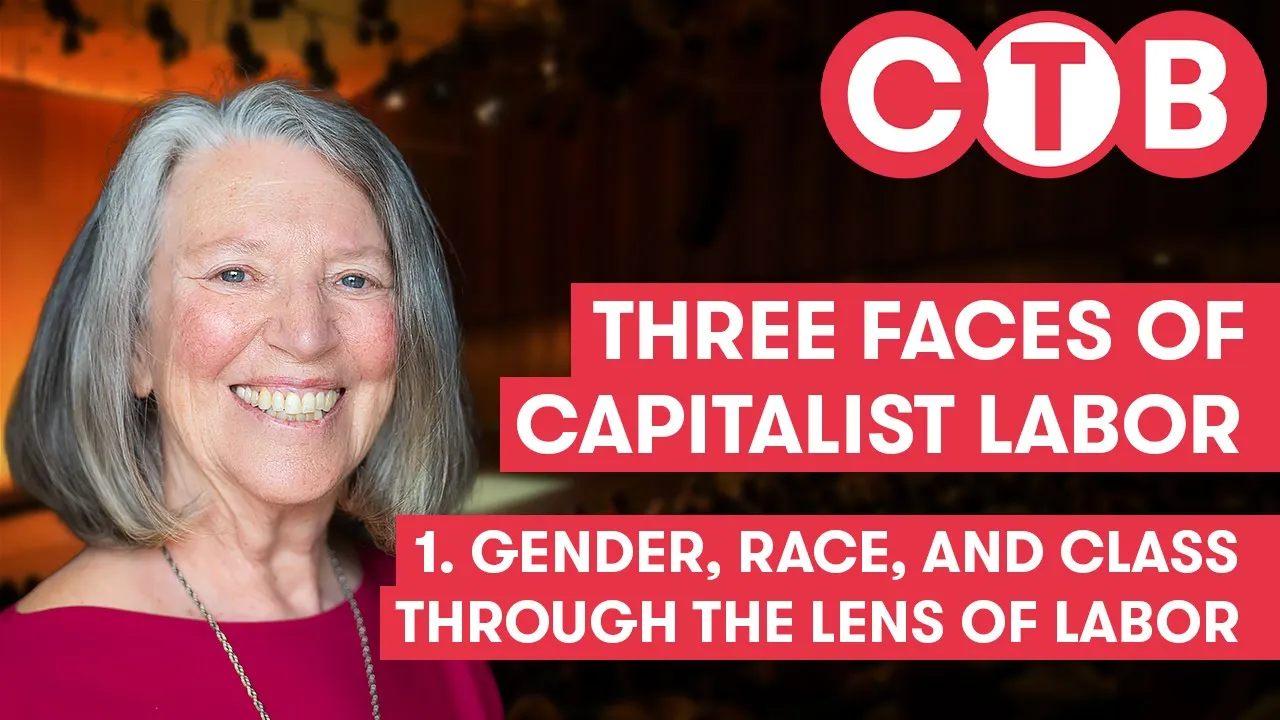
debates on identity politics and emancipatory strategies whereas in those debates struggles against racism and sexism often appear to compete with or even oppose Not only each other but also class struggle nancy will show that they share common ground and offer an understanding of the respective social struggles as struggles over and this is her title three phases of capitalist labor thus uncovering the hidden ties amongst among gender race and class so if you have come here in order to find answers to everything you always wanted to know about gender race and Class until those issues are
connected you are at the right place one might elite that intersectionality has become a placeholder to mark the connections between the class race and gender lines of domination what we will listen to over the next three days is a profound attempt to fill this gap and spell out these connections that have often remained merely asserted the answer so much can be revealed without giving too much away is based in A theory of capitalist society by identifying the driving mechanisms nancy will lay bare a deep structural dysfunction at the heart of our form of life as
she says the crisis that surround us and the respective struggles and social movements regarding race class and gender thus need to be connected because they already are connected in the deeper Logics of the system today crisis might surround us but neither the concrete analysis and exploration nor the solutions to our problems are self-evident once you leave the realm of as nancy would say shallow moralizing or inconsequential outrage we need to think big nancy likes to say now the format of the benjamin chair and the benjamin lecturers as a three-part series of lectures is actually designed
To make this possible to enable us to think big and to arrive at the roots of the matter it will allow her to develop a gin win plot with a sophisticated storyline and give her the opportunity for a deeper and extended engagement this benjamin chair named after the berlin-born philosopher walter benjamin is a temporary chair at the center for humanities and social change at tumblr university suberlin Which was established in spring 2018 and is funded by the new institute foundation each year we appoint an individual as benjamin chair giving them the opportunity to develop and
discuss with us our center's research theme the crisis of capitalism and democracy from a specific perspective this work those weeks of intensive discussion and engagement public and less public events then find their Climates in the annual valter benjamin lectures and here we are tonight nancy fraser will present the first of her three benimi lectures the lecture that establishes and lays out the problem gender race and class through the lens of labor a post-intersectional analysis of capitalist society this lecture will be followed tomorrow by the next one labour's twisted history And then on june 15th and
thursday class beyond class toward the counter-hegemonic politics let me finish now by giving you some technical details and informations nancy fraser is now going to present your lecture of roughly one hour followed by a q and a of roughly 30 minutes might be a bit less because we have started late for the q and a there are two mics available in the ale if you want to ask A question please queue in front of those mics as a skipped microphone here often gangster please switch off your mobile phones british heights and i hate to be
the bureau of bad news but please keep on your mask or put on your masks and if you want to do us a favor please get tested every day before joining us here we will do the same Finally talking about hidden ties and labor thanks to everyone who has made this possible thanks to the amazing team of center of humanities and social change whom you will get to know in the last after the last lecture thanks to the new institute foundation who has made our work possible thanks to rigmas anna katzman georg dietz from the
new institute who are here with us today and a special thanks to ben shara the Director of the house de gruetto underweight who has agreed to host us here in this really amazing place i have to say this is just one of the most beautiful buildings on auditoriums that i know and laura matas who has been in charge of organizing this with us so once again i couldn't be more excited to welcome my esteemed colleague and dear friend nancy fraser for this Occasion we are tremendously happy and a little bit proud that she has accepted
our invitation nancy here you go [Applause] [Music] thank you so much uh rahel for that very beautiful warm and generous introduction and let me add my thanks to the whole team to everyone at the center for the humanities and social change For the team here at the house derek couture and dervelt and everyone else who has made this occasion possible it's really a great uh pleasure to to be here to see so many friends and and others and uh to really unveil to you for the first time in public uh this project which i'm only
at the very beginning of And i hope that i have made enough progress to have something interesting to say to you well let me start by mentioning the obvious the concept of labor is at the center of these lectures and of this project now you might think that in proposing that focus that i plan to return to a familiar and de passe model of critical theory if so you would be mistaken My goal here is to develop a new paradigm capable of clarifying the most pressing problems both practical and theoretical that we face in the
21st century certainly i will speak a lot about labor and about capitalism but not in your grandfather's sense on the contrary my aim is to transform our understanding of both of those concepts and through them To rethink that famous triad gender race and class over the course of these lectures those last three terms will i hope be transformed as well class especially will emerge in the new guys but perhaps you are wondering why labor why make that old-fashioned concept the starting point for rethinking gender race and class isn't it tied to a perspective that prioritizes
class over gender and race And why does the triad need rethinking in the first place doesn't it represent a huge advance over the labor metaphysic and class reductionism that dominated social theory and political practice in the past doesn't a focus on labor risk losing more recent insights won't an approach that centers that concept reinstall the same Discredited paradigm that feminists and anti-racists have worked so hard to dislodge my answer on most counts is no for reasons i'll soon explain but let me tell you first how i came to the idea of this project it began
with a site diagnose for several years now i've been struck by the mismatch Between the current scale of emancipatory political engagement on the one hand and the scale of the present crisis on the other emancipatory engagement is plentiful and potentially powerful to be sure it encompasses feminism anti-racism and anti-imperialism as well as movements for labor and migrant rights for social equality and livelihood security for democracy and Ecological sustainability for peace and human rights but these forces are fragmented and dispersed disparate and uncoordinated they neither coalesce around a shared project nor constitute a counter hegemony and
so they are overmatched by the scale of the present crisis it's a general crisis of our whole social order In which multiple injustices and irrationalities converge and exacerbate one another i need only mentioned planetary heating and global pandemics ballooning precarity and inequality declining living standards and shrunken social provision forced migration and racialized and sexualized violence authoritarianism and persecutory scapegoating De-democratization and militarization and now right on our doorstep war where is the emancipatory coalition that offers a credible response to this nexus of horribles where is the visionary breadth and practical heft that embodies a genuine alternative
to the system that generates them where is the project that could go toe-to-toe Against the powers that be against corporate neoliberalism on the one hand and reactionary populism on the other if this diagnosis is grim i am not alone in subscribing to it on the contrary many social justice activists and thinkers have grown dissatisfied with single-issue identity siloed politics appreciating the need for greater Coordination they are now seeking larger frameworks that can connect the dispersed struggles of multiple movements political organizations and labor unions the paradigm of intersectionality hugely popular among feminists and anti-racists and others
is one important marker of this aspiration others include the emergence or re-emergence of social reproduction Feminism racial capitalism theory eco-marxism and democratic socialism all these and more be token a growing desire for integrative thinking and practice these lectures aim to advance that integrative project although by a different route combining social theorizing with historical and political reflection i shall offer an account of capitalist Society as the common matrix that generates the social divisions of gender race and class as well as their intersections i shall trace that generative process through the lens of labor broadly conceived deviating
from received understandings i'll argue that capitalist society relies on three types of work not just exploited labor Performed by free workers in exchange for wages in for-profit enterprises but also expropriated labor unfree or semi-dependent coercively extracted from racialized populations subjected through conquest or debt and finally domesticated labor also known as care work and social reproduction chronically undervalued often invisible And constitutively gendered by mapping the entwinement in capitalist society of these three faces of labor as i'm calling them these lectures will try to uncover the hidden ties between gender race and class and with them i
hope a possible path to more coordinated emancipatory struggle now my argument will unfold over three Days and in three steps which complement and reinforce one another in tonight's lecture i'll make the case on the structural level sketching an expanded view of capitalism as something larger than an economy i'll argue that its operation depends for internal systemic reasons on all three faces of labor working together their invocation i'll show forms the triad's structural basis and undergirds the intersections Of gender race and class in tomorrow's lecture i'll turn to the plane of history tracing the shifting relations
among labor's three faces over several phases of capitalist development i'll specify for each phase who performs each form of work who is recognized as a worker and of course who is not i'll also track the overlaps and divisions Among three corresponding social movements and lines of struggle trade unionism feminism and anti-racism slash anti-imperialism my third lecture will probe the implications for contemporary politics although their work is functionally intricate integrated the three types of workers i'll be discussing remain politically divided According to the terms of the triad gender race and class on thursday in the final
lecture i'll examine some strategies for overcoming those political separations in the hope of scaling up emancipatory engagement so that's the overall plan for the three nights okay i begin today with w.e.b du bois Who provided the inspiration for this line of thought and i have to say that i'm especially pleased to acknowledge that here du bois you may know had important connections to berlin and to humboldt university where he studied from 1892 to 1894. when it was still called friedrich wilhelm's universitate although long neglected those ties are now marked by a plaque in the main
Building of the university and will be celebrated as it turns out very soon on july 1st at the ceremonial unveiling of the w.e.b du bois memorial and that's the first such honor accorded by humble to a person of color and or to a former student in that sense the timing of these lectures could not be better that said my interest in dubois is not ceremonial but Substantive his stay in berlin was formative for his overall development and for the aspects of it that inspire me here it was at humble that he first encountered sociology and
social theory disciplines that he went on to integrate with a historical perspective he acquired at harvard and with the political orientation he developed by living while black in the united states This rich combination of social theory history and politics is on brilliant display in the work that first led me to the idea of three faces of labor and that is his masterpiece black reconstruction published in 1935 which offered a major new interpretation of 19th century american history and of global capitalism more broadly an interpretation centered on labor Now the book covers the period from 1860
through 1880 for those who are not americanists that's the period that includes the civil war and formal abolition of slavery it also includes post-war reconstruction whose radical wing aimed to transform southern society in a way that would make emancipation a reality not just a legal proclamation and it includes finally what du bois called the counter-revolution of Property which re-established black subservience and white property rule now in du bois's view this period was a major historical turning point in which fundamental questions about the country's future and by extension the future of capitalism were up for grabs
would the outcome be plutocracy or what he called an abolition democracy one based on labor as opposed to Property du bois thought that what he called black reconstruction or radical reconstruction prefigured the second possibility by inventing a new use for state power that use was to elevate and empower workers both black and white its suppression was plainly catastrophic for the freedmen and freed women who were returned to a state close to Bondage but it also harmed poor and working-class whites who lost the chance to improve their economic condition and to amplify their political voice plutocracy
du bois claimed had triumphed at least for a while now this narrative derives its political pathos from this intimation that du bois had of What might have been but its analytic power comes from his conception of labor in his view the question of slavery was a question of labor and anti-slavery was a bottom labor movement aimed at emancipating unfree workers not simply by legal proclamation but also by transforming the property system and power relations that governed their work for dubois then enslaved black labor Belonged to the same conceptual and political universe as free white labor
and the radical wings of anti-slavery and reconstruction belong to the same conceptual universe as trade unionism and socialism in reality du bois concluded the united states had two labor movements separated by color and status had those movements recognized one another and join forces They might have changed the course of u.s history and that of global capitalism more broadly now if that sounds strange at first hearing the view of abolition and reconstruction as centrally focused on labor has real historical plausibility and real continuing promise not least because it broadens our view of what counts as labor
and as a labor movement So too does the image of two labor movements failing to recognize one another what was missed du bois suggest was the possibility of an inclusive pro-working-class front appreciating that labor assumes more than one form in capitalist society such a front would have to recognize and embrace more than one labor movement failing that it would lack the political Heft and breadth of vision needed to defeat plutocracy and expand democracy now what is crucial for my purposes here is the idea of more than one more than one kind of labor more than
one kind of labor movement as i read him du bois was not seeking to homogenize labor not to dissolve its internal differentiations into an abstract universal rather he understood free and enslaved Labor as distinct but structurally imprecated aspects of a single social system enslaved black workers dubois explained were among what he called the founding stones of a new rapidly developing system of industrial capitalism producing cotton for mills throughout the north atlantic these workers as he called them literally kept those enterprises humming supplying raw materials for their free Counterparts to work up as commodities and for
the latter's employers to convert into profits black labor also served as the fulcrum for an extensive commercial net nexus linking the planters merchants bankers insurers and mill owners who divided the spoils framing the whole process globally du bois situated southern slaves within quote A dark and vast sea of human labor in china and india the south seas and all africa in the west indies and central america and in the united states that great majority of mankind on whose bent and broken backs rests today the founding stones of modern industry that's the end of the quotation
note by the way that word today rest today he's writing this in 1935 or just before 35 And that's a point i will certainly return to later in any case this remarkable claim cries to be read out alongside karl marx's identification of the so-called doubly free proletariat as the true creators of industrialism's marvels and as the system's eventual gravediggers where marx gave pride of place to free but property-less labor forcibly Separated from the means of subsistence and production and compelled to sell their labor power in exchange for wages du bois foregrounds the unfree workers whose
labor power is not theirs to sell but the property of others to command by the lash and calling them founding stones of the world capitalist system the author of black reconstruction delves beneath marx's quote hidden abode of factory production To an even more hidden realm on which the factory rests it's the relation between those two realms the factory and the plantation that is all important to call enslaved agricultural labor a founding stone of modern industry is to say that black expropriation undergirds white exploitation that the two processes are inextricably imprecated that the fates of the
two groups of Workers are tied together that neither can be emancipated without the other that two labor movements must join forces to abolish the system that generates their perverse symbiosis du bois here posits a structural division within the working class riven by what he calls a global color line this glass this class comprises again a dark and vast mass Unfree or dependent and a smaller whiter mass doubly free in marx's sense meaning formally free but compelled to sell its labor power whereas the second group's struggles are viewed through the lens of class and labor and
are often characterized as economic those of the first group are parsed in terms of status and citizenship status and citizenship Denied that is and are deemed political for dubois however those categories political versus economic are problematic uncritically reflecting the design of a system that requires both types of labor that imprecates them with one another and that profits from their conjunction while dividing them from one another in fact the division between free and unfree Labor in his view is at once political and economic the two groups of workers are distinguished both by the status of their
persons and by the form and remuneration or lack thereof they receive for their work and yet the two groups of workers are mobilized in tandem by one and the same social system it follows for du bois that neither Labor movement can emancipate itself on its own what is required rather is their cooperation in an inclusive pro-working-class front that embraces the cause of both now i'm going to say more in the final lecture on thursday about that political takeaway explaining why du bois thought that white workers had more to gain than to lose from such an
alliance and about Why i think that remains the case today but tonight's agenda is structural here i want to revise or rather extend his central argument i want to agree first with du bois that the abolition of slavery in the u.s and elsewhere did not put an end to unfree expropriated labor in the capitalist world system to this day bonded and dependent labor continues in various guises which we will enumerate And it is still strongly racially marked in light of this persistence i claim that it still makes sense to view the anti-racist and anti-imperialist struggles
of our time too as unrecognized labor struggles for reasons i'll soon ex explain but i want first to raise a question namely why stop there why not view feminist movements too As unacknowledged struggles over work in systems built on a gender separation of paid productive labor and paid an unpaid care work after all isn't that division between productive and reproductive work just as integral to capitalist society as the one du bois identified between expropriated and exploited labor and if struggles to abolish prisons and defund the police or at least in part labor struggles as i
Believe they are why not say the same about me too whose chief objective after all is to rid the workplace of abuses of power in the form of sexual harassment and assault why not view campaigns for universal social provision things like family leave child care elder care health care housing pensions income support and so on as struggles to prioritize the nurture Of people over the making of profit and why not view campaigns for the rights of migrants and domestic workers and for the unionization of nurses health aides teachers office cleaners cooks servers and laundry workers
as struggles to revalue social reproductive labor and to empower those who perform it gender i'm claiming is the missing third in black reconstruction As many black feminists have noted enslaved labor was not confined to the fields but also included coerced breeding which sustained what has been called the peculiar institution for half a century after the transatlantic slave trade was outlawed when du bois's book is read from that vantage point it virtually begs us to thematize social reproduction as a third phase of capitalist labor That work too was and still is a founding stone of the
global capitalist system supplying the owners with labor both exploitable and expropriable extending du bois argument then i propose to view capitalist societies as relying on three analytically distinct but mutually imprecated forms of labor exploited expropriated and domesticated Thus broadened his perspective invites us to view the shifting relations among the three faces of labor as constituting the hidden ties among gender race and class in capitalist societies identifying labor as the lens that discloses those hidden ties finally i want to reformulate du bois's political point our current aim should be to grasp the relations among not two
But three labor movements and to evaluate prospects for uniting them let me turn now to the concept of labor as i will use the term here labor is effortful social action aimed at meeting social needs now that's a very very general definition and it requires an important caveat neither the needs that labor addresses nor the character of that labor that addresses them Are given once and for all rather both develop historically along with the societies in which labor is situated and through which it acquires its specific forms in historical societies then labor interacts with nature
including with human nature changing the latter and being changed by it in effect our effort to meet our needs Changes us and transforms our needs while also altering society and non-human nature needs labor and nature develop together along with human society in human history defined this way as effortful need satisfying social action that develops historically labor encompasses quite a lot it certainly includes efforts to provision human groups with food to eat places to sleep means to stay warm And tools with which to affect all of that and more efforts that often result in the production
of useful objects but object-producing labor of this sort presupposes other types of effortful need-oriented activity including activity that maintains natural habitats and non-human creatures on the one hand and sustains individual people and human communities on the other Those efforts of maintenance nurture and replenishment also count as social labor even when they do not produce useful objects every human society undertakes them in one way or another along with the making of objects in fact it's hard to imagine how object-making labor could even exist without labor that sustains non-human nature and human beings Those last forms of
labor supply the condition that make the first form possible no wonder then that many societies do not separate the various forms of social labor i've just enumerated far from segregating them in specially designated institutional spheres they intermingle them freely in shared social spaces as when peasant women take their babies into the field and suckle them while Tending their crops in many societies too all the various labors i listed are understood as necessary and worthy all are treated as belonging to the same social universe even when tasks are divided by sex or class capitalist societies are
different however what counts as work in capitalism is employment And that covers a relatively narrow subset of the broad class of needs oriented effortful activities splitting off what is called production from the social activities that make it possible capitalist societies exclude the latter activity from the universe of recognized labor the work of maintaining what i think of as the background both material background and natural background and Social background is sometimes called reproduction as distinct from production a nomenclature that is worth interrogating but whatever we call it the work in question is socially necessary in capitalist
societies however it is largely disavowed and often unremunerated only under special circumstances Namely when they assume the guise of employment and are paid wages do activities concerned with natural and social reproduction appear on the corporate and state account books that recognize labor when not commodified they do not count as work even though they supply the necessary preconditions for those activities that do capitalist societies thus hive off one Portion of social labor from the rest and install it in a dedicated realm where it is made to serve a special function namely generating surplus value for the
sake of capital accumulation what counts in this system accordingly are activities that produce economic value and that means commodity producing waged labor under the aegis of for-profit firms This labor has some definite historical characteristics it is as i already noted doubly free in marx's sense free first because those who perform it have the status of unencumbered rights bearing individuals not bound to any one master they own their own labor power and are free to sell it to whomever they please but also free in a second sense because the workers are properties Having been dispossessed of
land tools animals and other forms of wealth they lack the means of production and they lack access to the means of subsistence in the end accordingly they have no choice but to sell their embodied capacity to work to some capitalist or another in marx's view moreover these workers as they are called are exploited they are paid only For their necessary labor time meaning for the hours required to produce a sum of value equivalent to their costs of living the value produced in the remainder of their working hours is surplus and a cruise not to them
but to the capitalist because they are compensated only for the cost of their reproduction they can neither save nor acquire capital thus their labor has a sisyphean quality Exploited wage workers push a boulder up the hill day after day without ever getting anywhere just to avoid getting crushed value producing labor is thus no picnic doubly free and exploited it is also often stultifying repetitive heteronomous and precarious no wonder then that officially recognized capitalist labor has been and still is A major site and stake of struggle in capitalist societies nevertheless exploited labor is only the tip
of the capitalist iceberg beneath it lie two other genres of labor first what i'm calling expropriated labor which is close to what du bois called dark labor and second what i am calling domesticated labor Which is close to what many feminists now call care work expropriated and domesticated labor are both forms of shadow labor intrinsic to capitalist society and entangled with exploited labor but overshadowed by it lost in the glare of the latter's presumed normativity to say they lie beneath exploited labor is thus to say two things first that they are founding stones in Du
bois's sense that is necessary conditions for exploited labor co-original with it and indispensable elements of the larger societal complex in which exploited labor is constituted as profitable and productive but also second that their crucial role in that complex is systematically under recognized and undervalued if not wholly disavowed by virtue of capitalism's inherent Economism by which i mean it's systemically driven and deeply reductive equation of work with activity that advances capital accumulation by expanding value my point then is that expropriated and domesticated labor are every bit as intrinsic to capitalist society as exploited labor taken together
and along with it They form three interlocking pillars of one social system by calling them three faces of capitalist labor i mean to say that they are analytically distinct but internally related and mutually imprecated each face of labor has its role to play in capitalist society but the role of each is co-constituted in and through its relation to the Others and none can play its role without the others together they form a nexus at the heart of capitalist society this nexus powers capitalism's singular productivity and destructivity while also inscribing gender race and class within it
as deep-seated social differentiations and as sights and stakes of social struggle Let me elaborate expropriated labor is unfree or dependent labor unwaged or underwaged coercively extracted from subjugated populations in a sense it's as old as the hills we find it in one or another guys throughout human history including in ancient empires and feudal societies hence long before the advent of capitalism that's doubtless why it has sometimes Been considered residual an archaic vestige of pre-capitalist society destined to fade away as capitalism matures and yet it doesn't dependent on or underwaged labor is alive and well today
in forms both old and new we find it even now in prisons brothels sweatshops plantations slaughterhouses favelas and industries that employ Migrants especially migrants without papers it has been said that behind manchester stood mississippi meaning as du bois explained that slave labor supplied the cheap raw cotton that fed the iconic textile mills at the dawn of industrialization but the same is true today behind cupertino stands kinshasa where lithium for batteries and coltan for iphones are mined on the cheap at Times by enslaved congolese children the question is why why does expropriated labor persist in a
social system that prides itself on its modernity one that claims a monopoly on technological advancement and efficiency on the one hand and on liberal values and human freedom on the other the reason is expropriated labor has a structural basis in capitalist society Although it is usually seen as the antithesis of exploited labor it is better understood as one of the latter's enabling conditions the reason is in part economic expropriated labor is cheap extracted from subjugated populations who lack state protections and actionable rights this labor is unregulated by contract or law Sitting near the far end
of the spectrum between doubly free and outright coerced even when not literally enslaved those who perform it cannot command a wage that covers their living costs and that's a major difference from exploited labor which as i said is paid at least in theory for its necessary labor time meaning for its living costs in expropriated labor by contrast Capital does not even pay for that helping itself to a productive input for whose reproduction it does not pay capital gets the latter but below cost on the cheap now from a strictly economic standpoint expropriated labor is of
great potential interest to capitalist firms by definition a system devoted to the limitless expansion and private appropriation of surplus value gives them a deep-seated interest in Cheap inputs expropriation raises profits by lowering costs that's the effect obviously when firms employ dependent labor directly in for-profit commodity production but they needn't go so far as that to reap the benefits they also profit by accessing cheap non-human inputs such as energy and raw materials which were produced by unfree labor somewhere else And they gain as well when the deployment of expropriated labor elsewhere makes available low-cost means of
subsistence such as food and textiles which lowers living costs and enables them to pay lower wages to their own exploited workers in other words by expropriating labor for unfree sorry from unfree or dependent subjects capitalists can more profitably exploit Doubly free workers what was true in du bois's time remains true today behind cupertino stands kinshasa behind those who shop at walmart stand those who sew in daca those phrases suggest a further point expropriated labor is generally racialized as du bois noted the distinction between free independent labor karst on corresponds roughly but unmistakably to The global
color line and that holds today as well who else are the expropriated in 1922 but again that dark and vast sea of human labor on whose bent and broken backs rest modern industry according to boys again this too is not accidental the association of expropriation with racialization is also structurally grounded but in a different way Which has it as much to do with politics as economics if for the moment we leave aside domesticated labor which i haven't yet gotten to we are led to view expropriated labor as du vois viewed it namely as occupying the
bottom tier of a politically constituted status hierarchy within capitalism's producing classes this view has considerable merit As we saw exploitable workers have the status of right-sparing individuals and citizens entitled to state protection and able to sell their own labor power by contrast the exp their expropriatable counterparts are constituted as unfree dependent beings stripped of political protection rendered defenseless and inherently viable it thus appears that capitalist society Creates two distinct categories of persons one suitable for mere exploitation the other destined for brute expropriation this division forms the structural basis of racial imperial oppression it is overwhelmingly
racialized populations who are denied political protection in capitalist society and subject to repeated violations We need only mentioned chattel slaves colonized subjects conquered natives debt peons illegals convicted felons racialized subjects of apartheid states and their dependents migrants all of whom are subject to expropriation not just once as were those who became citizen workers but again and again now what this shows is that the exploitation expropriation division is both economic and political Coinciding with the global color line it inscribes race as a structural fault line in capitalist society and thus implants within the latter a whole
series of structural injustices racial oppression imperialism old and new indigenous dispossession exclusion of asylum seekers abuse of migrants even genocide the common thread here is political exposure the incapacity to set limits and invoke Protections exposure is in my view the deepest meaning of expropriability the thing that sets it apart from exploitability and it is expropriability the condition of being defenseless and liable to violation that constitutes the core of racial oppression what distinguishes free subjects of exploitation from dependent subjects of Expropriation is the mark of race as a sign of viability once racialized moreover expropriated labor
is constituted as servile and menial lower in status that than exploited work however bad the latter is the former is indeed must be worse construed and constructed as degraded animal toil it is in effect sub work A term that signals the low status of those who perform it the substandard treatment afforded them and the subpar conditions of the work itself and of its surroundings and yet this expropriated labor of racialized others constitutes a necessary background condition for the exploited labor of capitalism's iconic workers Now this account of capitalism's exploitation and expropriation nexus is immensely clarifying
and right as far as it goes but it doesn't go far enough to speak of a single two-tiered division within the systems producing classes misses a crucial point those two tiers depend on and are implicated with a third that third phase of capitalist labor i call domesticated although i confess i Have some misgivings about that term i couldn't think of a better one anyone has an idea i'm very interested the problem is that domestication might suggest that the work i have in mind is performed exclusively within one's old private household and is unpaid and that
is not what i mean to suggest rather i understand domesticated labor broadly to include people nurturing and Community sustaining work of many sorts both unpaid and underpaid and performed in a variety of different settings from private homes neighborhoods and villages to public agencies civil society associations and even nowadays in for-profit firms in other words domesticated here does not mean domestic it does not indicate the social location or inherent quality of the work quite the contrary To call this work domesticated is rather to say that it has been tamed shaped by a historical process of constitution
which has made it shadow work the devalorized other of productive labor now to understand the full force of this claim we need to contrast the general idea of need oriented effortful activity aimed at nurturing people and Communities with the way that activity is constituted indeed twisted in capitalist societies sometimes called care affective labor or even subjectivization this activity comprises provisioning caregiving and interaction that produces and sustains social bonds in effect it forms human subjects sustaining them as natural beings and Constituting them as social beings forming their habitus and the and cultural ethos as well as
protecting and cleaning their bodies the work of birthing and socializing the young is central to this process as is caring for the old maintaining living spaces building communities and sustaining the shared meanings affective dispositions and horizons of value that underpin social cooperation By any non-perverse definition all of this merits the title of social labor understood broadly in this way social reproductive labor is essential to every society in capitalist societies however it assumes another more specific function to produce and replenish the classes whose labor power capital exploits to obtain surplus value Ironically then care work produces
the labor that the system calls productive but is itself deemed unproductive now it's true of course that much though not all care work is located outside the value accumulating circuits of the official economy as i said in homes and neighborhoods civil society associations and agencies of the state it's also true that relatively little of It produces value in the capitalist sense even when it is done for pay but regardless of where it is performed and of whether or not it is paid care work is necessary to functioning neither the waged work that is deemed productive
nor the surplus value extracted from it could exist in the absence of care work it is only thanks to housework Child-rearing schooling affective care and a host of related activities that capital can obtain a workforce suited in quality and in quantity to its requirements reproduction is an indispensable precondition for economic production in capitalist societies yet capitalist societies have historically constituted this activity as non-work splitting it off from properly economic Activities that produce value set apart from exploited and expropriated work social reproductive work is domesticated feminized and naturalized viewed as the simple expression of maternal feeling
or feminine instinct it is not counted as real social labor merely natural so the story goes care work doesn't involve the sort of intelligence creativity or skill that has been developed historically Through social practice as a result it too becomes cheap treated by capital like a natural resource simply there and available for the taking by firms who needn't bother to replenish what they take or repair what they damage capital in a word free rides on domesticated labor paying as little as possible for it if anything at all Here too it obtains an essential condition for
its self-expansion be low cost without having to pay for its reproduction now in its cheapness domesticated labor has something in common with expropriated labor but the differences between the two types of shadow work make all the difference although both are externalized from the Normative category of exploited labor doubly free labor one form is externalized through racialization the other through processes of gendering care work has been put on a pedestal and sentimentalized even as those who perform it are prevented from participating fully as peers in society sub work by contrast is bestialized and degraded toil unbefitting
a human being The second is looked away from and kept at a distance while the first is up close and personal even at times idealized granted neither group of shadow workers needs to be smart creative or skillful but the traits desired in each are not the same while care workers should be creatures of feeling exquisitely sensitive to other needs to others needs sub-workers should be thick-skinned Dumb beasts of burden who can take punches and endure pain in effect the first are hyper-affected while the second must be affect deprived thus the workers are differently constructed in
the two cases they are not interchangeable neither with each other nor with the mainstream of exploited workers those among them whom the system finds No use for and treats of surplus do not all belong to one and the same reserve army of labor rather they've been constituted as surplus sub-workers on the one hand and surplus care workers on the other at times however the two forms of shadow work overlap as when care work is treated as sub-work and performed under the lash and i'll return to that issue in some detail in tomorrow's lecture In any
case it is incorrect to say as some do now that capitalism requires social differentiations of some kind or another but not any specific kind that it uses whatever it finds to hand that's inadequate i claim because it misses the specificity of the system's requirements capitalism requires expropriated and domesticated labor as necessary conditions For the exploited labor that is widely thought to define and power it and those two forms of shadow labor are constitutive constitutively specific it is in one case it is racialized as subwork dependent toil for those who've been politically subjugated and constructed as
inherently viable in the other case it is gendered as non-work from those who've been socially domesticated and constituted as Inherently caring the key point is that these categorizations are systemic as are the faces of labor to which they are tied race and gender have structural bases in capitalist societies as of course does class and they are as deeply implanted in it as is the latter in fact each member of the famous triad Deserves its social me sorry derives its social meaning and political force from their imprecation with one another and that includes class as well
as race and gender its meaning too has been co-constituted with theirs through capitalism system dynamics in which all three faces of labor are implicated and it must be said deformed and that means As i'll explain in lecture three that we need to revise our conception of what we call the working class much more needs to be said about the the processes that constitute all of this about the various intersections of the three phases of labor and about the forms of social struggle to which they give rise and much more will be said about those things
in the next two lectures but i hope i've said enough today to Convince you that du bois was onto something important in black reconstruction by writing of what he called the dark proletariat and the global color line he pointed the way to a new view of capitalist society as a society that relies on more than one face of labor and that precipitates more than one form of labor movement that perspective has since been enriched And i'll say complicated by feminist analyses of gender care work and social reproductive labor by combining their insights with those of
du bois i have suggested that capitalist societies give rise for non-accidental reasons to a system-specific nexus of not two but three phases of labor analytically distinct but functionally imprecated internally related and Mutually co-constituted the effect is to uncover some hidden ties among gender race and class in capitalist societies it is also to deepen the conceptual force of the term intersectionality and to forward the political project i associated with it that project as i'm viewing it here through a lens inspired by du bois but widened Involves building a counter-hegemonic political block that embraces the concerns of
three labor movements of feminism anti-racism anti-imperialism and trade unionism a political bloc that fosters greater integration and coordination among them thanks very much for your attention i hope you'll come back for more [Music] wow so thank you so much for a fantastic And rich lecture i can't wait to hear more tomorrow actually and we do have uh some time for the q and a so please queue at the ales that are left and right at the center okay can you please dim the light so that i can see the audience okay okay so you go
first yeah bien dank um um Okay so the the question is you have emphasized um the fact that capital puts value on human beings and turns them into capital uh so you have only covered the human side of it but what about nature what about putting value turning nature into capital um it's a great question and um very um important to raise it here um you know They're i'm extremely interested in the way that capital constructs and essentially depletes and and destroys nature that's a absolutely fundamental dimension a necessary dimension of its functioning and it
has to do with the same dynamic of extracting value extracting profit by getting things cheap by not paying For the reproduction of the inputs not replenishing not repairing just grabbing and leaving you know a trail of wreckage everywhere that's equally fundamental to capitalism in my view there's a chapter on this this very issue in the new book cannibal capitalism now the question is how exactly should that whole problematic figure in to and relate to this question Of labor there are those who actually speak of the work of nature jason w moore has written a very
interesting book uh called capitalism in the web of life which makes the case that that nature works that that all of the its processes of self uh replenishment uh of uh reproduction and So on uh count as work and it's work that capital rips off precisely in the way i just said by not paying for its reproduction to me this i i understand it it's a very interesting idea but it's a bridge too far because i am interested in labor um from the perspective of trying to think about this a problem of building a Counter-hegemonic
movement ecological questions ecological struggles have to definitely be part of this movement but it and and they intersect with i would say the forms of labor struggles that i'm focusing on here but not because they are uh that that not because nature works Somehow the connections have to be uh drawn in a different way so for example i would make connections to the racialization side of things that i talked about here expropriation because in the following way subjugated dependent unfree racialized populations who are viable and subject to exploitation Are are living in in the places
that capital treats as its toxic dumps right uh when you're going to expropriate uh nature you're almost always with a few rare exceptions expropriating somebody's neighborhood somebody's habitat the place where they live and the place that has meaning where they reproduce their their Communities so in that sense ecological depredation and expropriation racialized expropriation are are closely connected this is an example of how i would like to to try to make some connections and i think i will say some more about this in the final lecture Without taking the jason moore root of saying that the
nature works and then is somehow a force a fourth face of labor on the left sorry yeah thank you uh thank you very much a very inspiring uh talk i just have uh two questions um the first one that comes to mind is the distinction that used to be made in the past between Peasants and workers so i wanted to ask you about that um i was thinking about you know the classical debates uh mao and lenin and so on and uh the reason i it comes to mind is because when i think of your
three phases of labor maybe the the position of a peasant might not fit neatly so neatly in either any category so they're not directly exploited in the sense of a wage labor They might not be expropriated either and they might not be domesticated either they might be land owners that are fairly you know uh wealthy or not depend all the you know depends on the case but i wanted to ask about uh have you thought about the peasant distinction in this and uh that's my first question and my second question concerns this notion of the
labor aristocracy That's been coming up a little bit in recent debates of course as you said the expropriation is structurally tied to exploitation and some people might argue that it's structurally tight in this specific way in that wages of the global north are sustained by the rents that are sought in imperial rents and so on so in a sense that there might be a tension or a contradiction quote unquote Between the wages of the global north which are like lubricated uh by the uh intense super exploitation of the global south i just want to see
if you have some comments on that thank you great thank you uh two uh very interesting and important questions uh you know uh peasants um um Your your right uh to say sort of on their face uh don't always uh aren't always expropriated or exploited but this is something i'll um i'll get to um tomorrow and uh there are uh forms of expropriation uh at work which work through debt through colonial tribute extraction under direct rule colonialism through Neo-imperial wealth drain unequal exchange and and all the rest in post-colonial uh imperialism so um i um
i i want to sort of include them uh in that expropriated category of course there um may there might be uh a wealthy peasants just as there are uh you know um highly paid professional workers uh uh Right that doesn't uh contradict the sort of idea of these uh of these three categories what what interests me about you raise the question about peasants and workers um that's a beautiful example of this problem of creating a counter-hegemonic block uh i mean lenin famously whatever else we say about him Understood that he had to create some kind
of a block uh among two different kinds of workers party all right whatever um i'm not i'm not gonna go there uh but you know and and so he's that that's a sort of uh a sketch here of kind of what the problem is the idea of invocation of different forms of labor neither of Whom is able to to change the system on its own okay as to the so-called labor aristocracy um this too is something i will talk about in the third lecture um and here uh just to give you a little uh foretaste
here i want to Rely uh again on dubois who who famously talked about um whiteness as a psychological wage uh meaning that um in a racist uh society white workers i i would never use the phrase labor aristocracy actually to describe people who are today devastated by opioid addiction and and suicide and god knows what else uh that that's uh it's not a good word to Use aristocracy but um let's see what was i saying yeah um but they for du bois's idea was they gained something but it's pretty damn little and pretty paltry it's
a compensatory self-esteem so to speak for that The idea is they they have much more to gain than to lose through an alliance that doesn't mean they recognize it all the time or even often although maybe there are some conditions under which they do but in any case the whole point of of trying to analyze these uh capitalism in terms of these three phases of labor is to show how divisions are built into the system They are not accidental these divisions it's not that people just get bad ideas in their head about other people there's
there's an actual uh not just deliberately cultivated division although that exists as well but there's an actual structural basis for it and so it requires serious political work in order to quote unquote uncover those Hidden ties and let people see who their real enemies are and not the ones that the system has constructed for them as enemies okay so we're just uh alternating between the two mics i have difficulty seeing the queue yeah yeah sounds good thank you first and foremost thank you so much for um what seems to be like a potentially very protect
productive way of looking At it i just went before jumping on ship i'm wondering what what if anything do you think might be lost by looking at it through a post-intersectional or like through post-intersectional lens at these movements and i mean just to so Yeah i mean is there is there i wonder i mean i wrote it down to be able to be concise so is is there something to be said about a recognition of different ways of being in the world in these movements or is it really all just about how we labor and
i wonder what would people like james baldwin bell hooks or perhaps an argent say about the argument you expounded upon thank you thank you I mean as i'm as i'm working through these ideas i'm constantly um posing these questions to myself what is lost um it's a question i um i pose to myself and one that i am going to take up explicitly in the third lecture you might think That by focusing on the labor dimension of gender race and clasp by singling that labor the labor side as the sort of the structural the constitutive
you know foundation of these divisions in capitalist society that one is engaged in a kind of reductionism that that it therefore turns out that all the other things that People fight against when it comes to racism that on their face don't have much to do with labor or when they fight against sexism or heterosexism or transphobia or whatever you know that that all of that gets lost and what i want to say my answer is that well it's a two-part answer one part is that in in many though perhaps not All cases it is actually
possible to show how issues that on their face don't seem to have a lot to do with labor actually connect up with it that's part one of the answer part two of the answer is that um even even where they don't directly uh Connect up with labor the labor lens discloses a structural picture about connection and about division that is politically helpful and that i don't i don't think it requires people to say to become kind of labor reductionist it invites a um a broad structural Understanding of society that helps one identify their real enemies
and and their potential allies but it doesn't it doesn't it's not saying that only labor counts that that's uh my idea and um and as to different ways of being i mean here we here i think we get to a difference between the the racialized dynamic associated with expropriation And the gender dynamic associated with what i call domestication because i think that we would say that in so far as expropriated labor is constructed as you know mindless degraded toil it's not a way of being that we want to uh preserve which is not to say
that There aren't all sorts of forms that people create to survive and to you know to to persist as they do it that might might have definitely be worth preserving on the other hand here's the difference domesticated labor um seems to me although it's very twisted and deformed within capitalism by virtue of this hyper affective equality it it acquires and by virtue of its Segregation it's kind of apartheid status it nevertheless this is right something there's something uh uh there's a kernel of something really important and i would say that what we want to do
there is to revalue it not to abolish it and and reorganize it in a different way so those are two different thoughts uh that Go in different directions about what we mean by different ways of being in any case last point i did not take du bois when he talked about two labor movements cooperating i didn't i don't think he was after a merger i don't think he was after a thing where now we're all just workers and the differences don't matter and when i talk about um Creating a counter-hedramonic block embracing three labor movements
i don't mean that now we're all just workers and the differences don't matter i i'm thinking of a of a kind of connection that involves let's say differentiation within alliance as opposed to Homogenizing universality so we have time for one maybe two more questions and please be patient if you don't get to ask your question we have two more days so you go yes thank you very much for this inspiring talk um i was wondering if you could maybe emphasize a bit on the point how capital is accumulated because especially nowadays The manner of accumulation
plays majorly role by speculation virtually and i think or we imagine that this point might be important to address to know what we fight against yeah thanks good question um so I mean part of the the um let me just preface this by saying that um you know that the standard view within traditional marxism is that capital accumulates by exploitation by paying doubly free wage workers only for their necessary time while appropriating surplus value That might be a technically good definition of what surplus value is but it doesn't tell the whole story about what profit
is profit comes not only from exploitation but from cheap inputs whose reproduction costs are not paid including going back to the first question natural inputs uh right taking gouging The earth and not uh assuming any obligation to replenish or repair to for right for for its reproduction expropriation is about another kind of non free riding sloughing off reproduction costs Domesticated labor is the same all of that feeds into profit it it it whether you call it it uh i mean again technically if you accept a certain definition of what surplus value is that's not surface
value but frankly i think profit may be even more important it is after all what capitalists care about most of them have Never even heard of surplus value and they will uh profit through these uh cheap in inputs that they acquire below cost what you call speculation uh financialization um um is uh very uh closely connected to that sort of thing it's it's a form of expropriation through debt wealth drain Um you know we could talk about the subprime mortgages that uh who sparked the whole 207.08 near financial crash in fact that idea of subprime
mortgage was where i got the idea of sub work from because it is another sort of racialized uh form of debt in any case a speculation doesn't create Anything at all but it does redistribute and we are facing a kind of massive revival of expropriation through speculation or through debt or through financialization today and and i will be talking about that in a later lecture okay so one maybe a short question and then we're going to Stop yeah i wanted um i wanted to ask what do you think about stuart hall and his idea of
race being a modality through which the class is left or experienced well it's a very striking turn of phrase and and i like it it's very suggestive um Look everything depends on what we mean by class and you know you you might have noticed that that that's a huge question the the the title of my last lecture class beyond class is that what it is yeah class behavior i mean that's like a for for those who Who know follow these arcane things that's a sort of play on tony negri's uh marks beyond marx the idea
is that there's another sense of class waiting for us at the end of this story that's going to show us how problematic our received idea of class is and i'm not sure if that's what stuart hall was getting at or or not but he was certainly positing some kind Of very close connection between race and class as am i you you can i mean it's clear that we can define what we mean by the global working class as du bois's dark proletariat plus smaller lighter proletariat plus i don't know what what word to to use
uh plus the domesticated proletariat if one Can speak that way that would all be the working class given the very broad definition of labor that i started out with but again they're not all the same the system constructs them differently and therefore it creates a problem for those who want to create the class for itself because they're all those divisions are real and materially grounded so thank you so much again for a Wonderful lecture for a wonderful start for the series of lectures thank you all for being here so looking forward to seeing all of
you tomorrow and i want to add a special thanks to the interpreters who have done wonderful work i think stressful i hope not exploited work and the technicians of this wonderful house see you tomorrow have a safe trip home and please Remember those road closures will pres i mean we'll persist over the next two days so um plan accordingly and get home safely thank you