[APPLAUSE] BRIAN ROBERTSON: All right, welcome. So first, just a little bit of background-- I'm an entrepreneur. My background's in software development. I started coding very, very young when I found a Commodore 64 and a bunch of other older machines, which by the way, I've seen many of them in your lobby. And I just [INAUDIBLE] today and go hang out in there now. So from my early background in software developments, I did that for a while. Went through the whole management ranks-- climbed the management ladder. And for me, it was a sense of I'm noticing the
human issues getting in the way of what I was doing in the technology world almost as much as any of the technology issues we're facing-- the process, the people, the way we work together, and all that. So I got really fascinated by that. And I worked in an aerospace company at the time. And it won an award for being the best mid-size company to work for in America, right? A really sizable award. And I realized I wasn't really satisfied there. Despite that, don't get me wrong. The benefits were great. The perks were incredible. I realized
what I really wanted was an environment where I could really use my talents fully where anything I sensed that could be better I could do something with it and act on it. And all of the free lunches and perks and even a really cool, Fun culture wasn't enough for me. I just wanted to use my creativity. And there was something getting in the way. And after a while, I realized what was getting in the way was something around the way we work together-- the structure, the politics, the bureaucracy. I had ideas. And I couldn't get
them socialized enough in the system to change anything. And I'd go to meetings and we wouldn't even get to my topics because they were painful and long and all of these other things that get in the way of us Using our gifts. So I eventually dropped out of that whole system and started my own company. And my goal with that company was I want to find a better way. There's got to be a better way to organize. And so my company became a laboratory. And we experimented over many years as we grew that business just
looking for how can we work together more effectively. And I had a bunch of ideas, most of which proved to be terrible ideas. And I won't share them with you. But over the years of experimenting, some stuff actually worked. So eventually we would name it Holacracy. But where this came from was not from a bunch of ideas, not from a bunch of theory, definitely not from a management consultant. It was from a bunch of entrepreneurs trying to build a business and figuring out what works through trial and error and a lot of experimentation. So with
that said, let me introduce you To the category of how to think about this thing. I think about Holacracy as a new social technology. And being a software guy by background, I think a lot about technology and usually when people talk about technology, they're talking about the physical technologies hardware. Gadgets, devices or even software internet-- whatever. But there's this other class of technology-- social technologies-- that actually in a lot of ways have been fundamental in our whole progress as a human species, at least as much as our actual physical technologies-- Technologies like rule of law
and democracy and all of the other ways that we humans group together, organize, and find ways to interconnect. Right, those are social technologies. And yet, when we look at the social technology in place in most companies, it looks like something out of the feudal empire. There are kings and lords and barons and down at the bottom, peasants. There's this management hierarchy that really matured. This technology matured about 100 years ago. This technology came about when the telegraph was still An exciting, new communication mechanism. And management technology has not really evolved in any major leaps since
then. It's an old operating system. And it's not that there's anything wrong with it per se. I think it's just quickly becoming obsolete. The world today is moving faster than our management systems are able to adapt and respond. If we want nimble, agile, responsive organizations, how can we make them more responsive? Perhaps-- perhaps we can look at this fundamental social technology and innovate in that area. How else could we run a company? And I think this is a worthwhile exploration because I think a lot of the challenges we see in organizations today-- the bureaucracy, the
politics-- they are hard to solve by just patching some new process on top of the way we run a company. In many ways, I think our companies today are perfectly designed to achieve significant issues with bureaucracy, politics, communication issues, and all of the other stuff that we suffer from in most organizations. Right? It's a feature, not a bug-- perhaps not an intended one. But there's something about this fundamental social technology that leaves a lot to be desired. And it also brings us some important features. This gets us alignment. It gets us accountability. It gets us
some way of breaking down the work and scaling. And we need these things too. So when we talk about new social technologies for running an organization, I think it's really important. We don't just throw out all structure. And that's not what a Holacracy is all about. It's about replacing this structure With some other way of structuring an organization that's maybe a little more responsive. And why it might we want to change this? And what issues might we need to deal with? Well, when we talk about structure at this level, we're really talking about power. Who
has the authority to do what in the organization? What can we expect from each other? These are deep issues. And when humans are involved, sometimes what we get with our nice org charts on paper is a management hierarchy that really Looks something like this. Give you a second to take that in. Have you seen any of these actually at play in a real organization by the way? I've seen at least a couple of these actually at play as the real power structure in a company. And it's no wonder humans are involved. We're messy creatures, right?
We bring our egos and our drama and our politics in. And when we don't have a good way of structuring the work around what we're trying to do together, We often end up resorting to the social dynamics at play. So what else can we do? Well, there's another way-- another way of achieving order, which is what we want in any organization. We need some kind of order. And if I look at the city around us, we're in New York right now. As much as it looks like pure chaos out there on one hand, there's actually
quite a bit of social order at play. I can pretty much fly into New York and trust that I'm going to be able to get a taxi, find a hotel, Get some food, and whatever else I might need to do. And the right place-- the right services will be there to support me and without a boss directing them all around. There's no boss that made sure the taxi was there to pick me up-- the hotel, the whatever, right? It just worked. So we ended up with emergent order-- the kind of order that is not imposed
top down from a centralized plan, but the kind of order that shows up when you have the right framework of rules and individuals with the freedom to act Within that framework of rules. We see this every day in our modern society. Yet when we go into a company, we see something very different. We see a very different way of achieving order. It's an attempt to centrally plan and control and achieve an order by imposing one as opposed to putting in place the right framework of rules and allowing order to show up. And many companies are
somewhere between those extremes of course. They're experimenting and exploring And many individuals when they see structure that doesn't make sense, say, well, forget that, I'm going to do what makes sense. And the structure often gets in the way. And I think that's why when we talk about structure in companies, there's a lot of people that have an allergic reaction to the idea of structure. They associate it with bureaucracy. But I'd say that's because we've got the wrong structure or the structure that is in the way. When I walk around New York, I don't experience the
structure of the rules of the game at play As limiting me. It's actually enabling me. I kind of like those two yellow lines in the center of the road as much as sometimes people ignore them. That's structure. It's limiting. And yet it's enabling speed and freedom and agility. The right structure does that. So how can we bring into our organizations a different type of structure. And what would that look like? Well, the first thing that Holacracy does is introduce a framework of rules just like we have in societies. And it's captured in a constitution. So
once a company tastes Holacracy, they experience it, they get a sense of it, and they decide they want to do this. They want to move forward with it. The first move is for the CEO or department head or whoever's adopting this to sign a declaration ceding their power into this constitution, saying I am no longer above the law, but I'm subject to the same rules that everyone else is. And here's a framework that we'll all be bound by as we go about doing our work together in this organization. It's a pretty big shift. Can you
imagine a CEO you know or a significant department manager or something like that signing a declaration saying I'm ceding my authority to just do whatever I want and run things as the boss into a framework of rules like this? It's a cool shift. And this constitution you can actually find it on GitHub for those of you from a technical background. It's an open source document. It's a fundamental rules of the game. I like to think of Holacracy like a new sport. And these are the rules of this sport. And it's a framework that tells us
all how we can act and interact and expect things of each other and change things in the company. So let's look at some of the key shifts that this set of rules introduces. And the first one is any of you have a static job description? Like something that hasn't been updated in at least months, if not years that maybe is out of date-- That probably was out of date by the time it rolled off the printer? When was the last time you ran to your jobs description to figure out what you should be focused on
today? Right? Anyone? No, didn't think so. Right? So that's because they're pretty much useless. I should say they're useful for some things. We write them so that we can post a job, great. But really, how much clarity does A typical job description offer for our day-to-day work? Really, nothing. They are bureaucratic artifacts. Holacracy replaces those with a new type of structure-- a new way of describing the work-- the roles at play. And they're dynamically updated. So with Holacracy instead of having one job description, you might fill 20 different roles. And you might fill 20 roles
in lots of different teams all across the company. It doesn't just have to be one place in this siloed structure. So you might fill lots of different roles. And each one is a little chunk of work. It's one discrete function. And the way of describing these roles is much more grounded. So it has real clarity. And companies running with holocracy-- people do go and reference their job descriptions-- their role descriptions regularly because they have really good clarity that's the result of the team's collective learning. And the reason is because they're updated regularly by the people
doing the work. So there's a process-- it's called governance. I'll talk about it in a few minutes where Each team gets together and they learn together and they capture that learning and distill down what do we need to be doing differently? Who needs to be focused on what? And we capture that learning in these roles. So they're living, breathing, entities. And they have meaningful clarity. That's one difference. Here's another. In most companies, you've got a manager who delegates some authority to you. Rarely is that really clear. Rarely do you know exactly what your authority is.
More often than not, it's kind of like you have the authority to do whatever you're doing as long as the manager thinks it's generally the right thing to do. And as soon as they don't, they'll get in and they'll tell you that. And then you better align with what they say. With Holacracy, instead of this kind of delegated authority that can be pulled back or micromanaged at any point, it's truly a distributed authority paradigm. So according to the constitution and the fundamental rules of this game, when you have a role that we created together Through
this governance process, you have the autonomy and the authority to do anything that makes sense to you to get the job done-- to get the job of that role done unless there's an explicit rule against it. So instead of needing permission to act and to make sure your manager is happy all the time, you've got autonomy and authority to go lead your role however it makes sense to you. And when we discover that there's a constraint we need, we will create that minimally sufficient just in time. So instead of needing permission to act first, You
have a blanket grant to do whatever makes sense to you. And as we learn together, we'll start adding constraints just when we need them. And there's no manager to undelegate that authority. So in a company like mine, we run with Holocracy. Everyone has a real autonomy and authority. Everyone can make different decisions and everyone knows what that is and what the boundaries are. So it's a lot like living in a society, right? I know I can do whatever I want in my house, my property. But if I want to go take my neighbor's car, I
should probably get his permission. That's his territory-- his property. Holacracy does the same. It makes clear what's mine to lead and control. And I don't need anyone's permission. It's mine. It's my territory. I can do whatever I want. And it makes clear where my neighbors are-- where the boundaries are and what we can expect from each other as well. Because when we have a autonomy in an organization, it's got to come with a responsibility. So here's another shift. What this does when we have constantly updating roles with real authority is instead of these large-scale re-organizations--
every few years and somebody comes in and changes the whole structure. Instead, we're doing micro-reorganizations constantly in every team. So we are rapidly iterating on our organizational structure. And this isn't done at the top and handed down. This is done in every team. Every team has a governance process that they go through. It might be twice a month. In a more mature organization with Holacracy, it might be once a month or every other month. We pull back and we say what are we learning and how do we restructure our team to capture that learning. So
rapid iterations, micro-restructurings throughout the organization. And what that means because we have this transparent rules system and we're constantly changing and adjusting and learning together is when we need to align-- get alignment, which we need, in most companies, the only way you can really get change enacted Is by working the political system at play. You build consensus. Anyone find yourself in a meeting at any point where you're really there to build buy-in. Or you were there because someone else is trying to build your buy-in for some change. And we play this game in the system
to get alignment. And that's actually really expensive. If every time I want to make a change to something and it's significant, I have to build buy-in and get consensus from everyone. There's a lot of meetings. They're painful. And there's an alternative, which is get clear whose is this to lead. And then that person doesn't need to go get alignment and build buy-in and get consensus. They know this is mine to lead. And I can go get input from whoever I want. And at the end of the day, I'm going to make the call. And I'm
going to lead this and make a decision. And everyone can have that in their area. And if we want to influence the person, we have a rule system to do it. This is the point of the Holacracy constitution. It gives us a framework where if I need to expect something different from you than what you're doing, I have a structure in which I can propose that. And we can clarify the expectations between us-- the boundaries or the constraints we're operating in. So instead of doing that just through political pressure, we can simply go use the
rules. So what we end up with is something a lot more like a sport where once everyone knows the rules, you usually don't see the players thinking about them. They're just on the field. They're playing the game. They all have autonomy. You don't see. You don't see athletes calling meetings to figure out who should pass the ball next. Are you OK with me passing the ball to you? Is that OK now? You also don't see managers directing the field. When people are out on the field, they're using their judgment in their roles with autonomy leading.
And everyone's doing that together. And the rules are simply the framework behind them. They're not in the way. They're simply what gives you a game in the first place to play. Now learning the game is a totally different story. And you've got to learn the rules. And there's a whole learning curve to this. But once you know the rules, they fade away to the background if it's the right game. So let's look a little more about how this actually shows up-- what it actually looks like-- how it works. And here's an example of a role.
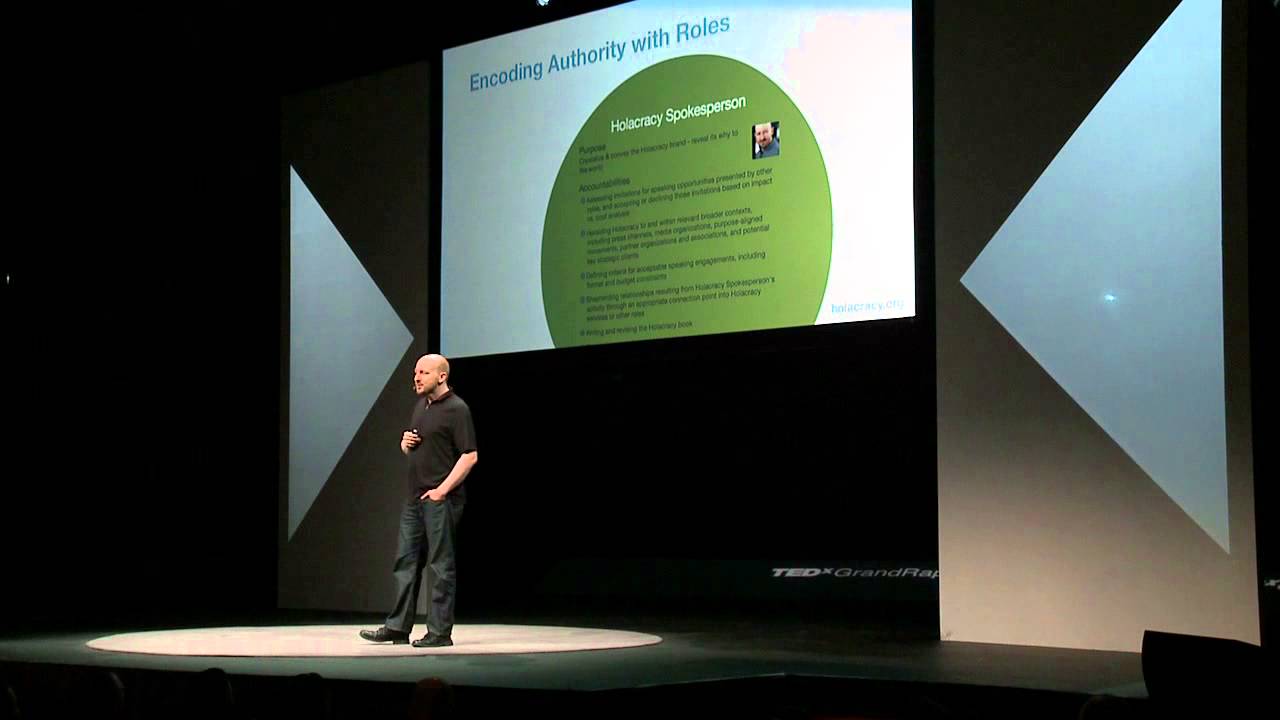
So this is a role I fill-- Holacracy spokesperson. And it has a purpose. Crystallize and convey the Holacracy brand-- reveal its why to the world. So I also have some accountabilities. These are things that others can expect of me. So to go along with my autonomy in this role, I have some responsibilities and captures them and tells everyone else what they can expect. And when I fill a role like this in Holacracy, I don't need permission from a manager. There are no managers. I don't need permission from anyone to do my job. I can do
anything that makes sense to me. I can make any decision and take any action to express that purpose. As long as I don't violate an explicit rule or constraint that's been documented somewhere-- so broad grant of authority. And here's how we might see some of those constraints play out. Here's another role. This is our web architect role filled by a colleague of mine, Olivier. And it has its own purpose-- clear and sexy website for Holacracy and HolacracyOne, my company. And notice this website-- or sorry, this role Web Architect, has a domain. Domain-- think of that
as property of this role. Its domain. It controls our website. What that tells me is although I have all the freedom in my role to do whatever makes sense to me, if I want to mess with our website, I need this role's permission. Kind of like in our society, I know I have the freedom To lead my life however I want. But if I want to use my neighbor's car, I better get his permission. We have a framework of clear boundaries with clear property. And we know who controls what. And we know what we can
expect from each other. We have agreements. We might have a neighborhood association or what have you-- the same thing here. So I know that I have a lot of freedom in my role. But he controls the website-- integrate with him if I want to do something on the web and vice versa. He's got a purpose. He's got the authority to do anything that makes sense to him to get the job done. And he needs to honor other people's property. So what we end up with is a system where there is no boss delegating and directing
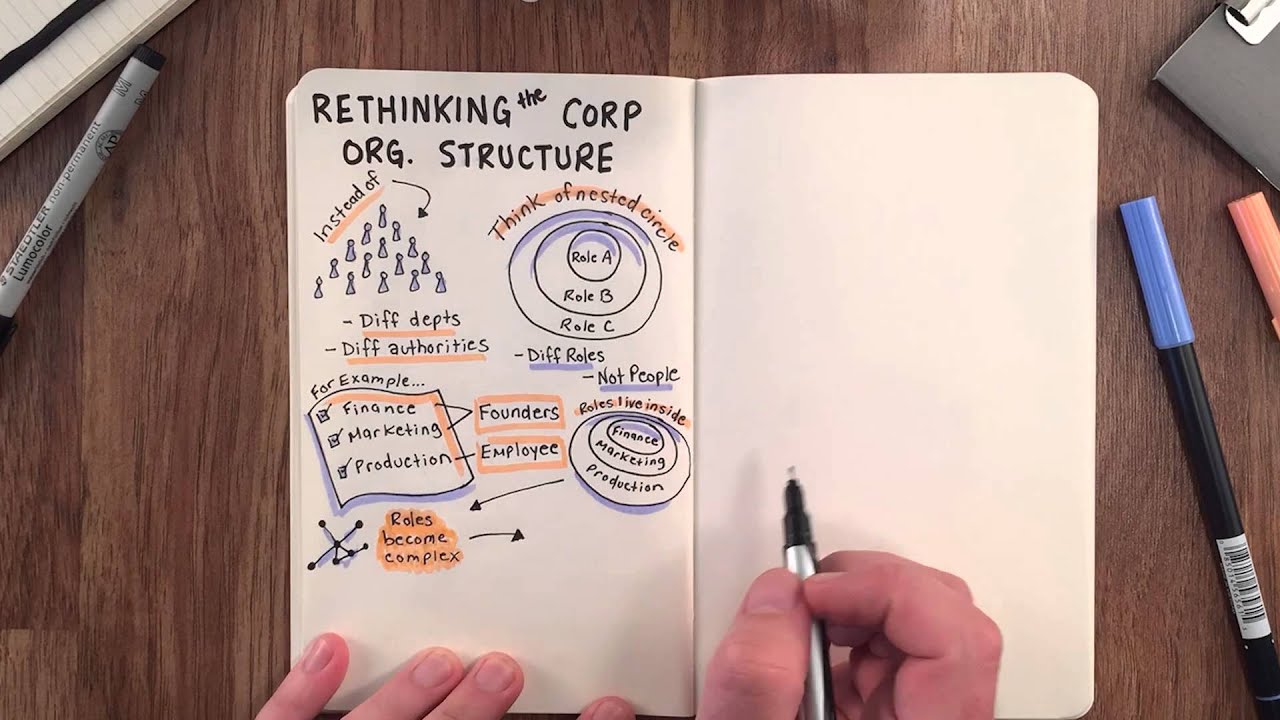
everyone else. Yet there are clear ownership. So it's not a consensus based system at all. Every role knows here's my territory. And I can lead that autocratically within my responsibilities and any constraints That we have defined in governance together. And that governance process happens in what we call a circle. So circles group roles together. The metaphor I like for this-- think of the roles like little cells. Each one has an autonomy. Every cell in your body has its own self-organizing process-- its own structure-- its own area that it deals with. Its own processes. And yet
each cell is also part of an organ. And that organ doesn't violate the autonomy of cells. Rather it adds another larger entity that integrates them-- that deals with the flows between cells. And that's what a circle does in Holacracy for its roles. So this is nature's way of scaling and organizing. And a circle in Holacracy is like that organ. And what circles do every month or thereabouts-- they'll hold a governance meeting. And this happens asynchronously between meetings as well where every role in the circle-- anyone who fills a role is invited to participate in the
governance process of the circle. So everyone who fills a role-- this circle-- it's our marketing circle outreach we call it-- it includes the two roles we looked at-- my spokesperson role-- the web architect. And we show up in this governance meeting. And that's where we define the boundaries between our roles. That's where we define what's his to control-- what's mine. What do we expect from each other. We can create new roles whenever we need them. And, remember, people fill many roles. So that doesn't mean hiring someone. I fill 20-some roles in my company. So we
can create any role we want and then go shop around and find the best fit for that role. We can change roles. We can add expectations on roles, constrain roles-- whatever we need to do through this governance process. And in that governance process, anyone filling a role has a voice. But we only use this collective process to define the boundaries-- to define the scope of authority of the different roles. Day to day when we're executing, we're Not trying to come to consensus on every decision. We're just getting the job done given the authority we've been
granted through this governance process. Even in the governance process, it's not a consensus-based process. And it's one that's actually grounded in logic and arguments. Anyone can show up and say, here's something that got in the way of getting the work done. Here's an example. And to resolve that and prevent it from ever recurring, I'd like to add a new expectation onto our web architect role or whatever. And then there's a process of sorting that proposal through. Everyone gets some input into it. Although you can't just say I don't like it. You got to say, well,
here's why that would cause harm in my work. And then we'll integrate and we'll sort that out. And we'll come out with some new governance that defines new expectations for the team that work. And then we can go embody those expectations, executing them, get the job done day to day. So we have a self-organizing process. And this scales. This is a fractal structure. So every level kind of works the same, right? So we don't just have roles within circles. We have circles within circles within circles. And this is, again, a very organic process. So just
like the human body-- cells within organs within organ systems within an overall organism. There's no boss cell in your body believe it or not. Right? There's no one boss cell that is telling all the other cells what to do and how to work. Rather every cell has autonomy and yet they also have to be aligned with the broader organ. They have to figure out how they work with the other cells. And that's kind of what the organs do. They group them together and deal with flows. And then there are larger systems that group organs. That's
what this is. So it's a fractal structure. Again, a lot like nature, this is nature's way of dealing with complexity at scale. And within this, everything's changing constantly. Every one of these roles-- they're dynamic. They're updated in regular governance meetings happening in every circle as we learn together to keep it grounded and real. So it's a very dynamic process. And this is why when if you read the press, there's some misunderstandings out there in Holacracy. One of them is that this is a "flat" structure or no structure. And it's not. It's actually more structured than
a typical management Hierarchy. It's just a different kind of structure. And it's one that is really trying to align with what's actually needed. It's the kind of structure more like those two yellow lines in the road. Not the kind that gets in your way that's bureaucracy and limits you, but the kind that enables us to go fast together. It's minimal, just-in-time dynamic structure. But it is structure. And its clarity. Who can decide what? Who can expect what from whom? All of that. And let's talk about one other piece, which is what drives change in the
system? And, again, the same thing that drives change in many living systems-- tension. And with Holacracy, we don't mean tension in a negative way. So I define tension as simply the feeling you get when you sense a gap between where we are and where we could be or some potential that's better in some way. We sense a lot of these. Yet, how many people can say, you know, anything I sense. Any tension I sense, any gap, anything that could be better, I know exactly what to do with it to drive a rapid, meaningful change anywhere
in the organization. Very few companies today can fully harness the sensing that everyone within is doing. More often than not, you get people who have sensed issues for years and don't know how to drive change. So all they can do is complain about it Or get apathetic or wait and bide their time for an opportunity. None of that is using that wisdom. None of that is actually taking what we're sensing and incorporating that into a learning organism of the company. So the goal of Holacracy is pretty simple. It's to make sure any tension sensed by
anyone anywhere in the organization has a place to go to get rapidly and reliably processed into meaningful change, at least to the extent that it's relevant to the company's work-- Its purpose in the world. And this also keeps us really, really grounded. How many organizational designs do you see today that are the product of somebody's vision? And, actually, that sounds great. But I think there's a lot of issues with that. Anyone here in the software development world? I'm imagining many of you, right? Have you ever seen software designs that are the result of somebody's good
ideas and vision and they apply this whole architecture to a software product as opposed to listening To what the customers want and listening to what the code even is telling you and keeping a more agile, adaptive design, letting the design tell you what it wants to be instead of you imposing all of your good ideas up front? We learned a long time ago in the software world that that kind of waterfall design process doesn't lead to great results when you have dynamic complexity in the world-- when you have a lot of change, a lot of
input, and you've got to learn. Our organizations today are in that world too. And get the approach we take to designing organizations is very much somebody's big vision, grand ideas, top-down imposed applied design. And then it's static. And it doesn't change that much. And the best we can do in that is try to work around it. And we experience the structure is getting in the way, limiting bureaucratic structure. If we want to respond to a world that is changing fast with our companies today, we need companies that can be responsive to everything Sensed by everyone
within and let the design evolve itself. So Holocracy can be described as an evolutionary design algorithm rhythm for a company. What it does is let the tensions we sense tell us where we need to change our organization's design. So the design evolves one tension at a time by somebody sensing what's getting in the way of the work and then doing something about it, responding to it, adapting-- changing the design of the company and testing it. How does that work? Is that better? Or do we sense more tensions? Great! More tensions. Good. Let's adapt it again.
So a company running with Holacracy, the goal is not to be without tension. It's just that the same ones aren't plaguing us for years that we're not listening to. We want to deal with those so that we are free to sense the next tension as we adapt and evolve in our environment. That is the whirlwind tour of Holacracy. I want to save plenty of time for Q&A because I got to imagine there's probably more questions than you came in with perhaps. Often there is. And then I think there's a book signing afterwards. And anyone who
wants to stick around, I'm happy to chat for a bit-- so questions? Yeah, mics. AUDIENCE: Hi, so suppose that an individual in 10 roles and those 10 roles are in 10 circles, Does that mean 10 governments meetings per month? And if so, how much of your time does this take? BRIAN ROBERTSON: Yeah, 10 different circles would be a lot. Most people, practically speaking, in companies running with Holocracy, you might have people in two or three circles-- maybe four or five. But more than that's really rare. It means they're invited to that many governance meetings. But
like everything Holacracy is tension driven-- tension needing to change the governance. Skip the meeting. Don't bother. If you have a tension, and you want to change the structure, then show up. And the beauty of the governance process in holocracy-- when you show up with attention and you take the time to go to a meeting and you address it, what you're doing is changing the structure so that tension never recurs and we know exactly who can make which decisions and you don't need to go to a meeting anymore. So what you're actually doing in the meetings
Is removing the need to go to meetings by getting really clear on who does what so that we never need to talk about this in a meeting again. AUDIENCE: So is it always clear enough who else your tensions affect to make sure that they attend the meeting because if they didn't know about it, they could show up. BRIAN ROBERTSON: Yeah, and usually yes. If somebody gets a tension they need somebody else, one of the rules in the constitution is if somebody requests that you priotize something in a meeting, you need to make it a priority
With some constraints. But generally, yeah. Great. Yeah? AUDIENCE: Thank you. So I have to fairly unrelated questions. One is you mentioned at the beginning that leaders would, or managers, would see their authority-- power of control to the constitution-- what would their role then entail? BRIAN ROBERTSON: Yes, this is one of the great challenges and changes that companies sort through. And it's not easy. So imagine you're a manager. You've climbed the rungs in that corporate ladder. You've got a bunch of direct reports. And, suddenly, there is a system that bakes management in as just a process
that everybody engages in to some degree. And you don't need a manager in the same way. What those managers need to do is make the shift to being more like an entrepreneur than a professional manager. In other words, how can I create value in this team? How can I actually do something that needs to get done? Catch something falling through the cracks? Build structure so that I've got the right roles in the right processes in place. So some of that is similar to what good managers tend to do anyway. And some of it is new
and different. And there's a big. So often those managers end up filling lots of roles. And they are creative roles. They are roles that aren't just coordinating among people, but actually getting to build and create and add value in new ways. And some people won't make the transition. Some people will say, you know what? I have a staked my self-esteem on being a manager. And I do not want to let that go. Or I've done it this way for 20 years. And I don't want to learn anyway. And they'll opt out. And you'll see that
too. AUDIENCE: And I see on the book that the forward is by a David Allen. And I was curious about if you had any thoughts on any work you had or collaborations with him Or things like that-- general comments. BRIAN ROBERTSON: Yeah, so anybody know David Allen's work? Are you familiar? A bunch of you. He wrote a book called "Getting Things Done." He is a productivity guru. He is a personal hero of mine. His company runs with Holacracy. And, yeah, so he was kind enough to write the forward too. He was actually one of the
earliest adopters of the system many years ago now. And for him, it was an extension of what GTD, or getting things done, his method-- what that does for an individual of getting really clear. What are all of the inputs coming into my world? And how do I respond to them quickly and consciously and stay clear and organized? He views Holacracy as doing that for an organization-- so the same kind of thing that GTD does for an individual. Holacracy is the same. It's about sorting out all this stuff-- the tensions-- the input coming in-- and figuring
out, all right, how do we clear those out of the way-- Respond to each appropriately, and then have space to be creative together. AUDIENCE: That's a really interesting framing way to look at it. BRIAN ROBERTSON: Yeah, definitely. Thank you. AUDIENCE: Hey, Brian, I'm Jason. Thanks for coming in. So you gave us a straight overview of the system. I'm curious about the outcomes. So who's using this? And are they're really seeing significant results That are different than, say, a traditional organization? BRIAN ROBERTSON: Yeah, so right now today as best we can tell, there's somewhere around a
few hundred companies out there doing this. And we don't have any actual hard data metrics that we've collected yet. I really look forward to that. Harvard Business School is doing an actual research project right now on one of the companies going through the transition. And I hope that'll be the first step to getting some real academic research And what effect it has. And so I don't have any actual hard numbers. I have a lot of anecdotal stories. And one of the challenges of this is it's such a fundamental change. How do you know whether-- even
great numbers. One company reported massive increases. They showed the revenue graph. And it was like this. And then it just went like this once they adopted Holacracy. But I'm skeptical. I love the data. And if somebody wants numbers, I'll throw that one at them. But how do you know that was because of Holacracy versus anything else in their world? I look at this. It's like changing your operating system. So I'm a Mac user. I upgraded from being a PC user several years ago, jumped into the Mac, and for me, it's just a better platform. And
my productivity, I feel like it's higher. I think I can get stuff done more easily. The operating system is in the way less often. It gives me great platform to build on top of. But I could tie any specific metrics I might want to. And it's hard to tie it back. It's more just I have a better platform. So for me, the best judge-- and what I encourage all of our clients and anyone trying this to really tune into is your own experience of is it easier or harder to use your voice and drive some
positive change? And I think that's a really interesting, reliable metric. And if you look at, for me, when I switched from Windows to Mac, I just feel like I can get stuff done faster and easier. And I hear the same from companies that switch to this All the time. And that's actually why many executives and CEOs make the switch after they try it even just for a couple of days. Through the different processes, Holacracy shows up and adds. And at the end of that, they have a direct experience of how did this way of dealing
with my tensions compare to what I would have done in the old system. And they get to see in the old system, I would've talked to a bunch of people, built a bunch of buy-in, called some meetings, wrestled with it, and maybe a year later, we would change. In the new system, it happens faster. So just one example-- in Zappos, which runs with Holacracy as well, there was a meeting of one of their circles where they restructured a business unit. And this was apparently a contentious issue. There was a lot of intense feelings in the
room. And there was a proposal to restructure, slice and dice this thing, and change some of what was expected from it. And at the end of about 20, 25 minutes, we ended up with a new, integrated output of total restructure to this unit. And with everyone there, bought into the path forward, even after people raised significant issues with it, we sorted all them out. 20, 25 minutes later we're done. They came up to me afterwards and said we've been wrestling with that issue for literally years-- through hours and hours and hours and hours of talking,
political influencing, meetings. And we never got to clear resolution. And it just carried it through inertia. We just kept it the way it was. Nobody liked it. But we couldn't agree on what to do about it. And now in 20 minutes, we just nailed it. And everyone's comfortable. Not that we've got the perfect result, but that we've got a next step. And we can come back to this meeting next month and continue to evolve it further as we learn what works and what doesn't about this. So to me, that's the metric that I like to.
Is it easier or harder to drive change and to get tensions addressed in the system, AUDIENCE: Hey, Brian, thanks for coming and explaining. It really is interesting. So I understand the structure and the freedom and the principles of Holacracy. In my experience, one of the detriments I see to organizations is more about ego and insecurity. And so I'm just wondering how those-- especially when you give a lot of freedom, you're going to-- this idea of land grabbing is always the term, right? And you get these people that are operating in that respect and the damage
it can do to an organizations. How does that work in your system? BRIAN ROBERTSON: Yeah, so I wish I had an extra hour for you. This is one of my favorite parts of Holacracy, actually. And it shows up in some of the rules of the decision making process used in the governance meeting. And those rules are there to keep egos in check from influencing your organization. It doesn't make people saints that have no egos. What it does is prevent the egos from dominating the meeting. And there's all sorts of interesting rules and a facilitation process
that's used to cut through that. If you want to see more of that, we Have a video simulation of the governance meeting on our website that you can go watch and see those rules. And they're specifically about how they deal with ego. But just to give you one a little example, a little taste. In the governance meeting process, let's say someone shows up and they propose a change. I think we should add this expectation to this role or give this rule this authority, whatever. There's a place where everybody gets to then raise objections to that.
But objections are not just I don't Like it or all the egoic response that sometimes people have. It doesn't solve my thing. Instead, there's these rules of what is a valid objection and what's not. And if somebody just shows up-- here is a real example. I had a team. It was a project management team. They were managing a big, new initiative. And somebody brought a proposal. Someone else gets really fired up, starts to jump in, and interrupt. And there's rules, actually, even about giving people space to speak and not interrupting so I stop the person
I was facilitating-- stop the person until it got to her turn. And then she had a bunch to say about it. We got to the objection part. And she says, objection! Yeah, this has been an issue for us for years. And I'm so frustrated by it. And that won't solve it. And she went on and on and on. The poor proposer was not trying to solve that person's issue. They were trying to solve their own little piece of it that they needed to get their work done. And here's somebody else from an intentionally-- she was
trying to help. But it was getting in the way of this person solving one issue. So she says objection. She says all this. And then using one of the rules in the constitution, I asked her this issue you're having now-- is that going to be created by her proposal? Or is that already an issue that you would like to solve independent of this. And, of course, she says, oh no, that's already an issue. I've been suffering from it for years. And I said, OK, well then that's not a valid objection, according to the rules of
the game because our goal is not addressed her issue. It's only to address the proposers. That's it-- that one issue. So for her to raise an objection, she has to be able to say here's why that proposal will get in the way of me doing my work. And she has to describe it concretely. Not just, I don't like it. It doesn't solve my pet issue that I want to solve or anything else. So there's a lot of rules like that that are just subtle. They are questions. And they help sort through and keep us laser-focused
on processing one tension at a time sensed by one person without anyone else's stuff getting in the way. And after that, I invited her-- you're welcome to add your item to the agenda. And when we get there, we'll focus on processing your attention however we can. So it's really about giving everyone a space to process their tensions without all the egos getting in the way. AUDIENCE: Cool, thanks BRIAN ROBERTSON: And there's more the book as well about that whole process. Yeah? AUDIENCE: Hi, I totally get how these processes can help make incremental tactical changes. And
I was wondering is there a place for longer term more strategic thinking. And if so, what sorts of circles-- what roles would You have to achieve that goal. BRIAN ROBERTSON: Yeah, definitely, absolutely. So, again, it's tension driven. So if somebody has a attention of, man, I think we need to be looking at longer term, bigger picture, strategic stuff. Great! Process that tension. Maybe we need to create a role. We have roles like a pricing strategy role in my company, which looks at across all of our business lines-- big picture. What are we trying to achieve
with our overall business model and all that. We have another role that looks at how can we support companies that are trying to do it themselves-- do it yourself Holacracy adoption, which is really hard. But we have a role that that's the big picture of you. They're looking years out. What tools can we create? How can we make that easier? So whatever you need to do, just show up, process that tension, and create whatever you need to. Another example-- the governance meetings although they often Are dealing with micro stuff because often the micro stuff is
what's actually getting in the way most practically in the work. Sometimes though they really do pull up really high levels. So we had one just last week actually where one of our team members showed up and he had a circle team that was doing some work. And it just didn't feel right. So he showed up and he said, I propose we just remove that circle, drop it, toss it out, kill it. It was an interesting proposal. And there were a lot of objections-- reasons why That circle is actually doing important work that we really need.
And then to resolve those objections, we pulled up to the kind of 50,000 foot view and looked at what is the circle doing that really matters? And why does the circle feel weird? And what can we do with those functions? And, ultimately, we restructured our whole vision. Inside of about 45 minutes, we completely restructured, killed one circle, put functions elsewhere. And it's really cool to see that kind of dynamic reorganization happening regularly in companies instead of it's static And its stuck in what they're doing. And it is often the big, strategic solution almost, but one
tension at a time. And for me, this is the really interesting thing is it's like imagine a company is a ball of yarn of tensions. Every thread is a tension. And it's all woven together. The temptation in a lot of companies is to look at the ball of yarn, pull back to get really strategic, and figure out how are we going to untangle all of these different tensions and solve it all. Holacracy invites a slightly different approach, which is grab one thread-- pull that one thread out. Disentangle just that one thread-- that one tension from
everything else instead of trying to solve all of it at once, which often means we talk about it forever and don't actually change anything. Solve that one thread. Good. Now solve the next one until, eventually, there's no more ball of yarn. AUDIENCE: So going by your terminology, I think a lot of tensions in organizations are around three pillars, which are motivations, incentives, and vision. Right? So a founder, like, for example, Larry here, might have a vision that, hey, I want to is the world. I want to Google to be present 30 years from now. But
I'm pretty sure there's some employee-- someone at Google who is thinking, you know what? Screw all of that. I want to make my paycheck bigger in the next six months. And that's all I care about. If Google starts going down, who cares? I'll just jump ship to some other company. So how-- and this is just one example. But how do you align those kind of tensions? And I think that's why the management structure exists that someone says, no, you want to do that? Go do it somewhere else. This is how Google wants to do things.
And that's where the top-down hierarchy comes in. BRIAN ROBERTSON: Yeah, so a huge piece of the puzzle-- not the only piece, but a huge piece here, is purpose. So Holacracy is a purpose-driven system, which means the whole thing we're organizing around is what is the ultimate purpose of the company. And how are we going to express it in the world. And that breaks down. So every role has its piece of that-- its purpose within this overall system. So that's one of the alignment functions in Holacracy is it's all about aligning around purpose as opposed to
aligning around a person like a manager, which a lot of management hierarchies fall into. People really align around what the manager wants Or how they see the world as opposed to around the purpose at play. And that also gives an element of motivation too. For me, when you get to fully use your autonomy, your capacity, your creative gifts to serve a purpose that you've chosen to serve. There's a certain kind of intrinsic motivation that can show up. Not that it's guaranteed to. Some people are still doing it for the paycheck. And then there's a whole
range in between of, hey, I want the paycheck. But this is cool work. But I see at least a shift towards that when companies shift to have really clear purpose that is compelling, that's broken down, and everyone has a place and the autonomy to choose something that they want to express and do it, you get a different kind of motivational force, which often then has pay and other concerns like that less of a front and center focus. Not that they're unimportant, but at least not the main driver of motivation anymore. And Holacracy isn't a cure-all
for that. Companies still have to wrestle with that, even with Holacracy. AUDIENCE: Cool, thanks. BRIAN ROBERTSON: Yeah? AUDIENCE: Hi, I have a few questions. One is-- you were talking about pay. How do you decide what people get paid? BRIAN ROBERTSON: I was wondering when somebody would ask that because it comes up in every talk I give. So to use a metaphor, again, think of Holacracy like a new operating system. It isn't a full, complete package with all the apps you need in your organization. Right? It's like I love my Mac, but I download a calendar
app because I don't particularly like the built-in one, whatever. I download other apps. Holacracy does not tell you how to do compensation. But you need an app to do that. So there are many approaches. And every company that uses Holacracy could do that a little different. They might install a different app for compensation. And the same with a number of other business processes-- Firing, benefits, all of these things are kind of like the apps of business. And that's said, to avoid completely dodging the question, let me give you a common answer. Here's one app that's
actually fairly common now. It's growing out there. My company uses it. Zappos is moving to something like it too. And it's a badge-based compensation app where badges represent skills you've demonstrated to your peers that you have. So you can earn badges in different skills. There's a library of badges. There's a process by which you can propose a new badge-- a new skill that you think needs to be recognized. And anyone can initiate that. And then anyone who's earned the same set about badges will get paid the same. And that's transparent and everyone can see it.
If you have this set of badges, your pay is going to be that. And if you get this set plus these two more, then your pay is going to be this. And if you think there's a set of badges that doesn't show up There and should have a different pay level, you can propose it and say, you know, these badges are worth this much and these are worth that much, then I think my set of badges here should be worth this much. And there's a process to evaluate that and get it put in place. So
what you end up with is instead of one linear climb across a ladder and pay is by management, grade or whatever, you end up with a very dynamic system where you can grow and develop in any number of ways by developing different skills that Are useful to the organization. And based on the skills you've demonstrated to your peers that you are using clearly and have, that will drive your pay in a very peer-to-peer distributed process. So that's one approach-- not required by Holacracy, but a common app that's Holacracy compatible. AUDIENCE: Thanks. And I want to
ask one more thing. You have all these roles the people decide on and define. And then you have all the people in your organization. What happens if someone's role disappears and they Need to go somewhere else? Or you need to fill new roles in your circle. And you need to get people from somewhere. How does that happen? BRIAN ROBERTSON: Yeah, think of it like a marketplace. You got your buyers and sellers. And you need to connect them and find the right transactions. So we talk about the role marketplace, which is all these roles, even in
a small company. 20 people-- you might have hundreds of roles that need to get filled. And there are new ones showing up constantly. So there's an internal marketplace that develops of, hey, we've got a new role in this circle. Here's what it is. And somebody's pitching to try to find someone to fill it. And you get some candidates that are looking for new roles that are not completely booked. Or they just want something new and creative add to their mix. And so they're shopping around. And they find this role. And then there's, of course, still
a need to make sure they're the right fit. So there's another role that is assigning people to roles And making sure they're the right fit for those roles. And that's going to the market maker that's bring them together. And lots of different companies will then do things to make that easier. Zappos use-- we have a software app that supports companies using Holacracy. They're using the API to build a whole role marketplace app as an extension of that because they have 1,500 people and lots of roles. So they're making it easier for people to search and
tag roles and find the right fits for them. AUDIENCE: Cool, thanks. BRIAN ROBERTSON: Cool, thanks. AUDIENCE: I have a quick question. Thanks for coming. Now I was thinking that Holacracy-- on paper, that sounds great. It's transparent. It gives people the power. In case of crisis, it's not like the South Park episode where every bigger leader keeps walking in and keeps changing the process. And no one really knows what the problem is. And the problem, actually, the solver who knows it is very deep down into the hierarchy without any power. That's apparently the problem that Holacracy
seems to solve. But as an organization that already has its own structure and its own hierarchy built into it-- and the people have worked hard to get high up there-- how do you start injecting such things easily and not like in a big bang that people don't forget the growing pain that much? BRIAN ROBERTSON: Yeah, to some extent, I have no idea. Good luck. What I mean by that is it's huge change. And you can't-- at least I have not yet found a way to avoid all of the pain of transformation. You don't change an
existing management hierarchy to something like this without going through some challenge along the way. That said, we have found some things that might help minimize it some. And one for larger organizations is pilot it somewhere. Don't just try to go over whole organization all at once all upfront. That's hugely painful. Find a department, division, team, subsidiarr-- something That has enough insulation from the broader corporate system to say we're going to do things differently on this team. And that's what Zappos did. They didn't start across 1,500 people. They started in a department of about 100 people.
And they piloted it there and got built in internal expertise, which helped them with their broader rollout. So they did that. That's one technique. Another is there's lots of ways to support it with the right support, coaching, training. Think of it like learning a new sport. You could try to learn a new sport or a complex game by reading the rule book and then jumping in with a bunch of people that have only read the rule book and trying to play. And that's going to be really awkward. Or you can get out on the field
people who have played before and a coach and not worry about the rules too much. You'll learn those as you play, right. And then get some on-the-field instruction. And that's going to be a much easier way to learn. So that's another piece of that. And finally, there are certainly a lot of things you can take out of this. There's a whole chapter in the book that's really just if I can't do this whole thing, what can I pull out of it? What little techniques can I use in my team. So that can be really valuable.
Although, that said, if you can, better to do all of Holacracy in part of the company than part of Holacracy in all of the company. And what I mean by that is think of it like playing a game. You're not really playing soccer if you adopt one rule. And if you want to be a World Cup soccer player, you don't get there by mastering one rule at a time slowly. You get there by doing all the rules when you're six years old and being sloppy and messy at them. And you're playing six-year-old soccer. And then
eventually your playing high school soccer and professional soccer and maybe someday World Cup. So better to adopt all of it and part of the company and accept it's going to be messy. It's going to be clunky and awkward and painful and slow at first. But as you get better and the rules fade to the background And you're now really playing-- you're an athlete-- everything transforms slowly. AUDIENCE: Thanks. BRIAN ROBERTSON: Cool. Thank you. AUDIENCE: Thank you for coming. I just wondered personally your experience being a CEO and then ceding your authority. And this thing that you've
created has taken on a life of its own. I just wondered what that experience Has been like for you. BRIAN ROBERTSON: Yeah. It's been an interesting one for sure. I have a colleague that does this work in France. And he also is an ex-CEO. And he said, it's funny. A lot of people think that would be really hard for CEOs to actually let go of power like that. He said, his experiences-- most of them are very happy to do that. And it's actually pretty easy for them, at least to make that leap. Learning the rules
is another thing and transitioning. And I've actually found something very similar. It's not every CEO by any stretch, but many of them, they want a better way to run their company. They know that for this thing to scale and outgrow their limits of themselves, they need to get power in other people's hands. They need to not hold everything. So many of them are already looking for approaches to get them out of being the central bottleneck in the system and yet that still provide order and transparency and don't end up crushing the company they built. So
many of them are very comfortable signing that. Where it gets interesting is when I as a Holacracy coach, show up in a meeting with an executive team or whatever and the CEO jumps in just out of habit and tells somebody, hey, why don't you then take on this or whatever. And I have to jump in and say, whoa, you don't actually have the authority to tell that person what to do anymore. You've ceded that authority. And there's no governance. So you have no right to expect it. Would you like to go to a governance meeting
And propose an accountability on his role? And he might raise objections. And then we'll integrate them. So that's an interesting than experience. But, again, most CEOs I work with the rise to that quite well. It's still a learning curve. And they have to learn new ways to lead. It's probably going back to what kind of leaders adopt something like this. It's those that are ready for going back and learning new ways to influence and want something new anyway. AUDIENCE: So it seems that the way that roles are handed out, there's a big focus on self-actualization,
finding something that's a right fit for you that's exciting for you or that you're motivated by. How do you deal with the fact that this grunge work that has to be done that's attractive to no one? How do you motivate people to do the crap job, so to speak? BRIAN ROBERTSON: Yeah, so two answers. One of them is something I find happening in my company and others often, which is it's not a problem. And I keep expecting it to be. I keep waiting for-- we have this new role. And it's horrible work. I mean, who
would want to do that. It sucks. And somebody volunteers. And I haven't quite figured that one out yet. I think it might just simply be the nature of when you feel this kind of peer-to-peer collaboration. And everyone knows somebody needs to do that. And they've got other work that they love to do. And if I could be of service and help out and do this crap role, then fine, great, I can do that. I'll volunteer. So often, it just takes care of itself, but not always. And in that case, the same thing applies in any
company still applies. Sometimes when you're hired for a job, it comes with conditions. And the same is true here. You might hire somebody into this on the condition that they accept role assignments like these. So we'll have that with somebody we bring in and somebody who joins our company, they might have some agreements that they come in with like you'll fill any roll that Deals with this kind of work. And as part of your employment, that's an expectation so that others know they can assign that person to those rules if the need to. AUDIENCE: But
it still seems it's very awkward to enforce, right? Or even just underperformance in general is something that's difficult to talk about in a group in front of the large number peers that you have to sit next to every day. So how do you in practice point out that someone is not fulfilling the expectations of their role In the way that if other people disagree with you, you now feel like you have to shrivel up in a corner and looking at the person. BRIAN ROBERTSON: Yeah, that's awkward. So the first line of defense with Holacracy is
make it a discussion that we never have to have in the first place by making blindingly obvious the performance issue to everyone, including the person with the issue. That doesn't always work. But a lot of Holacracy's processes are designed to get more transparency of everything-- What's going on. So often I see people self-selecting out before anyone has to talk about their performance because it's really uncomfortable being the one that everyone sees not performing and you know it. And you see it yourself. Or sometimes I'll see people calling themselves out and saying, look, guys, I know
I'm doing terrible in this role. But I don't know that we have a better fit. And I'm holding the line as best I can until we find the right person to do it. And then it can be an open, transparent discussion. So that's the first line of defense. It doesn't always work. But it happens more often in companies with a lot of transparency. And the second is you still need somebody whose job it is to watch performance. And if they've got a better fit for a role, get someone out of it. And put someone else
in. And that still shows up in Holacracy as well. AUDIENCE: So that person is essentially A manager then in that role. BRIAN ROBERTSON: The interesting thing is they have no authority to tell the person what to do. They have no authority to fire that person. That person might have 19 other roles in other circles. They have no authority to tell that person what they're paid in most companies using a comp app like the one I described. They have no authority to tell the person to take on these projects or these actions. All they're doing is
saying, are you the best fit I've got for this role? Once they put you in the role, it is yours to lead until they say, OK, great, I've got a better fit. I'm making a change. So it's a function that we associate with managers. And that's one of the tricky things. Those functions do still exist. They're just different. And they're divided out differently in Holacracy. AUDIENCE: Thanks. BRIAN ROBERTSON: All right, well thank you everyone. Appreciate your time for questions. Thank you. [APPLAUSE] AUDIENCE: Hi, I got two questions. The first one is how do you deal
with existing organizations where they are used to managing with authority. They are used to their power struggles and horse trading and all that stuff. How do you switch them over? BRIAN ROBERTSON: Yeah, with a lot of effort and coaching. It's not easy. AUDIENCE: What would be, I guess, the motivation? BRIAN ROBERTSON: The motivation to change? Usually, it's somebody at the top that starts having a vision and seeing that this management hierarchy is limiting our flexibility-- our responsiveness. Or they like Tony at Zappos said, I know as we grow, bureaucracy sets in. And I want to
grow more like a city, more innovation, more entrepreneuralism. So it's usually somebody starting to sense the limits. If you don't have anyone experiencing any tension about the current structure, It's really difficult to find anyone that wants to change it. But when you find someone that sees the potential for something different, than Holacracy gives a tool for, OK, here's something different, you can just do. And then there's the coaching process of shifting managers from being managers to being very different entrepreneurs, shifting other people that are used to looking to managers to make decisions and kind of
hiding in the hierarchy to step out and own their autonomy and own their authority. There's a lot of coaching that goes into all that. AUDIENCE: And my second question is about how do you deal with low performers that decide to come out with a little circle that does basically very little? BRIAN ROBERTSON: Yeah, the first line of defense is simply transparency when it's obvious to everyone around them that that guy's not performing, that creates a lot of peer pressure. And that's not the only answer. It's just the ideal answer. And I see this at play
in companies When somebody's poor performance is blindingly obvious to everyone, the person tends to opt out of a poor-performing role pretty quickly. When that doesn't happen, you still need somebody else that's making sure you have the right people in the right roles. And Holacracy has a special role in each circle whose job it is to get the right people in the right roles. And when somebody's not performing and they need to make a change, they have the authority to do that. Now that person can't tell you what to do. They can't tell you how to
do your role, but they can find the right people to give the autonomy to in the role. So there is still a function of that as well. AUDIENCE: Hi, I'm Tonya. I have so many questions. But a follow up question on that. So is there ever an issue with having more like in group, out group issues? The way that we deal with poor performers at Google is very private. So if you're a poor performer, your teammates Don't know about that. That's a private conversation you have with your manager. It's not like everyone at a meetings
is like you suck. We're all talking about you. So I can just see if there's a system which requires like large-- the larger-- people in masses behaving negatively towards an individual because they don't like how that individual is performing, can't that set things up for the larger issues rather than more private conversations one on one? BRIAN ROBERTSON: Yeah. I think there would be a terrible idea. But that's not how Holacracy does it. So it provides more transparency, which makes it more obvious. But that doesn't mean we have discussions about it. It's just more transparency of
who's doing what. What are they getting that every day? That's just more transparent. So it's not about having discussions. As a group, this guy sucks. It's more about for that person feeling like, oh, my god. My performance is being watched. Everyone can see it. We don't need to have a discussion when you know that you just have visibility. You can't hide somewhere anymore. Everything you do is transparent for everyone else to see. So that's the first sign. You still do have one-on-one private conversations when somebody needs to get removed from a role. So there's that
special role I mentioned in each circle. That person's not going to call a meeting about that with a group. They're going to go talk to the person and say, hey, I think we got you in the wrong role. But firing someone from a role is not the same as firing them from a company when they fill 20 other roles, maybe a different teams. So I've been fired from a role and thanked the person firing me because I knew the role was a terrible fit. And I was just holding the line until we could get somebody
better in it. And that's great. So it's not a public conversation about performance at all. It's still a very one-on-one when that needs to happen. AUDIENCE: So it sounds like while there may not be official managers, there still are people that can make a call on whether or not someone should be in a role? BRIAN ROBERTSON: Absolutely. So think of it this way. The functions that you typically associate with a manager get distributed out into different roles and different processes. So there is still a role that can decide who's in which role and make changes.
But that person can't set your comp-- can't fire you. And they can remove you from that one role, sure. They can't tell you what to do. They have no authority to say, hey, I want you to do x. Or you're responsible for y. That happens through other processes. All they're doing is looking at here is the role we've defined in governance. Who's the right fit for it? They get the right fit in. And then that person has autonomy until they jump in and need to make a change. So, yes, you still have the functions of
a manager. They just get broken out and distributed differently and not centralized all in one person with fuzzy boundaries. And they can tell you what to do and everything else all at once. AUDIENCE: My question is how-- so it seems to me like-- correct me if I'm wrong-- that people that have a certain skill set take on these particular roles. So my question is how do you develop and grow people into other roles or into other areas that they want to go into? BRIAN ROBERTSON: Yeah. So the first line of defense there is it's everyone's
responsibility to deal with their own growth. And that's what many companies rely largely on that. Some go further and say, and we want to develop cool internal training programs to make it easier for people to do that. But the first ownership rests with the person. So if you want to grow and develop in new areas. Go shop around in the role marketplace. It's what we mean by there's a space hundreds of roles around the company. Shop around. Go find which ones excite you and that you might be able to start filling. And see if you
can find one that's maybe 5% of your time, but in a new area that forces you to stretch and grow and develop in that way. And then take advantage of whatever training programs or whatever else you can find or get. And so it's a much more organic growth path. Instead of you grow by climbing the rungs on the hierarchical ladder, it's more what skills do you want to build? Go find ways to use those skills. Go develop in lots of different ways. Whatever makes sense to you. AUDIENCE: Hey, I really appreciate a lot of the
philosophy behind a lot of this. I actually think at Google we do a pretty decent job at some of the principles you recommend. Of course, we're not perfect. And we don't take it quite to the same extreme. But I think a lot of the things you were talking about I've seen work here pretty well. One of the things we try to do pretty thoroughly at Google Is use evidence and data to support our management decisions. What evidence do you have to suggest that this works? BRIAN ROBERTSON: None. So I say that jokingly, although, there's truth
to it. It's too early. We don't have any good, hard data yet. I can't wait till we do. But frankly right now, we have anecdotal data. That said, Harvard Business School is doing the first serious academic study on this. The results are not published yet. Although the researcher tells me they're really cool and interesting. So I can't wait till that's out. They're setting up a second study they are looking at doing now. So we will have data at some point. That said, this is a really tough thing to get that kind of hard data on.
I have anecdotal data. I have one company said, our revenue tripled after we adopted Holacracy. And that may be-- I'm sure it's true. But how do you make the causal link between Holacracy and revenue tripling, really? Like did you launch a new product? Maybe that was-- So it's so hard to make that link. Instead, the data I tend to encourage people to use. And this is a form of data. But it's a subjective form. It's tune in to your internal experience. Is it easier or harder to use your skills to drive change in this company?
Because if everyone involved is saying, hey, we tried this for a few months. And what we notice is we can use whatever tensions we sense. We can get them processed into something more quickly with less obstacles and less waste in the way. That should translate into better results as best we can. And I think there's a lot of wisdom in that internal sensing. So in the absence of actual hard data that I trust, that's the data point I tell the people to use-- tune in internally. AUDIENCE: Leaders who might be playing around With the idea
of potentially doing this. Following Zappos's transition, it seemed like at one point they had one foot in. And now they have both feet in. If Google were to do something like this with the version of the constitution that you have now, would you recommend all or nothing approach? Or could you do this in small, meaningful ways? BRIAN ROBERTSON: Yeah, so the answer is a little nuanced. I'd recommend very similar to what Zappos did. Their footsteps are excellent ones to follow. And they've done an amazing job. What they did was first they adopted all of Holacracy
in part of the company, which is actually way better than trying to adopt part of Holacracy in all of the company. So think of it like a new sport like soccer. You probably don't get to play World Cup soccer by starting and saying, all right, let's master kicking the ball and nothing else, just kicking the ball. And then the next thing. Probably you get there by playing soccer at six-year-old level. But you're still playing by all the rules of the game. So better to play by all the rules of the game, Even in just one
team or department. And Zappos started with that. They started with one department. They played by all the rules as best they could. Now in terms of one foot in one foot out though, even playing by all the rules doesn't mean you've adopted everything that you eventually will. So to use another metaphor, think of Holacracy like an operating system. It's a platform. But it doesn't give you all the apps you need. So you guys know-- a good platform goes a long way. Apps matter a lot. You need both. Holacracy is just the operating system. The apps
that you will eventually build on top of it are things like how do we do compensation? Holacracy constitution does not tell you anything about how to do compensation. It tells you how to decide how to do compensation, but not what to do with it. Nor does it cover firing, budgeting, performance management-- all these other processes that you need. Those are the apps of business. And when you first start running with this new operating system, the best thing to do. And this is what Zappos did. Keep all your apps as they are. Otherwise, you're just changing
too much all at once. So bite off a piece at a time. You do need to adopt the full operating system. You don't run half Windows half Linux. It doesn't work. You're either on Windows. You're on Linux. You're on Mac OS X, whatever. But you can do that. When I first-- I switched from Windows to Mac a few years ago. And when I did, I installed parallels. And I ran most of my apps-- the same ones I did on Windows. And that was a nice, graceful path-- new operating system, still used Quicken and all these
other apps that were Windows-based. And then eventually I started upgrading my apps and getting onto Mac apps. And that was a much easier path. So at the same time, you're going to feel some pain. And that's what Zappos talked about with one foot In, one foot out. They were doing all of holocracy-- first in part of the company-- then in all of the company. But they were still running backwards compatible apps or barely backwards compatible apps. So their compensation system was still relying on what looked like a management hierarchy. That's tough when you're running in
this new mode at the core of your operating system that doesn't use management hierarchy. But your comp system still does. It's hard to tell people own your autonomy and your role. The boss can't tell you what to do when the boss can set your pay or fire you, which was the one foot in, one foot out. So companies when they adopt Holacracy will start there. But then, eventually, they will feel some tension about that. And then they start working on the apps. And they'll start either designing their own compensation system that is more Holacracy compatible
and doesn't rely on a management hierarchy and firing processes and all these. Or they'll go out into the open source Community of apps that are out there and find one that works for them. So we have an approach to compensation, for example, that's very Holacracy compatible. It's also similar to what Zappos does. You can steal ours or vary it or whatever. AUDIENCE: One more question. And actually, just for the record, we also at Google-- our managers don't set our pay. So I think there are some things as Mary Kate was mentioning that are already applied
at Google just we have something in between a Holacractic version and a feudal system version. But one more question about managers. So I think back in the day, Larry and Sergey didn't like managers. And they're like, well, let's just try not having managers. And they experimented with that. And they found that a lot of Googlers really missed having managers. And the thinking here is if you have a good manager, that someone who's in your corner-- they are a people manager. They're not like a project manager. So there's someone-- that's a person whose job it Is
to check in with you and say, how are your projects going? Let's talk about your career development-- how do you feel about well-being, work-life balance. And so I just wonder have you surveyed people at these companies. And have you found that anyone really misses having a more-- someone that's really in their corner whose job it is to care about them and their careers, their work? BRIAN ROBERTSON: Yeah, definitely. It is difficult to go from having that-- having that parent-like figure, especially If you've got a good one. If you've got a bad parent, that's different-- the
same growing up. It's really comforting to live in your parents' house, have them take care of your needs-- know that you don't have to brave the world of being an adult yourself fully because you've got a good parent. And I think a lot of our attempts to develop organizations today rely on trying to get better parents. In other words, let's get better leaders, better managers in place so that they're good parents instead Of the bad manager parent. And I think that can go. To a large extent, that can improve things-- that can help. But at
some point, if you really want to take that next leap, you need to move out of home and learn to be an adult that doesn't need the caretaking protective parent. It doesn't mean you don't have a relationship with your parent. It doesn't mean you don't have peers that can support you-- that you can lean on-- that are on your side-- that are helping you-- that are mentoring you. You can have all of those things without having It be parent-child dynamic. It can be adult to adult and peer to peer. So we have a role in
my company. It's called partner-partner. So it's a partner's partner. And that role is there as a mentor for new people as they come into this organization. So there's lots of ways that you can support each other as well as the informal that always happens. But there is that big shift from parent-child dynamics to being an adult out in the world. And that is hard. You see a lot of people that are uncomfortable with that at first. And some of them don't want it so much that they will leave. You will lose some people when you
apply a system like this. It's really hard. Some people choose to stay at home until their parents literally kick them out. And some people don't. I know plenty of people at are approaching 30 and still live at home as a child under their parents' roof. So it's tough. And yet there's also so much that happens in somebody's internal development even when they really do leave behind the sheltering comfort and safety of that parent-like manager figure and own their authority, be an adult, still get mentoring and all that. The other thing I'd say is when most
companies attempt to throw out managers, the biggest mistake they make is not replacing it with an alternate structure. And that is not what Holacracy is about. Some companies do that. A few even make it work like valve makes that work actually pretty well. Although they have a lot of politics because there's no other process. So politics kind of rule. But it's really hard. Holacracy is not that. It's more structured, not less. It's just a completely different kind of structure, more like a city that lets more of a dynamic order emerge. So you've got to replace
it with something or you don't get a nice replacement For management structure. You get something that often is a big step backwards or at least a side step into a completely chaotic space. So replace it with something would be my lesson. MODERATOR: All right, that's all the time we have. So thank you so much, Brian. BRIAN ROBERTSON: Thanks everyone. Appreciate it. [APPLAUSE]