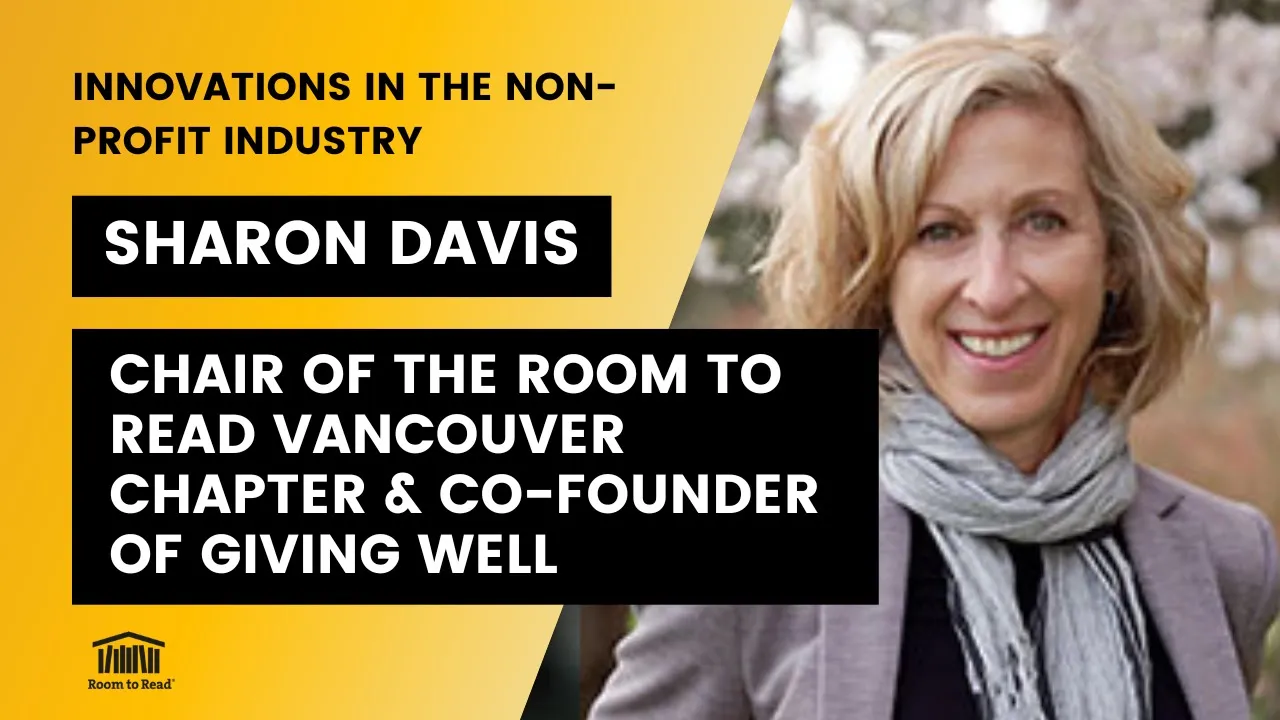
foreign Universe podcast the cast get it the cast my name is Alina and I'm the founder of illuminate where we Mentor job Seekers and help employers to Fast Track their business goals I interviewed a celebrity cast of incredible individuals who have truly inspiring careers we're talking about the work Journey the process of taking the lead to create a life and career they love and what happens when they push aside their fears and doubts to unleash their fullest potential today we speak with Sharon Davis who is a philanthropy professional volunteer and woman's advocate Sharon is the
chair of room to Read's Vancouver Chapter Room to read is a global non-profit organization that focuses on working in collaboration with local communities partner organizations and governments to improve literacy and gender equality in education before joining room to read Sharon was a vice president for Scotia capital currently she is also the co-founder of her own Consulting agency giving well educating individuals and businesses on the strategies of effective philanthropy hi Sharon it is such an honor to have you on our podcast today my first question for you is could you tell us about your background and
what Drew you into the nonprofit space so I had a successful career in investment Finance which is in some ways quite a departure from the nonprofit sector and in other ways a lot of crossover skills so my experience in business actually provided many skills that were transferable to the non-profit Arena I left that job and with very little Direction in my mind as to where I wanted to go and I just started volunteering with a number of organizations that aligned with my passions so I found my business sense was actually valued and I was quickly
being offered board positions contract work to sort of help non-profits navigate their challenges and so I worked in a number of different areas from literacy to sport to at-risk Youth and more just to get a sense of how it all worked I really wanted to understand how the nonprofit side worked and and I was really lucky that I found some wonderful mentors along the way who were and I was just really eager to learn and Implement right away so it's like a crash course in the non-profit sector and then after all this exploring and learning
I settled in with an organization an international charity called room to read and I've worked with them or volunteered with them for a number of years so the non-profit World Isn't that different from the for-profit world it's just a matter of how they do their reporting Etc and they're just working towards that cause but in both instances as much as the non-profit world is changing so is the business world so technology crowdfunding Partnerships covid um have all had an impact on what's happening in the non-profit world could you share a bit more about the skills
that you brought from the corporate finance world and how those were transferable into the non-profit world the client-based relationships which is very similar to the donor based relationship tips creating Partnerships working in kind of a sensitive area because whenever you're talking about money it's always sensitive to people so whether that's a client investing their money or a donor investing in a non-profit organization there really is no different they should be treated similarly and then just Finance in general is is sort of an area where uh non-profits often struggle you know keeping their books properly you
know what can they can and can't they do and all of that so the finance side was great and then just that networking building uh creating all of that is is really similar in both sides so Sharon how do we talk about money what are some tips that you have I think first of all you just have to respect that it's hard for people so many people in past Generations have grown up where that's just like a taboo subject you just shouldn't talk about it and so you you have to get people you know on
your side you have to build that trust it's not like you just want to dive in in the first meeting ask a donor for money so that's you know what a lot of people think you need to do it's it's all about the money and it's not it's about the relationship building and the other side is kind of the youth which we now have a great opportunity to educate them about money and finance and budgeting and all those things that they're going to need in life which a lot of people didn't learn in school and
then they get out there in the real world and it's really challenging for them it's great that we're building financial literacy for young people now you know this actually reminds me of the National High School leadership conference that we held in Toronto last weekend and the theme was all about money so I absolutely agree that we need to start talking about financial literacy at a young age especially for youth the challenge that we had was we gave the youth a challenge called the millionaire challenge where they pretended that they were a new grad graduate graduated
from UBC with an arts degree and they have a 55k annual salary job where at the end of the month they were only able to save up 68 dollars and so we gave them the challenge to to come up with a solution of how do you become a millionaire with 68 dollars left each month and it was pretty interesting so I absolutely agree that the subject is can absolutely be tricky but it can be very meaningful as well this leads me to my next question describe a day in your life and your favorite Parts about
working in a non-profit I think one of the things I like most about it is is no two days are alike so you're always talking to different people from different walks of life and probably the only thing that you have in common to start with if you're talking to someone who's coming to your non-profit is you're both passionate about the cause whatever it is that they're a non-profit for so every non-profit's different they're all trying to solve a problem an issue or help their Community or the world in some way and that to me is
inspiring so just having that ability to work in that environment is I think it's a it's an honor and so I start typically just by learning as much as I can about the organization and then sort of find out what they're doing right what their challenges are what resources they have and then what they need and then start to explore putting together an approach of how we can help them and whether that's they want to improve their social media presence whether they want to you know improve their their donations so get more donations in the
door a lot of it is is just so personal to to that non-profit so for me every every interaction becomes a different story and uh my favorite part is that they're so appreciative of everything that people do for them it's it's not like when you're in a regular job and somebody goes oh thanks um like they really genuinely appreciate what you're doing and they can't believe that someone's there doing that for them and nothing's really taken for granted so when a new implementation like that starts it's just it's a really uplifting experience and there's a
lot of buy-in on the part of the nonprofit because they really want to see themselves improve or they wouldn't be at this point in their in their Journey so once they get a little taste of it and and you change a few small things and they see the possibilities then they're like open to whatever you can bring to the table so I think it's that level of appreciation and that that openness to just learn because sometimes it's a big case of they don't know what they don't know how would you describe the atmosphere in the
non-profit world we know in the corporate worlds it's all about Precision it's Perfection it's doing everything absolutely right in the startup space it's a little bit all over the place you're moving with various parts every day you know constant the only constant is rapid change and startup Founders really have to adjust with that with limited resources and a very tight timeline how would you describe the atmosphere in the nonprofit space it's sometimes a little bit like the startup space as you mentioned because a lot of non-profits for many years were just chasing the money and
they they weren't doing it in a very concise way and it was all about the next donation and the next donation and we can't do this until we get the money and there was no plan in place so it wasn't like they had these goals and then they went out and fundraised to reach them it would be like okay we got some money and now what can we do and so that part of it is starting to evolve and change and they just need to learn to run their operation more like a business in that
sense like have goals have um a plan and not just a six month or a one year plan but a long-term plan like any business they have a lot of challenges and it's more convincing them that there's a more effective way to do this because they do just seem to be in this constant cycle of of chasing the money so there's organizations that rely solely on grants they're incredibly vulnerable if those grants disappear on them there's those who just rely on the one-off annual donations and they don't have any sense of security you don't know
if that donor is coming back next year you can call them and you can ask for more money but there's no guarantee there so there's just sort of so much hanging in in the abyss for them and what they really need to find is partners they need to find long-term Partners who are willing to get in deep with them for three to five years and yes we're going to support you and we're going to help you in any way we can and it's not just about money it's sometimes all the in-kind things it's it's can
we help you with your I.T you know we're a law firm and we're your partner now can we give you legal advice or we're a counting firm or we have an accountant who works for us can he come over you know once a month and help you with your accounting you know the IT department can help them with their software to maybe communicate better with their donors so all those things are helpful and if they don't have to pay for them that's a bonus because if they had to pay for them they probably wouldn't do
it because they don't have the resources to do that they're more concerned about focusing on their programs and not spending money on how they're going to up their game so once that partnership is formed it becomes like a win-win situation it's it's now a two-way street it's not just the donor giving to you you're working together maybe the non-profit is thinking of starting some kind of a new program they can brainstorm it out with their partner maybe their partner is even willing to take ownership of that and fund it for them and and get the
publicity for doing that so there's so many ways that they can start to take an active role in the non-profit and and go from there and and just see what develops but it's it's almost like a marriage we often talk in in the non-profit sector about how finding the perfect charity for you as a corporation is a bit like dating it's having passion it's having um aligned values it's having common interests so all those pieces fit together and that's what you're looking for when you're bringing together a donor and a non-profit or a charity so
I don't think a lot of people see it that way but it it really is I mean we're all driven by our values and our passions and so it just makes sense to me so I know that room to read engages volunteers uh incredibly well and it also goes into communities in third world countries and helps to build that Community into a sustainable economy of its own can you tell us a bit more about that so it's it's kind of two separate entities so the communities that we work in overseas are all local Nationals who
work there we don't catapult people from North America over to Cambodia to to do work so we hire all local Nationals which is providing jobs providing experience and just tapping into all their local knowledge and the language of course is is key as well so the other side of it the fundraising side of it we've developed over the years a chapter Network where we have these volunteer chapter networks in there in multiple cities around the world and they're kind of like a little small business in a way because once you form it you can do
whatever you want to fundraise so it's there's nobody dictating how you do this work so you can have whatever events you like to have you can have your own social media campaigns and you just bring together a group of like-minded volunteers that want to form this committee and meet on a regular basis and and find what it is your specific Committee in your city is passionate about doing and and what that might look like so it really has created a lot of unique events around the globe and it connects to a lot of people in
our own communities to create that awareness for room to read and and the plight of illiteracy around the world and then the fundraising is is the added bonus in the end and so what are some tips and advice you would give young professionals aspiring to enter the nonprofit good world do it for starters just do it don't overthink it Follow Your Passion so if you're wanting to work in the non-profit it's it's got to be more than just a job it's a mission so look for the right fit look for things within yourself that are
aligned with the work that this person is doing it it's not just oh let me attach myself to this non-profit because they're going somewhere it's it's not that kind of thing so in Canada when it comes to jobs pay jobs in the nonprofit sector there is still some pay discrepancy for the similar work that you would do in the corporate world and that is just because of the restrictions of resources they just don't have the money always to pay as much as you might make doing that same job for a for-profit company it's getting a
lot better it's definitely gotten a lot better in the US and it just continues to improve but there's still a little bit of a lie there and like any job get out and learn as much as you can about the organization itself so if you were applying for a job at you know Amazon or wherever you would learn about the organization before you went in for That interview so it's it's no different in that sense and I think one thing that really stands out a lot at the nonprofits is is that creativity so take something
that's really out there and and present it to them and see how they respond to that and that might give you some Clues as to what the you know what the working situation might be like attend one of their events and and see them in action and you know you can kind of be behind the scenes they don't even know who you are or you could just make a small donation and see how they engage with their donors so how are you received as a as a donor and networking has been a Mainstay for me
in navigating the nonprofit sector you just have to get out there and talk to a lot of people and it doesn't mean attending every event in town it means selectively talking to people on an informational level not a job application approach so I have weekly conversations with all kinds of people in the sector um and just try and see what they think is going on and share what I think is going on and just it can lead to a lot of things it can lead to conversations like we're having today which we met through networking
it can lead to being invited to be on panel discussions it can lead to someone saying I talked to someone the other day and they would be perfect for this job that you have so I think it's just knowing who you really are and what you want and what you're passionate about and matching that up again back to the dating thing matching it up with the with the non-profit that's doing that I love it I think we're going to change the title of this episode to shall we say dating in the non-profit or we may
be able to have a fundraiser based around dating now I love it this is so creative well I have my last question for you Sharon sure um so this one what is one emerging Trend within the nonprofit industry and how do you see that impacting the industry in the future I think it's if I can have not just one but if I can have two because they kind of go together it would be creativity and Innovation so finding new ways to get your message out that'll make you stand out from the crowd hosting engaging events
not just the boring someone stands up and speaks and then you all eat dinner and go home so just getting the audience engaged in what you do and and making room for for young people to participate so a good example of this and this was mass purchase participation was this is going back to 2014 the ice bucket challenge do you remember that and so it it drew so much attention for ALS prior to that Challenge ALS was a little known disease that struggled to fundraise and this just launched them into the stratosphere like everyone wanted
to throw a pail of cold water over their head for whatever reason that was and it brought a ton of innovation and change and made them a household name and they they didn't know that when they started they didn't hire a fancy PR team they didn't embark on some expensive marketing promotion they simply came up with this quirky idea and it might have been over beer in a bar somewhere let's get people to dump cold water over their head and see if they'll raise money and it simply went viral we can't predict what goes viral
but there's no magic formula and this worked for them and now they're doing amazing work and they're probably on the Tipping Point of you know some amazing steps in in helping with that disease so I think you just have to step outside your comfort zone and certainly people did in this sense with the gold water and I think just be Innovative like that phrase that just makes the hair on the back of my neck stand up is that well we've always done it this way and I I never want to hear that when I'm out
there dealing in these circumstances so just try new things be Innovative be creative don't make assumptions that it won't work you won't know it won't work until you put it out there and and try so I would just say for people to just get out there and do it I love it be entrepreneurial exactly yes I believe the entrepreneurial mindset applies to everything that we do in life including dating exactly and I think the entrepreneurial aspect is quite new to the nonprofit sector they haven't really delved into that as much and consequently there isn't as
much collaboration going on perhaps as there should be so they're working towards that and and I've been really pushing the agenda on the collaboration side of things that you know don't hold things so close to the chest get out there and talk to your competition they're not competition you're all trying to save the world so do it together this isn't a business where you're selling widgets and and you want to sell more than the guy down the street this is changing people's lives so I think collaboration is going to be the key to the future
of the nonprofit sector thank you so much Sharon for sharing your wisdom today thank you for having me thank you until next time bye for now [Music]



![#29 - Phillip Haid [A Better Leader], Founder & CEO, Public Inc.](https://img.youtube.com/vi/Jv9ayc9Nqzw/maxresdefault.jpg)