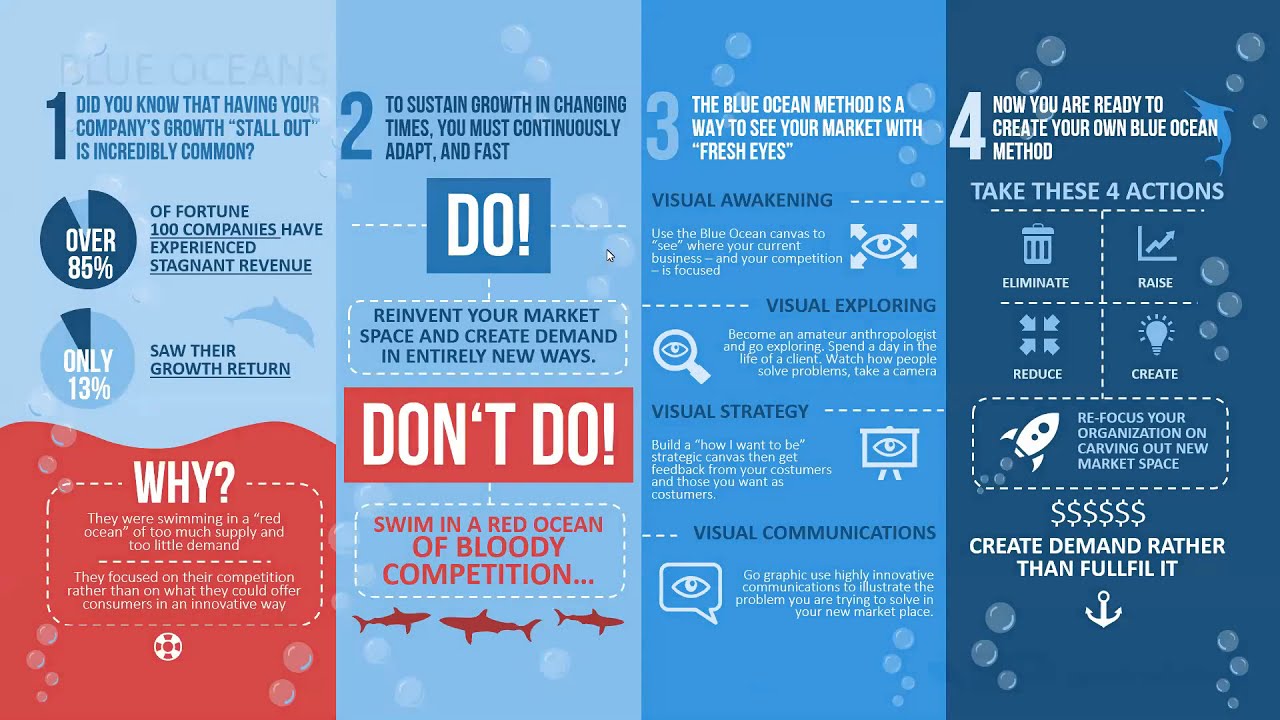
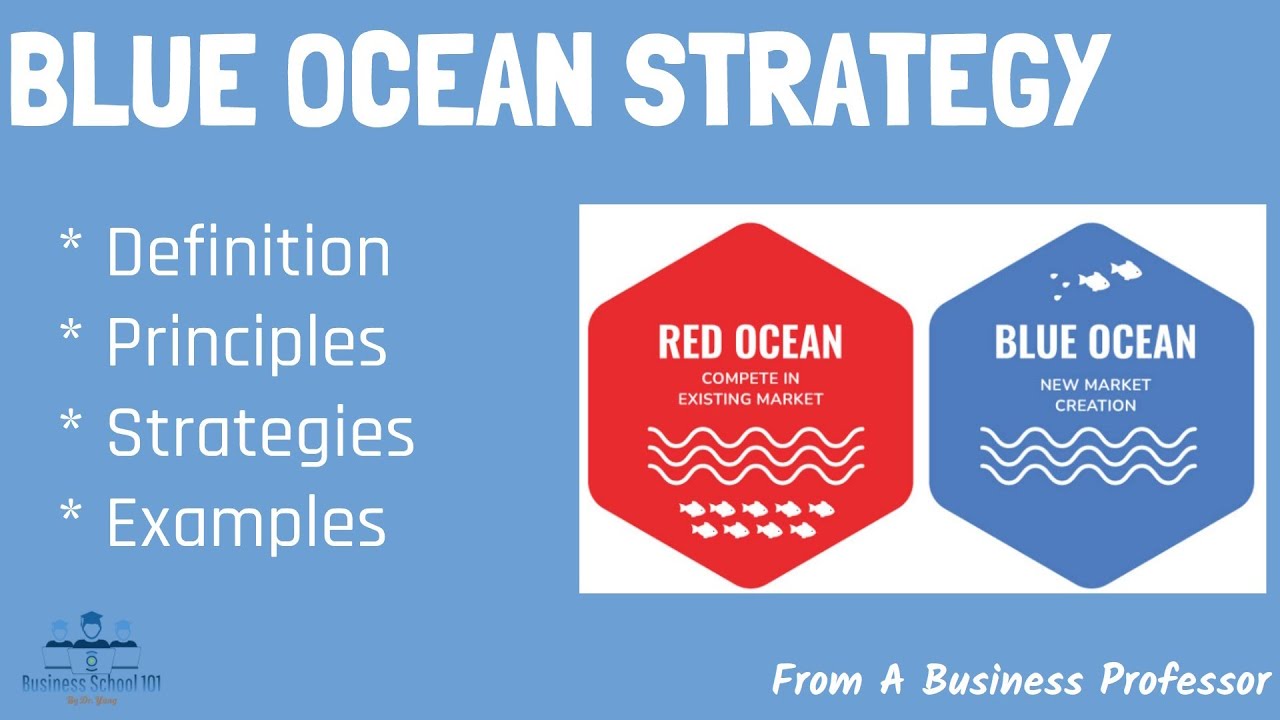
Hey there, fellow marketers. Professor Wolters here, and today we're here in London, England, and today I want to talk about, is actually a continuation of our discussion on blue ocean strategies, and this video is actually going to talk about the differences between red ocean strategies and blue ocean strategies, okay? And the thing is, is when you're thinking about red ocean, when we think of red ocean, you think, oh, there's blood in the water, cause all the blood that's in there is from all the fighting to all the competition, and that's the thing is, in a red ocean market, you're basically fighting over the same market, the same people, the same sales, and stuff like that.
So we're fighting all the time, all right? Whereas that blue ocean, what you're doing is you're fighting over an uncontested market. You're not fighting.
It's a completely open ocean. There's no worries. I can wander through it, have no problems.
Whereas in a red ocean, you know, wherever you went, wherever you go, you're going to be fighting. So like in the mobile phone industry, everywhere iPhone, Apple goes, Samsung's there fighting them and stuff like that. So you have those things.
Now, next thing you might want to look at is in terms of competition, and how we kind of view competition. Well, in a red ocean, what we're looking at is our competition, we're always fighting with them, so it's a constant battle, a constant, you know, tug of war of who's winning, who's losing, and stuff like that. Whereas in a blue ocean, competition is basically irrelevant, because we're making them irrelevant by putting ourselves in our own little world.
I mean, the Southwest's, the Ryanair's, the easyJet's, they're not concerned with Delta. They're not concerned wi- wi- with British Airways, because we're over this low-cost field. We're not even worried about your stuff.
We're not competing with you. We're over here, and that means that the other market that they're fighting over is irrelevant to us. So we're not even worried about that, and a lot of it will really come to in terms of demand.
Okay. So in terms of the red ocean, you have- you're bowing over that existing demand. People already want flights.
Okay. If we're looking at the airline thing, they already want those flights. We're fighting over those flights, you know, those kind of things.
Well, the thing is, in a blue ocean, what we're kind of coming up with is, and we're not selling the same old product, we're not selling a flight. We're selling a low-cost flight. Whereas a normal flight has food and drinks and free baggage and stuff like that.
We're just selling, look cheap flight, you want anything else you're gonna pay for it, we're just selling the flight part. And so it becomes kind of a very different battle, because you're selling very different products. So with a red ocean, you're focused on existing demand, because people are already buying those things, like the plane tickets, and stuff like that.
We're only focused on the normal plane tickets. That's what we're really going for, this existing demand. But then our blue ocean strategy, what they're trying to do is create a completely new demand for something that people hadn't even been looking for before.
Do you think about in terms of airline tickets? Well, we were all buying normal plane tickets before that had free bags and, a- a- and food and drinks and stuff like that, a- a- and those things, a- a- and assigned seats. Well, the thing is, we created this whole new demand for low cost tickets.
Yeah, there's, there's no luggage included, there's no drinks included, there's no nothing included, it's just a cheap fare, it's just the flight itself, none of the other add ons. And so we actually kind of created this whole new product, this whole new demand for a completely different kind of industry. So it can be a completely different kind of clients.
Now another thing I would say is in terms of the red ocean, what you'll end up seeing is companies will either go for a low-cost leadership, or maybe a differentiation strategy, they're gonna go for a traditional strategy kind of thing. It's an either or kind of thing. Because we realize, look, we got to be at least special, like we got to be Target, so people will come to us for that fancy shopping experience, or we've got to be Aldi or Walmart and have the lowest price possible.
That's what we're gonna do. And we're gonna fight tooth and nail for those little areas. Whereas in a blue ocean, since you're a new thing, you're actually differentiating yourself, just because you're this whole other new product, this whole other new demand, but also you're kind of doing a low cost thing as well, because you're the ones setting the cost, and you're doing something different.
So if you're looking at the airlines, they went for that whole low cost thing over here that didn't exist. So we're specializing in cheap tickets. So it's differentiating ourself, because we're giving you this other option of different kind of products, because it's a different kind of flight, but also trying to give you that lowest price when we are there.
And last thing I want to touch on is this kind of cost value ratio, like how much does it cost to do that and what value am I getting out of it? And the thing is, is when you're looking at the- the red ocean, we're focusing on that traditional cost value relationship. Look, we're gonna give you the extra seat room, we're gonna give you the food and stuff like that.
So you value that, but it raises our costs. The thing is, we have to kind of fight over these things and do these kind of things. And that's we're gonna look at.
Whereas the blue ocean, what they're trying to do is do something completely different. We're gonna go beyond the cost value relationship, because the thing is, is if you're looking at those cheap airlines that the service a lot of times, not all the times, like I like easyJet's service, I like Southwest's service and stuff like that, you know, but the thing is, they're like, look, we're- we're going over something different, our cost value, we're giving you such a cheap flight that you're not really caring if you get good service or not, because it's such a cheap flight. I mean, I'm not the biggest fan of flying with Ryanair, but I still do it because man, I can't beat those prices.
And that's the thing is it doesn't matter the cost value, it just it's such a good cost, it's such a different price range and stuff like that, that it gives me a whole other perspective on those flights. That's why when you have those cheap flights, you're like you know what, I hadn't thought about going to that city or that country, but with prices like that, how can I say no? Okay.
And that's one of those things, these red and blue oceans. Remember red, you're constantly fighting and doing battle over the same demand, the same pro- price value ratio, the, all these kind of things. It's the same stuff every day.
And the thing is you want to get out of that everyday grind, kind of fight in bloodied water to go into that nice clean blue ocean. So you want to make sure it's like look, let's see if we can create that new market. Let's find something that people hadn't thought about before.
And that can be like I said, you're looking at those cheap airlines that came out. Also think about when the Wii came out versus the PlayStation, the Xbox, they went for a whole new blue ocean. It's, it's the stand up and play video games and do your Wii bowling or Wii baseball, it totally changed the market.
Now the thing is, which you have to realize is those blue oceans, if it looks really good, what happens to all those tourist destinations that look great, eventually people go there, right? And eventually that blue ocean becomes a red ocean as well. So that's why, if you're looking at, you know, the- the Ryanair's.
Ryanair, easyJet probably, you have a lot of airlines that have now in that blue ocean, and now it's also a red ocean. So over time, the blue ocean will turn into a red and then we try to find something else. I hope this helps you understand the differences between red oceans and blue oceans in terms of blue ocean strategies, and what we're kind of dealing with.
If you want to learn more about business and marketing, dude, subscribe to our channel. We got new videos coming out every so often. So hopefully it'll help you learn some more and have a great time and bye from London.