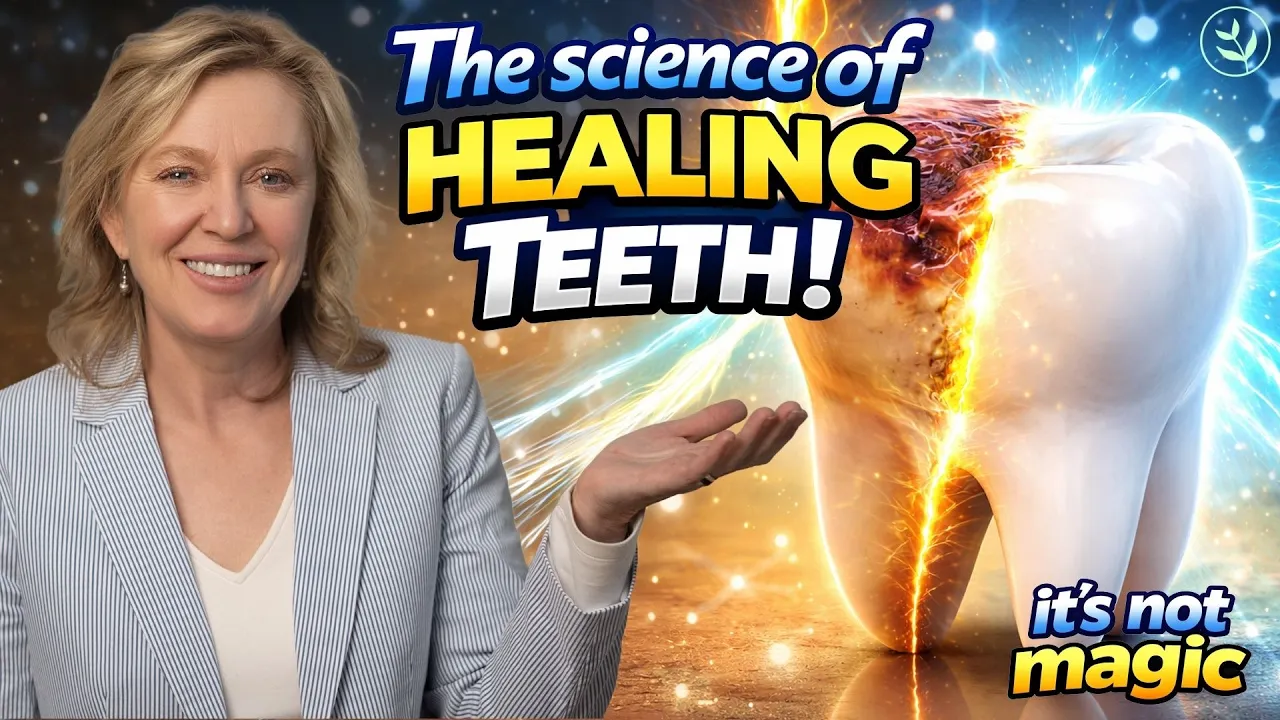
Can your teeth actually heal [snorts] themselves? Well, your teeth can't regrow, but they can remmineralize. And the science behind this is increasing every single day.
And it's [music] actually more interesting than people are talking about. So, everything that I tell you today, every claim I make is documented by research. You can find all of that in the notes at the bottom.
Make sure to check that out if [music] you're interested. And by the end of today's video, I'm going to give you a fourpart formula to actually heal your teeth. To start with, we have to talk about what's happening when you start to get a cavity.
It's all about the acid. [music] And that is step number one is managing the acid. Why acid?
Well, when our mouths get to a pH of 5. 5 or lower, what happens is that minerals in our teeth are actually pulled out into the saliva. This is just what happens when something acidic touches something that has minerals involved.
I often joke that this is the old science fair experiment where you'd pour Coke on top of a battery terminal or something that has a lot of mineral buildup and it eats it away. It dissolves it. The same thing happens in our mouths.
So where does the acid come from that literally dissolves the minerals in our teeth? Two places. Number one, from our diet.
So if we're actually eating a lot of acidic foods, this might be soda or energy drinks or things that are really acidic even in the foods that we eat like pineapple and tomatoes and lemon juice is a big one that people don't think about. All of these are very acidic. When that acid touches the tooth, it literally pulls minerals out and dissolves them.
Now, our teeth themselves are made of 96% minerals and the mineral is called hydroxyapatite. It's just a bunch of minerals stuck together, primarily calcium and phosphate. The other 3% is water and some other organic materials, but 96% is minerals.
So when that acid contacts the tooth, it pulls the mineral out and that mineral goes into the saliva. That's source number one. The second source is when you eat sugary foods.
That's actually the favorite food of bacteria that live in your mouth. Now when the bacteria eat that sugary food, they actually excrete acid. So it's not the sugar that leads to the cavity.
It's the bacteria eating the sugar that leads to the cavity. So again, it's all about acid. So acid control is so crucial for actually healing a tooth.
We're going to get into that in a minute. Step number two, we need to manage that saliva. So remember I talked about when the acid dissolves the minerals, the minerals go into the saliva.
Down the hatch they go. They are then used somewhere else in the body. Well, if your body has enough minerals, there's this constant eb and flow in the mouth.
You eat something, pH drops. And this happens automatically. So, every single time you eat, the pH is going to get more acidic in your mouth.
PH drops, minerals are pulled out into the saliva. If there's enough minerals to be had in the body itself, saliva will bring more minerals back and will neutralize the pH and remmineralize the tooth. This is literally going on all day long every single day.
So when we think about this, there are two things that can help. Number one is we have to reduce the number of times that that acid drops. So this means reducing the number of times that we're putting something in our mouth.
It takes our saliva a half an hour to an hour to bring that pH back up, to get rid of the acid, to bring the minerals back. So, you have to give your mouth time to recover. This is where the healing part comes in.
Enamel looks like a matrix. It has holes. When the minerals are pulled out, it leaves a hole.
Well, the saliva can bring something that will fill that hole back up again. But if it's never the right pH, if it's always acidic because you're constantly sipping on something or you're constantly popping something in to snack, your saliva never has a chance to do its job of bringing the minerals back. So, there's simple little things you can do like instead of a snack at about 9:30 in the morning, drinking a glass of water instead.
Just that one step alone could be the difference between you being able to heal a beginning cavity or not. How long are you giving your mouth in between meals and sips to be able to recover? That's one way we can control the saliva is giving it a chance to do the job.
The second thing we can do is to make sure that that saliva actually has the minerals that are needed to be able to remmineralize the tooth. What are these minerals? Largely calcium and phosphate.
But here is the missing piece that a lot of people don't understand. Those minerals don't necessarily just go where they're supposed to go. Vitamin D3 is a traffic director particularly for calcium in the body.
So if you have enough vitamin D3, it will say okay go and be available to help remmineralize the tooth. Vitamin K2 then tells it either to go into hard tissues or into soft tissues. Now what is the difference between this?
The hard tissues are teeth and bones. That's where we want the minerals. The soft tissues are things like your kidneys, heard of kidney stones, gallbladder heard of gallstones.
Your arteries heard of calcifying arteries or plaque in the arteries. We don't want minerals there. So you have to use vitamin K2 in addition to the vitamin D3 to tell the minerals where you need them to go.
So what do I tell people all the time? Minimize the snacking. Make sure your mouth has time to recover and add vitamin D3, K2, and a mineral supplement that contains calcium and phosphate.
This is so crucial because it's just a matter of how many minerals are going in, how many minerals are going out, and are you getting more in than out? That's what we call demineralization. So, we're not actually healing a tooth.
were remmineralizing or putting minerals back into those holes. Now, this is the difference between fluoride and hydroxyapatite. Now, hydroxy appatite is one of the greatest preventive inventions of really this century, of my lifetime.
Hydroxy appatite, remember, is the mineral your teeth are made of. So, when you are brushing and using a hydroxy appatite containing product, you're just putting minerals back in where they came from. What does fluoride do?
Fluoride actually changes the mineral structure. It turns hydroxy appatite into florap appatite. Fluorapatite is actually harder and more resistant to acid attack.
This sounds awesome, right? You can't dissolve it as easily. Well, it's not actually healing anything.
It's just making what's there a little harder, but it's not putting back what was lost. Do you see the difference? There's so much research that shows that hydroxy appatite can reverse the beginning signs of tooth decay because the beginning signs of tooth decay are empty enamel crystals, holes where those minerals were pulled out of.
We have to put them back. Not just harden what's left behind. So this is how you actually do remmineralize your tooth.
You're not regrowing it. You're hardening it and refilling it. If that makes sense.
So this is strategy number two. Strategy number three is control the bofilm. What does that mean?
Well, what this means is bacteria, remember, eat sugar, create acid. They're going to repopulate in your mouth about every 2 to three hours. So you're going to brush them off and they're going to be back again this evening.
So it's so important that you continually keep the teeth clean. It's actually less important which bacteria are there. There's not really good bacteria and bad bacteria.
There are ones that like sugar more than others. It's more important that you just get them all off. So, this is the reason that we tell you brush your teeth, floss your teeth.
It's going to help with cavities because it does help to remove the bacteria that may be excreting some of that acid that are dissolving minerals out. So, this is step number three. So, so far we have control the acid, right?
A little bit less snacking if possible and watch what you're putting in your mouth, the acid content of it. Support your saliva. So, make sure that you're giving your saliva enough time to do its job in between meals and that that saliva has minerals to spare.
Number three, control those bacteria. Make sure you're getting it off every single day and keeping it nice and clean. All right, we're here to step number four.
This is all about just being conscious with what you're eating. Remember, we want to minimize the number of times that we're eating. We want to really reduce the acid content in those foods if possible.
And we want to make sure that those foods are full of minerals, right? Minerals are the key. So, let's put this all together into a complete format and complete program for you.
You're not rebuilding a tooth. You're not actually putting something there that wasn't there in the beginning. What you are doing is realizing that when a cavity starts to form it be, it's because minerals were pulled out and left a hole behind.
The bacteria are then able to crawl in. They eat more sugar. They excrete more acid.
More minerals are pulled out and the hole gets deeper and bigger. What might this look like? Well, this might be a white spot.
You might see a white spot that's kind of matte, not very glossy or shiny. That's what a beginning cavity looks like. you might actually feel some sensitivity.
So, you're drinking something cold and yeah, I can feel that. These are all signs that a cavity is starting. When you are in that phase, you are able to add minerals back into those holes and actually fill them up again.
So, again, we're not adding what wasn't there. We're just replacing what was lost. Can you see the difference here?
You're going to be able to tell the difference. You're going to see those white spots change. They're going to get glossy again.
you're going to feel a lot less cold sensitivity. I remember a woman told me that she literally had to microwave her fruit to be able to eat it because even fruit was just so sensitive to her teeth until she filled them up with hydroxy appetite. Then no longer no more issues like this.
So control that acid, take care of the saliva, [music] and control that bofil. Make sure you're keeping the bacteria off. Add a lot of minerals through supplementation if necessary for sure through your diet [music] and you can have healthy teeth for life because it is possible to [music] keep your teeth healthy.
Research agrees with me and proves what I'm telling you is true today. This information is out there. [music] It's so fascinating and really today is the day to live because we have so much information available but also so many [music] products available to make healthy tea for life a real possibility for you.
Keep subscribing, keep checking in here because this is the kind of information I want you to know. I want [music] to translate the science that's happening today into real actionable things you [music] can do every single day at home to keep your teeth and you well.