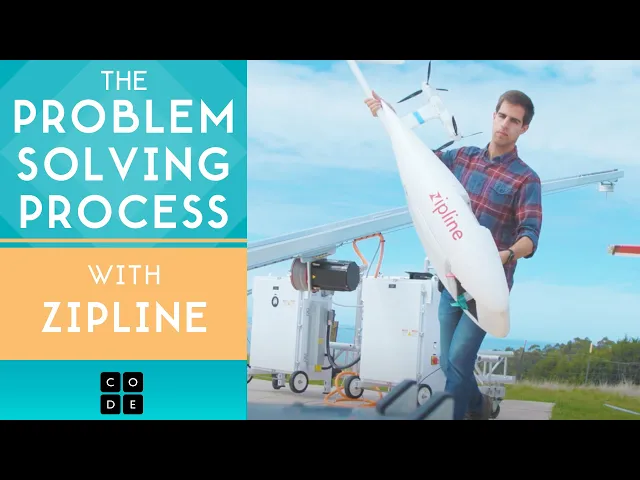
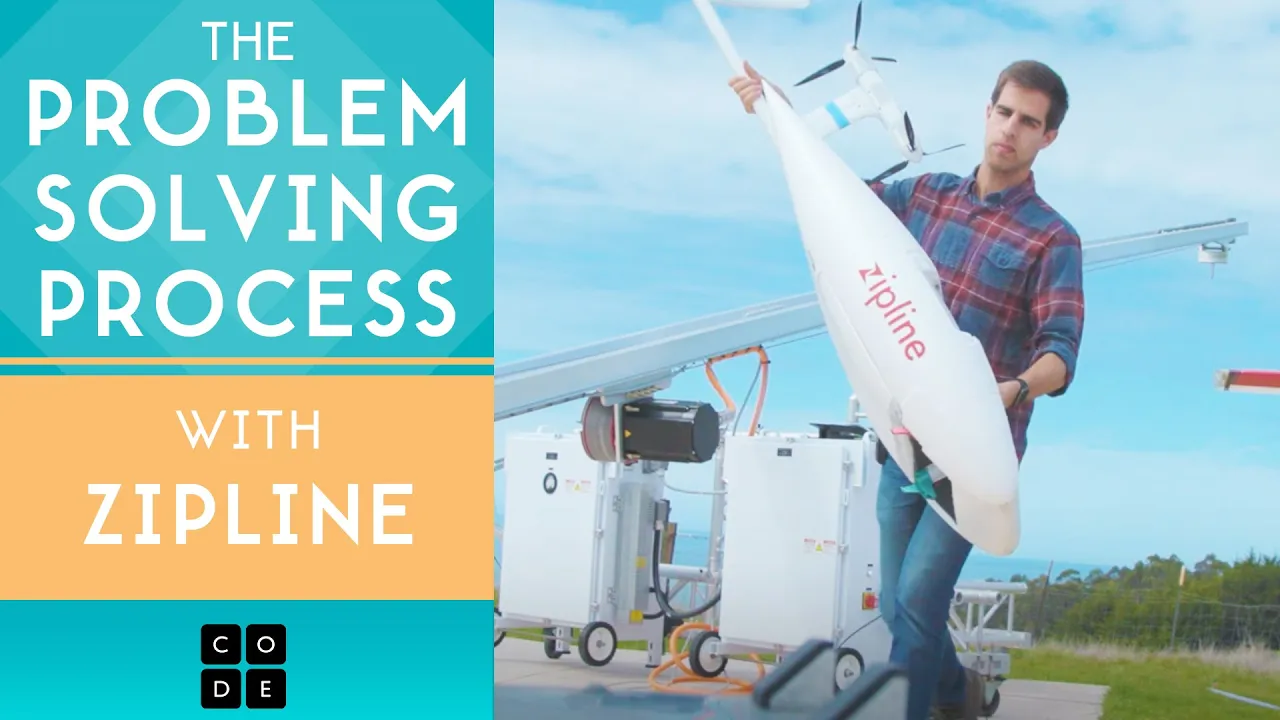
Hi, I'm Ryan and I'm the Head of Software at Zipline. Zipline operates across Africa using drones to make life-saving blood deliveries. We deliver medical products like blood and vaccines to places that otherwise can't be reached.
We all deal with different types of problems every day. . .
And one way or another we come up with solutions. But did you know there's actually a series of steps you can take for solving any problem? It's called the Problem Solving Process and it has four basic parts.
One: Define - identify the problem. Two: Prepare - research previous solutions and brainstorm new ones. Three: Try - put a plan into action and test to see what works.
Four: Reflect - review what worked and what didn't and how you might change your approach in the future. Let's take a look at how this process is used in the real world by looking at where I work - Zipline. At Zipline we started by defining the problem.
First, when people need blood they need blood fast. Second, blood is very hard to store because there are many different types and it expires quickly. And third, most of the world does not have roads we can rely on for delivery.
The next step was to prepare a solution. First we travel to Africa and met with doctors, the people on the ground who are most familiar with these problems. We learned that storing the blood in one place would really help if only there was some way of getting the blood from that place to remote clinics on demand.
Next we came up with all kinds of ideas and really let our imaginations fly. The solution we thought might work was an airplane shaped drone that could fly really far, really fast, over all kinds of rough terrain. When it flew over its destination it would parachute drop a package of blood to the doctors on the ground, then return home.
Now it was time to try this all out. Thanks to previous medical research we knew techniques for building a blood storage facility. So we built one in a central location so that we could deliver blood to almost anywhere in the country.
Then we built drones. . .
a lot of drones. We tested how to fly the drones, turn them around, and recover them. And as we tried we had successes and we had plenty of failures.
We quickly learned that dropping the blood from the sky worked really well. But we also learned problems like weather and hardware failures could slow us down a lot. So as we tried we had to go back and prepare new solutions, as we defined new problems.
Finally we had something that worked! It was time to look at what we had done and really reflect on how it had gone. We reflected on our original definition of the problem and asked if our solution was better or worse than what existed before?
We even started to think about how our solution might be used to address other problems. Could it work for delivering medicine or even organs? Could it work in reverse and collect items from distant locations?
And could we get this solution to work in other countries? For each of these questions we went back and we redefined our process and we made it better. The Problem Solving Process works in all kinds of areas.
. . Creative.
Personal. Existential? You name it!
By using these four steps, you can figure out a process to make anything work!