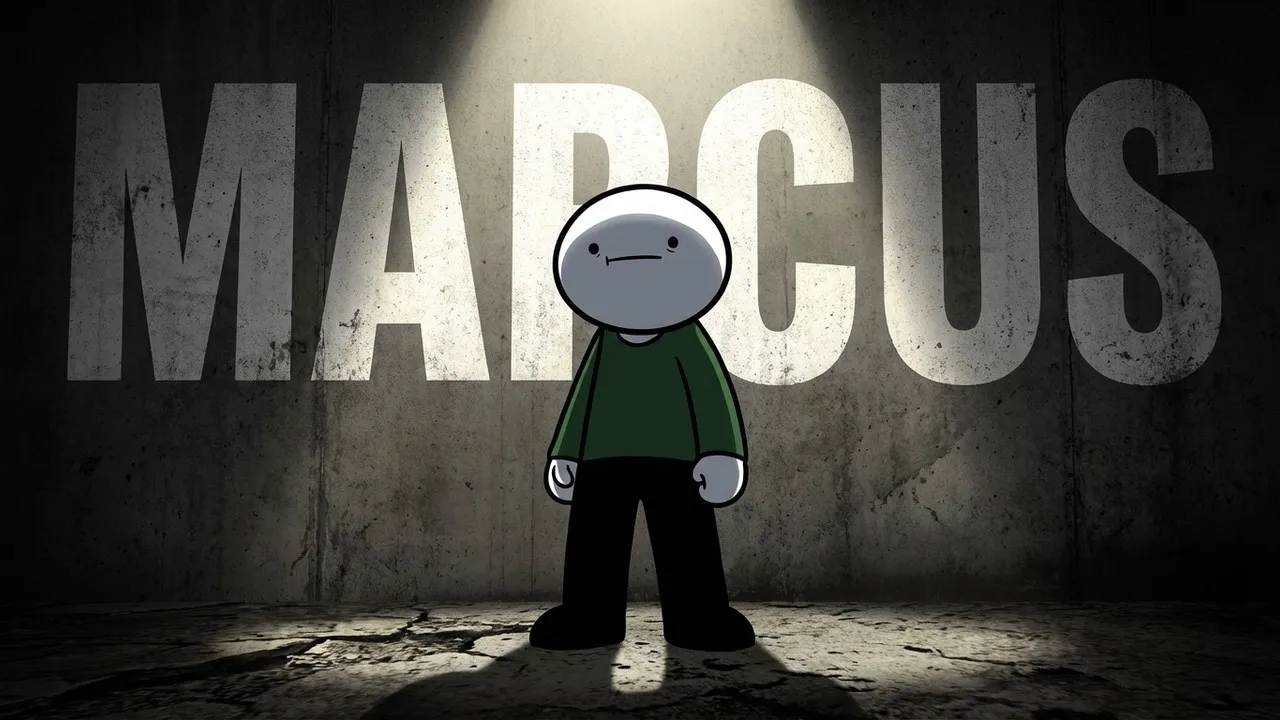
Every story has a Marcus. The partner who covered for you. The cellmate who drew the map.
The neighbor who showed up with beer and asked no questions. The man through the wall who kept tapping back. You've seen him before.
Different face, different role, same name. This is his story. His name is Marcus Webb.
That's where this starts. Not with the cell, not with the verdict. Not with the 14 years.
with a man who had a name and a career and a life that made sense. And with a specific Tuesday morning, everything stopped making sense and never fully started again. This is his story, all of it, from the beginning.
Part one, the FBI years. Marcus joins the bureau at 26. He passes every test.
He scores in the top 3% of his academy class. His instructors write notes about his pattern recognition, his ability to hold contradictory information simultaneously without forcing a premature resolution. One instructor writes that Marcus asks better questions than most agents twice his experience.
Marcus files this away and doesn't mention it to anyone. That's also something the instructors note. He's assigned to the Washington field office and given a partner named Delgado who has been there for 12 years and who teaches him over two years of shared cases and shared coffee and shared silences and surveillance vans what the job actually is versus what they told him it was.
Delgato has a theory he delivers in pieces, never all at once. The theory is this. Federal law enforcement is not about truth.
It's about provable truth. The difference between those two things is the entire job. You can know something completely and be unable to use it.
You can prove something partially and close a case. Learning to navigate that gap without letting it corrupt your relationship to actual truth is what separates the agents who last from the ones who don't. Marcus takes this seriously.
He builds his cases carefully. He documents everything. He becomes the agent other agents call when they need someone whose notes are airtight, whose chain of evidence will survive cross-examination.
He's 31 years old and he already has a reputation for being the person you want on a case that actually matters. He meets Rodriguez on a joint task force targeting a moneyaundering operation out of Miami. Rodriguez is DEA, faster, more instinctive, more comfortable operating in gray areas.
Marcus finds this frustrating at first and then instructive. Rodriguez makes leaps that turn out to be right without being able to explain why. Marcus explains everything and is right about 60% of the time.
Together, their combined right percentage is higher than either of them individually. The Miami case closes with eight convictions. They shake hands afterward and both understand this is the beginning of something.
They worked together on three more joint operations over the next two years. A narcotics distribution network out of Houston, a money service business in Chicago fronting for a cartel, a human trafficking operation that required 6 months of undercover work and resulted in the largest single trafficking bust in that region's history. Rodriguez calls him after Chicago and says, "The thing about working with Marcus is that you always feel like you're operating at full intelligence, like nothing is being hidden from you or simplified.
Most people give you the version of the situation they think you can handle. " Marcus gives you the actual situation and trusts you to handle it. Marcus doesn't know how to respond to this, so he says, "Thank you.
" Rodriguez laughs and hangs up. He doesn't see it at first. How could he?
But there's a raid in year three of their working relationship that goes badly in ways that can be explained by circumstances. And Marcus, who was there, who saw the positioning, who knows what a compromised operation looks like, files away. He watches.
The weight starts dropping off Rodriguez. The eyes change quality. There's a hypervigilance that wasn't there before.
Not the useful kind that comes from experience, but the brittle kind that comes from something else. Marcus watches. He waits.
He gives it time to become something he can be certain about. He becomes certain on a Thursday evening in a parking garage after a debriefing. He walks Rodriguez to his car.
He puts his hand on the door before Rodriguez can open it. He looks at him for a long moment. Then he says four words.
I know what's happening. Rodriguez looks at him. Marcus looks back.
Neither of them says anything for 30 seconds that contains several complete conversations. Then Rodriguez tells him everything. Marcus handles it the way it needs to be handled.
He gets Rodriguez into a program through channels that don't immediately trigger a formal investigation. He covers the exposure at work, creates space until Rodriguez is functional enough for the process to happen on terms that don't end his career. He becomes his handler.
He witnesses the badge coming off. He shakes Rodriguez's hand. He walks out first so he doesn't have to watch him get smaller in his peripheral vision.
6 months later, Marcus gets a call. not a promotion, something different, a recruitment from a different building with different acronyms and questions about what Marcus wants to do with the rest of his career. He says yes because at 31, with 5 years of federal law enforcement behind him, the next level seems like the obvious move.
He has no idea what the next level actually costs. Part two, the CIA years. His partner's name is Cole.
They're assigned together on Marcus' third week. Cole has seven years in the Directorate of Operations, speaks three languages fluently, and two others well enough to be dangerous, and has the specific quality of intelligence that presents as relaxed confidence rather than performance. He's also, Marcus thinks within the first month, one of the most genuinely decent people he's met in federal service.
The decency isn't soft. It's principled. Cole believes in the work the way some people believe in religion, not naively, but with a deep understanding of what it requires and a willingness to pay that price.
They run operations together over 7 years. Syria, Eastern Europe, a particularly complicated 18 months in Southeast Asia that required both of them to make decisions they'd spent years hoping they'd never have to make. They trust each other in the specific way you trust someone when the consequences of misplaced trust are catastrophic, which is to say completely, but with full awareness of what complete trust costs.
Marcus knows Cole's wife's name. He knows the specific way Cole explains complex intelligence assessments, always starting with what he doesn't know, building toward what he does, never overstating his confidence. He knows that Cole brings him soup when he's sick.
That he keeps a photo of his daughter on his desk in a frame she made in elementary school. That he takes the hard cases because someone has to and doesn't complain about it. He knows that if you're in trouble in a foreign city at 2 in the morning, Cole is the person you call.
He knows all of this and it doesn't help him with what happens next. The Syria operation goes wrong in ways that won't be declassified for decades. Assets are compromised.
Operatives are burned. Three people are arrested by a foreign intelligence service. The investigation into how the operation was penetrated runs for 11 months.
Someone inside provided information. The evidence is specific and points to a specific workstation, a specific access pattern, a specific travel history. The evidence points to Marcus.
The counter intelligence investigation starts on a Wednesday. By the following Tuesday, Marcus is in an interrogation room, the kind he sat on the other side of a 100 times, answering questions he doesn't have the answers to. He maintains his innocence because he is innocent.
He keeps looking for the mistake in the evidence, the clerical error, the misattributed access. He keeps thinking there's a logical explanation that will make this stop. There isn't one because the evidence was placed there deliberately by someone who knew exactly how Marcus moved through the world because that someone had been watching him move through it for 7 years.
He doesn't know it's coal yet. That knowledge comes later in a different room and it doesn't help the way he thought it would. He's given a choice.
Resign quietly, cooperate, walk away with his pension intact, or fight it. classified proceedings, years of legal process, no guarantee of outcome, his entire career becoming evidence in a process he can't fully see or respond to. He's 38 years old.
He sits in his apartment for 3 days trying to find the path where fighting this works. He can't find it. The evidence against him is his own professional fingerprints placed on things he didn't touch.
On the third morning, he takes the deal. Cole stops by when Marcus is clearing his desk, says it'll work out. Marcus looks at him and nods.
He still doesn't know yet. He loads the last box into his car in the parking garage and sits there for 40 minutes without starting the engine. Then he drives home.
He applies for 43 jobs in the first 3 months. Two call backs, zero offers. The background check keeps coming back wrong.
He can't explain the wrong without explaining everything. and explaining everything means explaining he was investigated for treason. By month five, he's behind on rent.
Part three, the years between. The man who approaches him is named Reyes. Reyes has a talent for finding people whose capabilities exceed their circumstances and whose circumstances have made them flexible about certain categories of legality.
He's professional about it. He explains the work clearly, the compensation clearly, the risks clearly. He doesn't pretend it's something it isn't.
Marcus thinks about it for 3 weeks. He runs through every alternative. The math keeps coming out the same.
His savings will last four more months. He has no viable employment prospects. He has knowledge and skills that have value in markets that don't require him to explain his background.
The choice isn't between good and bad. It's between different kinds of bad. One month becomes three.
Three becomes six. The questions get more specific. The compensation gets better.
The thing Marcus is part of becomes clearer in ways he works very hard not to look at directly. He finds a lawyer when the legal exposure becomes something he needs to understand. Marcus comes back three times before something shifts slightly in the way the lawyer looks at him.
a calculation behind the professionalism, a misalignment between what a lawyer would say and what this lawyer says. Then the letter arrives. He goes to the coffee shop with a folder.
He lays out what he has without anger because anger isn't the useful emotion. He watches the lawyer understand the situation. He watches the face do what faces do when they encounter a door that's already locked.
And then unexpectedly, the honesty comes, the real story behind the note, the debt, the specific, desperate arithmetic that produced this choice. Marcus listens to it and recognizes it. He's been doing his own version of that arithmetic for 8 months.
He does the calculation that isn't the efficient one. He says the thing that costs him something. He walks out and thinks about the gap between what he came in to do and what he actually did.
Three months later, the federal investigation closes around Reyes's network. Marcus is on a list. He has 48 hours before the list becomes warrants.
He doesn't run far or well. He's been on enough fugitive cases to know that running is almost never the right move. They find him in a motel in Delaware 11 days later.
Federal charges, conspiracy, association with a criminal enterprise. The prior CIA investigation gets folded in. The one that was supposed to be closed.
The one where the evidence points at him for things Cole did. His public defender has too many cases. Marcus is a number in a docket.
Part four. Inside the cell is 8x10. His cellmate, a man named Garrett, gives him the same orientation Delgado gave him on his first FBI case.
the actual rules versus the official ones. Marcus listens the way he always listens. He builds the picture of the environment the same way he used to build pictures of targets and networks, old habits running in new terrain.
He also starts studying law. He has time and he has the prison library and he has 15 years of watching how federal systems actually function versus how they're supposed to. He reads everything he can find about wrongful conviction, about evidence tampering, about the specific categories of prosecutorial misconduct that he knows from his own case exist, but that he couldn't prove in the timeline he had.
He builds the theoretical case. He doesn't know yet what he's going to do with it. His sixth month inside, a new man arrives on his block.
young first time. The specific look of someone whose bail math didn't work and whose legal representation has too many other cases. Marcus recognizes everything about this from both sides of the equation.
Now, he doesn't do much at first, just the basics, the rules nobody writes down, which guards are worth talking to, how to survive the first month without making enemies. He offers this the same way Garrett offered it to him. Without ceremony, because withholding it doesn't help anyone over weeks, they talk.
Marcus learns the shape of the case, the circumstances that led here, the math that doesn't add up between the charge and the person he's looking at. He starts to see what a better outcome might requires and what he could do to create it. The transport map takes two weeks to draw from memory.
every exit, every camera position, every timing window he's observed during his months here. He pushes it across the gap between bunks on a Tuesday night. "You're welcome," he says to the ceiling.
He means it without reservation. The extraction works. He hears through channels.
7 months later, he's 3 weeks from his own release date when the taillight gets him. The outstanding warrant he didn't know was still active. the math of the prior robbery charge under the state sentencing structure.
He does the calculation in the back of the patrol car very quickly, 32 months. He sits in county holding for a long time without speaking. He thinks about the map he drew in the dark.
He thinks about the math he was doing when he drew it. He still thinks it was the right call. You don't get to only make the good choices and still be the person you are.
Part five, the wall. Solitary comes through an accumulation of incidents that Marcus neither started nor could have avoided without becoming a different kind of person. 7 months total across two stretches.
Enough time to develop a relationship with silence that he didn't know was possible. The cell is 6 ft by 9. The light doesn't change between day and night.
The meals arrive through a slot. The only human interaction is the guard doing counts who speaks in numbers. 47 47.
The numbers meaning you're still here. You still count. The institution is still aware of you.
Marcus develops a practice. Three taps. Pause.
Two more. It starts as something to do with his hands, a rhythm to impose on the silence. He does it against the wall to his left for four days before anything comes back.
On the fifth day, three taps, pause, two more. He lies there with his hand flat on the concrete and feels something he'd have trouble naming, but that has to do with proof of existence. That somewhere in this building is another person who found the same rhythm.
He doesn't know who. Doesn't need to. He starts talking through the wall about time and how it moves differently in here.
About the way silence once you stop fighting it becomes something you can actually use. He talks because when he talks the tapping comes back and when the tapping comes back there's a shape to the hours that wasn't there before. He gets transferred without warning on a Tuesday.
There's no goodbye protocol. He's there and then he's not. He thinks about the tapping sometimes after whether it kept going, whether the person on the other side waited.
He hopes they found something else to count. Part six, the row. The new charge comes from the prison escape.
Not direct participation, but accessory liability for the map, for the institutional knowledge that went into the route. His public defender argues hard on the causation question and loses. He's transferred to a facility in Virginia.
Death row. He's 42 years old. He's been FBI and CIA and associated with a criminal organization and convicted on fabricated evidence.
And he spent 7 months in solitary. And now this, the specific stillness of a place organized around scheduled death. His neighbor in the next cell is a man named Davis.
Nine years on the row when Marcus arrives. Davis has seen enough arrivals to know what to say and when to say it. He gives Marcus the orientation in pieces over the first weeks.
How time moves here. What the sounds mean. Which guards treat you like a person and which treat you like a problem that hasn't been fully solved yet.
They talk through the wall over months and then years. Davis tells him about his daughter, how she looked at 17 compared to six, the specific way her eyes had changed, the person she was becoming without him. He talks about the gap between the father he intended to be and the father the evidence suggests he became.
He talks without drama, just as facts about the shape of a life that went one way when it could have gone another. Davis doesn't talk about the case, not for years. Marcus talks about the law.
He's been studying it for six years now through prison programs and library books and correspondence courses. He understands federal procedure better than most people who went to law school. He explains things to Davis sometimes.
The appeals process, how it actually works versus what the public defenders tell you, the specific categories of newly available evidence that could reopen a case. Davis listens. He's a better listener than Marcus expected.
In year four, Davis tells the truth through the wall. Two in the morning. The confession he's been maintaining in a different form for his family.
The story that lets his daughter keep a certain image of who her father is. Stripped away. What actually happened?
Marcus listens without interrupting. When Davis finishes, Marcus keeps tapping. Three.
Pause. Two. Not more.
Not less. Just the signal that says I'm still here. I heard you.
You haven't lost me. Davis gets a stay. He's still on the row when Marcus gets his date.
Marcus gets an execution date in year six. He's 48 years old and the system has decided based on evidence placed there by someone who knew exactly how to make it stick that he should die. The math of his appeals has run out.
His case is reviewed, denied, reviewed again, denied again. The letter arrives in year seven, one page. An attorney named Clara Oay, staff counsel at a wrongful conviction nonprofit.
She's been reviewing his case for 8 months. She thinks there's something in the digital forensic record of the CIA access logs, the specific pattern of timestamps, the metadata of file movements that doesn't hold up under analysis tools that didn't exist when the original evidence was compiled. She wants to visit.
He reads the letter three times. Then he folds it and puts it under his mattress and doesn't read it again for 2 days because he can't afford to want something that might not materialize. Then he reads it a fourth time and writes back.
Part seven. The case. Clara Oay is meticulous and exhausting and completely unmovable in the way of someone who chose this work on purpose and understands exactly what it requires.
The case takes 3 years. Three years of digital forensic analysis of legal arguments about newly available evidence of prosecution opposition and judge skepticism and the specific slow grinding of a system that resists its own errors. During those three years, Davis gets his execution date.
The stays have expired. The date is set for a Tuesday in March. Davis's daughter has spent years writing letters and attending hearings and holding signs outside courouses.
She believes in her father's innocence with the specific completeness of someone who hasn't been given reason to believe otherwise. Marcus presses his hand against the wall the night before Davis's date. Davis presses back.
They stay like that for a long time. not talking, just the pressure of a hand against concrete communicating something that doesn't have language. The execution happens at 6:00 a.
m. Marcus knows the moment because the road changes quality at that hour. A settling like a building after a heavy door closes somewhere inside it.
He taps the wall every morning for a week afterward. Three, pause. Two, not expecting anything back.
just refusing to let the absence be total. He adds Davis's name to a list he keeps. Not the photograph wall he'll build later.
That's for people who got out. A different list. The ones the tools weren't available for in time.
The list is something he carries. He doesn't look at it often. He keeps it because pretending it doesn't exist would be a form of dishonesty he can't afford.
The exoneration comes through on a Wednesday morning. Marcus is 56 years old. He walks out of the Virginia facility into a world that has moved forward without him.
He has a bag with the items from his cell. He has a check that covers a fraction of what 14 years actually costs. Clara Oay is driving.
They go to a diner. He eats breakfast for the first time in 14 years that wasn't served through a slot. He eats slowly.
He doesn't say much. Clara doesn't push him to. He knows what comes next.
He's known for years. Part 8. After he applies for emergency bar exam accommodation in Virginia, the process takes 16 months and three character fitness hearings.
A reviewing board has to decide whether being framed for treason and wrongfully convicted constitutes a character defect. It decides it doesn't. He passes the bar on his second attempt.
His first case is a wrongful conviction case. The man is 24. Eyewitness misidentification.
7 years served. Marcus reviews the file over a weekend on yellow legal pads because he thinks better in longhand. By Sunday evening, he's decided.
He visits the facility on a Tuesday. He knows what the room smells like before he walks in. He knows the quality of the light.
He knows the way someone sits across from you when they've stopped expecting anything useful to happen in that chair. He puts the legal pad on the table. He asks the questions that tell you what you're actually dealing with.
He wins the case. He stands outside the courtroom when the door opens. He shakes hands.
Firm. No performance. His third case is a man named Elijah, 29 years old, 6 years served on an aggravated robbery charge.
Marcus goes to see him on a Tuesday. He explains what he's found, what it means legally, what the path forward looks like. Elijah listens with the focused attention of someone who has been waiting a long time for someone to say something worth listening to.
Then Elijah asks how Marcus knows about this stuff. Not about the law, about the specific experience of being in the room, of having your fate depend on whether a stranger's memory of a traumatic moment is accurate enough to mean the difference between your life and someone else's. Marcus tells him the short version, FBI, CIA, framed, convicted, 14 years, exonerated, law school, home.
Elijah looks at him for a long time. Then he says, "So, you became the person who does for other people what nobody did for you in time. " Marcus doesn't answer immediately.
He looks at the legal pad. He looks at the notes he's made. Yeah, he says finally something like that.
He wins that case 8 months later. He takes a photograph of Elijah walking out on a Tuesday morning into a city he hasn't navigated in 6 years. He adds it to the wall.
The wall has photographs now. 23 of them. 23 people who walked out.
The wall is getting full. He thinks about Davis sometimes when he looks at it. Davis, who pressed his hand against concrete the night before his date, who told a truth through a wall at 2 in the morning because he needed someone to carry it, who didn't get the letter.
The list in the drawer is longer than the wall. That's the thing Marcus lives with. He keeps them separate.
The wall is for the winds. The drawer is for the reckoning. Both are necessary.
He thinks about Cole sometimes, too. Cole resigned 6 months before the exoneration came through. The circumstances were described as a routine transition, which is what they say when someone is quietly removed before something becomes publicly visible.
Marcus learned this from Clara. She mentioned it briefly. He didn't ask her to elaborate.
He stopped being angry about Cole somewhere around year 8, not because the anger wasn't legitimate, because he couldn't afford it. Keeping Cole central to his inner life was a kind of ongoing victory for Cole's decision. Marcus refused that.
He filed Cole in the same place he files all the things he can't change and moved his attention to the things he can. Rodriguez reached out when the exoneration came through. A short email, two sentences.
Just wanted you to know I heard and I didn't forget what you did. Marcus read it twice and filed it in a folder he keeps for things he needs to remember exist. Part nine, the last morning.
He is 60 years old. He has been FBI and CIA and an asset of a criminal organization. He has been convicted and imprisoned and placed in solitary and housed on death row.
He has been exonerated and admitted to the bar and has spent four years doing work he should have been able to do from a position of stability rather than a position of recovered ground. He does not have the life he thought he was going to have when he was 26 and passing tests and being told by instructors that he asked better questions than most agents twice his experience. He does not have the 14 years he spent inside, which is perhaps the strangest formulation.
You don't have them. You don't get them back. They happened and they are permanent.
And what you do with their consequences is the only available response. What he has is this office, this barcard, this wall of photographs, these case files, this legal pad, this pen this morning, this specific cup of coffee that is slightly too hot and will be exactly right in about 4 minutes. He has the memory of Davis pressing his hand against a wall.
Of Rodriguez in a car saying four words without being asked. Of the tapping through the concrete that someone on the other side kept up long enough to establish that he wasn't alone. Of Garrett's orientation.
Of Clara Oce's letter. Of Elijah saying, "So you became the person who does for other people what nobody did for you in time. He has all of this.
It is not a small amount. " He opens the case file. He picks up the pen.
He writes the first note on the legal pad. He underlines it. He turns the page.
His name is Marcus Webb. That's where this starts. It's also where it ends with a man who has a name and a career and a life that makes sense again.
Different name, different career, different life.