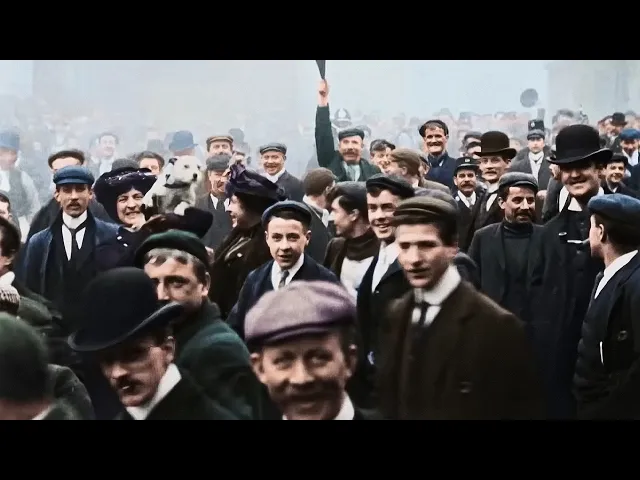
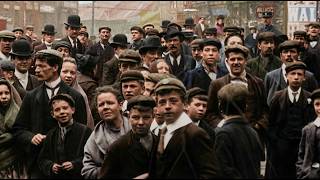
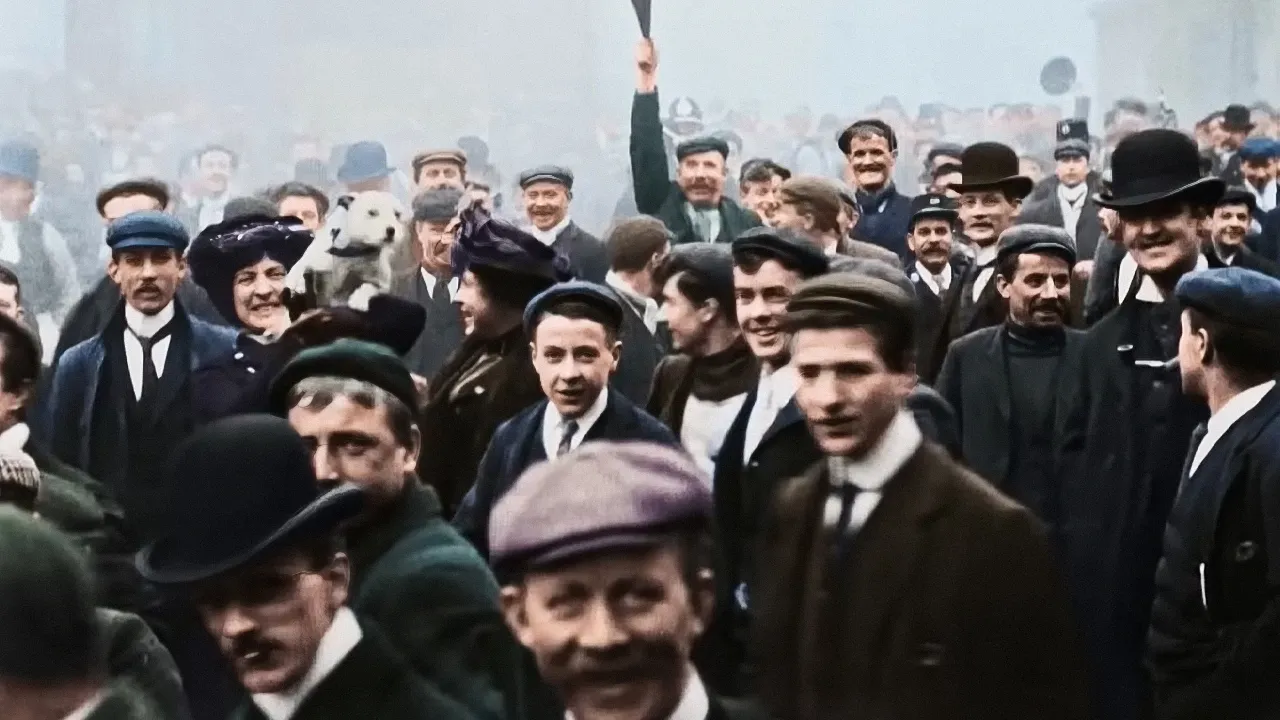
This is Britain in the 1890s, when a thrilling new invention, the motion picture camera, first captures a nation on film. We're seeing this era more or less as the people who lived in it saw it. People were absolutely riveted by moving pictures. Now, the Victorian empire is transformed for the first time into glorious colour. I mean, it just reminds you the Victorian world wasn't black and white. It wasn't Dalai. This world was vibrant. People come alive in colour because you can see the colour of their skin. These pictures show Britain at the height of empire,
as its people were transforming the world. They're looking for opportunity, trying to escape the class-based nature of British society. They capture the triumphs, disasters... And the unveiling of secret desires. This at the time would have been incredibly sensual and incredibly erotic. These films reveal people filled with hopes and aspirations, as well as the enduring wealth divide, with others trapped in a land of homelessness and hunger. There are lots of economic ups and downs in Victoria and Britain, So one minute a trade can be booming and the next it can be in trouble. And they record
the much-loved entertainers whose talents brought light relief into the lives of millions. It is incredible where this footage has lasted and that we can look in a world that has all but disappeared. This is Victorian Britain on film. It's the 22nd of June, 1897, and people from all over Britain are gathered in central London for the greatest celebration of the century. For the first time, filmmakers could capture moving images of a revered but reclusive sovereign as she marked her 60 years on the throne. Queen Victoria's Diamond Jubilee in... 1897 was the great event of the
end of the century. There might have been about 40 cameramen at work during the procession, Hanging off railings, stationed at every corner. People said, be sure that you see it. Future generations will be able to witness this thanks to moving pictures. Amid a crowd of around 3 million people, the filmmakers' hand-cranked cameras captured the Queen in her gilded state carriage. .escorted. By her cavalry. You can see the crowds bustling against the soldiers, wanting to get a sight of her. By 1897, The country is at its height of power, and Victoria, as the figurehead, as the
head of state, really represents this power of the nation. During her reign, Britain's empire became the biggest the world had ever known. Its control over a fifth of the Earth's surface meant that Victoria ruled over a quarter of the world's population. She's not just Queen of the United Kingdom, she is empress of the Great British Empire. It's so symbolic of the influence that Britain wielded at this time and indeed the legacy that it left behind politically, legally, Culturally, linguistically around the world. There we see soldiers of the empire from Bengal and other places in what
was British India. These spectacles are a kind of sanitised representation of what imperialism meant. The empire was built on the blood of soldiers and of the labour of enslaved people. But ordinary people could buy into this. And when they went out to fight and die, they could believe that what they were fighting for was all of this. This is a huge spectacle, a massive, massive pageant. It runs for, I think, Six miles. Perhaps it's from Buckingham Palace to St. Paul's Cathedral. So that's Victoria. She's wearing black, obviously, which is standard, Victoria. She's worn black for
40 years by this point. She was in mourning for her husband, for... A couple of her children, some of her grandchildren. She'd lived to a ripe old age, and so she had buried a lot of people. She's been transformed into this figure we now think of as relatively humorless, tough, and quite elderly. She had arthritis. She was probably in pain as she jolted along in her carriage. In her diary on this day, Queen Victoria wrote that no one had ever been given such a rapturous ovation as she was given. Almost a year to the day
after Queen Victoria's Jubilee, huge crowds gathered again in London to toast another grand display of Britain's imperial prestige and power. Filmmaker E.P. Prestwich joined 30,000 spectators at Blackwall, on the banks of the Thames, to watch the launch of a new giant of the seas, the 13,000-tonne battleship HMS Albion. The crowd was excited and expectant, but that mood was about to change. It's so full of sound and motion, it's amazing. You can see the ship just slicing through the water there and the flags fluttering. This would have marked the epitome of British naval prowess. The Royal
Navy was the fundamental institution that maintained the Empire. A British Empire, Immense in size and very difficult to maintain. A way to do that was with control of the seas. You lose sea power, you lose the Empire. As a state-of-the-art, steam-powered battleship, the Albion was a source of great pride for the Royal Navy and the shipbuilders who made her. Launch days were moments of excitement. And anxiety for everyone involved. Quite a dramatic time launching a ship, because they don't put the engines and everything in until later on when they're fitting out. But it's always useful
to see when they launch that they will in fact float and that you've done the right calculations. Another camera recording events that day belonged to 28-year-old Robert Paul, a man who'd become one of Britain's most talented and prolific filmmakers. He'd hired a motorboat to get closer to the action. We have this film in this form because Paul may have been one of the only early cinematographers to actually have an electric camera. All seems well as the albion slides down the slipway. But soon, a miscalculation does reveal itself, one with deadly consequences. The people launching it
have not really quite taken account of the wave that's going to be created. And the scaffolding, which supported a huge crowd of onlookers, was swept away into the water by a great tidal wave. Robert Paul's camera captures the unfolding havoc as the Albion's wake crashes into the viewing platform and plunges 200 spectators into the Thames. When the disaster unfolded, and the reason we have footage of people shouting, gesticulating, is because... Apparently, the camera was just left running. The guy shooing away, the filmmaker there, as if the camera shouldn't be watching this, and we shouldn't be
watching this. He's filming the aftermath, he's not actually filming the launch. And that caused controversy because it was seen as distasteful. In the middle there, Do you see that? There's a man who's wearing a bowler hat who seems to be blowing bubblegum, which is quite surprising. But it also is a really lovely image of Victorian stoicism that he's helping clear up after a tragedy, and there he is, blowing bubbles, and these men who aren't looking flustered or too emotional, but they're getting on with trying to help with this tragedy that's happened. It is the first
disaster movie, in a way. It's actually shot in the teeth of disaster, right on the spot, simply because the camera happened to be there. The Navy's celebration for this... Great addition to its all-powerful fleet turned instead to horror as 34 men, women and children drowned that day. The Albion disaster remains one of the worst ever tragedies on the Thames, despite the dangers afflicting the shipbuilding industry. The Victorians built vessels that gave Britain pride and joy. Their cameras captured Britain's boarding luxury liners and observed hijinks on the high seas. It's clear there's no women taking part.
I don't think anybody with a big dress would have fitted through these hoops. But they're on the sidelines, cheering them on. With their new motion picture cameras, the Victorians sought to capture life in the greatest cities of the age. Blackburn-based film producers Michelin Kenyon observed the Powerhouse of England, the North. They were drawn to the metropolis on the Mersey that linked the manufacturing industries of Lancashire and Yorkshire to the Empire and beyond. This is the great port city of Liverpool. Which is very dear to me because I grew up in Liverpool as a little girl.
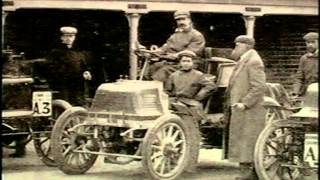
Liverpool was a very prosperous city by now. It had made a lot of money, serious money, from the slave trade going back to the 1700s. And you can see this very grand motor vehicle that's just come out of a garage, that it's well ahead of the times. Just around this time, a law is passed in Parliament... To increase the speed limit from 2 miles per hour to 14 miles per hour. So that was a great excitement for everybody. That they could now do 14 miles per hour legally in their French imported cars. This is fantastic.
This is Holy Corner. Throughout the Victorian period, shopping became a major part of the leisure activity, and these shopping arcades were known as cathedrals of consumption. I mean, the title of the shop, Bunnies, is lovely. Specialists in oriental goods and novelties, perfumes, stationers, I mean, they sell everything. The one thing that really caught my eye was on the top floor there, where you have what looks like teapots. Now, of course, that really resonates with me. Because at the height of the Victorian era, Britain was importing a lot of goods from China, including porcelain and, of
course, teapots. This is a hat shop. Hats are incredibly important for Victorians to signal their status. So it's great to see here, you know, the Reds and the Blues and the greens. And these are quite lively colours that people are wearing. It's very easy to assume Victorians were rather drab and colourless in all sorts of ways. But here we can see, you know, they had a strong sense of fashion and of colour, and they like to look good. Even the dog there, look, has got a coat on. So if you thought that coats for pets
was a silly modern invention, there we go. There's a pug wearing a nice... Woolen coat. The three women that you can see here, Hats that they're wearing absolutely are magnificent, the ermine that they're wearing, they're dressed in absolutely stunning clothes. And they're not black and white, they're engaging in colour, they're wearing things that delight them. Textiles were a vital commodity in the story of Victoria's empire. Raw cotton from America, India and Egypt. Was the biggest import into Liverpool's docks. Much of it sent on for processing in Lancashire's mills. At its peak, an astonishing 40% Of
the world's cargo passed through the Port of Liverpool. Through entry points. Like this one, Alexandra Dock, which opened in 1880. These dock workers would probably have been loading and unloading from the great ships that would come from far and wide. They were part of this... Very important economic cog in a big economic wheel without realizing it, I think. There's a boy there who's clearly trying to sell newspapers without a huge amount of success. 1890s is the beginning of sort of modern tabloid newspaper journalism. The Daily Mail is founded in the 1890s. A few generations before
this, there's no way that working men would have either been able to read or been able to afford to buy a newspaper. As Britain's leading gateway to the Americas, Liverpool also established itself as the main point of departure for some of Britain's biggest transatlantic cruise liners. Each year, companies like Cunard and the White Star Line would transport hundreds of thousands of British travellers, many of them migrants, planning to start new lives in the US. This is one of my favourite films from the period, The Cunard-Lacania going. .on. Its voyage to America. When it actually was
launched in 1893, it was the fastest ship in the Cunard line. And broke the record, The Transatlantic Crossing, which is the blue ribbon Record, which became a massive source of competition between the German and the British shipmakers. At the beginning of the 1800s, to get to America would take about six weeks, maybe seven weeks if you're unlucky with bad winds. By this point in the 1890s, you get to America in six days, and that is an incredible transformation in terms of speed. Huge trunks. It's just incredible when you think of the... Restrictions we have on
luggage today, traveling. But they are packing their lives into these sea chests. It's almost a little microcosm of society on land. In that you have a very clear class distinction and therefore a very different experience of what your journey at sea would be like. This is a story of mobility for the rich and the poor. So you take a liner like this, you might think, Oh, it's very grand. This is the rich, you know? Traveling in style across the Atlantic. But it's just crammed, full of third-class passengers. These people are trying to escape poverty. They're
looking for opportunity. You don't often think of the white English population as an immigrant population. But in fact, that's how America, to a greater extent, became America, because of migration from this country. For many... Emotions swelled at the moment of departure. Excitement, but also fear for the adventure that lay ahead. It probably started off with great elation. Their friends waving them off, but then, as they crossed the harbour bar, they might have felt just a little twinge there as it first went. All seas have got their own characteristics, but the North Atlantic, very heavy swell.
I was seasick in every warship I ever served in. Taking care of the thousand first and second class passengers, As well as a thousand less demanding travellers in steerage, were the Lucania's 400 strong crew. Captains and the senior crew members of these ships, these were figures of great reputation and renown. They were beautifully turned out, and they exuded a kind of feeling of reassurance. And here we see the captain with his great coat. They used to have this phrase, you know, master under God, what the captain said went. And I believe it still does, Really.
Someone has to take charge of the whole situation. There was probably immense trust in them and they were very competent seamen in those days. The crew, of course, more interested in the camera than they are in scrubbing the decks. And this one has escaped from the kitchen for a little while, just to show off the ship's cat. And, of course, all the maids who would have had to service the cabins. Looking very prim and proper here. These women are dressed as maids, but their official title is stewardess. It was one of the only jobs that
women could work at sea. And their role really was to look after the ladies in first and second class. From helping them dress in the morning, tidy up after them, mend one of their dresses, help them find some form of entertainment on board. The Lucania belonged to the illustrious tradition of steamship building that had made Britain the envy of the world. That heritage owed much to the engineering genius Isambard Kingdom, Brunel. In 1843, he created the SS Great Britain, at the time the biggest ship in the world. The Great Britain was the very first iron-hulled,
screw-propelled steamship to ever go to sea, because she was built in the middle of the 19th century. Steam technology was just not advanced enough yet to fully rely on it, so steamships still carried sails, just in case the engine failed or you ran out of coal. Whereas later steamships at the very end of the 19th century, like the Lucania, the technology was there, it had developed at incredible speed, so sails were a thing of the past. My third great-grandfather, A chap called Thomas Trevor, was a ship steward, and he had served in a steward in
this ship. The SS Great Britain. He was paid £3.15 for his six weeks or thereabouts voyage, which was roughly about £550 in today's money. Facing long days at sea, many passengers kill time by exercising a characteristically British fondness for games. This is a wonderful film. I just love the fact that people are trying to... Squeeze through a life belt. They're not all young, by any means. They're being watched by an enthusiastic group of spectators. Because being on a ship for a long voyage was basically very dull. It's clear there's no women taking part. I don't
think anybody with a big dress would have fitted through these hoops. But they're on the sidelines, cheering them on. The great Victorian steamship serviced almost... Every corner of the British Empire. One of the most intrepid of all the Victorian filmmakers... Joseph Rosenthal recorded this scene from a steamship in what was then a small colonial backwater, the tiny island of Singapore. A lot of these young men used to dive for fish, but here they're diving for coins thrown by passengers, possibly even by the filmmaker himself. You are watching boys in Singapore through the eyes of a
Western observer. Looking Down, in both senses, looking down on these native Singaporean boys and filming them as a sort of exotic spectacle. Would they have been perceived as being of a lesser class or a lesser civilisation because they're not clothed fully as the Victorians were? It emphasises the alienation and the exoticism, and this gap. Between us and them. Films that recorded such scenes of life in the empire fascinated people back home. Filmmakers also profited from so-called exotic performances staged in Britain by filming dance spectaculars like this one at London's Crystal Palace in 1898. Increasingly, moving
pictures would soon showcase the greatest stars of the day and feature worldwide celebrities like sharpshooting Annie Oakley. I think she could shoot like a cigarette out of someone's mouth, You know, that kind of level of skill, I mean, terrifying. And some films would even kiss goodbye to long-standing Victorian taboos. This was, I suppose, Victorian porn. By 1900, a new technology added an extra dimension to the viewing experience. For the first time, audiences could hear the voice of the American entertainer Lil Hawthorne. British director Walter Gibbons recorded her performing the song Kitty Mahone, and then synchronised
it with footage captured on the roof of the new London Hippodrome. To produce Britain's oldest surviving sound film. It shows how film became the new way to capture performances by the stars of a much-loved part of British culture, the Music hall. Music Hall is a staple of Victorian entertainment. The acts are very varied. There's singing, there's dancing, there's comedy, there's satire. You'd go along and you'd see 20 or 30 different performers in a night. All sorts of great stars, such as Dan Lino. There was Vesta Tilly, who was a huge international superstar. She did songs
dressed as a man, and she'd come on and sing songs about fancying girls. In 1900, cameras captured a British Music Hall megastar at work during the Paris Exposition. Harry Ralph, better known as Little Titch, was a small man with a mighty talent. Little Titch was born in Kent. He was only four foot six. He had six digits on each of his hands. He was an incredible, great mimic. He could change the contours of his face, and he had that whole clowning ability. And people would literally cry with tears, with laughter. This is his most famous
act, called the Big Boot Dance. He's putting on shoes, which are about 28 inches in length. And he then proceeds to do some very funny sort of walking around, leaning, bending. I mean, up on the tiptoes there, Which it takes incredible control to do that. It was what they used to call leg mania. They used to call it, which was he did lots of stuff with his leg. Well, this is it. It's where he just leans forward and puts the hat on without touching it. Look, brilliant. And he was much more original than just that
routine. He was a good actor. He played all sorts of... Characters in his songs, this is my favourite. He wasn't actually called little Titch, because titch was a common word for being small. It's the other way around. We talk about people being titchy because of him. He was so incredibly popular. It is the power of personality which always wins, always wins. All the great performers had that. Don't wrap all with an organ. Roy Hart has been in show business for over 60 years. He was inspired to tread the boards by his grandmother, Alice, Who taught
him songs from the golden age of Victorian Music hall. But he soon turned his hand to comedy, the discipline that made his name. I always just called myself an actor, but I played comedy all the time, of course. You've got a face like mine, I haven't got much more of a chance of it. Playin' Romeo, however you... The great joy of coming into variety as a sort of unknown was this is where you learn your business. So I learnt to tap dance a bit, learnt to sing a bit, even learnt to dance a bit, Because
what I do in comedy, when I always sing, that is the best way, best way to learn to act, to do anything, is to watch the best. When I actually came into the business, I did work with some of the great old musical turns. We were just about to snuff it, Really. A few of the Victorian Music Hall's funny turns used film in their acts. The comedian and magician Sam Dalton was among the first British performers to amaze audiences by using camera tricks. Film could have magical effects on a performer's career, too. In 1894, the
American inventor Thomas Edison arranged a demonstration of his new movie camera and asked the celebrated sharpshooter Annie Oakley to help. She'd been born kind of into poverty and had learned to shoot as a very young girl in order to support her family, because she would shoot animals and then sell them to a butcher. She's hitting, I think, glass cylinders thrown into the air. I think she could shoot a cigarette out of someone's mouth. That kind of level of skill, I mean, terrifying. Annie Oakley, of course, is the famous Annie-get-your-Gun heroine. People were absolutely fascinated by
her. She became famous by being in a competition with a man called Frank Butler, who was a famous sharpshooter. And when she outshot him, He then fell in love with her, and they were married for 50 years until she died. She was most famous here in Britain for coming over with Buffalo Bill. Who was this huge superstar who came across with a massive Wild West circus involving Native American Indians, horses and all sorts of exciting things from the West. 60,000 people a day flocked to see the Buffalo Bill Wild West Show when it toured Britain
for the first time in 1887. Even then, Annie's exceptional talents earned some very high profile admirers. When Queen Victoria met Annie Oakley, she said to her, You are a clever, clever little girl. And then she would go on private shooting days with members of the aristocracy who were determined to actually outshoot her, But she managed to beat them all. My gran actually saw the show and it was some big open-air thing. But all she ever said, oh, a bleeding noise, she said. They're firing up things. And they had Indians, and apparently it was quite a
show. But it wasn't just highly skilled humans who'd win the popularity stakes on the Victorian Variety circuit. Animal-based novelty acts were adored, and the quirkier they were, the more beloved they'd be. Parachuting monkeys, High-diving horses, and belligerent marsupials featured in the earliest British films, like this one from 1895. God, this is so unethical, isn't it? I mean, it's a child fighting an animal. I mean, by modern standards, people are like, oh, my God. Kangaroos could be trained to box. They needed to have gloves on because they've got sharp claws. Pretty dangerous, actually. A pal of
mine is a great circus man. He said The easiest thing in the world to get a kangaroo to box, because it's a sort of sexual thing. And if you... Punch them on a certain part of their body, they think it's a rival kangaroo. So they turn around and give them one, you know. And that's it. He said, that's all the training they require. It's not a full-blown kangaroo, it's a joey, a young kangaroo. And he's just melting hell for leather out of that poor child. What's interesting about it, I suppose, is that on the first...
Look, you can go, okay, Well, it's a kangaroo fighting a human. That's just a funny thing. But there is also, slightly underpinning it, an understanding of the animal kingdom and the human world. Being more closely linked than we would have thought, by the 1890s, Darwin's theory of evolution has been widely accepted. So the idea of humans having descended from apes, having come from the animal world, actually is relatively accepted. And also that there are things that animals do that we do and that we're not so different from each other. Groundbreaking works by Victorian scientists like
Charles Darwin increased public interest in the structure of animal and human bodies. It was a timely moment for one German showman to teach British men how to sculpt the body beautiful. This extraordinary figure, your classic Victorian strongman, Eugene Sandow, bodybuilder, one of the first of his kind. And this is really to do with the whole kind of Victorian cult of the body and cult of physicality. He had completely mastered his body from a young age. He had developed his muscles through constant exercise and repetition. He could lift incredible amounts of weights. I mean, one of
his tricks was he'd put a grand piano on his back and have musicians on top of it playing, and he'd walk around the stage carrying it. And he became a star because he offered people self-betterment. In 1897, Sandow opened his own gymnasium in London. Patented his own brand of dumbbells, and published a fitness magazine promoting his regime. Recommending cold baths and eating raw eggs, he also sold protein-powdered drinks, and he founded the first major bodybuilding contest at the Royal Albert Hall in 1901. But much of Sandow's philosophy was based on some of the most misguided
and dangerous theories of the time. He was a eugenicist. His name was Eugen. Clues in the name. He argued the white race was superior, that he could make Britain stronger and healthier, and more virile and more macho and better soldiers. It's about fitness, not just being physically fit, but being also racially fit and ethnically fit as well. And it connects with the Eugenic movement of the time. So, although it's about health and strength and vigour and physique, it's also about contrasting that with... More inferior bodies. So there's a sinister side to this, too, I'd say.
While Victorian men were allowed to show some skin in public, ladies were expected to remain firmly covered up. Yet some early filmmakers did persuade a few brave women to break the taboo and peel off for their cameras. In 1896, Brighton-based Esme Collings produced A Woman Undressing. Which is now considered Britain's first ever erotic film. In today's standards, there's nothing sensual about this performance. It's how you can imagine her taking her clothes off to go to bed at the end of the day. How many layers she's wearing. Everything from the corset to the underskirts. No wonder
it was quite titillating to see that all being removed, because there's a lot of it to take away. Of course, the Victorians were very puritanical in the way they thought or behaved. The church had a much greater role in those days. But I think when you're repressed in such a big way, you have to give vent to your desires. So this was, I suppose, Victorian porn. This lady undressing would not have been shown in the musical. Would probably have been shown at what was called a smoker, because you could smoke. It was a kind of
euphemism for a male-only entertainment. The idea, of course, is that this is sort of voyeurism, that we are peeking into her private boudoir. I like the fact also she only has one sock on at the end. I don't know if that's super sexy, you know, just one ankle out. You don't want to overload them with two ankles, too much. These films, to me, highlight one of the biggest misconceptions of the Victorian era. We've always been taught the Victorians have this very stiff upper lip that's showing the ankle isn't absolutely abominable. But actually, it's the Victorians
who first really define what sexuality is. They study it, they find it really intriguing. The theme of repressed Victorian sexual desire was also explored in Britain's earliest film dramas. From their base at home, Firth in Yorkshire, the company Bamforth & Co. produced the 1899 film The Kiss in the Tunnel, Telling the story of a passionate encounter on a train passing through the Pennines. This is a really important moment in the history of filmmaking because it's a step towards editing. Train enters tunnel, cut to interior of the carriage, with a couple, kissing, fondling, and then train
leaving. So we've got a complete kind of dramatic situation. This is what people can get up to in the dark, in the tunnel. Of course, this has now become a classic, hasn't it? The train going into the tunnel. What would happen in the dark of the tunnel? That's actually quite shocking. I don't think you would see many images of... Kissing on screen at that point. This film I find incredible because it, to me, encapsulates all the newness of the Victorian era. You can see the woman sort of being quite shy at first. She's covering her
face with a newspaper. She's acting demure. And then this moment, this kiss, This at the time would have been incredibly sensual and incredibly erotic. What you actually get is... One of the first kisses on screen in the United Kingdom. I thought it was going to be one of those classic kind of kisses, but actually, they are really going for it. That's a Yorkshire lad and lass from Helmfurth having their bit of stardom on the big screen. Attitudes to sex were changing, and across Victorian Britain, so was almost everything else. Filmmakers reflected the nation's anxieties about
rising crime. The Victorians had, of course, An enormous fear of crime. They're both fascinated by it and they're terrified of it. And the menace hidden in grime. The reason I think the Victorians are obsessed with hygiene, cleanliness, is because the alternative is infectious disease and early death. And while soap makers were cleaning up, the dirty world of Victorian advertising still saw things in black and white. Throughout the 19th century, city streets heaved with people, traffic and invariably, foul smells. Everywhere, the stench of coal, fires and factories and horse droppings, mingled with the odour of a
largely unwashed population. But affluent Victorians believed that cleanliness was next to godliness. So for those in the soap business, it was boom time. This is one of the great early advertising films that survive. This is Vinolia soap, one of the great commercial successes of the Victorian era. And here we're seeing an army of women marching off, carrying Vinolia soap to the grimy masses. In the 19th century, you get germ theory. It's a discovery that germs exist, and that's how disease spreads. Once hygiene comes in as an idea, people start buying soap in larger and larger
quantities. The Victorians had only just started to have plumbing, so the idea of washing, of soap, of hygiene in the home is something that Victorians, particularly the middle classes, are starting to embrace in great numbers. To market their products, soap manufacturers often drew upon disconcerting stereotypes that revealed the stigmas of the age. Very often, the way that it was advertised, And there's some extremely unfortunate and to our eyes, unpleasant adverts which show a little black boy or little black girl being given soap to clean themselves up. So there's this contrast between black and white and
the idea that if you use soap, then you can clean yourself. And Vinolia, as well as Pears Soap, had these adverts, like contrasting a little white child with a little black child, saying, use our soap. For Britain's middle class, life was on the up, but the desperate plight of the urban poor was almost impossible to ignore. Among the charities and philanthropists helping those in need was Nottingham-born methodist, preacher and founder of the Salvation Army, William Booth. He used the new medium of film to promote his ideas. His film crew followed him on his speaking tours
across Britain. I love the fact that he's just like holding the crowd and getting out to where people are. That's a big crowd, Isn't it? There's no shoes on some of these children as well. It just brings back the reality of what they were really dealing with. William Booth thought all the social problems of the world could be solved by knowing that you were valuable and that you were loved. And they went to the outcasts. They went to the gamblers, the drunks, and they went to the prostitutes. Basically, the people that the rest of society
wouldn't touch. Booth's Salvation Army served breakfast to children of the destitute, provided shelter for the homeless, And in 1891, he launched a campaign to improve the dangerous conditions endured by young factory workers in one of Britain's most important industries. There had already been a lot of noise in the press about... The conditions of working for young women, and particularly in the match factories, they used phosphorus to make the matches. And that caused something called fossy jaw for these women, where it literally would eat away at their faces. It was a horrific way to die. And
rather than just looking at it and saying, oh, isn't that sad, he said, let's do something. He built a factory, he employed those same women, and they had safe working conditions, time off, appropriate pay, and safe matches. Marketed under the name Lights in Darkest England, Booth's matches were cheaper than rival brands, so he helped put unsafe match factories out of business. And with it, the use of phosphorus. Victorian street life was a great source of inspiration for storytellers, and nothing stirred the public more than crime. Notorious criminals dominated news headlines and fascinated best-selling novelists, like
Arthur Conan Doyle. Early filmmakers also realised that crime really could pay. In 1895, American-born inventor and director Burt Akers produced Arrest of A Pickpocket, a work that's now considered to be Britain's first ever film drama. This is extraordinary, this footage. I mean, look. Two men wrestling him to the ground. Early example of police brutality, Perhaps. The Victorians had, of course, an enormous fear of crime. They're both fascinated by it, and they're terrified of it. The exploits of notorious felons whose crimes haunted the public imagination continued to inspire filmmakers for years after Queen Victoria passed away.
In 1905, director William Hager dramatized the astonishing crime spree of Charles Peace. The most infamous fugitive of the Victorian age. I first came upon Charles Peace when I was researching my own novel, The House of Silk, Which is a Sherlock Holmes novel, And actually, Charles Peace does have a distinction of being one of the very few real people who turn up in a Sherlock Holmes novel, Because he was probably the most famous criminal of his time. The story of Charlie Peace is this incredible double life he led. Bye, Day. He was a prosperous businessman who
played the violin. By night, he was a notorious cat burglar. Every image of him looks different because he was a master of disguise. He was like the world gurning champion. He could twist his face. He actually looks quite a repulsive individual, but apparently he was irresistible to women. Made in 1905, when Charles Peace was still a household name, the film depicts him entertaining his neighbours, Mr and Mrs Dyson. But soon... Passions are inflamed after he expresses his love for the lady. Oh, he's found him with his wife, not happy about that at all, an altercation
stuff. It's always threatening revenge, and here it comes. Why is it within Victorian melodrama, when anything bad happens, the woman always puts her hands up to their cheeks and does that? It's rather sweet. And there he is, killed. Later, policemen catch Pete during a burglary, when he shows just how far he'd go to evade justice. But then, If it couldn't even get any better as a narrative, he escapes from the police. And then he gets chased through the countryside and gets re-arrested. And on the night before he is going to be executed, he confesses to
the murder of the constable. And a poor young Irishman had been framed for it. Peace was a murderer and a renegade, yet, strangely, he acquired a cult status in parts of Victorian society. There's some element of sympathy for him and some element of admiration. He was injured as a young man in an industrial accident and then turned to a life of crime and sort of outwitted the police. Ultimately, people didn't approve of criminals who murdered policemen, and so people were also pleased to see him get his comeuppance. This film of Charles Peace ends with the
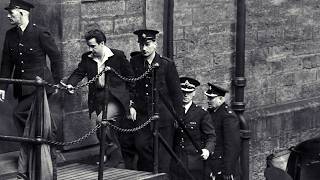
fate he faced in real life, an appointment with a hangman at Armley Jail in Leeds in 1879. I can't believe that we just saw the man drop into the scaffold. Would they even allow us to show that these days? I mean, drop into the trapdoor from the scaffold. Extraordinary. And I can imagine, gosh, how the Victorians would have enjoyed watching this. For years after his death, the legend of Charles Peace lingered on. I just cannot believe the media obsession with Charlie Peace. There was a huge tableau in Madame Tussauds until the 1950s. So, well before
Jack the Ripper... The most famous criminal of the late Victorian period was this gentleman from Sheffield, Charlie Pace. While crime continued to fascinate, the obsessions of Victorian filmmakers ranged from childhood play... That's like a flying headbutt. .to. The sporting passions that put Britain leagues ahead. 100,000 people would come to watch a rugby match. If you weren't there, you didn't see it. And captured the work of a new emergency service that was setting city streets alight. Horstron Fire Engines Turning out were one of the spectacles that animated the Victorian street. They really brought it to life.
In 1898, London-based filmmaker Charles Goodwin Norton... Aimed his lens on these energetic children, recording their every move for posterity. Street entertainment was a great feature of Victorian life. Here we've got a little troupe of dancers who are very well rehearsed. The children are gathering round the barrel organ at the back. You can see him winding it up. This is the equivalent of carrying your speakers out and putting them on the street and everyone having a dance. There's so much joy, There's so much fun. It shows that children will always be children, no matter what. Time
and place you put them in. We all know that childhood mortality was really terrible in the 19th century. About a quarter of all deaths were of babies in 1900. About 50 times higher than it would be today. And that's one of the things I have in mind when I'm watching a film like this. It kind of makes it all the more poignant that these boys and girls, these are the ones who have survived and stayed healthy and are able to dance in the street. Without realising, Victorian filmmakers were documenting the shifting face of childhood. Changes
in the law now entitled children to protection from exploitative employers and to free elementary schooling. In 1901, Mitchell and Kenyon cameras captured some of the earliest moving images showing the excitement of the young students of York Road School in Leeds. They're so small. See, all these children are so well dressed. You can see the flags with the union jack on. Another sign of even the children are taught to be proud of their nation. Obviously, it's a special occasion for them. There's a camera there. They've been told this very exciting thing is happening, the film's being
made. And you just imagine how exciting it was for them. One thing that really impressed me was how very well disciplined, very orderly they are, marching alongside their teachers. Just there is a boy wearing a pair of glasses, which the camera doesn't deal with very well. The lights reflecting off them. These children would not be well off, and pair of glasses would not be all that cheap. So I'm thinking that boy probably has got quite a serious problem with his eyes. It was Victorian teachers who first introduced physical education into British schools. But from time
immemorial, children have always devised their own ways of expending their excess energies. This is a very complicated game of leapfrog. I've never seen anything quite so developed. Wow, hang on. It's like a flying headbutt. This is kids being kids, but it's actually, it's really fun. It's like, organised fun. They know what they're trying to achieve here and they're having several goes at it and it's not quite working. The last kid's going to jump on. There he is. Oh, no, they've collapsed. All right, try again. Children are good subjects for filming because they move fast, they
rough and tumble, they jump around, and what early filmmakers want is movement, action, activity. They're also popular. People like seeing children on screen. Maybe they like it because they're better behaved than in reality. There you have it, you know, kids learning, kids playing. This is what childhood should be. For the Victorians, it's not about work, not about being exploited, not about getting old before your years, not about being precocious. It's an idealised view of children. The introduction of PE into schools would boost the development of Britain's favourite team sports. By establishing rules and creating new
competitions, the Victorians shaped the modern sporting world. Mitchell and Kenyon sent their cameras to Yorkshire to observe the players and fans' passion for the new breakaway sport, rugby league. When filming is introduced into sporting events, this tradition of the home team coming out first actually starts, we think, with the camera. So this is Dewsbury, And now we get Manningham. Manningham in the hoops and the dark shorts. This is fantastic footage. It shows that in their time, these people are heroes. 100,000 people would come to watch a rugby match because there isn't live TV. If you
weren't there, you didn't see it in the 19th and the early 20th century. There wasn't a concept of weekend in the way in which we now have. But these sorts of sporting activities were the beginning of that weekend, certainly because people absconded. So they just didn't go to work because they wanted to see the game. You can tell by the uniforms, it's totally different to what I used to wear. That's a certainty. No shoulder pads are noticed. Long shorts, dark socks. The guy with his shirt ripped off his back. But the movement's good. They've moved
the move in the ball, everybody chasing about. Defensively, It's different. Or now the guy with the torn shirts. Showing his body off and changing his shirt. Good physique, no fat on him. But they do look young. I said I would have looked young when I started, I was only 17. For four decades, Nigel Stevenson played for some of rugby league's finest sides, including 13 years at Dewsbury, where he was a key player in their First division championship winning side in 1973. We were the best team in British rugby league in 1973, so without a doubt,
lifting that trophy. And then coming back to Dewsbury and being met in the town by a must-have-been 10,000 people, it was magnificent. I'll never forget that moment. For many Northerners, the local rugby team is part and parcel of their town's identity. This area, the Heavy-wooling district, was renowned for its rugby league players, from the Dewsbury, Batley, Huddersfield. Castleford, Wakefield areas. I think it's great, the tradition of our sport is all that way back. I hope the tradition keeps going another 120 years. Mitchell and Kenyon specialised in films capturing local life, and across the very same
town, they found another great subject. Nothing was perhaps more exciting than the fast and dangerous work of the... Dewsbury firefighters. As few people had telephones, the brigade was alerted to fires by the ringing of the town hall bell. Horstron Fire Engines Turning out were one of the spectacles that animated the Victorian street, And people did turn out to see them. You can tell it's cold. People have put on their best clothes. You can see the wonderful hats and scarves. It's worth remembering that fires were very common in Victorian times. Illumination was... Mostly naked flames, and,
of course, most buildings were absolute tinderboxes. Firemen have become really popular figures in Victorian Britain. In the late 19th century, Dewsbury Fire Brigade was mostly volunteers. They joined local policemen to respond to fires. Today's 44-strong brigade is made up of trained professionals who respond to an average of over 1,000 call-outs each year. They recognise the challenges their predecessors faced when tackling similar emergencies. RTC, two vendors involved, persons trapped. I can't imagine driving that. I'd love to see you driving a horse. Yeah. Just standing out. Immaculate the look as well and the turnout. I don't think
they've got much protection, though. No boots, no leggings, no gloves. What was that, a control wear? I suppose the principles of firefighting are still the same. Put the water on, the fire goes out. In Victorian times, the noise and excitement of the fire brigade would attract everyone in the neighbourhood, even the local pets. Poor dog looks like he's going to get run over in a moment. This footage is not only people's fascination with the fire brigade, but also people's fascination with the camera. What this film, really, in colour, actually brings to life, the energy and
power of the fire brigade, the children running in the streets, and the Victorians lived in the streets. They played in the streets, they worked in the streets. And they celebrated in the streets. The street was an extension of their front room. If we attend an incident, nowadays, we still get a lot of people watching on. It's a different context because social media has taken over so much now. We might go to an incident and there might only be 10 or 20 people watching, But then within 5, 10 minutes it'll be on Facebook or it'll be
on Instagram and then... I think the whole of Jews were probably still watching, but just in a different way. Soon... Mitchell and Kenyon would switch from filming firefighters close to home to depicting British fighters under fire, far away. There was a real public appetite to get some sense of what life was like for our soldiers out there. People knew it was tough. The Boer War showed really the vulnerability of empire. It was a wake-up call for Victorian Britain. As Victoria's long reign was drawing to a close, Britain's power still reached across the globe. But there
were signs of unrest in some important parts of her empire. In 1899, settlers of Dutch descent, known as Boers, were again challenging British control of South Africa's lucrative mineral reserves and fertile lands. An army of almost half a million British and colonial troops was sent to quash an uprising by determined rebels who were armed with modern rifles and artillery. For the first time, filmmakers were able to present to a fascinated public moving pictures of Britain's forces at war. They followed Aberdeen's Gordon Highlanders on the march at the township of Ladysmith in the Natal. Remember, the
people watching these films would have had husbands. Brothers, sons, serving out in the cape. And there was a real public appetite to get some sense of what life was like for our soldiers out there. People knew it was tough. These guys have been in the field for weeks at a time, they look tired, they've lost lots of weight and they do look a bit scruffy. And there's Captain Mickledron, VC, with his one arm just beside the mounted officer there. He was severely wounded at the battle of the Lanselot Gat. Just prior to the siege of
Ladysmith, he went back to Ladysmith, where they tried to treat his wounds, and then the siege began. Move his arm there, so this is obviously him. He won the Victoria Cross, Britain's highest award for bravery. I've never seen any Victorian-era film colourised, and it really does completely bring it to life. You can almost hear it, and you take note of everything much better. But filmmakers soon resorted to different tactics when they couldn't access the front lines of the conflict, which forced many to film elaborate reconstructions of the action. Often far away from the Cape. It's
a propaganda war. It's a media war. And what we're seeing here is reconstructions. And the reason for this, obviously, is that it's too dangerous to actually film real footage. You'd have to be very, very brave to stand there, cranking your camera as people are shooting around you. This film, Called The Dispatch Bearer, is one of Britain's first ever action dramas. Its depictions of Boer war combat might have convinced some... Even though it was shot in the Yellow Hills area of Blackburn. Why not stage your own? Why not get a few local amateur actors out, a
few uniforms and a smoke bomb or two, and you can stage the kind of action which the audience is keen to see? The actors are playing dead very convincingly. They've got guns in their hands and the smoke goes off when they shoot, so maybe, yeah, Maybe a lot of people would have been taken in by this. They look so staged, so overly dramatic. The British soldiers do not look like British soldiers of the period. They've got sort of outdated weapons. They almost look slapstick here. We try and make it a bit more accurate than this.
Toby Braley is involved in creating historical re-enactments of the everyday life of British soldiers stationed in South Africa during the Boer War. We just felt that the second Anglo-Boer war is kind of forgotten nowadays from the public memory. We don't tend to do the battle reenactments and fake deaths. We pitch tents, as we'll live like they do, We eat like they do. We drill and parade as they do. Oh, oh, shot! Oh, oh, light it! We'll do field manoeuvres, So when they're in battle, how they would have gone to meet the enemy. Try and get
the best experience that we can for ourselves and for the public and the people that come and see us. Britain finally defeated the Boers in 1902. But victory came at great cost to the country's reputation. The Boer War also has a terrible... Place in British history in that. It was where concentration camps were first used by Lord Kitchener, by the British forces, And over 20,000 Boer women and children died in those concentration camps of malnutrition and disease. The era of imperial conquest was definitely over, and I think what we're seeing in the South African war
is Britain holding its own. But with more difficulty than might have been expected. Queen Victoria had seen the empire expand. Now it would begin to contract. On New Year's Day, 1901, the Australian Commonwealth was inaugurated, after Britain granted it the right to self-rule. In time, many others would follow. On the 22nd of January, Queen Victoria died aged 81. She had reigned for 63 years and seven months, longer than any British monarch before her. Just as they had four years earlier, at her jubilee, film crews were there to capture Victoria's final journey. It was a massive,
universal mourning. It was the death of the mother of the empire. Queen Victoria was dead. All these... Generals and military types looking very pompous, but perhaps not wanting to realise that this is the end of it all and that they have to face reality. And things are going to change. At this moment, the empire is very, very much in people's minds as a huge part of what it means to be British, and this ceremony, purple and white drapes over the coffin, the soldiers, the horses... The gun carriages absolutely embodies that. And there we see the
next king of England riding along behind his mother's coffin. You see her son, Edward VII, there in the middle. He represents something entirely different. He's going to become king and the whole country is about to change once more with the First World War. And after that, nothing will ever be the same again. What we've got here in Victorian film is really time travel. It's the first era that is captured on film. We've seen sex, we've seen crime, we've seen death, We've seen this sort of celebration of life. They felt the same as we did, and
they really embraced the highs and the lows and the pleasure, pain, happiness of life. It's still funny watching little Titch running around in his big shoes, putting his hat on, still makes me chuckle. So there are things about this that connect across the decades and... Remind us of the sort of common humanity. To see it like that in colour is pretty breathtaking. It just adds a whole incredible emotional dimension to trying to understand these people. As they look out at us, peering into the camera, Quite extraordinary contraption, and we peer back at them. By making
it colour, it makes it seem modern, relatable, more accessible, so it can provide context and clarity. To historical moments. And the thing about colour, it just narrows the gap between us and a world that we think we've lost. It is incredible. We can sit here today and look in a world that has all but disappeared. Here it is, on the screen. It gives me a sense of a timeline to which we all still belong.