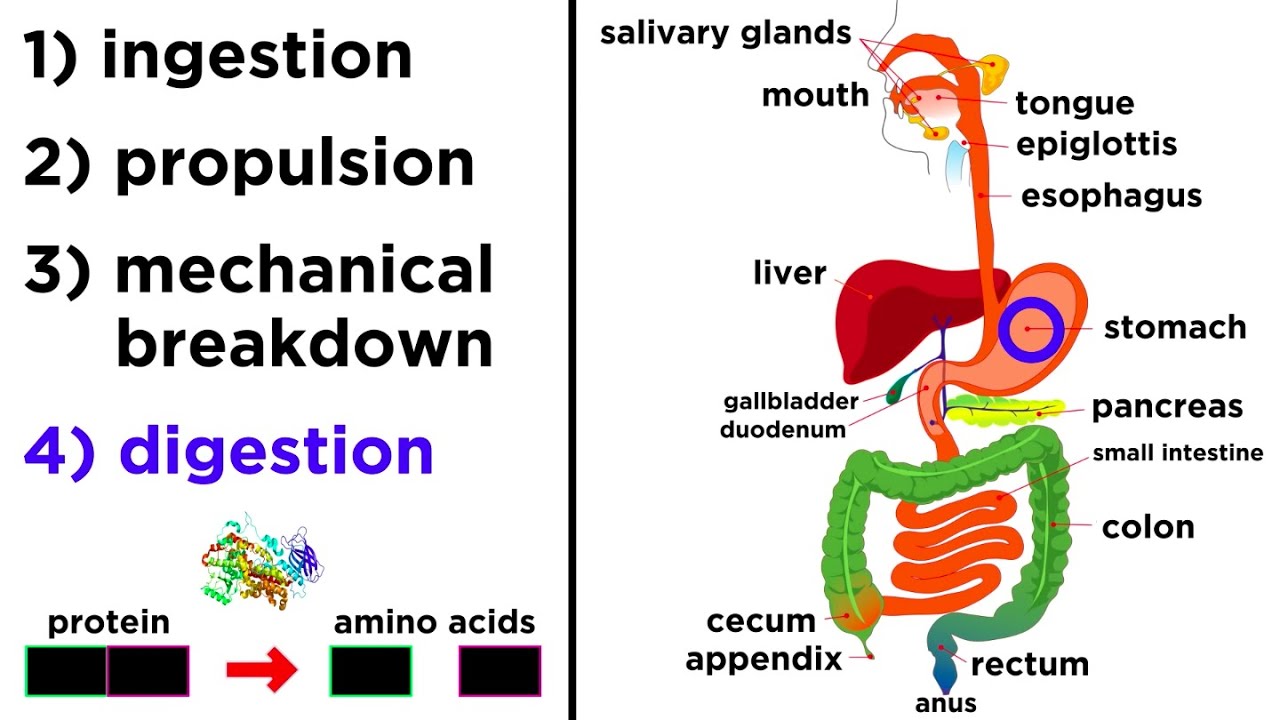
hello and welcome to the review of chapter 64 of guyton and hall's medical physiology textbook in this chapter we go over how food goes from your mouth and it goes all the way through the intestinal tract if you enjoyed the chapter please don't forget to give it a like and subscribe to the channel so to begin with we'll start off with some simple definitions so hunger is simply the desire for food whereas appetite is the type of food that the person is preferentially going to seek mastication is just chewing so the act of actually chewing
your food and sizes provide a cutting action due to their shape and molars provide more of that grinding action and the muscles of chewing and mainly innervated by the fifth cranial nerve and what happens is that essentially the presence of food within your mouth results in the inhibition of the muscles of mastication so then the lower drawer drops as soon as your jaw drops you initiate a stretch reflex to then have a rebound contraction so then you then actually chew down on the food the chewing down of the food pushes the food against the mouth
and once again inhibits the jaw muscles so then your drawer drops again and so forth and the process repeats until you grind down your food to be small enough to be swallowed swallowed is just the glutitian and involves three main phases the first phase is voluntary and that initiates the swallowing reflex and just essentially is the pushing of your food bolus into the back of your mouth the second phase is where the involuntary phase starts and that's the pharyngeal phase and that's just the passage of food from your pharynx into your esophagus and then lastly
your third phase is the esophageal phase once again involuntary as food passes from the pharynx down the esophagus into the stomach so your voluntary phase is just initiated by you when you actually want to swallow and that's when you squeeze your food backwards in your mouth into the pharynx once it reaches the pharynx there's a series of actions all being sensed by both the trigeminal nerve and also your glossopharyngeal nerve resulting in reflexes through your brain stem and the swallowing center to then innervate the various muscles to cause the various actions here such as pulling
up your soft palate so the food doesn't go up into your nose pulling your palatopharyngeal folds medially creating a slit so then only food that has been chewed or masticated enough is able to actually pass through it so then you're not trying to swallow a large solid item the larynx is pulled up in anteriorly which then it puts the epiglottis over it to then cover over the airway so you don't aspirate your food due to that movement you also enlarge and open the esophagus opening up the upper esophageal sphincter so then food content into the
esophagus which is usually closed so then you don't actually have air going into it and then the entire muscular wall of the pharynx contracts so then a bolus is able to travel down through your pharynx and into your esophagus this is all sensed by your trigeminal and glossopharyngeal nerves going through your medulla oblongata and then eventually the motor nerves involve the 5th 19th and 12th cranial nerves in the pharyngeal phase in the esophageal phase it's mainly just the glossopharyngeal and your vagus nerve and the proximal portion and then just your vagus nerve and the distal
portion and once again also the divide in the musculature in your esophagus proximally is striated muscle and then distally is smooth muscle and we have two primary movements of getting that bolus down the esophagus you've got primary peristalsis which is just a continuation of the pharyngeal contraction pushing the bolus down into your stomach and then secondary peristalsis which is any residual food left in your esophagus then stimulates further contraction through a reflex arc through the myenteric plexus of the actual esophagus itself so then you're able to result in another contraction to push the residual into
your stomach the lower esophageal sphincter is present so then you don't have reflux of stomach contents into your esophagus but that will open and be receptive to any food passing through it as soon as food is traveling down your esophagus an issue with the relaxation of that lower esophageal sphincter is called achlasia now next up we get to the motor functions of the stomach so the stomach has several rolls here one that stores large quantities of food so you're able to eat enough at one time store it and then eventually digest it and then mixes
the food with the gastric secretions to create a semi-fluid mixture called chyme and then it lastly slowly empties the chime into the duodenum or the small intestine at a rate that allows the small intestine to absorb the material and further digest the material for absorption so the anatomy of the stomach is outlined here we have the cardia the fundus the body the antrum and then the pylorus at the end here now when food enters there's this vasovagal reflex where distention of the stomach results in a reflex to then relax the stomach so it can accept
a larger quantity and then the stomach gets the function to one produce its digestive juices which we'll cover in much more detail in the next chapter but then also have these peristaltic moves or these constrictor waves or mixing waves because of this remember that basic electrical rhythm there's slow waves resulting in continual contraction mixing the food and the stomach so then there is a continual contraction that pushes the food through the stomach resulting in a higher higher pressure in the pylorus and creating a nice semi-fluid chyme like fluid that is then allowed to pass through
the pylorus if you have nothing in your stomach then you can get hunger contractions which is just a rhythmic peristaltic contraction which is more intense when you're younger and healthier with normal gastrointestinal tonus and also when you have a lower blood sugar if that hunger goes on for longer say 12 24 hours you get mild pain called hunger pangs now once this kind has actually reached the pylorus about 20 of the time the stomach will do a certain peristaltic action where around about the mid body a very strong contraction occurs it pushes all the way
into the pylorus and pushes against this region resulting in what's called the pyloric pump trying to push any material through this thickened region of the pylorus which is quite muscular which gives it the name of a pyloric sphincter so then this pyloric pumps out able to squeeze through any material that has been adequately mixed and turned into climb and then anything that actually goes through is called stomach emptying the regulation of stomach empty is kind of two-part one there is a role of the stomach that whenever there is greater distension there is greater emptying or
through either neurological signals or hormonal signals such as gastrin released from g cells of the antral mucosa that increases the acidity and also helps to promote emptying we'll get to this in more details in the next chapter as i mentioned all the hormones we'll get to in more detail in the next chapter or the greater effect on stomach emptying is actually duodenal factors so the duodenum the next part of the small intestine will actually be able to inhibit gastric emptying if there is too much material so there's too much distension there's an irritant in the
duodenum or there's too much acidity so the duodenum hasn't been able to neutralize the acid or the osmolality of the time is too high or too low so then we don't get dramatic electrolyte imbalances so the duodenum is really accepting the material from the stomach and then saying nope that's enough we need to digest this we need to get rid of this we need to regulate this a little bit more or we need to neutralize it more before we accept more gastric contents and it does this mainly through a hormonal mechanism and once again we'll
get this in the next chapter but the big role is cck on cholecystokinin which really senses excessive fat in the duodenum and inhibits the emptying of the stomach because fats take a little bit longer to digest and absorb so next up is movements of the small intestine and the small intestine is really just a big tube that passes the semi-fluid liquid through it and there's two actions mixing contractions and propulsive contractions which really the difference between them is pretty slight but i suppose the roll is slightly different mixing contractions also known as segmental contractions is
depicted up here in figure 64 3 where basically the material is just chopped in half through just one contracted segment so as you can see if there's material through here and there's a contraction you just chop it in half and it's not really moving anywhere you're just moving and chopping up all the material in the small intestine and then the next movement is propulsive movements which is our peristaltic wave so that's a mix of your circular muscles and the longitudinal muscles circular muscles contracting proximally and then kind of moving in the abort direction while the
longitudinal muscles are contracting abort to it to help squeeze that material forward and then there is also reciprocal dilation distally so essentially you're squeezing that material through the intestine like i mentioned in that previous chapter like emptying out the toothpaste packet you're just squeezing the material forward and that can be initiated or enhanced after eating a meal from stretch of the duodenal wall all through various hormones like gastrin cck insulin modal and serotonin they just help to propel it all forward help these movements we do have something called a peristaltic rush and that's when we
have intense irritation of the intestinal mucosa so let's say an infection and then that results in just a very powerful rapid peristalsis that goes through the entire intestinal tract whereas normal peristaltic movements is just a few little centimeters this is the entire track just trying to quickly get rid of whatever's in the intestine because it's irritating to the intestine and that can result in diarrhea because of that rapid movement and poor absorption of material now there are also movements of the muscularis mucosa so that's actually within the villi themselves and these movements just help serve
almost milk material into the lacteals and health absorption just to increase the interaction between the intestinal contents and the surface of the epithelium now the last portion of the small intestine is the ileocecal valve and that prevents backflow from the colon into the small intestine and that's just another sphincter essentially and there's kind of two components to it there's a valve which is protruding into the cecum so if the cecum's dilated or full of material it's going to push this valve closed so that you don't have any movement backwards and then the electrical sphincter which
is a smooth muscle just keeping that closed now that will be constricted and contracted in addition to the inhibition of any peristalsis and ilium if there's any irritants in the cecum of the cecum's enlarged now the last portion of the elementary tract here is the colon the colon has two functions one absorption of water and electrolytes which occurs proximally also known as the absorptive colon and then two the storage of fecal material until it can be expelled also known as the storage colon the second half of the colon now the movements in the colon are
usually very sluggish it takes several you know eight to ten hours for things to move through it and the reason behind that is one we get these very slow mixing movements that very slowly propels material for than the proximal coil one resulting in what's called a hydration which is basically just these circular muscles constricting on these longitudinal strips called this tiny e coli and it causes this bulging of the large intestine which is the illustrations so this bulging helps to kind of turn over all the material on there expose all the material to the epithelium
so then the colon lining is able to actually absorb as much water and nutrients as possible so because of that slow movement there is this very slow movement of material all the way through the proximal colon and then trying to get out into the distal colon we can have some propulsive movements however which are called mass movements that only occur once or twice in a day just for 15 or so minutes usually after eating a meal like breakfast where you just have this sudden massive contraction peristaltic movement of the entire large intestine to propel the
material into the rectum now a propulsion of the usually semi-solid material onto the rectum then stimulates the defecation reflex it will get to very shortly now these mass movements occur and initiated because of the gastrocolic endurance reflexes so distension of the stomach results in a neurological reflex to cause mass movements and get material moving in this large intestine now once fecal material actually gets proposed past the sigmoid flexure into the rectum it then stimulates the defecation reflex now material gets propelled from the large intestine around the sigmoid flexure into the rectum where it's temporarily stored
until it's expelled it doesn't get expelled immediately because we have two sphincters there the internal anal sphincter and the external anal sphincter the internal was under involuntary control whereas the external is voluntary control and is actually striated muscle so any movement mass movement of material until the rectum will actually propagate the tif defecation reflex through both myoenteric reflexes which is initially weak to relax the internal anal sphincter but you will not defecate unless you have voluntary conscious control through the potential nerve to relax the external angle sphincter now there's also a stronger component to this
reflex instead of just the myenteric reflex of the large intestine there's also the parasympathetic defecation reflex which involves the sacral segments and the pelvic nerves that really intensifies this peristaltic action so then you're able to really expel the material if you need to dedicate at that time and in this focus 64 6 really gives us that mechanism so we have the parasympathetic nerve supplies through the pelvic nerves that helps to stimulate peristalsis and then we have the skeletal muscle nerve to the external anal sphincter then that helps defecation to occur now newborn babies they don't
have voluntary control of the external or sphincter so they just defecate at inconvenient times now this reflex can also be inhibited by some other minor reflexes that occur in very specific situations like the peritoneal intestinal reflex if there's any irritation of the peritoneum such as peritonitis or the renal intestinal invisible physical intestinal reflex which is an irritation of the kidney and bladder can also inhibit that reflex but otherwise you're able to control defecation and actually initiate defecation yourself if you're able to hold your breath contracting your abdominal muscles increase the pressure propel fecal material into
the rectum and then initiate that entire reflex arc itself and with that that's the end of the chapter i hope you enjoyed it if you want to support the channel and get access to downloadable audio files please check out the patreon link in the description otherwise feel free to drop a comment and we'll see in the next video