Uh you seem to be very wellversed with multiple technologies. Uh I think you said UI, SQL, Java, Python. Uh which one interests you more?
Um like my f personal favorite is C from which I actually started. That is where I got interested into programming and that is what made me understand the basics and how exactly the programming works, how exactly you build the logic, how internally everything works. So that is my first step in this particular field.
So that is my favorite and I have worked on the other technologies also like for development of my projects and all. So back backend fronted as well as the processing. Okay.
Uh are you familiar with SQL? Yes, I have worked on it for my academic projects. Okay.
Like uh could you tell me like what is the difference between a database and a database management system? uh basically database is the organization of the structure. So nowadays if we talk about today's era everywhere there's so much of data and uh every business decisions and everything depends on data.
So having a data stored in a in a proper structured format is very important. So database is something which gives you a structured format wherein you can store the database and database management sorry database management system is something which helps you interact with the data that you have stored then what about this RDBMS which we hear about what don't you know about it okay uh in relation RDBMS is the relational database management system wherein whatever information that we are storing so it's form in it is in the form of tables wherein we have multiple columns and multiple rows and in relational database there are multiple tables wherein there are some relations for example if I talk about a college management system so there will be a student table and there may be a teacher table so student and teacher they are related to each other so these two tables will be linked together with some common fields or some uh relationship between them and there will be another table maybe course so multiple tables linked together to form a basic relational database management system. Then how is data stored in the uh data DBMS that is not relational in that it is like u only single table there are no relations there in a relational datab management system there are multiple tables and then they are related to each other.
Okay. Uh is there any relational database management system you worked with or do you know any of them? Can you list to name a few?
I know SQL server then um Postgress SQL then uh Oracle also. So these are a few that I know right. So what about SQL?
What is what do you think is S SQL? Basically SQL is the query language like I spoke about data being stored in tables and all. Now if we have a proper structured data like you know where the data is stored properly the next step would be to actually use it to actually when we need to add those data you know the information into the tables we need to retrieve it we need to view some uh information from that.
So in that case we need some commands that we can operate it on. So SQL is a query language which gives us these uh basic commands that we can work with with the database. So it will help ush add more data to it, read some data from it, delete it or whatever operations we need to perform.
What is about the difference between SQL and MySQL? Have you heard about MySQL? Yeah, MySQL is a relational database management system.
So it's a system software that is there to work with the database and SQL is the query language that gives us the commands. Okay. uh you said no that in relational database management system uh we are working with tables.
So data is stored in the tables any kind of data can be stored or is there a way I can restrict or enforce rules on the type of data that can be placed in a table. Yes, I believe the main aim of having this kind of structure was to have a data that has some restrictions on it. Like for example, if I talk about storing data in normal files or something there, we don't apply any rules.
We can just add some information. So there's no restrictions to that. But in database when we store some data, we can have some constraints on it.
For example, if I talk about uh like um student ID, role number so that is something which is mandatory. It needs to be there. So I can have it like it has to it cannot be null anytime.
like student name that also has to be there. Like the student name cannot be null. If I'm storing some record in a table, I cannot keep the name value as null.
So in that case I can apply a constraint. There are multiple constraints in SQL. So like null, not null, unique, check and there are multiple ones which we can use and restrict how we want the data to be stored in what particular format and what are the rules that needs to be applied.
Okay. Uh for example uh say u um you wish to uh create a table. What is the SQL query for that?
Uh for that we have the command as create table. Then we give the table name. Uh could you write it on a notepad please for us like if possible?
Yeah let me check. I have made you presenter so you can even share the notepad. Yes ma'am.
Yes ma'am. Uh is it visible? Yes sir it's visible.
Okay. So if I have to create a table for example a student table I need to use the create command. Okay.
Then after that table and then I need to give the table name. Let's say I'm creating a student table. So create table student round brackets.
Now within this I will have the multiple fields that I want to store like whatever related information I want to store about the student. So for example role number which will be of type uh number. So it can be int.
Then uh name. So for name we need to give the data type as vcat. Then um we can have let's say phone number which can be of type decimal.
I can just have some 10 numbers here and etc like whatever more fields you want to add. So you can just keep on adding the name of the field and the data type that you want to store it with. So can you tell me uh what is this 30 you have written in this bracket after what does it actually indicate?
Uh this indicates how many characters you can have. For example, a name can be of any number of characters. We are not fixed with it.
So that is why we use var wherein we can have characters less than 30 and up to 30 like 0 to 30 characters. So does it it represents the maximum value? Yeah it yeah it represents the maximum value.
Suppose uh say you have created uh this table okay called student and after this I write another query say create table and I write student in lowerase letters. Will it work? Will it create uh will they be treated as two different tables or will it be uh will it raise an error?
What do you think would happen? Uh I believe it will create another table because the name the name of the data like the table should be proper the it should be case sensitive. Okay.
Uh what about applying constraints over here? Uh for example I can have the name as not null. So I can just add it as not null.
So this will apply a constraint wherein the name will not be allowed to have a null value. Okay. Uh there were like there are like few constraints like primary key and foreign key.
Uh do you know what they are like what is a primary key and what's a foreign key? Could you Yes. Uh basically primary key is uh it is marked by a field.
Like for example uh if I want to get the data of the student so there should be some unique value that gives me access to the unique record of the in like for the student. So basically role number is something which is very different like there will be no student with the same two role numbers right so that can be a primary key which gives me the unique value. So basically primary key is a unique field that have like it is a field that has unique values and which help me access the unique records and foreign key.
Now I spoke about relational database wherein the tables are connected to each other. So a foreign key is a primary key of one table into the other table. Uh for example if I talk about the student and a course student table and a course table.
So a student will will enroll into multiple courses like um there will be multiple subjects let's say um Python, C# and SQL. So these multiple subjects they have applied for. So the primary key of the student table will go as a foreign key in the course table indicating that this particular student has selected uh this particular subject.
So that is how it will be linked. So you are saying that if I want to like have a foreign key in another table then role number should be part of that particular table. No not that particular table like for student role number is a primary key then this role number will act as a foreign key for the subject table.
Okay. Do you know about CRUD operations? Yes.
Uh basically uh when we talk about tables we have different operations to perform on like inserting new records, deleting some records, creating a table. So all update, delete, alter, all these come under crowd operations create. Okay.
So uh what about this retrive? Is there a way to retrieve data from your table? Yes, for that we will be using the select command.
So select is a command which helps you fetch different like datas depending on different conditions as well. You can either see the entire data like entire table or you can have some restriction. You can have some conditions applied wherein you want to see the partic like data related to particular values.
So even that can be done. Could you write the query that select query could you write it? uh for example, if I want to see the entire data from the student table, I'll just write it as select star from and then the table name.
So basically the star means I need all the columns to be displayed. So if at all I need specific columns, I can just write the names of the columns which I wish to see. Okay, great.
Uh could you tell me like um what kind of uh statement is this select? Have you heard about those DML DRL statements? Yeah.
So this is the data retrieval or sometimes it is called as data query language. So it comes under the that what about this create table that you have create that SQL query. What kind of statement is it?
Okay. Basically we have DDL, DML and DQL. So DDL basically works with the structure.
So that is where in create comes in structure in the sense the the columns that we will have the data types that we will have the constraints that that we will have. So create is one of the command DDL commands. Then we have alter uh then then we have drop.
So these are the few DDL commands and then if I talk about DML commands there are update delete. So basically it works on the data. DDL will work on the structure and DML will work on the data that is stored inside the tables.
So under DML we will have update, we will have delete, we will have insert. So these are a few commands that we will have in DML. Okay, what about um if I wish to insert data into this table?
What is the SQL statement? Uh for that I have to use the insert command. So insert into then the table name.
Insert into student. Then I need to specify the column names. This is optional.
I may specify or I may not. Then I'll just say one number after this values and then I in the round brackets I have to give the actual values that I need to store. For example, 12 is the role number.
uh name can be arro and then phone number. So this is how it would insert a a record in the table. Is it possible to insert more than one record at a time?
Yes, it is possible. So in that case I can just put comma here and then values and then uh multiple values can be put. Okay, what if I don't enter I enter only 13.
Okay, say you entered just say huh I did not enter the means values for name and phone number then will it work? No, it will throw an error because uh we have specified here that we are entering columns like these three columns and the provided row is only one like provided value is only one. Okay.
So uh suppose um I don't enter any data for role number which you have written as primary key. Will it will it work? No, it is not supposed to work because uh primary key enforces some constraints like uh that it should not be null and it should be unique.
So these are by default constraints when you use a primary key constraint. So when we say null, what do you mean by null? Is the value being zero?
What that is the meaning of null? What is actually the meaning of null? Null means no value basically.
So it's an empty space. You're saying the field is empty. Yes.
Okay. Uh what about uh this um do you know drop command drop truncate and delete these SQL statements? Yeah.
Could you uh just elaborate the difference between uh drop and delete and truncate? Okay. So drop is basically one of the DDL commands wherein it works with the structure.
So for example, if there's one table which you want to delete, you wish to just remove it from the database completely with the structure with everything then drop command can be used. So it deletes everything the the structure that the the columns the data within that everything will be deleted altogether. Then if I talk about delete that that is one of the DML commands.
So it only works on the data. So only the data which is stored not the table not the table structure it will only affect the rows the records that are stored depending on whatever conditions you want. So delete can be either used with conditions or without the condition as well.
So when we use a delete command without the condition it just empties the table. So all the records will be deleted irrespective of any of the conditions. Then if I talk about the truncate that is basically you is used to empty a table.
So structure remains but the data is removed from the table without any condition check. So when I'm having this truncate which deletes all the rows why do we have this delete then uh delete is basically to because see if it in truncate we cannot apply that only these particular records needs to be deleted. It will delete all of the data at once.
But with the delete command we have that opportunity to specify that only these condition based like for example uh students living in Pune I just want to delete the data for them. So I can put a condition like delete from this table where the student city is Pune. So it will only delete those particular rows and the other records will be in place.
So how do I know that the table no longer exists? Is there an SQL statement to check? Like you're saying now for drop uh the table itself gets dropped it.
No, it's not there. And whereas for delete and truncate only the data gets deleted but the structure remains the same. So is there any SQL statement?
You do you know? Uh I think it is show tables. If we execute show tables command, it displays all the tables that are there within the database.
Okay. And if I want to use a database, then what's the command? It's use in the database name.
Okay. Right. Uh could you explain um the order by clause uh with an example using the student table itself?
Okay. Uh for example, I want to display my student records. Uh for example, in the ascending order of the names.
Okay. If I want to do that. So basically order by is to represent your data in a in ascending or descending order order of some particular field.
So if I want to just display everything here like all my data from student table okay um wherein uh I will just say select star from student then I'll say order by uh let's say name. So here what I'm trying to do is I am like whatever data that I receive all of that will be ordered in ascending order of the name. So it will be alphabetical like a the name starting with a will be starting in the top and then followed by the next characters.
Yeah but you did not write in ascending or descending order. Yeah by default it is ascending and if you want it to be descending then you have to specify it as DESC. Okay.
So this will display the uh will it display only the name column or display the entire table? No, it will display the entire table because I have selected here all columns. So all the columns will be displayed but the order of which it will be displayed will be according to the name.
Okay. Uh what about this alias concept in SQL? Do you know what it is?
Uh that concept basically creates a temporary name for a table or for a column. For example, if this is like stu I'm using a student table and I want to keep it keep a short name for it so that I can use it later. Sometimes we we may want to use the table name in in further queries to use it with the column names and all.
So for that we can have a short name. It is just an alternate temporary name that we can give to any table or any column. And one there's another advantage of that having an allies is the the names of the fields the names of the column that is something very like you know a confidential data kind of thing because if I know the name of the column I get access to like I can have I can just perform different queries and work with that.
So if at all I want to hide that information from the user while displaying what I can do is uh instead of having the role number as the exact column name I can just name it as something else let's say in some other um you know maybe RN like that something so that the original column name is hidden and no one gets advantage of using it. So that's an additional advantage of using allies. What about aggregate functions?
What are what are those? what are those and what all can we do in SQL? Uh in aggregate functions basically when we want to uh perform operations like counting something or finding the totals or average finding the minimum value.
So we have some aggregate functions like uh sum, count, max, min, average. So avg that is so these are some aggregate functions which gives you an a combined result. Like if I use a count var count aggregate function, it can give me the total number of records that are there.
If I just count all the records, it will give me how many records are there in my table. Max will give me the maximum value depending on something. For example, I want to see uh the student with maximum marks.
So I can just apply that max aggregate function with a marks column and then it will give me the maximum value for that particular column. uh could you please write a query where we count the number of students? Yeah, sure.
So, I'll just uh it will be in select because aggregate functions are used with the select clause select command. So, select count. This is the aggregate function.
I will apply it on the uh role number because uh this is a unique value and it can give me the total number of students. So select count from student. So this this will basically give me the total number of uh student records in my table.
What if I write select count star from student? Will it be same? Will it give me the same result?
Uh I haven't tried it with star though. Like I've always worked with only with a single uh like single column field. I would try that to see maybe.
Okay. What about if I want that student with maximum role number then what is the query? So for the maximum the student name with the maximum.
So for that I'll have to write the name because name is a column that I will require and then max. Okay. Uh how about uh you know you said database your RDBMS consists of multiple tables uh and uh there is relationship between those tables right?
Yes. Yes. So if I wanted to join two tables is it possible?
Yes. Uh there are multiple joins that we perform. So whenever we attically ally when we have multiple tables there is a requirement wherein we will have to get the results from multiple tables.
So we will have to join the join the records join the data together and then we perform the queries on that. So basically we use join there are multiple joins which are there which we can perform according to what is the requirement of like what our requirement is what data we are trying to get. Okay.
What are the different kinds of joints possible? Can you list a few? Yeah.
So the like there is like inner joint, full outer joint, then left outer join, right outer join. Um yeah these and cross join. So these are a few joints that are there.
What is the what is inner join? Uh inner join basically gives you the data that is common between multiple tables. Uh for example, if I want to see the students and the courses like the subjects, students and the subjects, I want to see which student has taken which subject.
So it is a data that is common between two tables like I have the records of the students in my student table and for those students I have some information in the subject table as well. So this is what this is some kind of information which I'm trying to access which which is given by the inner joint. It's basically the intersection of two tables.
Uh do you know anything about normalization? Yes. So when we uh when we are structuring the data when we are putting it into a tabular format.
So normalization basically means structuring like you know putting it in a proper structure having proper data types for it and um like putting it in proper fields. So that is what the normalization that is the basic of the normalization. So could you explain like one NF for us one normalization form?
Okay. So normalization has multiple forms. The first form like every form has some restriction like some rules to be applied.
So in for for the one and if the rule is like we cannot have any any column that has an aggregate that has composite values. For example, I am storing phone number for a student. So I cannot have a phone phone number column having multiple values in the same cell.
Like for single student phone there are multiple phone numbers in the same column. That is something which is not allowed in 1 N and NF. So if that is not there then the table is in 1 N and NF form.
Okay. Uh fine. Uh Shina sir.
Yeah. Yeah. Uh please continue.
Thank you Arush. Thank you. Welcome.
Thank you so much. Yeah. Uh Arouch you can uh close the sharing of the screen.
Yeah. Thank you sir. Yeah fine.
Uh as apart when you are in the uh college uh like apart from the academics so you might have learned uh as you are into the uh BTE into the computer science. So you might have learned some subjects as a part of computer science right? Yes.
Apart from the subjects whatever you have discussed at the college did you learn any additional programming languages or technologies or nisha or advanced technologies as a as your own interest? Uh as per my own interest I had uh gone into the basic game development that is scratch. It's actually uh there for the kids but then uh it just attracted me because it was a basics of game game development.
So I had just tried learning it so that I can get a get an idea of game development as well. Okay. Uh did you use any technology for that?
Uh it is there's a scratch website like it's it's a sc the that is a scratch like technology is only scratch. So it is like classical user interface that is basically for kids for developing some games but I just tried it with an interest of getting an idea of how the game development would you know happen. So I had tried that once this next scratch technology.
Okay. Uh apart from that did you participate in any uh hackathons or uh coding competitions, coding challenges? Yeah, one of the coding challenges it's like from code chef.
So every time they have these starters and these kind of competitions so I had participated in one of them. Okay. And uh uh did you do any uh certifications in uh programming languages like Python or Java or any other technologies?
I had one I had just attended one um short like crash course on Python that was a part of extracurricular activity. So that certification yeah I had done that once. Okay, that's good.
Uh apart from the academics and this uh technology events any other events you have participated or you have led any events? Um during my academics not the technical ones but uh there was one um um competition that was called Aishkar. So that was based on electronics um that was one of my subjects in the initial year.
So I had participated for the project the electronics project in that once. Okay. So wherein it was some in uh invention that was that was needed to be done based on electronics project.
Okay. Okay. That's good.
Fine. So uh if you are selected in which role uh you are interested to take up in IT industry? U my interest is uh like majorly into development because that is something which I've been loving and uh enjoying to do a lot.
So I would look forward to getting into a developer uh like even a full full stack or any front front end back end but into a development field that was that would be my uh first preference. Okay. Um fine but uh once fine initially I may be taking you into the development but later after few months uh our project requirement may be changed and I may ask you to take up a different role like for example as a tester.
So what is your uh uh take on that? are you interested or what is your uh decision uh being in a development role? Uh so that development role is something which I would always want to be in but if the project requirement is there and the organization that I'm working for is it is my duty to you know uh get forward to it and uh get something more progressive for the organization.
So if that helps I would really be a part of the testing team and later on I would wish to come back to development whenever possible but for the time being if it is required and I can help it I can give my contribution towards it I would really take up that role. Okay, that's good. Like uh can tell me about the team working uh teamwork basically when whenever we are into any of the um any of any project or any work we have we always have a team.
So what I believe is we should have like every team member should have the rights to put share their views and also to listen to others. So this is and also help each other because teamwork any team would only be successful if we are all helping each other and we all are heard and like we all have we all have the space to speak as well as we all listen to the others as well. So it should be a mutual contribution every time and we should just have some compromises also whenever required and then the team can go smoothly because if team is working fine then any of the project and any of the work can be just work perfect.
Okay, that's great. Like have you worked in any teams uh during your academics like projects or whatever it may be and what the role you have played? Yes.
Uh during the academics also the the academic project that we were supposed to do was in a team work instead. So we had all divided up uh being being the strongest person in technology. I was the major I had the major responsibility of having those main part develop and all.
Other team members were designing documentation and these were the other people's role and my role was the proper development part. Okay. Then how did you coordinate with other team members?
We we initially uh planned and distributed the role depending on u depending on the strength excuse me depending on the strength of the individual. So who whichever team member was like comfortable and who had a strength in that particular field we assigned those tasks accordingly and then we planned and started working on it. Okay that's good.
So coming to now the IT industries like you know uh uh it's ge uh geographically it will be distributed all over the globe and uh we may uh need to the associates to travel. Okay. So maybe uh within India or maybe uh uh offshore.
So are you ready for that? I believe traveling gives you more exposure like the more people you meet the more knowledge you gain and that is give that is give that is what gives you exposure to many ideas. uh like according to what I have been through in the college and all what I've heard from my from my different like from my cousins and all who are working they always tell me that when you when you talk to more people when you interact with more people they you get more idea and you get more clarification get to know many things which you will not know being in one place so getting into different places knowing more people and that is something is very uh important in your growth in any organization or in your career.
So I think that is a very uh good opportunity and I would take up whenever possible. Short-term or long-term? For example, if we asked you to move for uh uh long term like 3 or 4 years.
Three or four years. Yeah. Okay.
That would also depend on my family. So um depends on the circumstances and the family uh situations. I would take up that uh responsibility.
Okay. Fine. So coming to the learning part, let's say that uh uh once after you are taken into a project, suddenly a requirement will be coming up and you are asked to learn some advanced topic.
Let's say that uh uh you are good at Java. I have learned it. Uh I know the basics of Java to some extent.
So suddenly uh you are taken onto your project where uh the requirement is to learn the advanced concepts like JSP serlet uh springboard hibernate and so on. So these advanced topics are required for project and you are asked to uh uh learn. So how do you do that?
Uh and how much you time you'll take? Okay. uh for that I would first look for the um like the site or some online tutorials wherever I can get the information where I can get some courses that I can which I can follow if I'm in an organization I believe that there are many sources that you get being a part of an organization so I'll make use of all the sources and I will just make it as quick as possible because learning technology is like learning is always a crucial thing in when you are a part of a technology G field.
So I would just do do it as soon as possible. Uh like uh see uh I may not be giving you the entire time for learning because you'll be working and simultaneously learning. So how do you balance that then?
Uh I will try to complete my task uh in very short period of time and then give the rest of the time for my learning. So and I will just concentrate more and more and like um just try to complete the learning as quick as possible so that I can make up for it. Can you give some uh uh good learning resources on the internet which you have already used for learning?
Um I have used LinkedIn sometimes and then YouTube videos are also sometimes which are very uh useful in clearing your doubts. Some sometimes you get some animated videos wherein they really clear your concept in depth. So that is also like whenever I get stuck with something I do prefer going on YouTube and searching for that.
But for a complete course or something UD me, LinkedIn these are the sources which give you a complete idea on a full full-fledged course. Okay. Okay.
Fine. Fine. Uh nice talking to you Arish.
Thank you so much. Uh yeah uh Val uh it's for you now. Yeah thank you.
Thank you Arouch. Thank you Shinas. Thank you Panka.
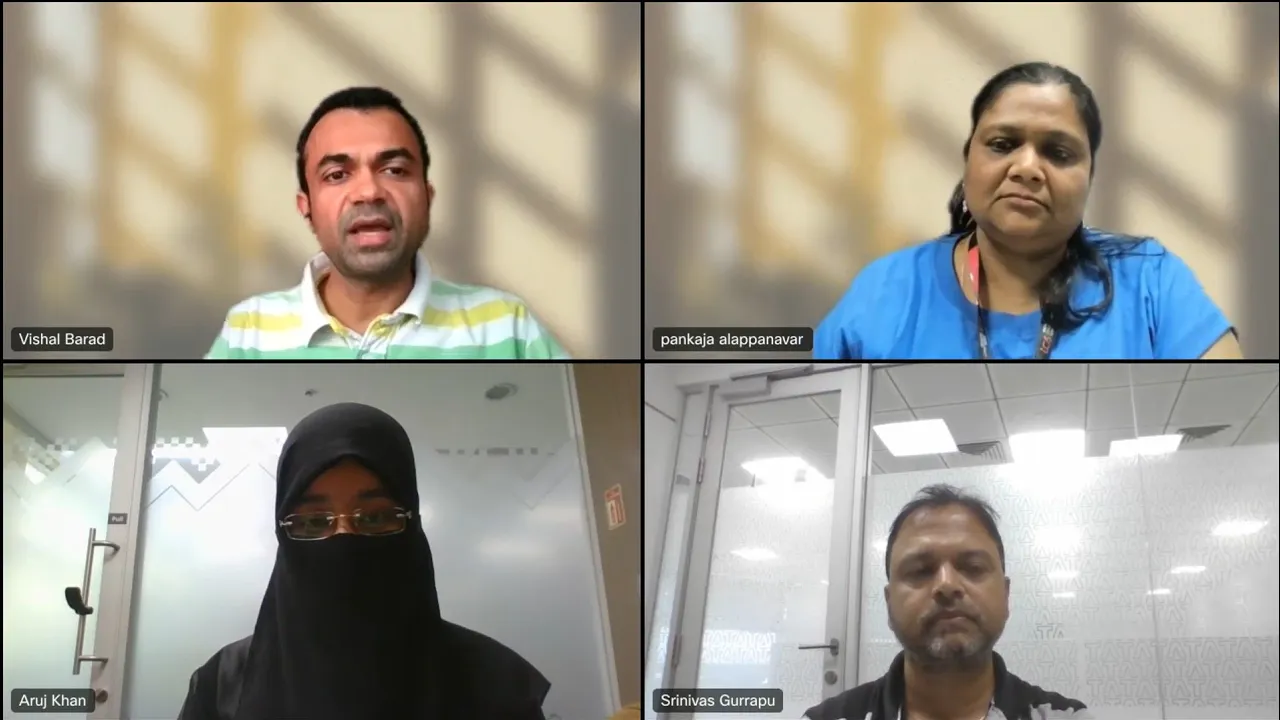
Uh so can we have quick uh feedback? Uh Sinas you can share about uh the managerial round. Panka can share about the technical route.
just one one uh observation and later on I would request Aruj also to share with today's audience. uh technically yes she was prepared very well and uh she uh it was very much revealing uh you know when she was responding to SQL questions that she has done lot of hands-on okay and that's why uh for almost for every question she had a confident answer and practical answer okay but uh one thing Arun how did you like see the the way you are communicating. Okay.
Your communication is uh of a really it's it's it matches very high quality. Okay. So apart from how you prepared on technology, if you can give some tips to the audience uh on how you made your communication very effective, right?
That will be really helpful. Okay. So after shinasar is done, panka jam is done once you know we come to you please do share tips on communication as well right.
Yeah sir over to you. Thank you so much sir. Yeah so coming to the managerial round actually uh any manager once if he's doing a managerial round.
So definitely looking for the aspects like learning. Okay. So during the academics whether the associate or the candidate learned on his or her own and for extracting that for knowing that information generally uh I may be asking like what are the resources they have used or you have used and then after the academics even after coming out of the college like uh especially when they are into the projects how they can develop on their own like um identifying the resources and then uh going through the resources and developing on their own especially when uh the project deadlines are uh short.
Okay. So this is actually what as a manager definitely I'll be looking for okay and then uh fine coming to the communication definitely that I'll be looking after brother but that we will assess during the technical round itself. uh like in this case you can see uh a very confident uh you can see during with the communication itself we can see uh uh the confidence levels that is one more thing and uh yes I said about the learning attitude so that is uh very important uh and then also uh during the academics uh apart from just learning uh the subjects whatever there for example if you are a computer science you may be just learning the theoretical structures like algorithms terms designing and so on software engineering whatever maybe but apart from that yes there is a scope like learning um other technologies or something advanced courses so definitely uh I'll be looking after that because uh definitely it will be helpful uh for your career as well as for the company so this is what about uh my observations and about the managerial round uh yeah uh panka now uh you can give your feedback Thank you Shinas.
Like when we uh look when technical round basically we look at whether your concepts are very clear like here Arush chose her field or her chosen subject of interest was SQL and she had prepared quite well for it. So that is what uh we look out for key how confident you are in your chosen subject. Okay.
whether you are able to answer uh you know basic concepts and you basic when you are saying key like yes I would like to like you know um would uh when I say I prefer Java or when I say I prefer Python you need to prepare for that and please don't prepare in bits and pieces you would I would prefer or we would prefer that you prepare it thoroughly okay though know all the nitty-g gritties of your um programming languages okay so most of the time uh you will get to know you get you can master that particular programming languages or whatever is your um technology you are interested in. I think uh you could do it by you know uh being part doing your projects okay or being part of your coding challenges like Arouch mentioned that she was part of some coding challenges. So please do participate in them.
uh please do your projects by yourself and also communication skill you know uh you need to really work on them because they also matter a lot and I would also suggest key you keep an updated uh regarded related to technology so you could read various um you know articles papers journal papers or you could go through newspapers you know keep yourself updated so basically uh we just look at whether or not you are confident in the chosen subject of interest and uh whether you know the basic concepts thoroughly. So that is what I would like to say. Thank you Arj.
Yeah. Thank you. Thank you Pangistan.
You can share the tips uh for the associates for the candidates. Okay. So basically what I would recommend is firstly when you are learning when you are into any engineering or something you have to learn all the basic concept that is where you get the strength from and the next strength is from actually applying into applying it into the academic project.
Generally people don't do their projects on their own but that is where you get your practice from. That is something where you actually apply things and those things which you apply once are always there with you. So you don't have to always prepare for the interview once you have worked with it.
So practice is something which is more important than theoretically preparing for an interview. So the more you practice throughout your uh academics, the more you work on your projects, the more confidence you get. So the basic knowledge and confidence is something is which is the key to having a very good interview experience.
So I would always uh want I would always recommend that be confident just whatever you know be very uh clear with it. Whatever knowledge you have you should be completely uh confirmed about okay this is something which I know about and I am very well versed with that. So just go with that particular thing and whatever like as Panka Jam said if you are telling about some particular technology first work on the basics because that is where your knowledge is tested the advanced concepts and all you may know it but the basics is where that is most that is what is wanted the most and about the communication um that will also come from practice.
So while uh you are in your academics do participate in some uh events wherein you have to speak up where you have to uh get on the stage and just you know be be a person who will talk. So more the more you practice and the more you uh participate in such events it boosts your confidence and it will really help you in your interview performances. Yeah that is what is from my part.
So all the best to all of you for all your interviews and uh Arroj how did you improve on your communication uh basically sir that is from practice like uh when you like basically we all know that English is a language which you will be which you will require in organization. So I would recommend that in your academics please do practice English language only like whenever you talk make sure that you are talking in English because the regular conversation is only the key that will help you give you know be good at communication that is what how I have also learned so we had always been talking in English so it is like it is not something that I'm trying to do it is already a part of me now because I've been already practicing so since when you realized and you started doing this was it in college was it in school? The reason you know reason I'm stressing on this point many times you know when we are conducting these simulations when I'm conducting sessions for these uh students and this uh our uh community who might you know appear for TCS interviews I do get questions like uh is it okay if we uh you know if we respond in Hindi like those kind of questions.
So there so you know there there are a certain number like where these candidates might be struggling on English. Okay that's why you know I before we close today's sessions yes I thought we can share some tips. So for you when did you realize that uh you should be doing this?
Basically in my school it was a compulsion. It was a convent school. So there was no choice of not talking in English and it was so English medium school everything is in English and we were all supposed to only talk in English.
If we were found not talking in English we were punished. So that is what uh made us like you know that is what forced us to talk in English and then that is from where we started practicing and once it was on us we we had like I already like with my friends also with teachers everyone we used to only speak in English. So that is where we got into practice like that is from where I got more practice from school itself.
So my base is actually from school only of this of talking in English. Vishal can I add like yeah please ma'am please please please uh right uh generally like when I used to teach in academics like so like students used to ask me so I usually used to tell them key uh if you're not good at it you need to read um any it could be a book it could be a newspaper but you need to read it loudly the more you hear yourself the more you will correct and more you will start speaking and pronouncing words correctly so actually reading out um English text loudly would actually help them improve their communication skills. Uh this is one suggestion I can give actually.
Yeah, very very very good suggestion. Thank you. Uh yeah, I just want to add one thing please please like whenever you're learning some technology we basically when we are trying to clear our concept we tend to get it into the language because on YouTube we get uh videos on any language.
So I would recommend that you you get your concept clear in the English language only because we all know that everywhere in the organization and everywhere we will be have we will have to talk in English. So that is a priority. So you should keep practicing it and the more you hear the more you read read as bank ma'am said the more you read the more you hear and the more and then after that you have to speak up that is where you have that will come in.
So practice is always a key for any u better performance that I would just say that. Thank you. Thank you Arj.
So thanks.