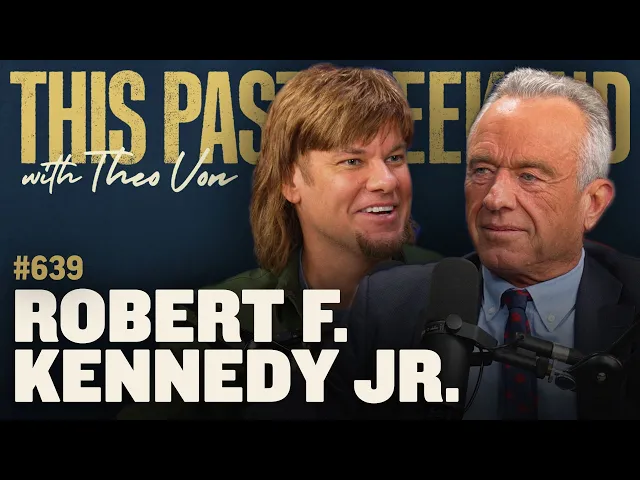
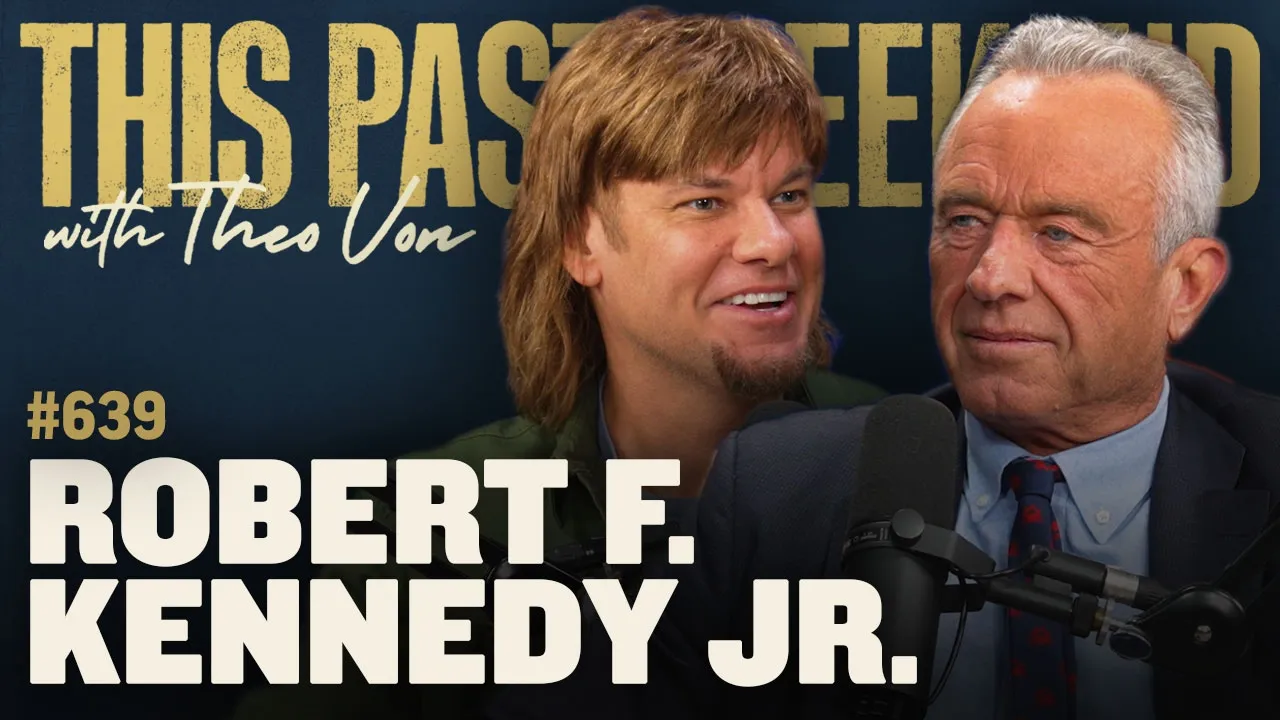
Just wanted to let you know our episodes are now available in video on Spotify as well. Today's guest is the Secretary for Health and Human Services for the US government. He's an attorney. He's an environmentalist and he's my friend. Uh I'm so thankful that he is joining us. Today's guest is Mr. Robert F. Kennedy Jr. I know And I will find a song. >> Good to see you, bro. >> Yes. Good to see you, too. >> Secretary. >> Secretary. Now you you can still call me Bobby. >> Okay, cool. >> You I know each other
from Can I say where we know each other? Sure. Yeah. We've been in recovery for together for years. >> You for almost over 40 years, right? >> Yeah. 40 43 years. >> Wow. >> That's wild. >> Yeah. >> Yeah. That's where we That's where we met each other. 7 a.m. meetings above the bank over there. That was a >> We shut those down during CO. >> I know. That was heartbreaking. That was >> We still did live meetings every day during CO. We moved from the bank. There was about 15 of us who moved from
the Bank and we found we we got into the Palisades Playhouse which now is burned down during the >> uh during the fire but it was kind of a pirate group and you know I mean for me >> um I you know what I said this when when we came in and I said I don't care what happens I'm going to a meeting every day. >> Yeah. >> And I said I'm not scared of a germ. You know, I used to snort cocaine off of Toilet seats and I know this disease will kill me, right?
>> Like if I don't if I don't treat it, which means going for me going to meetings every day. Um it's uh it's just bad for my life. So for me it was it's it was survival. And then you know that the opportunity to help another alcoholic that's the secret sauce of the meetings and that's what keeps us all sober and keeps us um You know from from uh self-will. >> Yeah. you know. >> Well, yeah, you get reminded. I mean, I go to meetings and I get reminded that other people ex like I hate
to say exist, but like just that other people are just that I'm not alone. I think, you know, I get like I I see face. I'm like, "Oh, yeah. I care about this person. They care about me." It's like for some reason in my in my addiction, It's like there's a part of me that forgets that people care about me and that I care about them. And so, but when I go to meetings, it's like an immediate, it immediately fills that whole backlog in, you know, but I have to go and kind of recharge that
battery a lot. Um, you uh Welcome to Tennessee. >> Thank you. >> Yeah, I saw you with Kid Rock. >> Yeah. >> Pretty cool, dude. That freaking He used to say he used to have cocaine and oysters. I'm like, that's a meal. That's a meal, dude. That's an aphrodesiac, I think. >> Yeah. I'm saving a seat for him still. >> Oh, yeah. Yeah. Yeah, he's one of a kind, man. His brother only has one leg, too. Do you know that? >> I met his brother, Bill. >> I think he got the vaccine, but that's just
me. But anyway, he had two a few Years ago. That's all I'm saying. >> But he he lost his leg when he was a kid at around the same time my cousin Teddy lost his leg. And both of them became um uh ski racers. So they were the top I think Ted, my cousin Teddy was the number two uh uh slalom skier for on one leg and he was also very proficient. So they became friends. So that was interesting. >> So he knows your cousin. >> Yeah, he grew up with him. >> And they were
in like a special division or no just normal division. >> What are they called? The parolympics. >> Parolympics. >> I didn't know Billy was a parolympian. I know he's a great golfer. >> I mean they're just so they're a hilarious. >> How does he golf? cuz he he doesn't his his leg is cut off so high he can't really use a prosthetic. >> He I mean I don't know they had it uh I Know a a lawn mower. Somebody hit him with a lawn mower. Look at that right there. >> Wow. His father ran him
over with a tractor. >> Yeah. Oh, >> and just put him in timeout. >> But yeah, he's phenomenal. And he has the best he has the best sense of humor. You know, I'm just joking. Uh, I know both those guys super well and uh they've been great like neighbors in uh In Nashville and um Kid Rock Bobby, he's done a lot of nice stuff for me over the years and stuff like that and includes me in things and we were just texting the other day. He's got a big heart, you know. >> Yeah. Well, he
spoke very highly of you. >> He's a nice guy. I saw you with Bill Lee, too, our governor. >> Yeah. Yeah. I met him at the he did a fireside chat with me about a year ago at the governor's conference and I Really we uh we really bonded. He's a he's a good guy and he works with both sides on the legislature. He's got um a great relation and he's done a bunch of good stuff in this state. He's gotten you know he's on top of fluoride. They got really good SNAP waiver. So that I
think they've got probably one of the best SNAP waivers. The SNAP waivers is the food stamp waivers. So you can't sp spend food stamp dollars on Uh sodas or candy, but they also have sugar content and they have uh uh corn syrup content. >> Oh, here in Tennessee? >> Yeah. So I think they're the only state that has that now. And they've also banned food dyes. They banned a couple of them and they're going to ban the rest of them now. And what have we finding out with food dyes? Like >> well the food dies
we've now you know we've told the companies they got to get Rid of all of them. There's nine of them and the worst four we already banned. But the other five I think by the end of this year everybody should have stopped using them. And then we rapid uh approved four new vegetable dyes so that they can replace them with you know something healthy. So we did that through FDA. We're working with the industry to make sure that they can do it. But they've been very very cooperative. Most of them About 40% of the industry
you came to us including the entire ice cream industry came to us and said we want to do this but you know help us. So we um we're working very closely with them and they're all getting rid of it. I mean we should have gotten rid of it a long time ago. The Europeans don't allow it. Canada doesn't allow it. other countries uh don't allow you can buy Froot Loops in this country that are just loaded with chemicals and you can buy same Company makes Froot Loops for Canada and Mexico that don't have the chemicals.
>> Yeah. Well, yeah, there's a kid on on T there's a kid on TikTok and he was eating Froot Loops and then his poop was glowing in the dark. You see that? I'm like, dang, that thing will swim upstream. That's crazy. I mean, but yeah, that Yeah, some of it definitely seems bonkers. And what did you say about fluoride? Uh Tennessee has a law that has to where the the water district Has to inform the public about it. The fluoride is crazy because we know it reduces IQ. There's no question toxicology program has done a
metaanalysis and they can you know it's dose related. So every um milligram of fluoride that you add reduce your IQ more. >> God and um >> and it doesn't work systemically. you know, it was put in in the ' 40s and because it does help with tooth decay, But the effect is all topical and back then they didn't have fluoride toothpaste. They didn't have fluoride mouthwash. Now we do. Uh the parents can get the fluoride for their kids and they don't when you put it in systematically, it destroys your bone mass. It destroys your thyroid.
>> Horrible for us. >> It's horrible. And it destroys IQ. I mean, if you have kids, would you rather them cavities or or even lower IQ? >> Yeah, I'd rather have them have cavities. I'd rather have holes in their teeth than holes in their ideas or whatever. >> Right. But but the uh the European nations abandoned and there has been no increase in cavities. So, you know, uh it doesn't make any sense for us to be putting it in. And yeah, this is the bill known as the Tennessee Fluoride Free Water Act prohibits public water
systems in Tennessee from adding Fluoride or any fluoride containing compounds to drinking water intended for human consumption and bans the sale of bottle water with added fluoride. So we don't have fluoride in our water here. >> Well, there is natural fluoride in a lot of water. It's just it comes from the geology. So, >> but we're not adding more, >> right? We're not adding it. >> Nice, dude. Yeah, because what? Yeah. What if you're trying to think of Something, you have two sips of water and then you're like, "God, I can't even now. I'm screwed."
Your parents send you to take a test and they give you a bottle of water and you're like, "God, I don't have a chance now." Um, but thank you. Thank you for for leading the charge on a lot of these things. Thank you for caring about a lot of these things. I think I just want to say that I know that you do care about so many of these things. Um, I did see there's a There's a Tennessee Farm Bill and there's a lot of stuff you want to talk about, too, and we'll get into
some of it for sure. Um, but this is what I was talking about right here. This bill, it's the Yeah. Farm Bill 809. The bill is sponsored by Representative Rusty Grills. Would limit lawsuits if a user gets sick from a pesticide. Under the proposed legislation, as long as a product's label was approved by the Environmental Protection Agency, a Person wouldn't be allowed to sue over the labeling. So, actually Sean Ryan, uh, the podcaster and John Rich, the musician, they shared this online and on the day that it was going up for vote, I believe. Yeah.
Right here. Tennessee state politicians side with foreign pesticide companies over people dying of cancer. Ryan posted on X alongside a video speaking out against the bill. As did musician John Rich. After the push back, Representative Grills took the bill off notice, which at least delayed the vote. It's unclear why that decision was made or whether Grills has plans to bring the bill back to this legislative session. And bring up a just I just just so we know who's doing this, bring up a picture of uh Mr. Grills. Oh, there you go. Well, I mean, look,
if you're a farmer and you get sick from using a pesticide that you didn't know would make you sick, that you wouldn't have recourse against a Pesticide company that did know that they caused illness. because these companies knew that these caused illnesses. >> Well, yeah. Yeah. Evidence from lawsuits, internal documents, and independent reports indicates that Monsanto had information suggesting potential risk to human health from some of its pesticides, yet worked for years to downplay or obscure those risks in public and regulatory arenas. I mean, That's just wild. >> The reason they're doing this is because
of my lawsuits against Monsanto, >> right? I remember you had that huge settlement against them a long time ago, right? >> Yeah. I think it was uh 20 uh maybe 2019. Uh we finally settled it. But I did three of the trials in San Francisco and the first one we won I think 289 million for you know people who got nonhodkkins lymphoma from using Roundup And then the second one we won 89 million. The the third one we asked for a billion dollars from the jury. It was a couple that had both got it simultaneously.
They were home gardeners >> and their dog also got at the same time. They had a a labrador retriever and the dog died. Uh both couples were sick. We asked the jury for a billion dollars and they gave us 2.2 two billion. And they did that because we were able to show them documents That showed Monsanto knew of the danger and then worked with corrupt officials, a guy called Jess Roland inside of uh EPA who was the head of the pesticide division and that um they had deliberately concealed the science, fixed the science and now
the the big study that they used to prove safety has now been retracted. Yeah. Yeah. I think I saw an article about that. Like they they'd found emails that they were like um that it Was kind of ghost written or something from the >> Yeah, it was ghostritten. And also the head of the pesticide division, they they asked him the Mon Monsanto asked him secretly and now we have these emails to kill a study by another agency called ATSDR. And uh he said, "I can't kill it. It's that's not my agency. I can kill them
in EPA, but not outside." And they said, "You got to do it. We Can't have this study go forward." And he said, "Okay, I'm going to do it, but if if I succeed, you got to give me a gold medal." And we had all of that. >> And we were able to show it to the jury. And they were angry. And that's why they gave us that huge judgment. >> A gold medal in what? Just anything. >> A gold medal for, you know, killing a study that showed that it caused cancer. >> It showed that
it grew insane. >> Bet it's at a contest level now. that That it's that that things like that are so like prolific that now it's like there's awards for it, you know, it seems baffling. Um there's been a ton of lawsuits about this, right? Like about pesticides causing uh diseases and uh sickness in people, right? Um or about this glyphosate, I think it's called. >> Yeah, glyphosate. >> There's been a ton of lawsuits, but they still don't have to take this product off of the shelf, though. That's the Craziest thing to me. Is that right?
Well, you know, the it's a problem because you have um all the rowcroppers are dependent on it right now. And there's other technology that is uh that is emerging right now that actually, you know, I looked at one yesterday. It's a tractor attachment that uses lasers to kill weeds. And that, you know, if they can make that affordable, particularly for smaller farmers, that Will be the answer because you'll be able they they can kill bugs and they can kill weeds. You program this thing and it zaps the weeds with a la laser and makes the
all the cells explode and it destroys them. And um so that you know we there's a future that we can now see the light at the end of the tunnel there. But right now, if you banned glyphosate outright, it would put out of business 80% of our farmers. >> Got it. Wow. So, we're kind of dependent Upon something that we know makes us sick. >> Yeah, we are. And, you know, we're trying to we're doing a lot of work in the HHS to look for other alternatives and to find a a um you know, find
an offramp because the farmers don't want to be using chemicals anyway. They're very expensive. They know, you know, they have some of the highest cancer rates of any profession. Uh, and farmers care About their land. They want to leave it for their kids. It also destroys the microbiome and the soil and that causes erosion. And so, it's not a, you know, it's not a good long-term solution. Um, you know, the issue is how do you transition off of it without putting farmers out of business? >> Right. >> Here's that laser. >> Oh, wow. That's unbelievable.
laser Weeding robot kills 100,000 weeds per hour. >> Yeah. And it also kills insects. You can program it to kill, you know, certain insects. And you know, that machine looks that machine probably costs a million dollars. So, >> um, >> but if you could have a couple of those running at night through your farm, that'd be sick. >> Well, yeah, it would be it's a lot better than using chemical pesticides. So, this is going to be, you know, the future, but >> Well, we're not there yet. We're not there. Wow. It's just wild that we
get stuck into something that makes us sick and we don't have a, you know, it's like I don't know. It just feels like such a conundrum. It must be that like that for you guys a lot where you're like this is just kind of where we are, you know. Um The the agricultural community has been very very supportive of the Mahaj agenda and um they're helping us transition away from ultrarocessed foods which is really the biggest issue. That's what's causing all these chronic disease in kids. And farmers are going out of business. You know, farmers
usually lose money seven out of 10 years. Even when they're making money, they're making, you know, a lot of them are just making uh for their work hours minimum wage. And there and we're having a hard time finding young people who will go into farming. That is a crisis that you know we need to uh we need to keep into consideration and and you know you have people at USDA finally who are you know really intent on solving this problem but nobody wants any farmers going out of business. >> Got it. Whenever you became secretary
did it feel like you like um now that now you're like on the inside like did It does it feel like you go behind this curtain and now you get to see this It does. >> Yeah. >> Do you have to sign an NDA to have the job? >> No. No. And I mean, we're doing the opposite of that. We're going to be, you know, this is the most transparent in um uh administration in history. I mean, there's no president who's done ever done three or four press conference a Day like President Trump does, asking
answering any question people fire. >> He's a machine. Well, we >> I don't know how many press conferences President Biden did in his entire administration. >> He doesn't know, >> but it's a lot less than President Trump does in a month. >> Yeah. Oh, for sure. >> And then, you know, we're um we are right now using AI To um to revolutionize the freedom of information laws so that people are going to be able to get freedom of information requests immediately. Like what do you mean a freedom of information request? >> Yeah. So if somebody
wants a document from the government now, it could take 6 months, two years, and we're going to make it so that they can get it instantaneously and that all of our documents are going to be public Except those that are uh shielded under the statute for, you know, for one reason or another. And the the big um issue that you know the big problem that we're dealing with is that uh there is that you know that there there are names and privacy issues and you have to redact those legally. We have to do that and
we have to make sure we don't make any mistakes. So the AI is you know that's what we're working out now. >> Whenever when you got in office there was you guys did like a big cut down of like a lot of the divisions and stuff like that. What was I think you went from 20 something to 15 maybe 20? >> We we had 82,000 employees and 20,000 of them left and they left. >> 20,000 of them left or did you guys make like cuts? Cuz I just knew that you guys made like a bunch
of cuts. >> Different cuts. There were buyouts so that people who are at the end of their Career could retire early. Um there were rifts where people were people who were very new were let go. And it was about uh reducing the workforce, but it was reducing the bureaucracy. We weren't reducing we weren't getting rid of um of research or anything like that. We didn't touch that except if there were certain categories of research like DEI research or there were other categories that were just it was not real science and it was Not science you
know we're we're changing the trajectory so that the purpose of NIA the focus of NIH is going to be figuring out why we're all so sick you know why is this chronic disease happening what are the exposures that are causing it what are the alternatives, how do we end it? And so we're shifting the focus, but we're are the amount that we're spending on research the same that we spent, you know, in 2020, 2019. Well, was there Like a recalibrating there? Cuz like I had a friend Heather who was working at UCLA, she was a
researcher there and she said that like a lot of the during like the Doge period and stuff, a lot of their grants got cut and there was like a like a kind of a I don't know if it's called a moratorium or like a pause. there was a pause and every administration does that. You need to do a review and make sure that they're uh that that those research projects are Not you know torturing beagles or you know or doing DEI or um and how do you decide that is it do you decide or is
it like >> we go through every single grant >> we had you know big teams going through those grants and then with there's tremendous There's tremendous ways. We had 40 communications departments. We had 40 different um >> uh divisions studying addiction. And so we consolidated those. So there wasn't, You know, you have 10 people doing the same job and not talking to each other with computers that are internet that are not interoperable. >> Oh, it's the government. >> Yeah. And we're changing that now so that you know we consolidate it and we're making it more
streamlined and efficient. But it's so that we can do the job better. So we can do better research. And then the research, you know, was Never replicated. And which means that that's part of science that if somebody does a paper that makes it scientific hypothesis, you don't just accept that. you get somebody to replicate it and see if they come up with the same result and that was not happening. There was no virtually no money spent on replication. And because of that there was huge incentives to cheat because scientists if they have a hypothesis And
they do they get a grant maybe hundreds of thousands maybe millions of dollars to prove that hypothesis and then they once they prove it they get it published and that's how they advance their careers. Well, if they fail to prove it, if the science says what you were thinking is not true, then they can't get published. They you should publish that, too, because that's science, you know, but it doesn't get Published. So, their careers are, you know, and endangered. It's hard for them to get the next grant. >> And so, a lot of them had
this incentive to cheat. >> Ah, so they have to win if they get it. if they if the hypothesis is a null hypothesis, they don't get they you know their whole future goes into the toilet >> essentially. And uh and so because they they knew that study was never going to be Replicated, nobody was going to check on them. there was an incentive for them to cheat and >> and there must have been a pipeline just for companies then to just get like get like >> sided uh lopsided science or or solosided science that wasn't
um >> yeah I mean I'll give you an example there was a study done about 20 years ago on amaloid plaque and that as the Cause of Alzheimer's and that study came up and said yeah it's the cause of Alzheimer's then we spent billions millions of dollars doing six or 800 studies that followed that and they all were as it turned out they were all cheating and you know the ones that were many of them were cheating but all of them were kind of confirmatory and all of their hypothesis about what's caused Alzheimer's was ignored
put on the shelf You couldn't get money for it because they said we already know the answer and then there were drugs developed etc And um and the in the end, you know, we came in we and this scandal was brewing. The head of Stanford University Medical School had to resign the dean because they knew what was going on >> because he was involved in publishing some of these fraudulent studies. And um but they did it for 20 years because nobody ever had to really replicate Those original studies. And that happens all the time. I
mean you go down these scientific deadends and uh and so now what Jay wants to do is to spend 20% of our budget on replication so that every study gets replicated and we know Jay Bodachara who is >> okay yeah I know you're talking about >> and he was one of the guys who was censored during co he was >> one of the top um statisticians at Stanford and he and a lot of other ones Were you know were censored or lost their jobs. Marty McCary who you know also >> yeah I love his book
one of his book I read >> he was also censored um Oz was censored and they're now running the agency so these are people who want to do real science and not politicize it to depoliticize the science we had 10 people doing you know these bure administrative jobs and now we're We've cut that down to five you know so uh all the cuts that we did were meant to streamline the agency so that there's more money for research. >> Got it. Like after the pauses on the grants and uh and some of those things, are
you >> the grants were were were renewed? >> Most of the ones are the ones that you guys seemed that you guys thought were viable. >> Yeah. On almost all of them. >> Got it. When I want to add some Bitcoin, Moon Pay is usually the first app that I reach for. You don't need to buy a full Bitcoin and the whole process is clean, simple, and easy to understand. Moonay has been a major partner of the show and I've actually chosen to take my compensation from them in Bitcoin. The Bitcoin lives in my personal
Moon Pay wallet and it's fully in my control. No one else has access to it. With the US Dollar constantly moving up and down, this felt like a smart way for me to diversify a bit and potentially get more long-term value out of the partnership. Just keep in mind, even though Moonay makes it easy to buy crypto, you should always do your own research and understand what you're getting into. Crypto can be volatile and there's always the possibility of losing money. Moonay is a tool to facilitate your transactions, not a source of financial Advice. Trade
responsibly. You know, earlier this year, I had a friend that passed away. And um and there was fundraising for him, you know, to help just to help have um finances to take care of his family moving forward uh to help with some things. And and fortunately, he also had a life insurance policy, you know, cuz you want to be able to make sure that uh just tuition, um child care costs, uh mortgage if you have one, things like That, that your family will be able to go on with some comfort. And that's where Ethos comes
in. Ethos is an online platform that makes getting life insurance fast and easy to protect your family's future in minutes, not months. There's no complicated process. It's 100% online. No medical exam required. You just answer a few health questions, get a quote in as little as 10 minutes, and you can get up to $3 million in coverage. As of March 2025, Business Insider named Ethos the number one nomed medical exam instant life insurance provider. Protect your family with life insurance from Ethos. Get your free quote at ethos.com/theo. That's ethos.com/tho. Application times may vary, rates may
vary. I saw you uh in your speech that you gave yesterday here in Tennessee saying that like there's all kind there's all Kinds of temptation to cheat if you know you're not going to get caught. >> Yeah. >> Well, that's true in every system. >> Yeah. Have you seen a lot of that? Like um >> I mean the amaloid black is a really good example. Yeah, we see it everywhere. We we see it everywhere in medicine. It's everywhere. And the journals are utterly corrupt because they're owned by the Pharmaceutical companies. And so people read a
journal and they think, "Oh, this is science." But even, you know, Marshia Angel, one that ran the New England Journal of Medicine for 20 years, has said, "You can't believe anything in the journals anymore, but they're just propaganda vessels for the pharmaceutical company." Richard Horton who are in Lancet who still runs it says the same thing that the uh you know the journals have >> and those are the people running them. >> What happens they make huge amounts of money and they make money from advertising which is paid for pharmaceutical companies and through a scheme
called preprints where the pharmaceutical company lands the story. They pay for the journal about a drug that they're trying to promote. They um they pay the journal to print the story and then they get a preprint. So it's a a very neat looking, You know, copy of their article with the cover sheet of the New England Journal of Medicine on it. And then they distribute that to their pharmaceutical reps who are like, you know, former Playboy models who go out and talk to the doctors and they give that to the doctor and say, "This drug
works, you know, do you want to have lunch?" >> Yeah. And the doctors then start prescribing the drug and they think, "Oh, well, it's legitimate because it Was in the New England Journal of Medicine." But it is not. It's, you know, you can't believe what's in those journals cuz it's all propaganda for for pharma. So, how do we get away from that? Like, how what are you guys doing to combat this or to to change this or can this change or is it just awareness and then people have to take the responsibility? >> No, I
mean what we're doing is open source journals. We're going to have our own journals that you know that um people can open source and publish but you'll have the peer review published with it. So before you publish you give it that you give that publication to a panel of experts who then read it themselves and criticize it and the peer review now is secret and um and then there is no raw data published so nobody can go in and replicate it. to the extent possible. Sometimes you you can't you have to buy The raw data
and it's very expensive or inaccessible. So you can't publish it. >> Um but you can publish the peerreview which is what we're doing. And so everybody will be able to say if they have 10 peer reviewers and they all say this article sucks. it's got all these holes in it. Then the public will be able to read that and doctors will be able to read it and the regulators will be able to read it and um so it's basically open source. It's you know With crowdsourcing essentially and it you know that's how you get credibility
in science. Science doesn't come from consensus. It comes from debate and you know you that's why you remember when they were telling us during co oh trust the experts >> well that's not a thing in science trusting the experts is the opposite of science that it's not a function of science or democracy it's a feature of religion And it's a feature of totalitarianism but in science you always question the expert >> yeah you can't there's not an expert in science because it's like an evolving thing right >> well you know when I did the Monsanto
is I was part of a, you know, big team. Uh, we had and Cheryl came to my to my uh trial. A, you know, a couple days she sat through and watched us try the case. And Monsanto had experts from Stanford, Yale, and Harvard, three big experts. And they testified. And Cheryl said to me at the end of the second day, she said, "Why are you guys even here? these guys are you know this science is very clear that man said that Roundup doesn't cause cancer and I said just wait and then our experts went
on and they were from Harvard Stanford and Yale and they said the opposite and were much more convincing and the juries were convinced >> and so there's experts on both sides of Every debate and a lot of them are paid to be experts they're hired guns they're mercenaries >> and uh we call them bystitutes the one that that worked industry, the ones that work for industry >> biioitudes. That's great. >> Uh but you know, so there's experts have their own bias. We all have biases. Everybody's got a bias. What you want to do when you're,
you know, when you're dealing with science, you want to expose Those biases. You want to admit them and acknowledge them and then you want to the science to be able to stand on its own. >> And that would that's the only way really to deolitize it as best we can. >> Right. What were some of the biggest cases of fraud like when you got in there and got behind the curtain and see like you know like the NIH, the EPA, like all just see what's going on back there. What were Some of the biggest cases
of fraud that you kind of found? >> I mean the biggest cases are what were we between Medicaid and Medicare? There's about 100 billion stolen every year and a lot of it is um like what's happening in Minnesota with the Somali community and what's happening now even worse in California. But you know, one of the problems is that that's a systemic problem is that Um Medicaid and Medicare now long no longer it used to be that they that they paid for your medical treatment, your doctor's visit, but now they pay for the person who takes
you to the doctor and they pay for home care and they pay for um you know a person to come in and pay your bills right so there there's all kinds of opportunities for fraud and a doctor recently you know Oz told me this told Oz he said and there was a doctor In California that he visited and the doctor had a patient who was a heroin addict heroin addict was coming to see him four times a month for some kind of a treatment and one day he he loo the doctor looked out the door
and saw his ex-wife waiting for him in the car. And the doctor said, "Oh, are you back together with your ex-wife?" And he said, "No, I hate her guts." And he said, "But she drives me because she Gets paid $600 every time she drives me." >> Wow. >> And he said, >> "That'll put you back together with your ex. >> We make $3,000 a month, you know, with her driving me this and then I drive her to hers." >> Wow. >> And so there's all kinds of those opportunities for fraud. And you know, We found
a hotel that had literally every room in it was the headquarters for a nursing group. >> Where was that located? >> It was in California. >> God. >> And you know, so they're all just P.O. boxes. They're not actually doing any nursing care. >> Nuh-uh. >> They're just collecting money. And as we now know, a lot of the money that was, You know, was was going into the Somali community for autism care. There were these phony autism care houses. >> Yeah. >> And a lot of it was ending up with al-Shabaab in in Somalia. So,
hundreds of millions of dollar, billions of dollars were being stolen, shipped to Somalia to um to fund a terrorist group. And but that's happening every day. Now, now we have the ability to catch them. >> How how are you able to adjust that sort Of thing now? Like, like what makes it different now? >> Because first of all, the under the Biden administration, I don't want to get super partisan. >> Yeah. >> But the Biden administration turned a blind eye to all the the fraud. It was mainly going to blue states and it was an
economic generator. there's money pouring into the blue states and um they they just said we're Going to we know a lot of it's stolen and illegal, but we're going to let it happen because it's coming to us. It's coming to our state. And so what we've done now is with Medicare, we control Medicare. The states control a lot of Medicaid. So it's harder, a little bit harder for us to detect fraud there. We've started out with Medicare. We're using AI and we're using AI which can detect the fraud. You know, it can detect it can
tell us whether this guy Who is who we're paying has been convicted of fraud before and you know we shouldn't be paying him again and it it will be telling telling us every aspect of his business that we need to know to to understand whether it's fraudulent. So, we're going to save just this year tens of billions of dollars in eliminating fraud in Medicaid. And if they used to pay it under the Biden administration, the system was called pay and chase. So, if they sent in a fraudulent invoice, we even if we knew it was
the HHS knew it was fraudulent, they would pay it and then they would put the inspector general to go claw it back. And of course, it wasn't there, but they so they never recovered anything. Oh, I see. >> Now, we're not going to pay them anymore. If they're fraudulent, they're going to get they're not going to get a check. We're going to save tens of Billions of dollars just this year. And we're going to save hundreds of billions over the over, you know, annually from now on. >> And that's because the AI is keeping track
of that. >> The AI can spot the fraud. >> Got it. And then with Medicare, with Medicaid, um, which is, you know, a joint state federal program, it's a little bit, we don't control the rails and the states control them. And So we need state cooperation and the red states are cooperating with us, but the blue states still won't cooperate. So that's going to take some time. And then there's categories that are much easier for us to control like medical devices. We we can do that quickly on our own, but there's other categories that are
going to be much more difficult, but we will get it done within the next three years. >> Whenever uh Doge happened, right, when Doge occurred, when Elon was in or he was involved or hypothetically involved is what it seemed like just like to the regular. >> He was definitely involved. >> He was involved. Was that successful? Was that real? Like what was the outcomes of that? like did that seem like a were you guys working together with that like what was that all about? >> I you know I think even Elon has said that um
there would have been better Ways to do it and that we you know going after the systemic what we're doing now this the you know the these large thefts you can cut a couple of thousand people and over the long run it's just you know drops of water in the ocean. Yeah. >> Oh, that's not going to save us huge amounts of money over the long term, but what we're doing now is going to >> the things you were just talking about, you mean? >> Yeah, >> that's going to help a lot. >> Yeah. >>
Is Doge still active? Is that program still active? What were the outcomes of that? >> Well, the outcomes were that a lot of uh you know, the I cut my workforce by 20%. But, you know, in truth, some of the um if some of those were very good cuts, it would have to I think we all agree, including Elon, that it would have been better to do targeted cuts. Cut the people who were actually um causing the problem and then keep the people, a lot of the new workers who, you know, who were only there
for a couple of months. um that that it might have been better to keep some of those people and change the culture. >> I see. So yeah, instead of more of like a mowing, more of like a pruning kind of thing, you mean? >> Yeah. Do you think America is sicker Than ever these days? >> It is sicker. We're the sickest country in the world. We have the highest chronic disease burden in the world. And that's one of the reasons during COVID we had um 19% of the COVID deaths in our country and we only
have 4.2% of the world's population and um so the the question is why did America do worse than any country in the world co was it mismanaging part of it was that but the big part and this is What CDC says we're the sickest country in the world that the average American who died from COVID had 3.8 ate chronic diseases and that's really what was killing them. It was very hard to die from COVID if you were healthy and um and so you know we need to get Americans healthy. We need to end the chronic
disease epidemic right now. We spend two to three times on our health care per capita what they spend in Europe. And yet we have the worst Health outcomes in the world. We're 79. >> Bring that up. Bring up a capita chart if you can. We have the, you know, we've dropped behind Europe by uh by six years in lifespan, 10 years in some cases. And yet our health outcomes are worse. We have the highest maternal immunity, highest maternal mortality. That means women dying in childirth in the developed world. We have the highest infant mortality. How
could that be with The United States? And a lot of it is because of chronic disease. And then you know our diabetes rate when I was a kid the typical pediatrician would see one case of diabetes over juvenile diabetes over a 40 or 50 year career that a 38% of American teens is diabetic or pre-diabetic. God is unknown. Autism rates have gone from uh less than one in 10,000 in 1970 to one in 31 today. >> Oh yeah. You can throw a rock and hit an autistic kid anywhere. >> And California is one in every
19 kids, one in every 12.5 boys. And so this the cost to our country. 77% of American kids can't qualify for military service. >> How many percent? >> 77% cannot get into the military because health reason. No. >> What? >> That is the truth. >> Yeah. And >> Oh my god, bro. That's insane. >> Yeah. Not. That should get people's attention. >> Bring that up. Is that true? Let me see if that's true. >> Bobby probably just uploaded this stat onto the internet from his phone a second ago, but still that's okay. That's how it
works. 77% of American youth can't qualify for military service. >> Yeah. >> And why? Why? Because they have chronic disease. They have asthma. They have diabetes. They have, you know, um they they're obese. >> One of those. But when my uncle was president, I was a 10-year-old kid. We spent zero on chronic disease in this country. Zero. Today, we spend 4.3 trillion a year. And um it's about 40 cents out of every tax dollar that is paid by you. The Federal government is now going to treat chronic disease. And it's it's unsustainable and it's getting
worse every year. Who's is it is it do you find that it falls more on it's the responsibility of the individual we're not taking care of ourselves or is it that we have a health a system that is allowing uh I I don't want to just say foods and drugs but allowing things into us that is not maintaining our natural health >> I mean individuals have a responsibility but the obesity when when I was a kid 5% of kid children were obese Yeah. You had one kind of fat kid in your class. >> Yeah. And
today it's uh you know 15% it's going overweight is 40%. Uh adults it's even higher. >> Well, we should just have a thick military then I think. >> But people did not get Americans did not get obese because they're indolent or lazy or they don't want to do exercise. They got that way because they're being mass poisoned. And they're being mass poisoned because the government lied to them. and it lied about the food. Oh. Um, now 70% of the food that our kids eat is ultrarocessed food and it's just poison. It's not food, it's just
poison. >> And which agencies allowed that? I mean, the EPA puts labels on the FDA. >> Yeah. >> So, do you feel like that's been one of The most compromised agencies? >> Yeah. It was owned by big pharma and big food and we're, you know, Marty McCary has changed that now. >> So, how do we know that that's changed? Like how do we as like a >> look at the food pyramid? I mean they you know the food pyramid when I came into office we were supposed to publish in January of last year. >> Oh
yeah. The last food pyramid I saw had vapes on it. So it was getting pretty Bad. >> We're doing vapes now. You mean the food pyramid? >> Oh the last one. Yeah. The one that Yeah. Funny. >> I was like this is getting bad. >> Uh but the food pyramid. So when I came in, we were uh the the Biden administration had prepared new dietary guidelines and they they were 453 pages long and they were completely driven by the same Mercantile impulses that put Froot Loops at the top of the food pyramid. How do you
put Froot Loops which is not a food >> at the top of the food pyramid? It's just poison. >> Yeah. and that but it was all driven by the commercial interests of the companies that controlled FDA. So when we came in we we went we got the best nutritionists from the best universities in our country. We basically locked them In a room. We we thought it would take a month but it took about 11 months. They fought over every single item on this in the food period. >> It took them 11 months to put this
together. >> Yeah. Because you have to go over science. you know, what is broccoli and how does it relate to how much protein should you eat, how much saturated fat should you eat, >> what's optimal. And so they had to go Through tens of thousands of scientific papers to make sure that every recommendation that we made is based solidly on a foundation of gold standard science. >> So for this this so this for them to create the food pyramid, it took 11 months. >> Yeah. And then we flipped it over. So, and we flipped it
over because the category of food that you should eat, you know, most is a broad category. It Includes vegetables. It includes proteins, you know, salmon and steak and >> and most of this is for children, right? >> Well, no, this is good for everybody. I mean, most diabetes >> I remember from like when I was a kid, you know, you would see it, you know? >> Yeah. Right. >> But I guess that's the first point you learn about it. >> That's and that's why we're all so screwed up. Um but the you know most diabetes
can be cured through diet and the doctors don't know this because they don't take most of them aren't taking nutrition in medical school and we're now requiring or we're working with the medical with the accredititors and with the testing the people who do the MCAT to make sure there's tests on nutrition. We're working with all the medical colleges to um make sure that now Doctors can have the 40 hours of nutrition in school. 80% of doctors say they do not feel competent to give nutrition advice. So what are what are they learning? They're learning pharmarmacology,
>> right? >> They're learning the pill. You let everybody get sick from eating the food and then tell them the pill that will treat that sickness. >> Yeah. At that point, you're just a drug Dealer >> and you can get rid of the diagnosis. Not only that, but now, you know, there's there's really clear science that you can get rid of mental health diagnosis that food can cure mental health problems. There's a a doctor in Harvard, Dr. Poland, who is uh who has cured schizophrenia with dietary change with keto diets. Um there's a paper that
>> that up. Is that true? >> Yeah. Go ahead and look it up. >> Cure schizophrenia with keto diets. >> Yeah. Well, I definitely noticed that with when I'm fasting, I get I'm pretty smart. >> Yeah, you get smart it, right? >> Yeah. Preliminary clinical findings, including case reports of small traits, suggest that ketogenic therapy may improve positive and negative symptoms, cognitive performance outcomes in individual schizophrenia spectrum disorders. I mean, I believe that so Much of this is true, just that like that so much of it is how we are operating. Um, it just feels
like we've been stuck in such a place where you have a like you have you have a food industry that doesn't care if you're healthy and then you have a health care industry that doesn't care if you get well. >> Well, everybody is making money from us being sick. And I I'll say one other thing about this. There are all these There are dozens and dozens of studies and you can look them up of their case control studies of juvenile detention facilities and prisons where they change. For example, in one wing the diet to real
food and they leave the other diet in there and that the disciplinary the fighting the violence drops precipitously. The use of restraints in one juvenile dispension facility dropped by 75%. Usually the violence uh uh drops by 40 or 50%. And you know people, it caused depression, it caused anxiety. These foods, you know, if your kid has anxiety, look at what they're eating. >> And you can change that in many cases by changing their diet and getting them to eat real food. >> Yeah. How how do you get the everyday person then to adjust their psychology
or like their thought like about taking more of an interest in themselves, you know? Because I think it used to just be You trusted the commercials. you're like this is great for you know it's like and you believed that you know >> yeah I mean the way to change human behavior is one get information out there that's real information the other thing that you have to do is you have to change the economic incentives and um right now we have perverse incentives that reimburse doctors that you know that insurers pharmaceutical companies the doctors the hospitals
are more Making more money if you're sick RIA with drug rehabs. If you come back, if you come back, if you relapse, >> they make more money, right? They shouldn't be paid that way. The insurance company should pay them one lump sum and then follow that addict for the next two years. And every time he comes back, you got to treat them for free. And that will incentivize them to >> do better treatment. >> You have to do treatment that works. And The ones that can't do that will fail. And the ones that can do
it, that get better and better at it, will do it. you change the economic incentives, you'll change human behavior. And then you have to get the information to the individual. And that's what we're doing. We're doing, we've um met, we've convened the 400 top tech companies before this administration. You could not get your own health records. So, you own your health Records, but you couldn't see them. You can't get a hold of them. >> What do you mean? Why not? >> Because they would information block you. They would make sure you couldn't get them. And
now we've got them all to agree they're going to stop the information blocking. Oh, your medical records will be on your cell phone. And that is great for you because if you live in Nashville and you travel to Los Angeles, you get hit by a car. You don't Want to spend an hour in the emergency room with a clipboard making out, you know, one of those forms. You hand your cell phone to the doctor. He puts it in AI and he knows what your blood type is, what your allergies are, what your contraindications, you know,
previous treatments, etc. >> Yeah, it is ridiculous. You have to do that all the time, >> right? So, what President Trump said to me is he said, I want to make every American the CEO of their own health, >> that they're in charge of it. And then we're doing, you know, we've gotten now we've changed the prior authorization. We've got 80% of the insurance industry together to eliminate all unnecessary prior authorization which is going to change the the experience that every American has with the health care system is when you go to a doctor he
says you need a knee surgery you may wait six Months for your insurance company to approve it you can't do anything about it and now we by the end of this care, you will know at the point of care. That means before you leave your doctor's office, you'll know whether your insurance company will cover that. And um that's going to dramatically change it. We were also >> But does that make it any more likely that they're going to cover it or does it just make it that you're going to Know? >> It makes it so
that you'll know and so the doctor will know there before you leave. >> Got it. and change the prescription or whatever you need to do. >> You'll at least know and you won't be, you know, sitting at home. And then the other >> and that's actually going to happen. >> That's happening. Yeah. And then uh the other thing that we're doing is we're Doing price transparency so that every hospital will have to publish its prices for every procedure. >> How are the patients? Are you familiar with that? >> Exactly. And that's to make you the
CEO of your own health. >> They already are supposed to do that, right? It was a law that Trump passed in his first term, but Biden never enforced it. So, none of the hospitals do it. We've now passed new regulations that is going to punish them draconian way if they don't do it. So, they're all going to be doing it by the end of this year. >> Are they going to try to find a way to skirt around that though? I wonder like are they >> Well, there it's No, and it's so screwed up because
if you go buy buy an automobile and the guy tells you, "Yeah, but I'm not going to tell you the price till after you bought it." >> Yeah. It's insane. you'd be, you know, and right now if you're pregnant in this country, you could go nine months on the phone every day trying to figure out what the child birth is going to cost you in your local hospital and and not be able to do it. >> Yeah. >> And we are bound to go online with a system that will make all procedures visible to every
patient. So, I actually looked at the mockup Two days ago for um uh for New York and it shows a map of Manhattan and a mile mountain around Manhattan and there's 30 hospitals and it shows the price of child birth at every hospital. The lowest one is 1300, the highest is 22,000 and it's everything in between 9,000 5,300. >> You can look and see. >> You can look and see. You'll be able to go to a menu online. >> It's like gas buddy when you're looking For, you know, gas station. But you're going to be
able to do that. >> Clean bathroom or whatever that clean bathroom. That one. That one's crazy. And they lie on there. And some of them are at rest areas, too. >> And I Yeah, I got accosted by a guy who was in a I guess he was like a Easter, he was like a Easter Bunny like impersonator or whatever. Um anyway, whatever. Good to be here today. Um so you're telling me that that's going To be a real thing? That's going to be available to us on our phone. So say if you I need to
get an MRI, I can look online. >> You can look and find. And right now there's no way that you can figure out the price of it. >> They'll lie to you. And but if you but if you call them and say, "Okay, I'm not going to come. I've had experiences where they will call you back and then we'll offer you a lower." Yes, >> you all playing that game and now they're not going to be able to do it anymore. >> How soon is that going to be released? >> It's going to be released
very, very soon. In the next couple of months, all the hospitals now have to come online and start reporting. And the ones that don't do it immediately, we are going to have very very high fines for them. So there's going to be big incentive for them to start start reporting. But it Also is going to drive down prices because why is there that observed differential between 1322,000? >> Just because we don't know. >> Because we don't know. So there's no market. So they do whatever the hell they want. And now there's going to be competition
because people will be able to shop. >> But won't there be lobbyists that are aren't there lobbyists just fighting you? I mean right here it says here's Compiled a list of example of hospitals and child birth costs in Nashville based on available self-pay cash bundles. Um Ascension St. Thomas is 4,800 to 7,800. Nashville General is 10,000 to 15,000. >> Yeah. I mean why is that? >> Yeah. >> That's just chaos. >> That's chaos. >> There's no market there. >> Yeah. But I mean it it's unbelievable. Uh And this happens at every s it can be
Something as small as getting like an aspirin when you're in the hospital. It can be anything where they just bill you later and like oh it's a $70 ass >> or they'll say to you, you know, if you want you could spend an extra day here. You look sick. You look like you could use the rest >> and you'll say I'll do that and then you get a $100,000 bill. >> That's crazy. >> Yeah. And they only have fluorescent Gone to the Four Seasons for Yeah. For four years at that rate. Um, so that's so
that's actually going to come into play. >> Yeah, that will be in play. >> And what's that going to be called? How will we access it? >> It's called uh uh price transparency, but I think we're calling it Trumpary. >> Really? >> No. Oh, >> I mean, if Trump named it, he would. I mean, he would name that in a heartbeat, you know. >> Oh, that's hilarious, though. Trumpy, dude. Oh, it's opaque. What does opaque mean? Actually, look it up. I don't know if I land opposite of transparent. >> Yeah. >> So, did I land
that right or not? It was somewhere in the middle there. >> It's halfway transparent. >> Yeah, there you go. Hey, who what was that? That's somebody in boots. Anywhere worth going is worth going in good boots. Find your perfect pair with Tovas. Tooas Crafts quality western boots for everyone from generational ranchers and lifelong cowboys to firsttime boot buyers. Every pair of Taccoas is handcrafted in over 200 steps. No stiff break-in period, just instant out of the box comfort. From cowhide and goat to exotic leathers like ostrich and kimon. Whether it's your first pair or your
50th pair, Tacovas has you covered. And personally, I like my feet better when they're in my Taccoas. From premium apparel to elevated leather goods like wallets, belts, and more. And right now, get 10% off at tkovas.com/theo when you sign up for email and text. That's 10% off at teas.com. Tovas.com/theo. See site for details. TOAS, point your toes west. You wouldn't hire a tweaker to be your barber, now would you? Your fade would be all over the place. They'd be pulling copper wire out of your sideburns. Hiring the wrong people can be disastrous. That's where Morgan
and Morgan comes in. If you're ever injured by negligence of another, Morgan and Morgan is America's largest injury law firm for a reason. Whenever I witness an Injury or a car accident happen, I automatically think, "Bam! Morgan and Morgan." Morgan and Morgan is America's largest injury law firm. They have over 100 offices nationwide and more than 1,000 lawyers. That's a lot. With over $30 billion recovered from over 500,000 clients, Morgan and Morgan has a proven track record of fighting to get you full and fair compensation. If you're ever injured, you can check out Morgan and
Morgan. Their fee is free unless they Win. That's free. Yep, that's right. For more information, go to forthepeople.com/theo or click the link in the description below. That's fothepeople.com/theo or click the link in the description below to let them know I sent you. This is a paid advertisement. That's see that's one of the most important things that's something that that uh that we've been talking about in here for probably like a year and a half Now, two years is the price transparency. Power to the patients. That's one of the groups that's like helping to push that.
I know. Um who are the people that are lobbying so hard for these things not to happen? Well, there were a lot of people in the agency who were, you know, obstructing any kind of change. And, you know, part of the challenge of running an agency this size is to is to change that, you know, the Institutional culture. And, you know, it's you're only bringing in there's, you know, 82,000 people. We only have 250 political appointees. They have to be good leaders. They have to be able to work with the bureaucracy. You need the bureaucracy.
A lot of these people are very gifted. They're idealistic. They want to do a good job. The leadership has been very bad for so long that um it's, you know, it's not allowed them to do what they want. And Uh and you know, we need to reignite that feeling of idealism. >> Do you feel good about it? Yeah, I think we're doing a really good job. I I mean, I think we've done more this year than any health secretary has done in history that HHS has done in a single year at any time. And I
think we're dramatically uh changing the um the relationship between Americans and their healthcare system. But, you know, it's like turning a a giant oil tanker. You have to keep Hitting it and hitting with the tugboat in the bow. And then ultimately it will start to turn and then you know you hit that um you hit it just enough times that it'll flip flip fast and things change. I I know before you leave you had there's a lot of like uh stuff that's focused around addiction, right? Um what do you want to say about uh where
do you think that we're headed with that? Some of the new things that you guys are going to Try to implement like with with part of your new program like what are some of the new implementations or some of the new focuses that you want to have people look at when they look at addiction? Yeah. I mean the the the problem with addiction is that the cost of the addict, you know, we would at at at HHS, we're the fiduciary, the medical cost of the addict. So we can look and say, okay, if we can
cure you from addiction, you know, I have a Cousin who, you know, Patrick Kennedy, and who was in Congress, but he did he had 17 rehabs, and he was telling me during that period of his life, he was at the emergency room every two weeks, and he had oh, he had irritated bowel syndrome and he had contusions and he had all of these, you know, other illnesses that he didn't even associate with addiction, but they are all associated with it and you know that you know probably >> gets deep. >> So, and he said in
15 years that he's been sober, he's never been to the emergency room once. >> And so, HHS is able to look at those costs and those trajectories and all those collateral damage in the health care system, the addicts costing elsewhere a lot more money with law enforcement, with broken families, with, you know, lost jobs and inefficiencies. And those aren't Internalized anywhere. And what we're trying to do is bring together all of the agencies, the VA, labor, uh, HUD, and HHS, all the agency of HHS together to look at that addict and then follow him over
have somebody responsible for following him over the lifespan of his addiction. And nobody does that. And so now it's the same problem that we have with the health care system. is that it's everybody's financial Benefit to keep that addict sick >> sick because everybody's making money from them. And um and so and you don't have anybody who's accountable for the outcome. And what you need to do is, you know, we're doing these pilot programs called Street in eight different local to figure out how to do this, to bring all the agencies together, do early interventions,
confront the addict on the street, um get them out of crisis, into treatment, out of treatment Into, you know, rehab, out of rehab, into sober housing, long-term care. help them find a job and to stabilize their lives and have one person who's responsible for that whole trajectory. >> Amen. >> Yeah. Because when it goes peace meal like that, it's just like it's easy for people to just >> and they hand him off and then everybody checks the boxes. >> Yeah. >> I found him a house. Okay. He's still shooting up. >> He's pulling the copper
wand, you know, piping out to pay for his dad. That's not my business, right? That's law enforcement. That's somebody else. >> Well, thank you. Yeah, I just I I think it's amazing that you care so much about that and uh yeah, I just yeah, for the the chance that people can get well and change their lives. Uh before you go, Bobby, um you and I have been friends And I' I've always trusted you and I've always, you know, I believe in you and I just know you as a person and I know um this is
a guy at certain points in your life. I think you just have to make choice like this is a guy I believe in, right? Like for as much as you can believe in a human being, you know, like acceptable levels. Um, who are some other uh like congressmen and senators on either side of the aisle that you believe that we can that regular people Like me can trust? >> People that I there there's a ton of Congress people who are incredible. And there actually too many to to even name to start naming because there's so
many good ones. But in the Senate, Ron Johnson, who you know is fantastic. Roger Marshall from Kansas is fantastic. Mark Wayne Mullins. Um, uh, the president isn't crazy about Rand Paul, but Rand Paul has been really really good on a lot of my issues. Um, and you know, there's a lot of other ones, too. So, you know, >> what about Senator Holly? Have you are you familiar with him? >> Yeah. Yeah. He's great. Um, you know, I've had tremendous support from the Senate, from the Republicans, Senate. The Democrats who have been my friend my whole
lifetime are, you know, it's just so tribal now that um people, you know, are not able to follow their conscience. They need to They need to uh >> ask their handlers all that. Well, they need to be part of the, you know, the the clash of tribal narratives. And, you know, my family is the same way. Um, you know, I lost a lot of family and a lot of friends. And, you know, the Democratic senators were all my friends. Bernie was my friend, etc. But now, um, they are, you know, they're just locked in. if
you're if you have anything to do with Trump, you're you know, you're Demonized and vilified. And like President Trump says, he said, "If I cured cancer, they'd still find something wrong with me." And I think that's true. That we're not, you know, we're we're locked in this very, very polarized base that is not good for our country. Um when my uncle was in there, everything he did was bipartisan. He was there for 50 years. And you know, he did he had more legislation under his Name than any senator in history. And it's because he was
able to work across the aisles. But no matter who you are now, you can't work across the aisle. So, we're locked in this deadlock. And it's very >> it's um it's troubling. Um but you know that it's just the reality of where we are. whenever you kind of got behind the curtain, was there any more information for you there about um any of the Assassination attempts that had happened with your family or anything like that? >> No, I mean my like did they give you any more like unredacted statements? Like was there anything like that?
>> No, I mean the President Trump has ordered all of that stuff to be released and in fact there was some stuff that I asked him not to release and he said no I'm releasing all of it. that the reason I didn't want it released is because there was um there was information in Some of the telegrams um that could have jeopardized a um uh people who were still alive on a completely different issue. >> But it seemed to me that it was you know that it's it was worth withholding a couple of these documents.
The reason I knew a lot about it is because my daughter-in-law, Amarillis Fox Kennedy, who ran my campaign, is now the deputy director of of national intelligence, And she's the chief of uh national intelligence at OM. And she was given the responsibility uh by President Trump of um of releasing all the JFK files. And she's been thinking about this for years. She was in the CIA. Um, wow. That's wild. Is she uh >> Oh, I met her. >> Yeah, you've met her. >> Um, but but so no, nobody slipped to a napkin and was like,
>> "No, >> this is who did it. It wasn't like that." >> Not not on that issue. >> Got it. >> I've had napkins slipped to me on other issues, but not on that one. >> Before you go, and thanks so much, man. I appreciate it. And it's great to see you. You look great. And uh I'm so proud of you. You know, I mean, I I know you don't care about that, maybe. Or you do. I don't know. It doesn't matter. I shouldn't have said that. I'm just like, yeah, you just Oh, you Oh,
you always remind me of like a just to be resilient. So, thank you. Um, that's what I meant to say. Um, yeah. If you had just like if you had one thing to just tell just people like what would you tell them? I mean, I'd say eat real food. If it comes in a package, you you probably should leave it in the package. But, you know, if it comes from the ground, if it comes from the water, if it comes from the air, you know, that's going to be good for you. And and food is
medicine. And uh you can heal yourself with a good diet. >> Amen. Cool, man. Thanks so much for hanging out, dude. And congratulations. And uh yeah, keep fighting for us. We appreciate it. >> Thank you, Theo. Great to see you. >> You, too, bud. Now I'm just floating on The breeze and I feel I'm falling like these leaves. I must be corner stone. Oh, but when I reach that ground, I'll share this piece of mind I found. I can feel it in my bones. But it's going to take