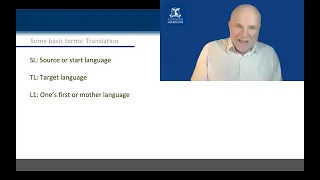
all right welcome to today's lesson in spanish translation uh today we're going to talk about definitions and models answer the questions what is translation on what are some of the steps in the process of translation so first of all some basic terms which we may have already covered in class right when we talk about translation we talk about going from the source text or st to the target text or tt in the source language sl to the target language tl so those are basic terms and in spanish source text is dexto original or texto de
partida or texto fuente literally or source language could be lengua or idioma original on the other hand right target text is going to be text meta or text objectivo textino so those are some basic terms that you'll want to be sure that you know in english in espanol moving on let's look at some definitions these come from the discipline of translation studies some of these people are dedicated translation scholars some of them might be linguists but let's look at these definitions what is translation a person named catford in his book a linguistic theory of translation
back in the 1960s defined translation as quote an operation performed on languages a process of substituting a text in one language for a text in another translation may be defined as the replacement of textual material in one language the source language by equivalent material in another language the target language so what he's talking about replacing is textual material in one language for textual material in another language that's kind of a what is textual material let's look at peter newmark one of my favorite translation theorists his definition is translation is a craft so it's interesting that
he calls it a craft consisting in the attempt to replace a written message and or statement in one language so whereas cat further talked about textual material newmark is more specific a written message and or statement in one language by the same message and or statement in another language so some important things to unpack in newmark's definition first he calls it a craft so it's an ability it's an art it's a skill that we develop we're replacing a written message or statement going from one language to another and i like how he says it's the
attempt so it's something that's difficult to do and also the same message so he hits on that idea of equivalence or correspondence all right moving on to one of my favorite theorists in translation studies mildred larson i like this definition she talks about the form and the content right so she says quote translation is basically a change in form it consists of transferring the meaning of the source language into the receptor language or target language this is done by going from the form of the first language so the source language to the forms of a
second language by way of semantic structure so she says and this is important it's meaning which is being transferred so the meaning is held constant only the form changes so she says translation then consists of studying the lexicon grammatical structure communication situation and cultural context so all those things we need to analyze right when we look at a source text analyzing in order to determine its meaning and then restructuring the same meaning using the lexicon grammatical structure cultural norms etc that are appropriate and the receptor language and its cultural context so she's making a distinction
between form and meaning or form and content and saying what must remain the same is the meaning or the content but what must change is the form we'll come back to her definition when we look at her model in just a minute a similar definition is by susan bassnet mcguire she says what is generally understood as translation involves the rendering of a source language text into the target language so as to ensure the surface meaning of the two will be approximately similar and the structures of the source language will be preserved as closely as possible
if you go back to the previous slide larson was talking about changing the form but holding the meaning constant bassnet maguire is talking more about a given take right we want the meaning to be as close as possible but we also want the structures or the forms the language forms to be as close as possible but not so closely she says finishing up here with her quote that the target language structures will be seriously distorted she's basically saying that we want the language of the source text to look as similar as possible to the language
forms in the i'm sorry we want the language and the target text to look as similar as possible but not so similar that they distort the target language structures right that they seem unnatural to a target language reader let's look at some models going back to mildred larson who talked about meaning is what's transferred but form is what changes when it's restructured so some of these models are similar and i think hers mildred larson's model is the one that makes sense to me and the others may be variations on this idea she has the source
language right this orange box that's the text that the client gives the translator to be translated the translator's task is to discover the meaning that's actually harder than it might appear and then what's held constant is that meaning the translator's job is to reformulate restructure re-express the meaning in the receptor language in forms that are appropriate for the target language so again with larsen meaning is held constant we sort of deconstruct the the source text figure out what it means and then we reconstruct that same meaning using the appropriate target language forms another model by
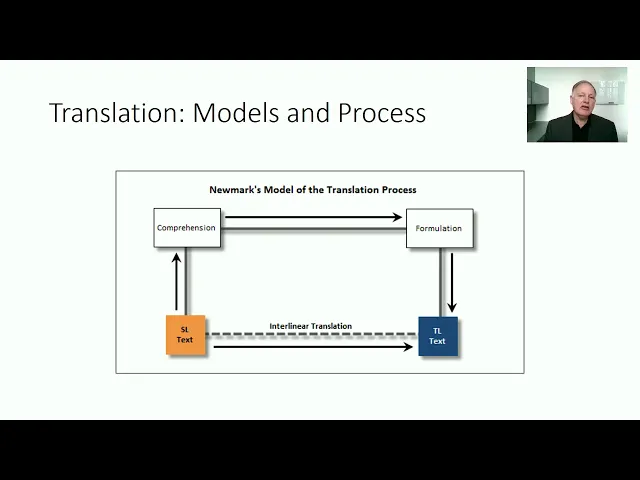
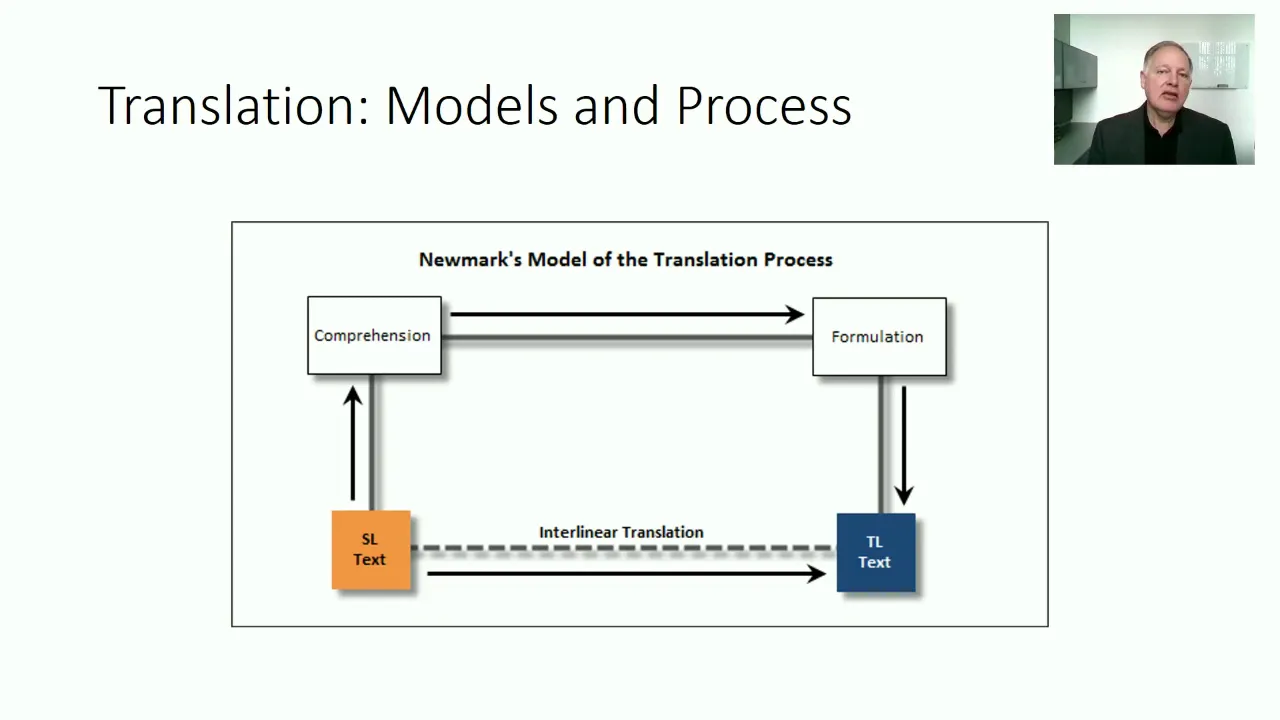
eugene nida here similar right he's showing how that determination of meaning involves analysis and then transfer and restructuring into the target language so a similar sort of sequence and process newmark if you look also the same steps you start with the source language text you go to interpreting or comprehending understanding what that text is saying and then through a process of reformulation into the target language text that dashed or dotted line he has across the bottom that says interlinear translation interlinear translation is word for word translation which he's trying to illustrate that that's not real
translation because word for word translation skips the steps of true comprehension and true reformulation all right so kind of putting all those things together i've come up with my own definition right based on several that i've read and so this is the one i want you to remember my definition and model of translation is what this course is kind of based upon so i would say that translation is a multi-step process in which various elements pertinent to the overall meaning of a text in one language its content its purpose the language register how formal is
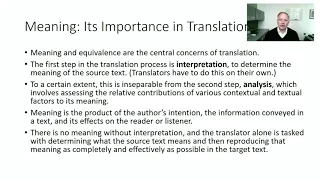
it tone effect on the reader among others cultural issues are replicated as closely as possible in another language so that's what translation is and it's important to understand if you see the blue box and i'll always reiterate this point the translation is a process that involves continuous decision making and so in terms of a model or the steps in this process i've identified five the first step is to not immediately start translating the text but to read it and interpret it right we need to determine the meaning of the source text and only the translator
can do that so what does the source text mean first step is to read it and interpret it determine its meaning second step is to perform an analysis to analyze the source text right assess the contributions of several contextual and textual factors to its overall meaning so we're trying to answer the question in the analysis phase or step how does that source text convey its meaning third is strategizing this is when we decide okay what are we trying to do with this translation what types of equivalency are we going to prioritize in which translation approach
a more literal approach a more free approach or freer approach or some other type of translation approach so we're thinking about how we're going to achieve that effective translation that's strategizing finally step four is when you actually dig in and start transferring the meaning restructuring the text reformulating it i call this step reformulation so that's when you're actually translating the source text creating the target text through the application of various translation procedures but then you're not done you still have step five which is review that's when you're proof proofreading the text editing the text making
sure it's accurate and free of any errors or mistakes okay so that's my five step model interpretation analysis strategizing reformulation and review let's look at one more slide i think this is just kind of interesting to think about as we begin this course what makes a good translator for example an agency translator a freelance translator or just an amateur hobbyist translator that's who's good and effective these are this is the skill set that um looking at several different websites and speaking to professionals that i know and through my own experience that i've identified first of
all if you think about that first step in my model translator has to have strong interpretive skills in the source language usually the source language the sl is the translator's second language so as a non-native speaker of spanish usually spanish is going to be the source language i'm usually going to translate from spanish to english in a professional setting so i need to develop super good interpretive skills in spanish second and this is very very important translators have to be excellent writers if you're not a very good writer in english you're probably not going to
be a very effective translator okay so you need to develop really good writing skills particularly in the target language which is usually the translator's native language so again in my case look at me do i look like a native spanish speaker i'm going to be my language pair is going to be spanish to english that's going to be my directionality you need to develop a deep understanding of the cultures of both source and target languages cultural understanding cultural sensitivity is very important to be an effective translator you need strong computer skills not just word processing
typing in microsoft word but also spreadsheets powerpoint you get all types of source texts in different formats you need to be familiar with the resources and tools computers assisted translation tools that translators use so just overall excellent computer skills you need very strong research skills you need to be a good critical thinker you need to be able to find accurate reliable information quickly so if there's something you don't understand in the source text you need to figure it out quickly thank god for google and and resources like that you also especially if you're working as
a freelancer you need very good interpersonal communication skills you're going to answer a lot of emails you're going to send a lot of emails you're going to take a lot of phone calls and so you need to be an effective interpersonal communicator and if you're working as a freelancer or on your own you've started your own company excellent time and workload management skills because translators basically make their money based on volume so it's all about being efficient being able to translate as much as much as possible as much as you can as quickly as possible
and finally some some traits not necessarily skills but personal or personality traits that make people effective translators detail-oriented being self-motivated because often you're working on your own you're not working with a team being organized intellectually curious if you're not a person that likes to learn gets excited about different ideas new fields you probably won't stay in the translation game very long need to be culturally sensitive as i just mentioned decisive because we talked about translation being a process of decision making and confident but not overconfident because i think something that translators need to develop is
that awareness of knowing what they don't know so that they can look look those things up so again this was today's video covered definitions of translation models of translation my own definition and model as your instructor and then finally we looked at the translator skill set hope this has been informative and i'll see you in class