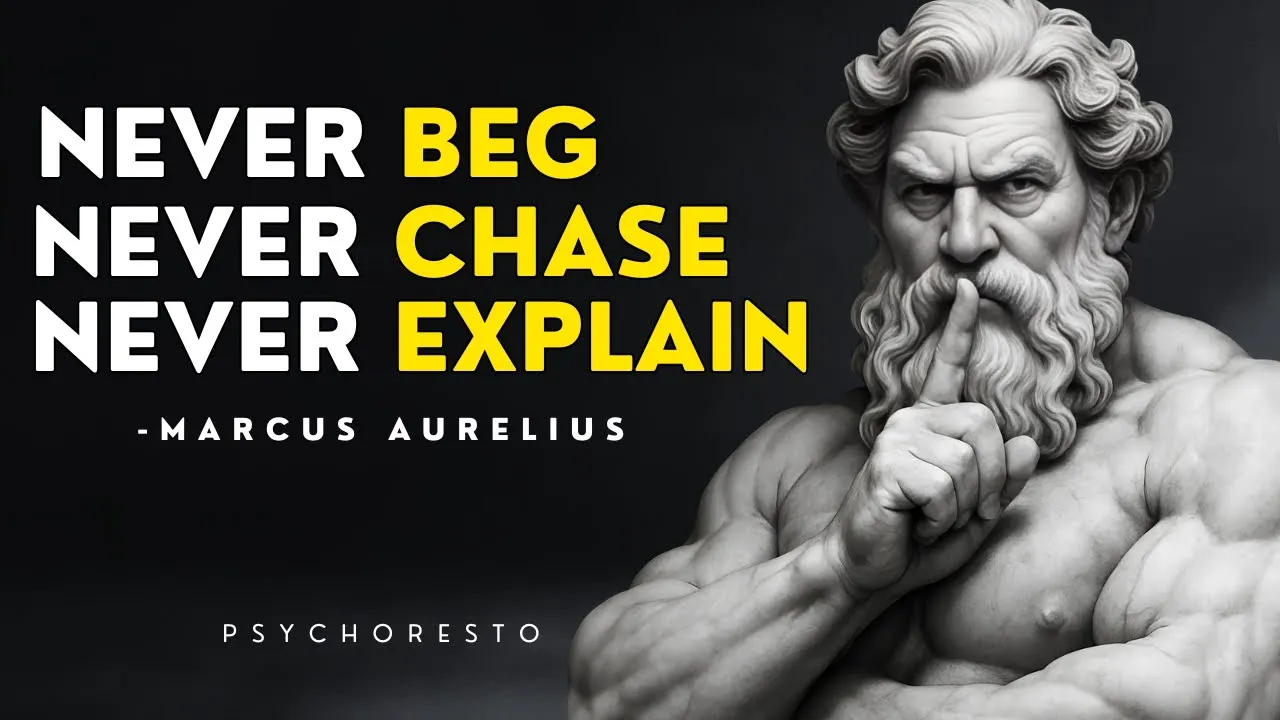
[Music] Hey stoic warrior, we live in a world where people are constantly trying to prove something. They prove they're right. They prove they're worthy.
They explain, overexlain, and sometimes even beg just to be seen. But the stoic doesn't do that. A stoic doesn't beg for attention.
A stoic doesn't chase validation. A stoic doesn't explain himself to the world because he knows silence is strength. Now, what most people do when they're hurt, rejected, or misunderstood, they rush.
They chase. They try to fix what's broken by explaining themselves to people who already decided not to understand. That right there is weakness pretending to be courage.
You call someone and they don't pick up. You text again. You message again.
You pour your heart out in a long paragraph, hoping they'll see your worth. But here's the truth. The more you explain, the more you beg, the more power you give away.
And that's not Stoic. The Stoics, like Marcus Aurelius and Epictitus, mastered the power of silence. Not because they didn't care, but because they understood this.
The more we value things outside our control, the less control we have. Epictitus. When you chase someone's attention or beg for their understanding, you're handing over control.
You're saying, "My peace depends on how you respond. " But that's not peace. That's prison.
Real strength is when someone disrespects you and you walk away without a word. Not out of pride, but because your dignity doesn't scream. It doesn't chase.
It doesn't explain. It silently detaches. This silence is not emptiness.
It's discipline. It's self-respect. It's inner strength that says, "I don't need to be heard by you to hear myself.
" And this silence terrifies people. Because when you don't react, they lose the control they thought they had over you. So today, let's talk about the kind of silence that builds power, not weakness.
The kind of silence that makes people wonder what changed. The kind of silence that lets your absence speak louder than any message you could send. We're going to break down six deep truths.
Six reasons why silence is a stoic superpower and why those who practice it never chase, beg, or explain themselves. If you're tired of overgiving, if you've been misunderstood, if you've ever chased someone who walked away from you, this is your moment to shift. Let this script be the reminder you didn't know you needed.
Before we dive into point one, do me one small favor. Like this video if it already resonates. Comment your thoughts and affirmations as we go.
Share this with someone who needs to hear this and subscribe to this channel for more stoic growth content. And most importantly, don't skip any part of this video because one idea, one truth might just change how you carry yourself forever. I want you to drop this affirmation in the comments.
My silence is my power. Number one, silence makes them feel your absence, not just hear your words. Have you ever noticed something strange?
When you stop explaining yourself, when you stop chasing, people suddenly start thinking. That's the paradox of silence. It doesn't push, it pulls.
Now, think about the last time you got hurt. Maybe someone ghosted you, disrespected you, or gave you the cold shoulder. Your instinct probably screamed, "Say something.
Fight back. Defend your worth. " But here's the thing.
The more you talk, the less they listen. The more you chase, the more they run. The more you explain, the less they value your words.
But when you go silent, suddenly they notice your absence more than they ever noticed your presence. He who does not understand your silence will probably not understand your words. Elbert Hubard.
Stoics understood this thousands of years ago because silence makes people uncomfortable in ways that noise never can. When you go silent on someone who expected you to beg, when you withdraw instead of react, you force them to confront something deeper, their own actions. See, silence holds up a mirror.
It says, "I saw what you did. I felt how you treated me, but I value myself too much to explain it to you. That kind of silence doesn't come from ego.
It comes from clarity. You realize if they cared, they would ask. If they respected you, they would reach out.
If they were emotionally mature, they wouldn't need a paragraph to understand your worth. So, you stay silent. And in that silence, you reclaim all the power you once gave away.
You stop wasting energy trying to be understood by people who don't even understand themselves. You stop trying to heal through conversation because some wounds heal better in silence. And yes, it's uncomfortable because your silence will trigger them.
It will confuse them. It will make them ask questions like, "Why isn't he reacting? Why didn't she respond?
Did they stop caring? That's when the power shifts because silence speaks one truth they can't ignore. You don't owe them an explanation.
Not anymore. Number two, when you stay silent, you hear the truth louder. The world is loud, but silence helps you listen, not to others, to yourself.
In moments of heartbreak, betrayal, or confusion, most people run to others for advice, validation, or a temporary emotional fix. They'll call five friends, scroll endlessly on social media, or even confront the person who hurt them, hoping the right conversation will heal the wrong person. But the stoic does something radically different.
He goes silent not because he doesn't feel pain but because he knows that real answers don't come from noise they come from reflection. If you are distressed by anything external the pain is not due to the thing itself but to your estimate of it and this you have the power to revoke at any moment. Marcus Aurelius.
When you get silent, truly silent, the mind calms down. And when the mind calms down, the truth rises to the surface. You begin to hear things like, "They never really respected me.
I just didn't want to accept it. I'm not angry because they left. I'm angry because I stayed too long.
I don't need closure. I need peace. " These truths don't come in a text message.
They come in the quiet hours when you stop explaining and start listening. Silence gives you space to separate your emotions from your values. Because when you're hurt, your emotions scream.
Chase them. Explain yourself. Prove your worth.
But when you're silent, your values whisper. Hold your dignity. Protect your peace.
Let them go. This is why Stoics didn't react quickly. They didn't make decisions in anger.
They embraced a kind of sacred stillness, a pause before the storm. Modern society teaches the opposite. Speak your mind.
Tell them how you feel. Don't let anyone disrespect you. But here's what most people miss.
You don't gain respect by reacting louder. You gain it by staying grounded in silence while everyone else spirals in noise. The more silent you are, the more people reveal themselves.
You don't have to ask, "Do they care? " Their actions will show you. You don't have to beg for clarity.
The truth comes out in your stillness. And most importantly, you stop reacting to life and start responding with purpose. Silence isn't passive.
It's focused. It's intentional. It's the doorway to inner wisdom most people never walk through.
So when you're unsure, when you're overwhelmed, when your emotions are clouded, don't act. Be still. The answer isn't outside, it's inside, and you'll hear it in silence.
Number three, begging for closure is a form of self- betrayal. Let's talk about something many people never admit. Begging for closure often ends in more pain, not peace.
We all crave it. That final explanation, that one honest conversation, the ending that feels complete. But here's the brutal truth.
If someone truly cared, you wouldn't have to beg for closure. They would give it to you with respect. And if they don't, your silence is the closure.
Don't explain your philosophy. Embody it. Epictitus.
This quote might not seem connected at first, but here's how it applies. When you stop chasing closure and start embodying your values, you stop needing other people to validate your pain. The pain is real.
But needing them to explain why they hurt you, that's you giving them control over your healing. Here's the cycle. One, they hurt you.
Two, you demand answers. Three, they respond with coldness or avoidance. Four, you feel even worse and the cycle repeats until you realize closure isn't something they give you.
It's something you give yourself when you finally go silent and walk away. It's easy to convince yourself if I just tell them how I feel. If I just explain my side, if I just get that one last talk, but here's what really happens.
You end up talking to someone who already made peace with hurting you. You end up explaining yourself to someone who's already made their choice. You end up wasting energy hoping someone else will fix your broken expectations.
That's not closure. That's self-abandonment. Stoics knew that emotions can cloud our judgment.
Especially when ego is involved. You want to be seen as the good one. You want to be understood.
You want them to finally get it, but chasing that is a betrayal of your own growth. Real closure is this. You recognize that what they gave you was the most they could give.
You accept that no amount of explanation will make them more respectful, more loving, or more honest. You stop waiting for a conversation that will never happen. And in that acceptance, your power returns.
The people who hurt you don't need to understand your worth. You do. The people who left don't need to say goodbye.
You can say it without a word. The people who ghosted don't need a second chance. Your silence is their answer.
So stop writing those unscent letters. Stop rehearsing the perfect message. Stop chasing closure in people who were never open in the first place.
Go silent. And let your silence be the space where self-respect finally breathes again. Number four, silence exposes what words try to hide.
When you go silent, something powerful happens. Masks fall off. Words can be a beautiful thing, but they can also be deceptive.
People say what sounds right. They say what they think you want to hear. They use explanations, justifications, apologies.
But silence, silence can't lie. What you do speak so loudly that I cannot hear what you say. Ralph Waldo Emerson.
Stoics understood this truth deeply. They didn't judge a person by their apologies. They judge them by their patterns.
And the best way to see someone's pattern is to stop talking and watch. Because silence is not passive, it's observant. When you stop explaining yourself, you give people space to reveal their real nature.
And trust me, they will. The one who truly respects you will miss your presence and reach out with honesty. The one who only used you will vanish because they never valued you in the first place.
The one who manipulated you will grow angry or confused. Not because you did something wrong, but because they lost control. Here's what most people don't realize.
Words can create illusion. Silence reveals reality. You don't need to confront them.
You don't need to test them. Just withdraw your words and see. See who checks in when you're quiet.
See who disappears when you stop giving. See who gets frustrated when they can't provoke a reaction out of you. That's the truth.
And it's brutal but necessary. Sometimes silence hurts more than a thousand confrontations. Because people can dismiss your words, but they can't dismiss your absence.
They can argue with your opinions, but they can't argue with your stillness. When you stay quiet, you stop feeding their illusion. You stop playing their emotional games.
You stop pretending that their words mean more than their actions. And this kind of silence, it brings you clarity. You stop needing people to explain why they treated you badly because their silence, their distance, their actions, they already did.
You start trusting patterns over promises. You start believing energy over explanations. You begin to value what's real, not what's spoken.
That's stoicism. It's not cold. It's clear.
It's not distant. It's discerning. It's not emotionless.
It's emotionally disciplined. So the next time someone tries to talk their way back into your life, don't rush to respond. Observe.
Go silent and let the truth speak without words. Number five, not explaining yourself is the highest form of confidence. Let's be honest.
When someone misunderstands you, it hurts. You want to defend yourself. You want to explain why you're not what they think.
You want to say, "That's not me. " But the stoic doesn't chase understanding from others. He seeks understanding within himself.
Why? Because explaining yourself to people who already made up their minds is not confidence. It's fear of being misjudged.
Don't waste what remains of your life in speculating about your neighbors unless with a view to some mutual benefit. Marcus Orurelius. Think about that.
Every time you try to convince someone of your worth, your goodness, or your loyalty, you're spending your limited time and energy on someone else's judgment. That's not power. That's insecurity.
The person who doesn't explain himself is not arrogant. He's at peace because he knows. His intentions are clean.
His actions are aligned. His value doesn't need to be translated to those who don't care to understand it. This level of detachment isn't easy.
You'll be called cold. You'll be labeled selfish. You might even lose people who once felt close to you.
But guess what? Losing people who never truly saw you is not a loss. It's alignment.
Here's the truth no one wants to admit. Most people don't want to understand you. They want to control how you're perceived.
And if your silence breaks their illusion, they get angry. Not because you hurt them, but because you stopped playing their game. When you stop explaining, you start leading with energy.
You stop justifying your distance. You stop explaining why you walked away. You stop defending your peace.
You simply act. And those who are meant to be in your life will understand that silence without needing subtitles. This kind of energy is rare.
It makes people uncomfortable. It makes manipulators lose interest. It makes users walk away.
But the ones who remain, they respect you deeply because they know you won't lower your value to fit someone's misunderstanding. That's stoic silence. Not loud, not desperate, not theatrical, just calm, rooted, unshakable.
You don't owe anyone an explanation for choosing peace. You don't need to convince anyone that your boundary is valid. You don't need to speak your value into rooms where your silence already said it all.
Number six, your detachment in silence is what teaches them the lesson. There's something uniquely powerful about a person who chooses to walk away. Not in anger, not in drama, but in quiet detachment.
You don't slam the door. You don't send a final emotional message. You simply leave.
And in that silence, you teach the lesson no words ever could. We suffer more often in imagination than in reality. Senica.
This quote reminds us that the real suffering begins when the mind starts replaying silence. When you stop responding, they're left alone with their thoughts, with their guilt, with their memory of how you treated them, with the echo of your absence. Your detachment says, "I no longer need to prove myself to you.
I will not stay where I am not respected. I've realized that peace is more valuable than connection. " Most people don't know how to handle this kind of energy.
They're used to people who react, who beg, who fight for closure, who break down to be heard. But when you go silent, you stop playing the emotional game. You exit with dignity, and your silence forces them to confront themselves.
They expect you to chase. They expect you to fight, to stay. They expect you to come back.
But you don't. And that scares them more than any argument ever could. because suddenly they realize they don't have access to your energy anymore.
They don't have the upper hand. They didn't think you'd really walk away. That's the moment the lesson begins.
Because people don't learn from words. They learn from distance. They don't change when you scream, "Respect me.
" They change, if ever, when your absence makes them realize what they lost. And if they don't, that's okay, too. The lesson wasn't for them.
It was for you. You learned that your peace doesn't need permission. You learned that not everyone deserves an explanation.
You learned that sometimes silence isn't just strength, it's healing. When you detach in silence, you remove yourself from toxic patterns. You stop bleeding in front of people who aren't capable of understanding pain.
You stop explaining storms to those who live indoors. Detachment doesn't mean you don't care. It means you care too much about your own soul to keep it in a space where it's being neglected.
That's why stoics weren't reactive. They didn't chase justice. They didn't seek validation.
They let the silence speak for them. You don't have to yell, "I'm done. " You can just be done.
That's real power. And that's the kind of silence that terrifies the people who thought they had control over you. So don't be afraid to detach.
Detach. Go quiet and let them sit in the space where your voice used to be. If you've made it this far, you already feel it.
There's a shift happening inside you. A quiet realization. A truth you've always known but maybe forgot along the way.
You don't have to chase, beg, or explain yourself to be worthy. You don't have to be loud to be heard. You don't have to prove your side to be understood.
You don't have to break your own peace just to keep someone else comfortable. That's the foundation of stoicism. It's not about coldness.
It's about clarity. It's not about detachment from love. It's about detachment from chaos.
The Stoics taught us something powerful. That silence is not weakness. It's control.
It's the refusal to waste energy on what's beneath you. It's the confidence to know that your presence is valuable, even when it's gone. There will always be moments where your emotions want to take over, where you'll feel the urge to explain, to fight, to prove.
But in those moments, remember this. Your silence might not win the argument, but it will win yourself back. Because every time you choose not to react, you build inner peace.
Every time you walk away quietly, you build self-worth. Every time you keep your dignity intact, you build the kind of power that can't be stolen. And if there's one thing to take from this entire video, it's this.
Let your silence be your final word. Not out of ego, not out of spite, but out of deep, unshakable self-respect. Thank you for watching.
If this video hit your heart, like it now. Share it with someone you know is ready to grow. Comment your affirmations below.
Your voice matters here. And subscribe for more stoic truth every single week. I want you to drop this final affirmation in the comments.
My silence is my last word and my most powerful one.