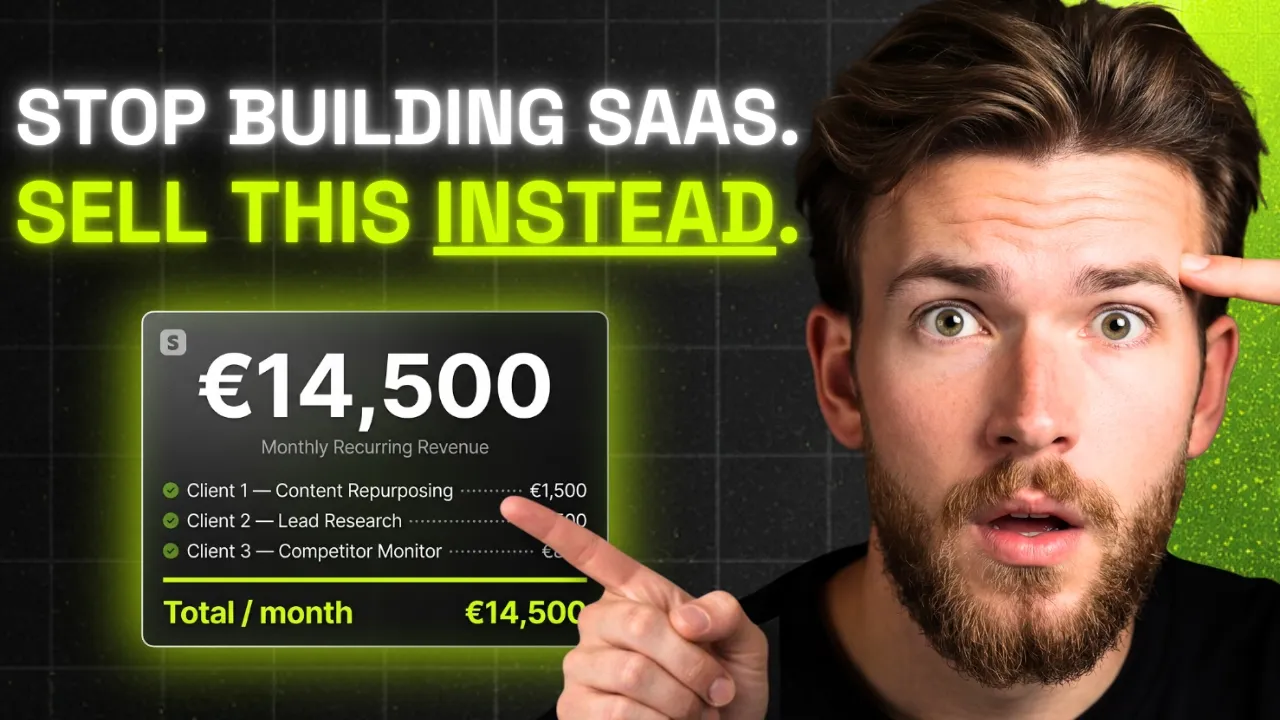
The guy who built Chetchub was asked, "If you were 24 and starting a company today, what would you build? " His answer wasn't a SAS. It wasn't an AI tool.
It was something most people in this entire space have never even consider it. And a few weeks ago, a publicly traded company restructured their entire business around this same idea. And they were calling it a paradigm shift.
I'm going to show you exactly what it is. And at the end, I built you a template you can steal and start selling with this week. But there is a password and I will only give it to you if you stick around.
It's very important that you understand every single part of this. But first, let me ruin SAS for you. Recurring revenue.
Build once, sell forever. It sounds perfect. But here's what actually happens.
You spend four to six months building 0 the entire time. Then you launch and you realize you need a,000 paying users just to make real money. At $50 a month, that's 50K monthly recurring revenue.
Except getting a,000 strangers to pay you for anything is borderline impossible. And even if you pull it off, Churn eats you alive. Every month, 5 to 10% of your users cancel.
You're not growing. You're running on a treadmill trying not to fall off. But here's the part nobody talks about.
People don't trust AI software yet. When someone buys your AI SAS, they're thinking, "What if this thing sends the wrong email? What if it writes something embarrassing?
" You're not selling a tool. You're asking them to take a risk and that's a brutal cell. So maybe services then an agency, your margins are 20, maybe 30%.
You can only grow by hiring more salaries or staying on your own. But if you're choosing to grow, you have more management, more fires to put out, and you don't build a business. You build yourself a stressful job.
SAS is hard mode and agencies are a trap. But there's a third option that gives you the best of both worlds. What if you could get SAS margins, 70 to 80%, but charge agency prices?
What if you could scale without hiring anyone? What if the reason people don't trust AI tools actually became your advantage? That is exactly what Sam Alman was hinting at.
That is exactly what Y Combinator is betting on when they say they want to fund the first 10 person, 100 billion dollar company. 10 people, a hundred billion and one business model that makes math work. And it is actually called RAS, results as a service.
So where SAS is basically telling you here's a tool and figure it out yourself, RAS actually says tell me what you need and I'll deliver it. The same tech, the same AI, the same skills you already have, but different packaging. And it's 10 times surprise.
The AI runs in the background. The client never sees it. They just get the result.
And because you deliver it personally, you become the trust layer. They're not buying scary AI software. They're buying you.
Now, I know you probably have three objections, but let me kill all of them. And I cannot read your mind, but those are probably the ones you have in your mind. Isn't this number one?
Isn't this just an agency? But with a traditional agency, your client pays 3,000 a month. Your margins after paying your team is 25%.
So your profit is $750. But you, with the RAS model, your clients pays maybe 1,500 a month, half the price for them, but your margin is $75. So your profit is actually over $1,100.
So you charge less, you make more because AI is your employee and AI doesn't need a salary, vacation or a performance review. So objection number two, how do I sell this without a product? You don't sell a product, you sell a promise.
I will get you 50 qualified leads a month. I will turn your podcast into 30 social posts a week. I will track your competitors and send you a weekly report.
The client doesn't care how you do it. They care that it gets done. Selling an outcome is 10 times easier than selling a weird new AI tool.
Objection number three, what if the AI isn't good enough? You are actually the quality layer. So AI does 80% of the work and you do the final 20.
You check it, you polish it, and you make sure it's right. You're still 10 times faster than doing this manually, 10 times cheaper than a team. But because you review everything, the client trusts you, not some random AI.
And this is not just theory. People are already printing money with this. Belkins, a lead generation company.
They don't sell software. They book meetings. The client pays monthly, gets qualified appointments on their calendar, and they have over 200,000 meetings booked.
Clients report 10x return on every dollar spent. And the client never touches a tool, never logs into anything, just shows up to sales calls. That's RAS at skill.
But here's what's exciting. One person with AI can now deliver what used to take a team of 10. So let me give you three ideas you can start with this week.
One, AI lead research, $500 a month. Your client tells you their ideal customer and you deliver 200 qualified leads monthly. Names, emails, company info, AI scrapes, and enriches and you just clean it up and done.
Number two, AI content repurposing. So, for example, $800 every single month and your client sends you one long video or a blog post and you turn it into 30 pieces of social content. So, the AI writes, you polish, the client gets content every week without lifting a finger.
Number three is AI competitor monitoring. So, for example, $400 every single month. You track five competitors and you give a weekly report on what they posted, pricing changes, new features, and what's working.
For example, and the AI monitors, you summarize, the client stays ahead, but you are the face. You provide it to them. And every single one AI does 80%.
You do the last 20. So, the client pays you for the result. Now, let me show you how stupidly simple the back [music] end is.
So, I'm building one of these right here, and it is a content repurposing service. This is what a client paying $800 a month will actually see. So, we have a landing page, what the service does, the pricing, and a button to get started.
We have an intake form. A client uploads their video or a blog and picks their brand voice. And then they select which platforms they want content for.
Then the back end AI takes the content, breaks it down, writes 30 posts in their voice, and finally the delivery dashboard. The client logs in, sees all their content, downloads it, done. That's it.
That's what you're selling for $800 a month. So if you have 20 clients on this, do the math. Because you're delivering results instead of handing someone a confusing tool, they stay.
So let me make this painfully clear. Path one, SAS, built for 6 months. Launch and grind to 50 users at $50.
That's 2500 a month. To hit 10K, you need 200 paying users. That takes a long time.
Path two, RAS. Build your back end in one week and get five clients at 1,500. That's 7,500 a month.
Already triple the SAS. And with 10 clients, I mean, do the math. Sell something high ticket, but with the same AI, the same skills, but a completely different life.
All right. So, I promise you a template. The link is in the description and when you click it, you will see a password field.
The password is results. Type that in, hit remix in love ball and the entire app copies to your account. If you want more templates like this, plus the full system for getting clients, this is what Build Loop is for.
Link is in the description. And if you've enjoyed this video, make sure to like and subscribe.





![Figma To App Store In 37 Minutes With AI [Tutorial]](https://i.ytimg.com/vi/adVJ0DBNOAw/mqdefault.jpg)