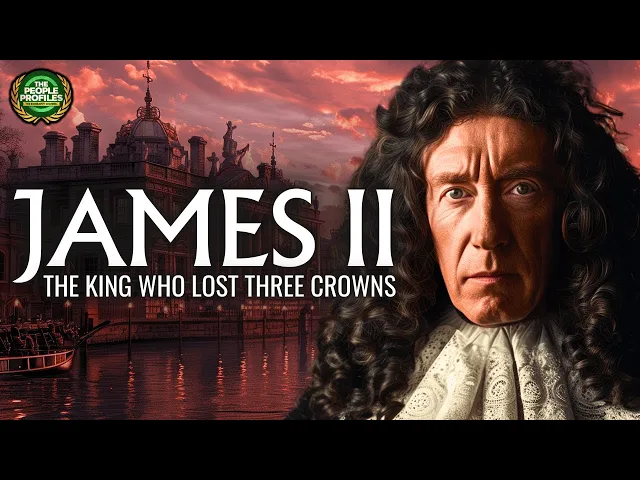
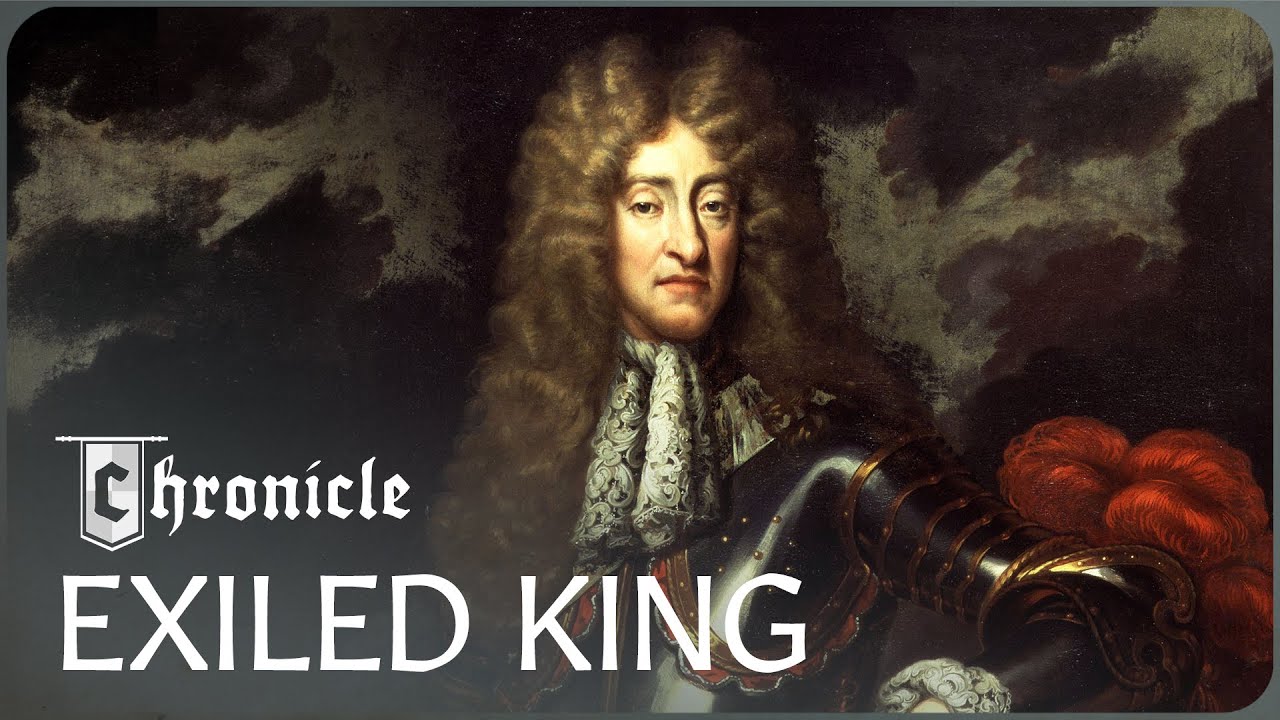
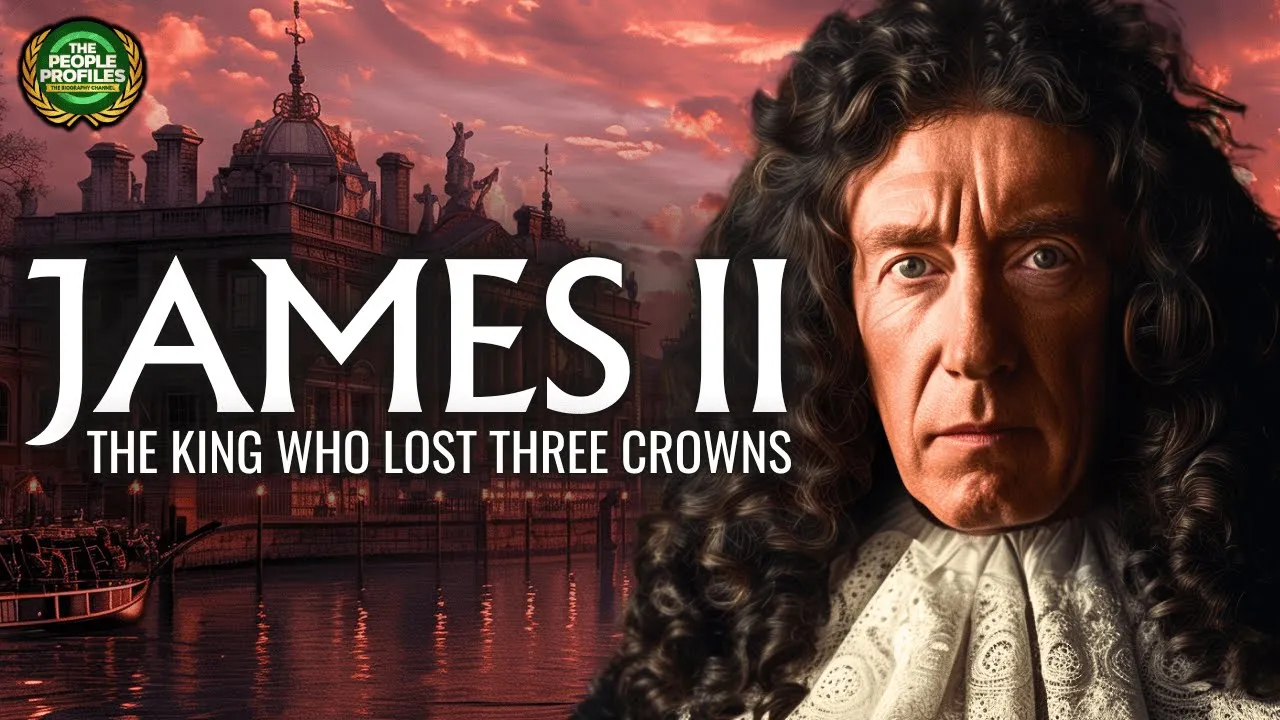
The man known to history as King James II was born on the 14th of October 1633 at St James’ Palace in London. His father was Charles I, King of England, Scotland and Ireland since 1625. At the time of James’ birth his father was involved in a growing conflict with the political communities of his three realms as his rule became more autocratic and he increasingly refused to consult with parliament in England about a wide range of matters. Much of this conflict concerned religious matters, and the desire of the Stuart monarchs to establish a more absolutist form
of monarchy such as was increasingly the norm on the continent in the seventeenth century. These forces would shape much of James’ life over half a century later. James’ mother was Queen Henrietta Maria, a sister of King Louis XIII of France. Henrietta was a somewhat controversial figure in England on account of her Roman Catholicism, a factor which insured that James, his father and his siblings would be constantly suspected of a form of crypto-Catholicism throughout the seventeenth century. James was not the first born child of his parents. Another boy, named Charles after his father, had been born
in 1630 and was heir to the triple monarchy, while a daughter named Mary was born in 1631. Additionally, James, Charles and Mary had several other siblings born in the late 1620s and 1630s, but many of these died either in infancy or their earlier years, in line with the high levels of infant and child mortality which prevailed in early modern Europe. Like any royal child in early modern Europe, James was raised by a series of private tutors and governors and governesses of his own private household, a peculiar scenario to modern eyes, which insured that many aspects
of his infant and childhood years were not overseen by his Mother and father, but by an extensive array of court figures. In James’ case much of his rearing was entrusted to William Seymour, Marquess of Hertford, a situation which persisted into the early 1640s. He was also granted numerous noble titles and honours from a young age. For instance, King Charles bestowed the title of Duke of York on his second eldest surviving son not long after he was born in 1633, though he would only be formally invested with it in 1644. This was an auspicious title, having
once been granted to the line of one of the sons of King Edward III of England, whose ancestors, the Yorkists, had gone on to significantly influence the course of English history in the fifteenth century. James was intimately associated with the title of Duke of York throughout most of his life and as we will see it also impacted on the naming of one of the world’s foremost cities. On top of this James was made a member of the Order of the Knights of the Garter in 1642, the highest chivalric honour in England, and the Lord High
Admiral in 1636. The latter position would become significant in later years, though obviously James did not exercise any substantive authority over the British Royal Navy after being appointed head of it at three years of age. These issues of his education and early years aside, James’ early life was otherwise blighted by the declining political situation across his father’s realms. Even when James was born King Charles was already growing into a more and more disliked figure across England, Scotland and Ireland, in large part owing to his unwillingness to convene parliaments in any of these countries through which
the political communities there could express their grievances and also owing to the perception of him as an autocratic and heavy-handed ruler, one who was especially reviled for his desire to impose a state-centred Form of moderate Protestantism. It was his efforts to introduce such religious conservatism into England and Scotland in the late 1630s which first led to outright clashes between James’ father and many of his subjects. This led to the Bishops Wars in Scotland in the late 1630s and early 1640s, which in turn led to an increasing conflict between Charles and the English Parliament in 1641.
To compound matters, a rebellion broke out amongst the Catholics of Ireland in the autumn of 1641. Within a year thereof Charles would be at war with the Parliamentarians in England, conflicts variously known as the English Civil Wars in England and the Wars of the Three Kingdoms when extended to Scotland and Ireland. These conflicts would last for years and shaped not only the reign of James’ father, but Also young James’ life and that of his siblings. When the First English Civil War broke out in 1642, James and his older brother Charles became points of political conflict
as their father sought to use the pair to display continuing signs of royal control over parts of the country. For instance, when their father abandoned London and left it under the control of parliament, James and Charles were brought north to join their father at a series of cities and towns where he established his government. York was one such town and, as the titular Duke of York, much was made of bringing James along, even at less than ten years old, to join his father there late in 1642. Other roles were equally ceremonial. James, for example, was
sent as his father’s representative to the governor of the town of Hull, Sir John Hotham, to inform him that Charles and the Royalist supporters would Soon be entering the port to dine there. This was an important moment in the growing conflict as Hotham’s refusal was one of the most striking episodes in the eventual outbreak of outright hostilities between King and Parliament. Charles effectively declared war on the Parliamentarians just a few days later. Thus, James found himself being sent to Oxford, a university town which became the Royalist capital in the mid-1640s and where James would spend
the next two years with his education being advanced under new tutors such as Brian Duppa, the former Bishop of Salisbury. It has been widely speculated, though, that James was not a talented scholar, his education having been immensely interrupted between 1640 and 1642 as the Civil Wars developed, and that he preferred hunting and other outdoor pursuits, although he did admittedly become a proficient musician and French-speaker, the latter being a language which was already Emerging as the lingua franca of European culture and court life. Developments with James over the next several years were peculiar in many respects.
While his older brother Charles was eventually sent to the continent to join their mother, Queen Henrietta Maria, in exile in France, James and his other siblings remained in England and were viewed as less valuable targets for Parliament to acquire. But James would soon be pulled into the intrigue. By 1645 the English Parliament had made considerable gains against the Royalists and was in control of ever growing sections of the country, while the First Civil War effectively came to an end in 1646 with Parliament’s capture of Oxford. As this occurred, negotiations were entered into between King Charles
and Parliament. Owing to these, James became a subject of political intrigue, with some of the Parliamentarians speculating that if King Charles would not make concessions, and with his son Prince Charles in exile on the continent, there might be room to crown James as a puppet king in his father’s place. Charles, alert to this eventuality, conspired to have his second eldest son removed from Britain and in the spring of 1648 he was sent across the North Sea to the Hague in the Dutch Republic where many of the Royalists in exile had congregated. Some few months later
James, like the rest of the Royalists and the royal family, would learn that King Charles had been placed on trial by the English Parliament and was subsequently executed in January 1649. Prince Charles, James’ older brother, would now become the centre of Royalist intrigue, but for James and the rest of his family, the next decade would be spent in constant exile in France and the Dutch Republic. In the early years of the Stuart family’s exile they primarily lived in France and near The French royal court in Paris. James’ mother, after all, was a member of the
French royal family and this seemed a natural location for the Stuarts to set up their court in exile. It was here in 1652 that James was involved in his first considerable piece of military activity during the Fronde, a series of revolts across the country against crown rule. He was subsequently given a senior military title within the French army, though as matters proceeded over the next several years both he and Charles ended up drifting closer towards the Spanish in their diplomatic alignments, a country with which France had been at war intermittently for decades. The Spanish controlled
the Spanish Netherlands at the time, a region approximate to modern-day Belgium, Luxembourg and parts of north-eastern France, and it was to here that the Stuarts drifted in the second half of the 1650s, with James and his brother residing for a time At Bruges. Here James prospered under Spanish patronage and he was even offered a position as an admiral in the Spanish navy, though he declined this in the hopes that a restoration of the Stuart monarchy back in England, Scotland and Ireland might yet occur. James’ exile would be resolved in a more successful manner than a
second period of exile that would occur at the end of his life. In the earlier instance, the antipathy which many in England, Scotland and Ireland had expressed in the 1630s and 1640s towards James’ father, King Charles I, soon gave way to a sort of fond remembrance. While James, Charles and the rest of their family were in exile on the continent in the 1650s, the English government had effectively evolved into a species of quasi-military dictatorship, one in which the former commanders of England’s New Model Army, which had been established In the mid-1640s to defeat King Charles
and the Royalists, were given positions of immense power. No individual was more powerful than Oliver Cromwell, who was eventually made Lord Protector of the English Commonwealth and was even offered the throne, though he rejected the offer. When he died in September 1658, though, England’s experiment in republicanism began to decline precipitously. Many people were unhappy with the dour religious environment created by the Puritans, of whom Cromwell was a prominent figure, while the economic situation was not good and Cromwell’s son, Richard, proved unequal to succeeding him as Lord Protector. Hence, in 1659 negotiations were opened between several
prominent English and Scottish lords and James’ brother Charles to have him return to England and for the monarchy to be restored. In this striking twist of events, Prince Charles quickly agreed to certain terms whereby he Would not seek revenge against parliament and would honour its liberties and rights in return for his accession as king. With this agreement in place, Charles and his entourage left the Dutch Republic in the spring of 1660 for England. Charles entered London on the 29th of May 1660 and the Restoration began as he was crowned as King Charles II of England,
Scotland and Ireland the following spring. The Restoration was quickly followed by James’ first marriage. This was to Anne Hyde, a daughter of Edward Hyde, the first earl of Clarendon and King Charles II’s chief minister for much of the 1660s. The Hydes had been stalwart supporters of the Stuarts throughout the 1640s and 1650s, but nevertheless James’ marriage to Anne in secret just a few months after the Restoration occurred, in September 1660, was controversial, as James had not sought the full approval Of his brother. It was effectively a shotgun wedding as Anne was heavily pregnant by the
time the marriage was legally declared. It was also considered problematic as it seemed to suggest that the Hydes were now obtaining too strong a position within the political sphere, as Anne’s father became the most powerful minister of the day and she was married to the king’s brother. This was especially the case as Charles did not have a legitimate male heir, although he had many illegitimate children, and as such, should Charles die prematurely, James would succeed him followed by any children produced through his marriage to Anne. The lives of these children, though, were all too fleeting.
A boy named Charles after his uncle and grandfather was born in late October 1660, just six weeks after James and Anne married, but he died of smallpox just six months later. Seven further children followed, but of these only two survived beyond childhood and infancy, the rest succumbing to infant mortality, the bubonic plague and other illnesses. The two survivors were Mary, born in 1662, and Anne, born in 1665. Both of these women would live to rule as Queens of England, Scotland and Ireland once day. The Restoration era and court is typically identified as a place and
time of immense sexual and moral liberty by comparison with what preceded it and the typical standards of the early modern era. This was typified in the character of James’ brother, the king, who sired well over a dozen illegitimate children with numerous mistresses and was a keen supporter of the theatre, drinking and other pursuits of a pleasurable nature. Despite his ardent religious beliefs, James followed his brother’s lead as a leading Libertine of the Restoration period. He had numerous mistresses, amongst whom Anne Carnegie, Countess of Southesk, was prominent, as was Arabella Churchill, the sister of John Churchill,
the future Duke of Marlborough. James’ other major activity for much of the 1660s and 1670s was hunting, particularly fox hunting, and he maintained an extensive series of kennels for his hounds and stables for his horses to this end. It was, in short, something of a frivolous life during the Restoration era for the future king. Yet in other ways he was more modest in his behaviour than his older brother. James, for instance, was known, for being opposed in general to gambling and to rarely drinking to excess, unlike Charles. Much of James’ activities in the 1660s on
an official level concerned his role as Lord High Admiral of England and the titular head of the Royal Navy during a period when Britain’s empire was beginning to expand in a significant way. These roles ensured that when England or Britain went to war James was responsible for overseeing naval affairs, while he also carried the titles of Lord Warden of the Cinque Ports, five historically important ports along the southern coast of England in the English Channel, as well as governor of Portsmouth, making James a significant figure as well when it came to maritime trade in the
English Channel and a wide range of other matters. Though he had held these offices as far back as his father’s reign, it was only in the 1660s that he began to exercise them in a meaningful fashion. Much of this focused on England’s major war with the Dutch Republic during the mid-1660s, the Second Anglo-Dutch War. This was fought at a time when England and the Dutch were major rivals for dominance Of huge amounts of European and Atlantic trade. As head of the Royal Navy, James was responsible for managing many of the naval clashes, though he earned
criticism for the Dutch raid on the Medway when English ships were attacked at anchor in southern England. Thereafter he initiated a programme of reforms to build a series of fortifications along the coast of southern England, to prevent against such further attacks. The Second Anglo-Dutch War ended in something of a stalemate, which could even be considered a Dutch victory, but in one important area the English came out on top. In the first half of the seventeenth century various European states had begun colonising various parts of the North America seaboard. The French for instance were entrenched into
the Quebec region by the 1610s, while England had settled its first colonies at Virginia and New England between 1607 and 1620. The Dutch were also involved, founding a successful trading and fur-trapping colony along the shores of the River Hudson, notably at the southern point of the island of Manhattan, a settlement which they called New Amsterdam, the capital of New Holland. This was a prosperous Dutch town hemmed in on the north by a wall which runs along the modern-day Wall Street and from which the latter business promenade takes its name. However, as successful as the Dutch
colony was, they could not stop the English from taking over New Amsterdam and New Holland during the Second Anglo-Dutch War. The Dutch relinquished it permanently to the English in the aftermath of the war. James had been granted proprietorial ownership of the region between the Delaware and Connecticut Rivers by his brother in 1664 and so he now became the overseer of the former Dutch possessions. It was in this capacity that New Amsterdam and New Holland were renamed New York after James, and his title as Duke of York within the English peerage. James had a legacy over
North America’s colonisation in other less salubrious ways. In the early 1670s the Royal Africa Company, which had a crown charter to trade with Western Africa and also engage in the increasingly profitable and widespread slave trade, received a new charter from King Charles II. James became the new governor of the company, meaning that when its board members met in London to discuss this early modern corporation’s business affairs, they reported to the king’s brother and he was in effect the CEO of the Royal Africa Company. Such was the centrality of his position to the growing English trans-Atlantic
slave trade, that when slaves were purchased in Western Africa for transport across the Atlantic to the English sugar colonies in the Caribbean or the cotton and tobacco colonies in Virginia and the Carolinas, they were typically branded with the letters ‘DY’ for ‘The Duke of York’. This was a significant period in the English involvement in the slave trade as the numbers being trafficked across the Atlantic increased and the slave laws in places like Virginia and North Carolina became much more oppressive. Previously slaves had some minimal rights when they arrived in America, but these started to be
reduced in the second half of the seventeenth century. James, as head of the Royal Africa Company, was deeply implicated in this activity. As deplorable as James’ role in the activities of the Royal Africa Company might be, there are some rehabilitating aspects to his personality and life during this period. A good example was his role in the emergency created by the Great Fire of London. The fire began on the night of the 2nd of September 1666 in a baker’s shop on Pudding Lane in the city. London had been through a very difficult time in the preceding
years, most notably owing To the last major outbreak of the bubonic plague across England in 1665, a pandemic which hit London hardest, killing tens of thousands of people there. As a result, the fire broke out when the city was vulnerable. Heavy winds and inaction on the part of the city mayor, Sir Thomas Bloodworth, led to it spreading quickly and by the 3rd of September large parts of the city were engulfed in flames. In the hours and days that followed, the king and his brother played significant personal roles in fighting the fire. The pair surveyed the
scene from a barge in the middle of the River Thames on the 3rd and ordered the destruction of 300 homes to create a firebreak to try to prevent its further spread. Thereafter Charles placed James directly in charge of the fire-fighting efforts. In the hours and days that followed, Londoners saw James in many locations, often overseeing The setting up of pumps and trains of water buckets to try to temper the fire’s spread. Although early modern fire-fighting methods could not prevent it from bringing down much of the old city, St Paul’s Cathedral included, this was owing mainly
to the wind and the lack of rain, whereas James’ active role in matters did much to endear him to Londoners for years to come. Something which would not endear James to his future subjects was his decision around 1668 or 1669, the exact date is unclear, to convert to Roman Catholicism. His religious views had always been ambiguous. Although raised within the Church of England, his Anglicanism was always tempered by the Roman Catholicism of his mother and his exposure to Catholic influences while spending much of his formative years in his late teens in France and the Catholic
Spanish Netherlands. To compound matters his first wife, Anne Hyde, was also drawn towards Catholicism, resulting In the Duke of York’s conversion in the late 1660s. He did not immediately make this known publicly, as much of his father’s woes in the late 1630s and 1640s had been owing to suspicion that Charles I was a crypto-Catholic, and any public conversion by a member of the royal family would have been a matter of severe public discord. However, eventually in the mid-1670s he would have to make his religious affiliation known more publicly, notably in 1673 when James refused to
take the Oath of Supremacy, an anti-Catholic oath designed to swear one’s allegiance to the Protestant Church of England according to the tenets of the recently introduced Test Act. As we will see, this growing public awareness of his Roman Catholicism led to increasing problems for James in the years that followed. James’ decision to convert to Roman Catholicism and to let his religious stance be publicly Known some years later must be viewed in the context of the history of early modern England, the period roughly from 1500 to 1800. This was a time when religion was still almost
inseparable from politics and caused great tensions across countries like England, a fact which had been made all too clear during James’ father’s reign in the 1630s and 1640s. Like all of Western Europe, England had been a Roman Catholic country until the early sixteenth century. But King Henry VIII had severed the English connection to Rome and begun the process whereby Protestantism was adopted as the state religion back in the 1530s. It took decades for the majority Roman Catholic population of the country to convert in large numbers to the new faith, but by the mid-seventeenth century, as
James grew up, Protestantism was the majority religion. As it became dominant a severe antipathy developed towards Roman Catholics or ‘Papists’ as they were pejoratively termed for their adherence to the Papacy, with the Pope represented as the Antichrist in Protestant pamphlets of the time. Accordingly, James’ decision to convert to Catholicism cast him in the position of a religious outcast of sorts, one who was perceived as a threat by the nobility, gentry and political classes. Consequently, in converting, James was setting himself up for clashes with the English parliament. This was all compounded by James’ marital life and
that of his brother. James’ first wife, Anne Hyde, died in 1671, most likely from breast cancer that developed in the late 1660s, in addition to complications from a string of difficult pregnancies. When she died it was soon revealed that she had received Catholic rites on her deathbed. Then, within just two years, James was preparing to marry Mary of Modena, a scion of a north Italian prominent aristocratic line of noted Roman Catholics. Accordingly, there could be little denying James’ penchant for Roman Catholicism by the mid-1670s, even though his public conversion did not occur for some time.
To compound the increasing rumours that James had secretly converted, there was also a growing awareness by the 1670s that Charles’ marriage to Queen Catherine of Braganza was not going to result in legitimate children. Thus, while Charles had many illegitimate children sired through his relationships with over half a dozen mistresses, none could succeed him and there was a growing likelihood that James would one day become King of England, Ireland and Scotland, if his brother did not produce a legitimate heir. These matters became even more problematic in the 1670s owing to a number of different political controversies.
One of these was the Treaty of Dover which Charles negotiated in secret with King Louis XIV of France in 1670, and through which he agreed to convert to Roman Catholicism at some future date in return for a large annual pension from the French monarch. Although he never did convert in this way to assuage the French king, the Treaty became highly controversial when details of it were revealed some years later. Then, to compound matters, in the late 1670s a number of conspirators led by an English priest named Titus Oates, invented an alleged conspiracy whereby a coterie
of Roman Catholics had allegedly plotted to kill King Charles II. Although the details are now widely believed to have been entirely fictitious, this did not stop hysteria gripping parliament and the wider nation in the months that followed. The Popish Plot, as it became known, saw concerns about James’ religion and his possible succession to the throne one day, reach crisis point. All of this culminated in one of the most trying events of James’ entire life; the Exclusion Crisis. Already in 1677 there had been growing calls for a change in the order of succession, should Charles die
without a legitimate heir. Much of this focused on the marriage that year of James’ oldest daughter Mary to the Stadtholder of Holland, William of Orange. As the House of Orange were stalwart Protestants, there was a growing belief amongst some ardent English and Scottish Protestants that in order to ensure a Protestant succession James should be excluded and the crowns should pass to William and Mary or any Protestant children of theirs whenever Charles died. The idea gained traction as the Popish Plot developed and by 1679 James was facing a bill in parliament which sought to exclude him
from the succession on the grounds of his Roman Catholicism. The Exclusion Crisis would become one of the most significant episodes in his own life and the political life of England in the second half of the seventeenth century. The Exclusion Crisis peaked in 1679 as parliament sought to exclude the Duke of York from the succession. This led to a wide range of political manoeuvres. For instance, Charles dissolved one parliament and convened another in the hopes that this would produce a more biddable membership which would vote in favour of his brother. There were also emerging political parties,
the Whigs and the Tories, the latter being the early modern forerunner of the British Conservative Party today, termed the Tories in a pejorative manner to refer to them as Irish bandits and thus Roman Catholics for supporting James’ claims to the throne in opposition to the Whigs. As vitriolic and combative as the negotiations became though, eventually James emerged victorious as those who opposed his position in the line of succession were ultimately defeated by those who believed that the line of succession should be preserved whatever the ostensible religious persuasion of the incumbent. Thus, by 1680 it was
relatively clear that James would succeed his brother as king one day, if he outlived him. In the aftermath of the Exclusion Crisis, although James had avoided being renounced as his brother’s heir, James effectively ended up in a form of semi-exile. Charles had taken the view that it would be best for his brother to avoid a public role in English affairs and so once the furore in parliament ended James headed for the continent, spending some months in the Low Countries, renewing some of his relationships from back in the 1650s. He also enjoyed the entirely tolerant environment
for a Roman Catholic in Brussels, where he spent much of this period. Yet it was short-lived. In 1680 he accepted an offer made by Charles for him to become the Lord High Commissioner of Scotland, a role which had been created back in the reign of James’ grandfather, James I, in the early seventeenth century after the thrones of England and Scotland were united. The High Commissioner was the most senior crown representative in Scotland, less powerful than the viceroys who ruled Ireland in the monarch’s name, but still significant figures. He took up the position at Holyrood Palace
in 1680 and would live in Scotland for much of the following years, overseeing the religious and political nuances of Scotland in a manner which would build alliances for James within his ancestral homeland, despite the fact that His religion was even more out of place in Scotland than it was in England. 1683 saw James having to head southwards once again. His brother’s reign became problematic during this period, a result of a new conspiracy which had been uncovered to assassinate Charles that year, known as the Rye House Plot. With this, and with the impossibility now that he
would ever produce a legitimate male heir, Charles began preparing for the eventuality of his death at some stage and James’ succession. Yet he surely would not have expected that it would come so soon. Charles died on the 6th of February 1685 from what is now deemed to have been apoplexy or the decline of internal organs, but which at the time was widely suspected of having been the result of foul play, a not unreasonable assumption given that Charles was only in his mid-fifties and his decline and death had been rapid. James was in place to succeed
his brother, and despite the incessant opposition to the Thought of him becoming king one day from within parliament, there was a generally positive mood throughout England to the succession of the new king when it occurred that spring. All seemed like it might go well when he and Mary were crowned at Westminster Abbey on the 23rd of April, but things would begin to decline all too rapidly thereafter. The first difficulties which James had to confront involved a series of rebellions against his rule. One of these was led by the new king’s nephew, one of Charles’s illegitimate
children, James Scott, first Duke of Monmouth. This was initiated in southern England by Scott within weeks of James’ accession, as Charles’ illegitimate child sought to claim a position of authority in England by capitalising on the perceived unpopularity of the new monarch and his religion. The Monmouth Rebellion has the distinction of having resulted in the last major pitched Battle between two armies on English soil when the opposing forces met at the Battle of Sedgemoor on the 6th of July 1685. It was a triumph for the crown and Monmouth was subsequently captured in Hampshire two days later
and executed a week later on charges of treason. By that time the crown had also put down a second revolt, this led by Archibald Campbell, ninth earl of Argyll, in Scotland. Argyll had co-ordinated with Monmouth in the hope that by launching dual rebellions in England and Scotland they would be able to split James’ resources and attentions, but Argyll’s efforts ultimately proved quite futile and after raising the flag in Scotland his cause engendered little support amongst a populace who had favoured James after his time as High Commissioner there in the early 1680s. Campbell was apprehended and
executed on the 30th of June 1685, seemingly bringing to an end this early opposition to James’ Rule. But more opposition would soon follow. The later opposition to James emerged almost entirely owing to the policies which he pursued as king from 1685 onwards. It was not simply the case that James was a Roman Catholic. Had he been so, and left the religious landscape of his kingdoms undisturbed, he may have been able to successfully rule as king of England, Scotland and Ireland. But James was determined that he would impose his religion on his realms and seek to
promote fellow Catholics over Protestants, Puritans and Presbyterians, the latter being the religious groups which had come to dominate much of England and Scotland by the late seventeenth century. The most glaring indication of this came in his desire to reduce or entirely dispense With the so-called ‘Penal Laws’, a series of different legislations which existed in England, Scotland and Ireland designed to prevent Roman Catholics and people of other prejudicial religious backgrounds from acquiring state offices. Some of these were minor bits of legislation, but others included a block of individuals becoming judges in countries like England and Ireland
unless they swore the Oath of Supremacy which acknowledged the king as the head of the Churches of England and Ireland or the Scottish Kirk over the Pope in Rome. This effectively prohibited large numbers of Catholics from attaining high political, judicial or administrative offices unless they refuted their religious beliefs. In moving to reduce these laws, James was effectively saying that he was going to overhaul the religious landscape of his dominions and place Catholics back in significant positions of authority, a development which the English and Scottish political communities had waged War on his father for during the
late 1630s and 1640s, eventually killing James’ father over their staunch religious views. In bringing these matters back to the forefront of the political landscape James was playing with fire. And it was not just matters of religion. His religious views also leaked over into matters of patronage and policy in other areas. A good example of this was provided in Ireland, where James showed sympathy to the majority Irish and Roman Catholic population. These people, who constituted upwards of 80% of the population of Ireland, had been profoundly disenfranchised in the course of the late sixteenth and seventeenth centuries,
with millions of acres of land taken from them and given to English and Scottish Protestant settlers. In promoting members of the residual Irish, Roman Catholic community, such as Richard Talbot, Earl of Tyrconnell, to positions of considerable authority in Ireland during the first years of his reign, James was effectively indicating that he would be willing to overhaul the land settlement in Ireland for religious and denominational reasons. Closer to home in England, he also allowed a Papal Nuncio appointed by the Pope to take up residence in England for the first time in over a century and a
half since King Henry VIII’s split with Rome. All of this, combined with the excessive favour he displayed towards some Catholic peers and his wider family and in-laws, amounted to growing tensions between king and country within just a year or two of James’ accession. It was clear that a conflict was brewing, but it would come from an unlikely source involving James’ very own daughter. What followed this period of growing disaffection with James’ rule and his penchant for favouring Roman Catholicism, is typically referred to as the Glorious Revolution in English political history, a name that is indicative
of the Protestant and nationalist historiography of England for much of the eighteenth and nineteenth centuries when James’ reign was first being written about. Catholics across his dominions would conversely have viewed it as an unlawful coup and deposition of a rightful king and one which served to further disenfranchise their religious community at a time when Europe was otherwise stepping back from the religious zealotry of the sixteenth and seventeenth centuries. It all began when in the summer of 1688 a son, resulting from James’ second marriage and named James Francis Edward, was born. This created a tense environment
for many English and Scottish Protestants, a large Section of which had accepted James’ accession as king on the grounds that he was a ruler without a legitimate male heir and already in his mid-fifties. Consequently, it had been hoped that James would die soon and that he would then be succeeded by his daughter Mary, an untarnished Protestant who was married to one of the pre-eminent Protestant figures from across Europe, the Stadtholder of Holland, William Orange, scion of a family which had led the Dutch estates in revolt against Spanish, Catholic oppression of their country all the way
back in the 1560s. The prospect that Mary and William might one day rule England, Scotland and Ireland as Protestant monarchs had assuaged many who viewed James’ religious beliefs and stances askew in 1685, 1686 and 1687, but with the birth of James’ son in 1688 they now began to consider other ways of ending the Catholic monarchical line that they saw developing. The Glorious Revolution was led by a number of prominent English and Scottish lords such As Henry Sydney, first earl of Romney, and Edward Russell, first earl of Orford. Russell acted as an envoy to present an
‘Invitation to William’, a letter drafted by himself, Romney and five other British lords to William of Orange in the summer of 1688. In it they presented a clear set of ideas around how William and the wider Dutch Republic, with several Protestant allies from across Europe, could intervene in Britain to depose James and claim his throne through his marriage to Mary Stuart. They assured him that if he elected to intervene in British affairs in this manner there was ample support for the deposition of James. William duly responded in the positive, being anxious to prevent James allying
with King Louis XIV of France in the latter monarch’s proposed invasion of the Dutch Republic, a combination of France and Britain presenting a grave threat to Dutch trade and territorial integrity. Thus, on the 5th of November 1688, William of Orange landed with an army of some 20,000 men in Devonshire in the English West Country. He then began marching on London, gathering supporters as he went. Conversely, it soon became apparent to James that he had very few supporters to bolster his cause and as the Dutch advanced on the English capital he and his family prepared to
flee the country. They did so, departing for France, on the 23rd of December 1688. In the late spring and early summer of 1689, William and Mary were duly confirmed as dual monarchs of England, Scotland and Ireland, completing the Glorious Revolution. However, while the coup had been successful, James was determined to fight back and reclaim his thrones. The conflict which ensued from 1688 to 1697 is known by different names in different parts Of Europe. For instance, in some circles it is known as the War of the League of Augsburg, a name given to it owing to
the fact that France faced a coalition known by that name, a league which included Britain, the Dutch Republic, Spain and Savoy. Owing to its duration it is also known as the Nine Years’ War. However, this was a wider conflict between France and its enemies across Europe as King Louis XIV of France sought to expand aggressively into the Low Countries and the Franco-German border. Within it James and his efforts to reclaim his thrones were just a marginal conflict, albeit one which played a significant part in the war in its first years. Most of this would occur
in Ireland where James had significant support amongst the predominantly Roman Catholic population and where large parts of the country declared In his favour in opposition to William and Mary in the course of 1689. The main part of the war to restore James and depose William would play out here between 1689 and 1691. This is known in the particular Irish context as the Williamite War, to distinguish it from the wider War of the League of Augsburg. The Williamite War began in Ireland in the spring of 1689 as numerous prominent Irish lords and political figures declared support
for the now exiled James and their opposition to the crowning of William and Mary. Foremost amongst these was Richard Talbot, first earl of Tyrconnell, who, even before James arrived in Ireland with a French army to mount a challenge to William, had already begun to take over the government in Dublin, convening an Irish parliament which quickly set about establishing Roman Catholicism as the state religion and completely overturning The land settlements which had been orchestrated over the previous century. Yet not all of the country was in Catholic hands. Large pockets of the island resisted the Irish Catholics
and the Franco-British force under James when he did arrive in the late spring of 1689, notably in the north of Ireland in the province of Ulster, which had been extensively settled by Scottish Protestants during the seventeenth century. It was here that the Protestants and Williamites won their first major victory when they successfully defended the town of Derry against a lengthy siege in the course of 1689. It was in this context that William’s forces began arriving to the north-east coast from late 1689 onwards in preparation for a march south towards Dublin and a clash between the
supporters of James and William. The Williamite War in Ireland is also somewhat colloquially known as the War of the Two Kings. This is owing to the somewhat unusual situation of two rival claimants to the throne fighting here in the course of 1690 in person. The campaign was virtually decided in one engagement. This was the Battle of the Boyne in Meath to the north of Dublin city. Here William and his primary commander, Frederick Schomberg, led a Dutch and British army of approximately 35,000 men against James’ Irish and French forces. The latter, at about 25,000 men, were
significantly outnumbered and the Dutch soldiers under William were seasoned veterans of several wars against the French in the 1670s and 1680s. In the end the Battle of the Boyne, which occurred on either the 1st or the 11th of June 1690, depending on whether one employs the Gregorian or Julian calendar, was a victory for William, as James largely panicked at the first signs of defeat and headed south towards Dublin. Thereafter he quickly prepared to depart from Ireland for France yet again. William did something similar, heading back to England to oversee the wider war against France. However,
Schomberg was left in charge of the army in Ireland and the Williamite War continued for another year and a half before James’ French and Irish allies were defeated at the battles of Aughrim and the siege of Limerick. With this, the most active period of James’ efforts to reclaim his thrones came to an end. From 1691 William and Mary were effectively secure in their hold over England, Scotland and Ireland. After his flight from Ireland and the eventual end of the Williamite War, James settled in France. There he, his wife and his son and ostensible heir were
afforded considerable hospitality by King Louis XIV, who refurbished the palatial chateau of St Germain-en-Laye for the Stuart court in exile. Here James would preside over a court in opposition to his daughter and son-in-law over the next decade, financially supported by his French host and maintaining many of the trappings of kingship, despite the fact that he clearly had lost his thrones. For instance, James maintained a wide range of poets, artists and musicians much as any monarch would. He was also able to worship freely for the first time, without worrying that his court’s Roman Catholic nature would
create political difficulties. Here the former king became broadly content with his situation, only displaying occasional desires to try to re-establish control over his thrones. This was especially the case from 1697 onwards as France established peace terms with England through the Peace of Ryswick. Thereafter James became something of a recluse according to many contemporary accounts, often venturing from St Germain only to hunt or for formal court occasions at Versailles. James became increasingly religious in his later years, viewing his decline and fall as a species of punishment for his past sins. For instance, in 1696, shortly before
the end of the war between France and England, James composed a religious treatise in which he thanked god for having stripped him of his thrones as a means of alerting him to his sins and his overt pride. In a fatalistic tone he proclaimed that, quote, “Providence had marked out no other way for his salvation except suffering.” This growing zealous religious outlook was mirrored in some advice which he composed To his son in his later years, urging him to remain steadfast in his Roman Catholicism. There were occasional breaks from this perspective, notably in 1696 when James
briefly considered that his chances of rejuvenating his cause had increased upon reports of the growing unpopularity of William in England, yet these were dashed in the weeks that followed as the war wound down. His position was not helped by the presence of two factions at his court in exile, one of which viewed the only plausible means of James reacquiring his thrones to be his public conversion to Protestantism, while others were adamant that in time James would be restored regardless of his religious stance. Perhaps one of the most peculiar elements of James’ years in exile involves
an offer to him in 1696 of the throne of Poland. The Polish-Lithuanian Commonwealth was one of the great states of Eastern Europe in the Early modern period, extending beyond the borders of modern-day Poland to include regions like Lithuania, much of western Ukraine and parts of Belarussia. Under its ruler, King John Sobieski, who had ruled Poland-Lithuania since 1674, the country had played a major role in European history, with Sobieski relieving the Ottoman Turkish siege of Vienna, the capital of Habsburg Austria, in 1683. Sobieski died in the summer of 1696 without a clear line of succession. Given
the intermarried circumstances of Europe’s royal houses there were numerous candidates to succeed. One was James who was proposed as the new ruler of the Polish-Lithuanian Commonwealth by Louis XIV of France. However, James decided to turn the offer down, fearing that his acceptance of the throne in Eastern Europe would negatively impact on the possibility of his restoration as king Of England, Scotland and Ireland. In retrospect this seems like a poor decision. Had James accepted the Polish throne he and his family would have been able to establish their rule in Warsaw and Krakow, whereas by remaining in
France he ensured that his cause withered and died. James’ last years were spent in a kind of quiet retirement. As part of the Treaty of Ryswick of 1697, James’ host in France, King Louis XIV, had effectively acknowledged William III as the King of England, Scotland and Ireland. Consequently, there was no real purpose to James’ last years in France and no major hope that he would be restored at this point. James’ health was also deteriorating as he progressed into his sixties. He became frailer from 1695 onwards after a bout of major illness and many who met
with Him in Paris in the late 1690s described a thin and unhealthy man. By 1700 and 1701 this had given way to regular bouts of fainting. Eventually one of these would prove fatal. After an episode during which he lost consciousness on the 22nd of August 1701 he never fully recovered. He was visited in the two weeks that followed by King Louis XIV and many other prominent figures who had accompanied him into exile on the continent before James passed away on the 5th of September 1701, though this could also be calculated as having occurred on the
16th of September as Britain and France employed two different calendar systems at the time. In a not entirely unusual scenario for the eighteenth century his body was dissected and various parts of it were interred in different locations. For instance, his brain was sent to the Scots College in Paris, while his heart was dispatched to a French nunnery. His body itself, though, was laid to rest at the Benedictine church at Faubourg St Jacques. It was widely hoped by many that his remains would be reinterred in later years at Westminster Abbey in England alongside so many of
his predecessors as kings and queens of England, but this would not be achieved, James’ body instead being dug up and displayed at the time of the French Revolution ninety years later and his corpse desecrated owing to his associations with the French monarchy. James’ death did not bring about the end of efforts to restore his line to the thrones of England, Scotland and Ireland. His cause was continued by his son and grandson well into the eighteenth century, a movement which is known as Jacobitism after the Latin word for James, Jacobus. Pressure was maintained by James’ son
and political heir James Francis Edward Stuart, who like his father was a Roman Catholic throughout the 1700s and early 1710s. This garnered little new support once James II’s other daughter, Anne, succeeded William III as Queen of England, Scotland and Ireland in 1702. But when she died in 1714 without an heir, bringing the line of Protestant Stuarts to an end, the succession passed to a new royal line, a German family known as the House of Hanover who were descended on one side from James II’s grandfather, King James I, who had ruled Britain and Ireland between 1603
and 1625. Thus, in 1714 the Hanoverian Succession occurred and a German became king of England, Ireland and Scotland as King George I. This was unacceptable to many in England and Scotland and in 1715 James Francis landed in Scotland to lead a rebellion which garnered considerable support there. This rebellion, though, proved short-lived, and James Francis returned to the continent, dying in Rome in 1766. He lived long enough to see his own son, Charles Edward Stuart, known to posterity as Bonnie Prince Charlie, lead a French-backed rebellion in 1745 when he too landed in Scotland and was backed
by many Jacobite supporters. Charlie met with much greater success than his father had in 1715, winning numerous battles in Scotland, but ultimately his efforts to wrest control of Scotland from the Hanoverians were defeated in the spring of 1746. Charlie fled to the continent and the Jacobite cause gradually died out in the course of the second half of the eighteenth century. King James II was one of England’s shortest reigning monarchs. Since 1500, for instance, only one king or queen has ruled for less time than James, Edward VIII, who abdicated late in 1936 after less than a
year on the throne due to his intentions to marry an American multiple divorcee becoming too problematic. To modern eyes the reasons for James’ overthrow can seem surprising. It was brought about almost entirely by the fact that he was a Roman Catholic and even before his accession in 1685 the English parliament had attempted to exclude him from the succession owing to his religious views. However, the seventeenth century was a very different time and place, one in which the religion of a monarch was a matter of major political consequence. In publicly affirming his Catholicism and then in
taking active measures within months of ascending to the throne to promote Catholics across England, Scotland and Ireland and favour the minority religion, James was effectively declaring war on his own aristocracy and parliament. In retrospect it seems almost inevitable that his actions would produce the response that They did and it was for this reason that James II lost his thrones after just a few short years. Nor do James’ actions prior to becoming king, most notably his role in the development of England’s involvement in the Atlantic slave trade, do anything to rectify his reputation. He was an
imprudent, heavy-handed man almost totally lacking in political tact. It was for this reason that he lost his thrones and died in exile a deposed and spurned king. What do you think of King James II? Was he unfairly removed from power or was his decision to favour Roman Catholicism in a country which was predominantly Protestant by the late seventeenth century a fatal error? Please let us know in the comment section, and in the meantime, thank you very much for watching.