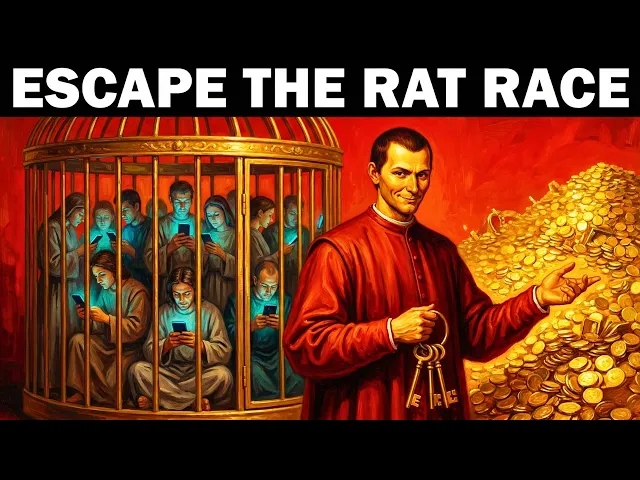
You are poor because you are a good person. You have been sold a fairy tale. A story that says if you work hard, follow the rules, and keep your hands clean, the universe will reward you.
You are waiting for a paycheck from karma. It is never coming. Money does not care about your morals.
It does not care if you are kind to your mother. It does not care if you are honest. Money is a neutral form of energy that flows toward control, toward leverage, and toward those who understand the dark mechanics of human nature.
While you are busy being a good employee, waiting for permission to be wealthy, the Machavelian strategist is busy building a dam to divert the river of capital into his own reservoir. He understands what you are too afraid to admit. The economy is not a cooperative system.
It is a battlefield. and you are walking into a gunfight holding a resume. I am going to hand you a weapon.
But to hold it, you have to drop the heavy baggage of your social conditioning. You have to stop wanting to be liked. You have to stop wanting to be fair.
We are going to apply the ruthless, cold, efficient philosophy of Nicolo Machaveli to your bank account. I will show you how to invert your psychology, how to exploit the predictable errors of the masses, and how to position yourself so that money flows to you not out of luck, but out of necessity. But be warned, once you see the strings, you cannot unsee them, and you will never be able to sit in a cubicle again without feeling like you are suffocating.
Phase one, the trap of generosity, the mizer's gambit. Machaveli wrote a chapter that terrifies modern sensibilities. It is titled of liberality and miserliness.
In it, he argues a point that contradicts every piece of abundance mindset advice you have ever heard on Instagram. He says that a prince who tries to be generous will ruin himself. To maintain a reputation for generosity, he must squander his resources.
Eventually, he runs out of money. to keep up appearances. He must then tax his people and become a thief.
By trying to be loved for his generosity, he becomes hated for his repacity. Translate this to your finances. You are bleeding money because you want to be liked.
You buy the round of drinks. You lease the car that stretches your budget. You buy the gifts.
You loan money to family members who will never pay you back. You are purchasing a temporary feeling of validation. you are paying a likability tax.
The Machavelian approach to money is cold. It is what the world calls miserliness. When you are building power, you must be stingy.
You must be ruthless with your resources. When you hoard your capital, you are not being greedy. You are building a fortress.
At first, people will call you cheap. They will call you boring. They will stop inviting you to the dinners where the bill is split evenly among people who ordered salads and people who ordered steak.
Let them Mchaveli argues that in time the miser is revealed to be the truly generous one. Why? Because by saving his resources he does not need to rob others.
He does not need to beg. He becomes self-sufficient and eventually he has the capital to do great things while the generous man is bankrupt and desperate. Stop trying to look rich.
Looking rich is the fastest way to become poor. The most dangerous financial trap is the gap between your ego and your income. The modern economy is designed to exploit this.
It sells you status symbols that depreciate. It convinces you that if you don't spend, you are failing. Invert this.
Embrace the reputation of being tight. When you refuse to spend money on things that do not build your power, you signal to the world that you cannot be milked. You signal that your validation comes from within, not from the approval of a waiter or a salesman.
Silence your ego. Starve the part of you that needs to show off. Accumulate in the dark.
A million dollars in the bank that no one knows about gives you a posture of total authority. A million dollars in liabilities that everyone can see makes you a slave to the bank. Choose.
Do you want to look like a king or do you want to be a king? You cannot be both. Phase two, despise the free lunch, the debt of obligation.
Robert Green, a modern student of Machaveli, crystallized this in law 40. Despise the free lunch. We are wired to love free.
The word bypasses our critical thinking. But in the psychology of money, nothing is more expensive than something you get for nothing. When you accept a favor, a freebie, or a discount from someone, you enter into a psychological contract.
You now owe them. You have lost your autonomy. You are weighed down by the heavy chains of gratitude.
The wealthy man pays. He pays the full price. He tips well.
He rejects the hookup. Why? Because he wants to be free.
When you pay for something, the transaction is closed. You walk away with no baggage. You owe nothing.
But there is a deeper layer to this. The free lunch is how the poor stay trapped. They chase the discount and miss the value.
They spend hours clipping coupons to save $2, wasting time that could have been used to earn 200. They accept the free entertainment of social media not realizing they are paying with their attention their data and their mental clarity. You are the product.
To break out of the lower class of thinking, you must shift from a consumer of free to a buyer of value. If you want good advice, pay a consultant. If you want a good network, pay for the dinner.
If you want to learn, buy the course. When you pay, you pay attention. There is a psychological trigger called sunk cost.
When you invest money in your own growth, your brain forces you to take it seriously to justify the expense. If you get a book for free, you will let it gather dust. If you pay $100 for it, you will study every word.
Use this against yourself. Tax your own ignorance. Machaveli understood that relationships are transactions.
If you are always the one taking the free handout, you are the subordinate. You are the vassel. If you are the one paying, you are the patron.
You are the prince. Start paying for your freedom. Clear the ledger.
Walk through life owing no man a favor. And you will walk with a lightness that terrifies those who are weighed down by social debts. Phase three, the producers trance, escaping the sheep pen.
The economy is a farm. There are the farmers and there is the livestock. The livestock are the consumers.
They are fed a steady diet of dopamine, fear, and desire. They are milked for their cash and sheared for their labor. They are kept in the pen by a fence made of convenience and entertainment.
The farmers are the producers. They create the feed. They build the fence.
They own the land. You have been trained since birth to be a sheep. Go to school.
Learn to follow orders. Get a job. Join the herd.
Buy a house. Tie yourself to the land. Watch Netflix.
Chew the cud. To make machavelian money, you must undergo a violent psychological shift. You must stop consuming and start producing.
This is the concept from MJ Demarco's The Millionaire Fast Lane, but viewed through a darker lens. Look at your bank statement. It is a record of you being a consumer.
Every line item is you giving your power to someone else. Netflix, Uber, Starbucks, Apple, you are transferring your life force money to them in exchange for a momentary hit of comfort. Now look at the other side.
Who is paying you? If the only person paying you is your boss, you are in a precarious position. You have one client.
You are a business with one customer. If that customer fires you, you go bankrupt. You must become the supplier.
Machaveli would tell you to control the resource that others need. In the modern world, that resource is attention, solution, or capital. When you scroll on your phone, you are the resource.
When you create the video, you are the minor. This requires a detachment from your own desires. You must stop thinking about what you want to buy and start analyzing what they are desperate to buy.
Study the addiction. Why do people buy that skincare product? Because they fear aging.
Why do they buy that car? Because they fear irrelevance. Why do they click that title?
Because they fear missing out. Do not judge them. Exploit the pattern.
The dark psychology of money is realizing that wealth is a transfer of value from the passive to the active, from the distracted to the focused. You must become a predator of opportunity. While your friends are discussing the latest TV show, you should be analyzing the marketing funnel that sold it to them.
While they are complaining about the price of gas, you should be looking at energy stocks. Shift your identity. I am not a consumer.
I am a producer of value. It is a lonely transition. You will stop enjoying things the way you used to.
You will look at a movie and see the script structure, the budget, the target demographic. You will look at a restaurant and calculate the table turnover rate. You will lose the innocence of the consumer, but you will gain the vision of the architect.
Phase four, emotional alchemy, loss, aversion versus aggression. Daniel Carneaman, the psychologist who mapped the flaws of the human mind, discovered a concept called loss aversion. He found that the pain of losing $100 is psychologically twice as powerful as the pleasure of gaining $100.
This is why you are poor. Your biology is wired to protect what you have rather than to hunt for what you could have. You are playing defense.
You are hoarding your acorns because you are terrified of winter. But in the game of money, defense leads to a slow death. Inflation eats your savings.
Irrelevance eats your skills. The Machavevelian mind overrides this biology. You must desensitize yourself to the feeling of loss.
You must view money not as a safety blanket, but as ammunition. Soldiers do not cry when they fire a bullet. They know the bullet is gone.
But they know that if they aim correctly, the bullet achieves an objective worth far more than the cost of the lead. You must be willing to fire your money. Invest in the skill.
Burn the cash on the ad campaign. Buy the inventory. Most people are paralyzed by the question, "What if I lose it?
" The outlier asks, "What if I keep it and nothing changes? " That is the true risk, stagnation. Machaveli said, "It is better to be impetuous than cautious, for fortune is a woman, and if you wish to keep her under it, is necessary to beat and illuse her.
Strip away the sexism of the 16th century and look at the energy of the statement. Fortune favors the bold. The market punishes the timid.
" If you are terrified of losing money, you are already a slave to it. You are guarding a prison cell. You must develop a financial callus.
The first time you lose money on an investment, it hurts. You feel sick, good. The second time it hurts less.
The 10th time it is just data. That didn't work. Adjust aim.
Fire again. This emotional coldness is what separates the elite from the middle class. The middle class treats money emotionally.
This is my hard-earned cash. The elite treat money logically. This is a tool.
Tools get broken, tools get used, but tools build empires. You need to detach your self-worth from your net worth so that you can risk your net worth to multiply it. If you cannot sleep at night because your stock portfolio went down 5%, you are not ready for wealth.
You are still a child needing a security blanket. Grow up. The market is not your mother.
It does not care about your feelings. It rewards conviction. Phase five, the asymmetry of silence, stealth wealth.
We live in the age of the loud, the fake gurus, the rented Lamborghinis, the watch me make $10,000 in a day screamers. They are the feeasants. They are bright, colorful, loud, and easy targets for the hunter.
The real predator is the tiger, silent, camouflaged. You don't see him until it is too late. Machaveli advised the prince to appear religious and virtuous while doing the dark work in the shadows.
In finance, this is the doctrine of stealth wealth. The goal is not to look rich. The goal is to be rich and look dangerous.
When you flash your money, you trigger two things. Envy. People want to take what you have.
Friends ask for loans. The IRS looks closer. Scammers target you.
Compliance. You become addicted to the status. You raise your cost of living to maintain the image.
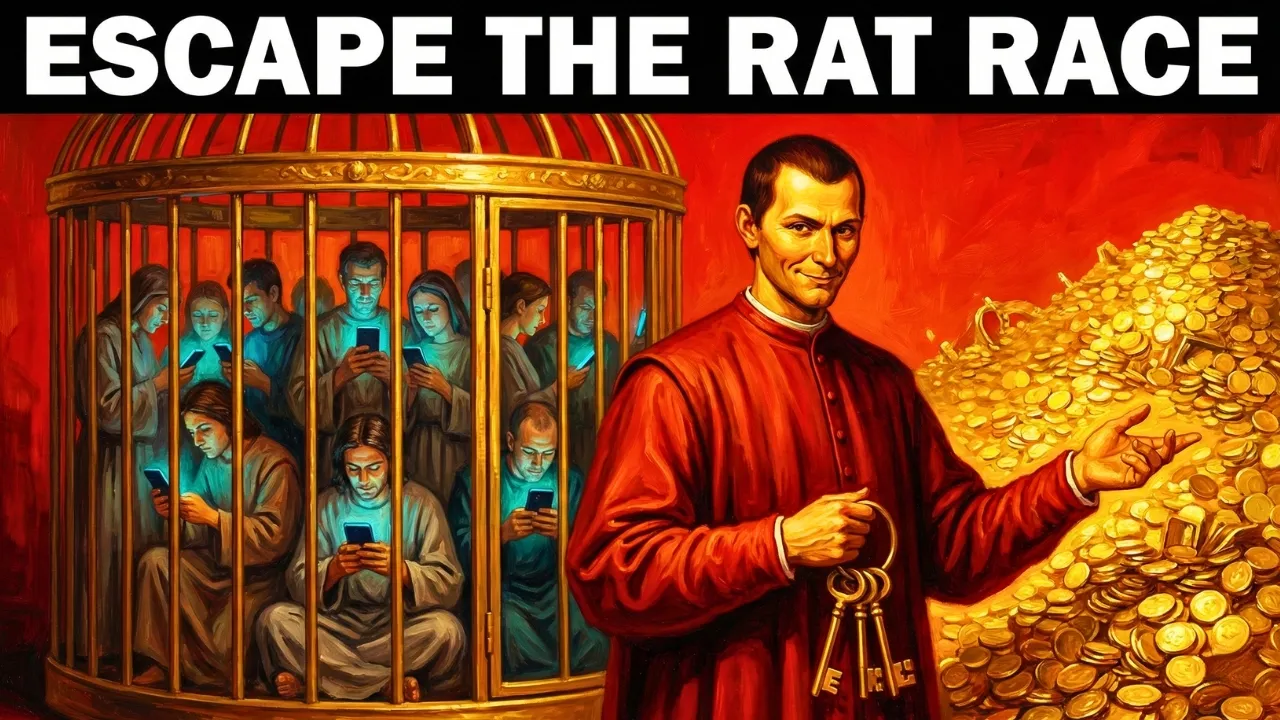
You build a golden cage. The Machavelian move is to live below your means while earning above your dreams. This creates a war chest.
When you have $100,000 in liquid cash, and you drive a 10-year-old car, you walk into a negotiation with a nuclear weapon in your pocket. You don't need the deal. You don't need the job.
You don't need the bank's approval. This is fu money. But it is not just about safety.
It is about information asymmetry. When people think you are average, they speak freely around you. They reveal their secrets.
They do not have their guard up. You can gather intelligence that the flashy millionaire never hears because everyone is trying to impress him. Be the gray man.
Wear simple clothes. Speak less. Listen more.
Accumulate assets that are invisible. Stocks, crypto, intellectual property, businesses. Let the fools compete for the loudest car.
You are competing for the quietest freedom. True power is the ability to disappear, to not answer the phone, to walk away from a deal because you don't like the other person's face. That is the luxury that Gucci cannot sell you.
Phase six, the art of exploiting predictability. the algorithm of humans. Machaveli knew that men are simple.
They are driven by two principal impulses, fear and greed. If you understand this, you can predict their behavior. And if you can predict their behavior, you can monetize it.
Most people try to make money by inventing something new. They try to be the genius. This is ego.
It is risky. It is foolish. The Machavelian path is to look for what is already broken in the human psyche and offer a cure.
Look at the industries that print money, beauty, fitness, dating, finance, politics. What do they sell? They do not sell lipstick.
They sell love. They do not sell gym memberships. They sell respect.
They do not sell stock tips. They sell certainty. You must stop looking at the product and start looking at the pain.
When you see a man buying a luxury watch he cannot afford, do not laugh at him. Analyze him. He is buying a shield against insignificance.
He is terrified of being overlooked. If you can bottle significance and sell it to him, you will be rich. This sounds cynical.
It is. But the market is not a church. It is a psychological exchange.
You are not taking advantage of people. You are servicing their deepest, darkest needs. the needs they will not admit to their wives, the needs they whisper to Google at 3:00 a.
m. Become a student of human desperation. Read the tabloids.
Read the angry comments on political videos. Read the reviews of one-star products. There in the mud, you will find the gold.
You will find the frustration. I hate how complicated this is. Sell them simplicity.
I feel like I'm falling behind. Sell them speed. I'm lonely.
sell them community. The good person tries to change human nature. He wants people to be better, smarter, less vain.
He goes broke trying to sell vegetables to people who want candy. The Machavevelian accepts human nature as it is. He sells the candy and perhaps he sneaks a vitamin inside, but he never argues with the market.
Do not try to be a moralist in a marketplace of sinners. You will starve. Phase seven, the leverage of other people's dreams.
The mercenary principle. You cannot get rich with your own two hands. You have 24 hours in a day.
Even if you work every second, you have a cap. You are limited by your biology. To break the sound barrier of wealth, you need leverage.
Archimedes said, "Give me a lever long enough, and I shall move the world. " In the dark psychology of money, people are the lever. Machaveli wrote extensively about mercenaries and auxiliaries.
He warned that they are dangerous if not managed but necessary for conquest. In the modern economy, you must learn to rent the time, talent, and dreams of others. This is the brutal truth of employment.
A job is a bribe. It is a transaction where a person sells their dreams for a monthly fee of safety. They want stability.
You want scale. You must become the architect. You design the system.
You take the risk. You hold the vision. Then you hire the builders.
You pay them fair market value. But the surplus value, the difference between what they produce and what you pay them, that is your profit. That is the reward for your risk.
Most people feel guilty about this. They feel like they are using people. Flip the script.
You are providing the structure. Without you, there is no job. Without you, there is no direction.
But here is the Machavellian twist. Do not rely on loyalty. Rely on incentives.
Men will sooner forget the death of their father than the loss of their patrimony. If you want your team to build your empire, you must align their greed with your growth. Do not give them a pat on the back.
Give them a commission. Give them a stake. Make them bleed when you bleed and feast when you feast.
But never ever give them the keys to the castle. Maintain the moat. You must own the brand, the IP, the relationship with the customer, the things that cannot be copied.
If your employees can leave and take your business with them, you do not own a business. You are being held hostage. Compartmentalize information.
Only the prince sees the whole map. The general sees the battlefield. The soldier sees the trench.
Keep them focused on their trench. Phase eight, the unfair advantage. Killing the judge.
The single greatest barrier to wealth is the belief in fairness. It's not fair that he has rich parents. It's not fair that she is beautiful.
It's not fair that I work harder but earn less. Cry about it. The universe is vast, cold, and indifferent.
It does not keep a scorecard of fairness. It operates on laws of physics and biology. The lion does not ask if it is fair to eat the gazelle.
It just eats. The fairness trap is a mental prison created by the weak to shackle the strong. It is a way to claim moral victory while suffering defeat in reality.
If you want to make money, you must kill the judge in your head. Stop looking for what should be and deal with what is. Is the tax code unfair?
Yes. Study it. Hire an accountant.
Use the loopholes that the politicians created for themselves. Is the hiring process biased? Yes.
Learn how to network. Bypass the application. Is the game rigged?
Absolutely. So why are you playing by the rules of the losers? The rich play a different game.
They do not trade time for money. They trade money for assets. They do not save.
They borrow. Debt is tax-free. They do not avoid risk.
They manage it. When you complain about the system, you are announcing your powerlessness. You are waiting for a referee to step in and save you.
There is no referee. There is only the market. And the market rewards one thing.
Value, not effort, not hours worked. Not sacrifice. Value.
If you spend 100 hours digging a hole and filling it back up, you have worked hard. You have sacrificed. You have sweated.
But you have created zero value. You deserve 0. If a man spends 10 minutes writing a code that saves a company $10 million, he has created immense value.
He deserves a fortune. Disconnect your effort from your income. This is the hardest psychological shift.
You must stop feeling guilty for making money easily. If you solve a big problem, you get a big check. It does not matter if it took you 5 minutes.
You are paid for the years it took you to learn how to do it in 5 minutes. Accept the unfairness. Leverage it.
Become the unfair advantage. Phase nine, the fortress of solitude, the price of the crown. As you begin to apply these dark laws, misliness, strategic spending, emotional detachment, leveraging others.
You will notice something shifting. The air gets thinner. You will have less in common with your old friends.
They are talking about the weekend. You are thinking about the quarter. They are talking about spending.
You are thinking about allocating. They will say you have changed. They will say you are obsessed.
They will say you are no fun. Good. Fun is the distraction of the poor.
Fun is the anesthesia they take to forget they are trapped. You are building a kingdom. Machaveli was exiled.
He wrote the prince in a small farmhouse wearing his royal court robes communing with the ancients. He was alone but he was in the company of greatness. Wealth requires a level of isolation.
You need silence to think. You need space to strategize. You cannot hear the subtle whispers of opportunity if you are surrounded by the noise of mediocrity.
You must become comfortable with being misunderstood. The sheep will never understand the wolf. They will call him evil.
They will call him cold, but they will also fear him. And they will respect him. Do not try to explain your moves to people who do not play the game.
Do not cast your pearls before swine. Keep your counsel. Build your financial fortress in silence.
Let the results speak. And when you finally make it, when the money is no longer an issue, when you have bought your time back, you will realize something profound. The money was never the point.
The point was the person you had to become to get it. You had to become disciplined. You had to become observant.
You had to become rational. You had to kill the child who needed approval and birth the king who commands respect. The money is just the scorecard.
The prize is the sovereignty. So here we stand at the edge of the abyss. You have two choices.
You can go back to the good person script. You can keep buying the rounds of drinks. You can keep complaining about fairness.
You can keep waiting for the world to recognize your potential. It is a comfortable path. It is warm.
It is crowded. Or you can step into the cold. You can adopt the Machavelian gaze.
You can start seeing money for what it really is, a tool of power. You can stop spending to impress people you don't like. You can stop consuming and start producing.
You can stop feeling and start thinking. It is a lonely path. It is a hard path, but it is the only path that leads to the throne.
The world is not going to save you. No one is coming. You are the prince or you are the peasant.
The crown is lying in the gutter. It is heavy. It is sharp.
It will cut your hands. Pick it up. But be careful because once you have the money, once you have the power, you will face a new enemy.
An enemy that Machaveli himself struggled to defeat. The enemy is not poverty. The enemy is not the market.
The enemy is the void that opens up when you realize that you have conquered the world but you have not conquered yourself. What happens when you have everything and you still feel nothing. That is a darkness for another time.
If this opened your eyes, understand this is only what I can show publicly. There are videos I cannot upload for everyone. There are aspects of dark psychology that I simply cannot discuss publicly on YouTube without being censored or demonetized.
The algorithm suppresses the most powerful information. Those exist behind the join button. If you're still here, you're not like the others.
Subscribe if you haven't. But if you want what's hidden, click the join button and step into the architect level. You will unlock exclusive uncensored videos that dive into the deepest parts of the human psyche.
Most won't. That's the point.