Congratulations, you've made it to the end. This is the 12th and final session of church planning and evangelism. Today's session we are calling a symbol.
Now, this is not an homage to Marvel's Avengers. uh this is assembling everything that we've been doing this term into the final session into the final projects. So let's take a look at what we're going to do today.
We're going to do have two parts to this. The first part we're calling the church master design and the second part is the milepost. Now, you're going to use postits in both of these.
And uh I want to be very clear, the mile posts that you've been making for the last 11 sessions, those are not for this session. Uh this first half of the session, they're for the second half. We're going to do new mile posts for what we're doing today.
So, let's take a look at what that might look like. First of all, church master design. This is how you take all of the different components of a church and put them together.
How you make the systems of a church work and how you add things like worship and and small groups and and administration. All these different things, how they flow together into one design in the church. Why is this important?
Well, let's start by looking at 1 Corinthians 12 verse 12 and then verses 14-1 17. Verse 12 says, "For even as the body is one and yet has many members, and all the members of the body, though they are many, are one body, so also is Christ. For the body is not one member, but many.
" If the foot should say, "Because I am not a hand, I am not a part of the body," it is not for this reason any less a part of the body. And if the ear should say, "Because I am not an eye, I am not a part of the body. " It is not for this reason any less a part of the body.
If the whole body were an eye, where would the hearing be? And if the whole were hearing, where would the sense of smell be? This passage points out to us the importance of having different parts and the way that they relate together.
This is using the illustration of a physical body to talk about the important systems of a church and how they all fit together. So the church is like a body and it's one of the many descriptors of the church in the New Testament. So how is a church like a human body?
First let's let's take a minute and look at the human body. The church has several systems in it. It has the nervous system, the skeletal system, sensory system, you know, sight, hearing, smell.
It has the digestive s system. It has the respiratory system, circulatory system, and the muscle system. There are all these things that work together in the body.
And the fact is that how one of them is doing can affect the others. Like for example, if you ate a meal that was not very good or maybe it was too spicy, it was really good, but it was too spicy, it can affect your nervous system. It can affect the way you sleep or the way you think.
If you eat a big meal, you might be sleepy. Um, if you injure a muscle, uh, you might compensate by limping and then you end up causing problems in your joints on the other side of your body. So, the challenge is that if your body is not working well together, one part can hurt temporarily or even permanently another part of the body.
So we want to try to avoid those things when it comes to the church. One part of your physical body affects the other. It's the same is true in the church body.
If you have something that is unhealthy in the church body, it will affect other things. If you have unhealthy leadership, it can affect all those who are following. If you have unhealthy leadership, uh it can affect your witness in the community.
If you are really good at sharing the gospel and at evangelism, but you don't teach people, you don't make them disciples, help them to learn how to be more like Jesus. Now, you have a church that's imbalance. Uh it's you could be described as being a mile wide and an inch deep.
There's no depth to your church. There's so many things that in one part of the church if it's unhealthy, it can become the problem for the other. As a matter of fact, what can happen is that weakest part ends up being what stops your church from growing spiritually and growing numerically.
So, what we want to do is have a church master design that will help you make all of this work together, help the body work together. You want to think through things to make sure that you're not deficient in some area. So, a church master design guides us into the future.
Remember, when you're doing this church master design for a church plant, you're not describing what is happening now. You're putting together a vision of what it's going to be in the future. This is what we're trying to become.
This is what we're asking God to make us because we believe this vision is from him. This church master design helps us to be healthy and productive. It lets us know where we're weak or where we're totally lacking.
Um, it lets us know where things are out of balance. It also lets us know what we should be doing and what we shouldn't be doing. If we look at a church master design and we see what that design is, we know those are the things that we've decided that God is leading us to become as a church.
Other things that that we may want to do may not fit in that design and we don't need to get distracted by them. The other thing that it does is it helps us identify the specific tasks. So if we know what we're needing to do for worship, for disciplem, for evangelism, for uh in preaching, for how we're serving the community, when we know what we're going to do big picture, when we know what we're going to do as our design, we then can figure out the steps to get there.
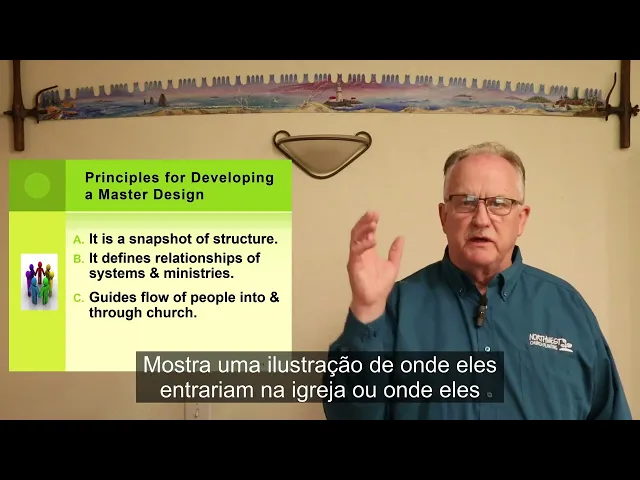
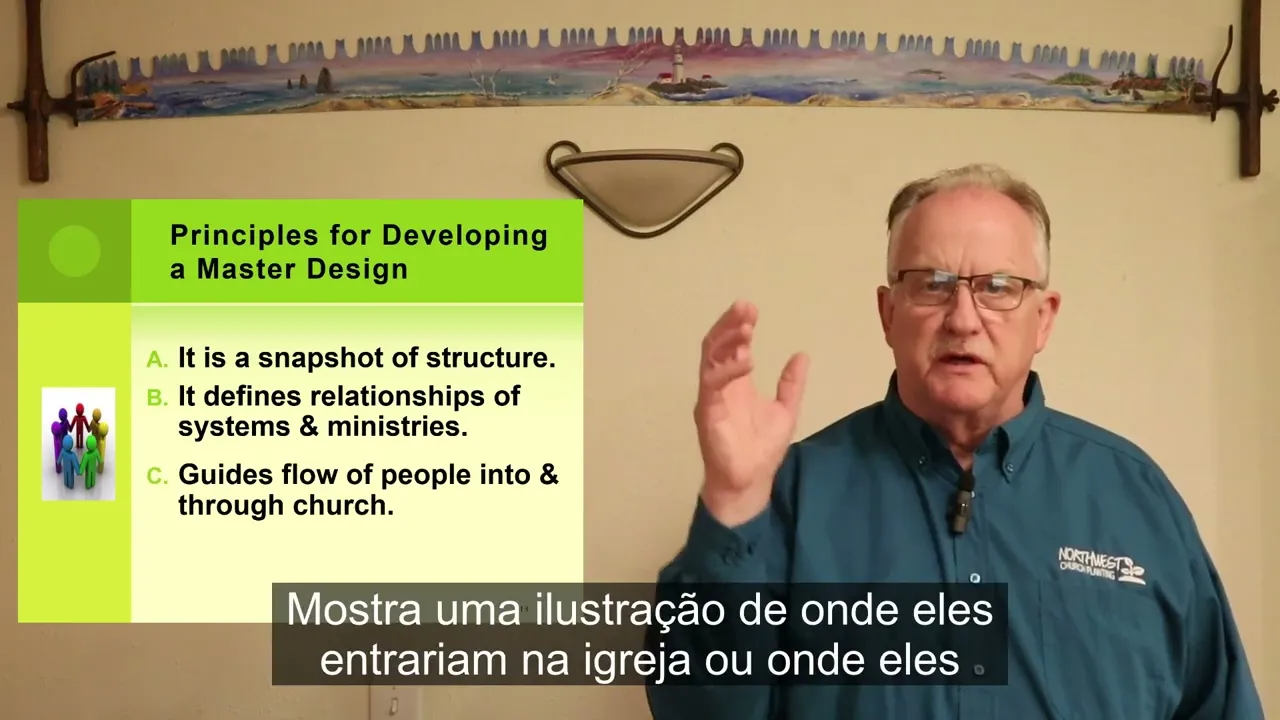
And that's actually what we're going to do in the second half of this session when we get to the mile post. So there's some basic principles we need to understand when developing a master design. First of all, it's a snapshot of structure.
It lets you see all the components of the church, but it also lets you see how things flow together. It defines the relationships of systems and ministries and how how does one lead to the other? How does one support the other?
What one might be something that one is doing that could be a hindrance to the other if you didn't make adjustments. So it also then guides how people would come into the church. It shows you an illustration of where they would join the church or where they would start checking the church out.
and then lets you see how they flow through it as disciples, as leaders, and ultimately to be sent out as future church planning teams. And it aids us in evaluating progress. One of the things that we did with our church system design when I was a church planner many years ago is we would look and say, "This is what we're trying to become.
This is our healthy vision of the church. " And every so often, usually about every six months, we would sit down and look at that and we would give ourselves a grade. We would say that we get a one, two, or a three.
And a a one, uh, me, man, we're just killing it. We're doing great. We're doing a great job in this area.
A two is we're not there yet, but we're growing. And a three, man, we're really not doing well in this area, or maybe we're not even doing this area at all. So it helps us to evaluate what we were doing in the church.
So how do you do this? How do you create a mis a church master design? Uh first thing you want to do is keep in mind the vision and core values of the church.
I would also add to this the mission. The mission we say doesn't change for all churches. It's to make Jesus known.
Go into all the world and make disciples. That's the mission for all of us. But it keeps in mind our specific vision like what do we see God leading us for our church to look like and the core values.
The core values are how we're going to do things, how we're going to behave. So remember the vision is what we're going to become. The mission is what we're going to do to become what we're going to become.
And the core values are how we're going to do what we're going to do in order to become what we're going to become. So keep those things in mind as you're looking at the vision of the church. You also want to keep in mind the doctrine of the church.
You shouldn't be doing any ministry that goes against scripture. So keep the Bible in mind first and foremost when you're planning these things. Second of all, you want to consider your context.
For example, if you're planting a collegiate church, that would be very different than if you're planting a church for people like me who are in their 60s. uh if you're planting a cowboy church, it would be different than a urban church. So you need to consider the context when not only when you're coming up with the vision vision of the church, but when you're making the actual church system design and the ministries of it.
And then you want to address each strategy piece as you've been taking notes throughout this. And believe me, there's a lot more sessions we we haven't been able to do. But as you're addressing each strategy piece, you look at those components and consider how does that fit into the overall plan.
So what do we mean by the addressing the strategy pieces? What are the different systems involved? Uh so you have the evangelism strategy.
How are you going to meet people? How are you going to engage them? How are you going to serve them in a way that you earn the opportunity to share what it is that you have to share with them about the gospel?
Earn the ask, as Professor Timothy likes to call it. Uh we have disciplehip and leadership strategy. One, it flows into the other.
We're making disciples. We're helping the disciples to be more and more like Jesus. And as that happens, we start to identify those who can lead others in different ministries.
So, what is your pipeline, so to speak? How does somebody come into that and flow through that until they're in a place of the service of service that God has for them? What's your gathering strategy?
How are you going to bring people together? You can go out and lead people to Christ and serve people, but how are you going to gather them together? How are you going to get what we often call is critical massive momentum, which means you're going to get enough people together that there is passion for what you're doing and they want to be a part of it and the church grows because of it.
What's your small group strategy? How are you going to get people into groups where they can be discipled and where they can love one another and serve one another, serve the community together? Stewardship strategy.
This one's very important and often overlooked in churches. What is your strategy for helping people to be good stewards in all aspects of life, including their finances? A lot of people don't want to talk about money.
It's like, "Oh, that's too personal. " Well, Jesus talked about money all the time. And remember, as disciples, we want to be more like Jesus.
Uh there was a study done years ago by a friend of mine, his name's Dr Dr Ed Stzzer and when he was working with the North American Mission Board, he did a study uh that helped people figure out who would thrive in a church plant, what church plants would thrive, what ones would survive, and what ones wouldn't make it. And the strongest churches, the top two factors that were in those strong church plants, number one was realistic expectations, meaning they had a good idea of where things were going to go. and they so they didn't dream so big that when things when they move forward they were depressed if they didn't hit those incredible unrealistic expectations.
Not saying dream low. I'm just saying we need to we need to seek God's wisdom for those expectations. Uh but the second thing that we saw in that is that a church with a health healthy stewardship education and disciplem process was more likely to be strong.
They taught their people about giving. Churches that avoided that ended up having problems. They got down the road and even if the church was growing, they might not have the finances that they need um to do the church plant.
I had a one of our church planters, he planted a church that grew to 350 people. And he called me one day and he goes, "I don't know what I'm going to do. " And I said, "What are you talking about?
" He goes, "I don't know how we can keep going forward. We don't we can't afford to pay our bills. " I'm like, "How can you not afford to pay your bills?
You have 350 people in your church. " He's like, "Yeah, but I intentionally did not talk about money. I intentionally didn't tell them to give because I didn't want to be a church asking people for money.
" And I said, "Well, scripture says we're to give. So, you're leaving out part of what scriptur is telling them, and now you're seeing the practical problem of that. " So, I'll get off that point, but just know that you need to have a good stewardship strategy in your church.
You have a worship strategy. Now, yes, worship can be spontaneous, but God can also honor some planning. Don't just show up and whoever wants to grab an instrument, do whatever.
That can happen sometimes and maybe a a acoustic worship, but sometimes you need to have some thought. You need to have some planning together between the the music and the the message and what else you're going to do in the service. It it is to build on what God is leading you in that day.
It needs to be planning ahead so you have the right personnel, the right equipment, the right instruments. Uh there needs to be strategy there. And then the last one, which as you might guess is probably the most important one to me when it comes to church planning is multiplication.
Remember what we said earlier. We multiply in everything. That means that we multiply disciples, leaders, small groups, churches, partners, and even networks and movements.
We're always trying to multiply. So, what is your strategy as you put this together? Do you have a multiplication strategy built in?
Not just for church planning, but are you multiplying worship leaders? Are you multiplying small group leaders? Are you multiplying uh disciples?
Are you multiplying different avenues to go out and reach into the community? Make sure that multiplication is in everything that you do. So, I'm going to show you on the screen uh just a few things that could be here uh related to some of these systems designs.
I'm not saying copy these, but these are examples of some other that others have done. And so um they you know in this example here at the center they're talking about how do we expand the church quality uh how do we do these things what and how does that fit into our worship into our mission to evangelism and ministry and then it looks at different components of that saying how does that build together so that's a very simple kind of process and I know it may be a little faint but around the words prayer but Bible study fellowship and disciplehip you have arrows that are there pointing towards how we're seeing the church to grow. Another discip another example might be it's all about making disciples.
You may have heard this. We make disciples who make disciples who make disciples and the church is planted. So how do we do that?
And so they use the letter M in English to illustrate these things. They have magnify God, membership, mature disciple, mission and management. And then they use smaller post-it notes.
Remember we had the 3x3 and the little ones. They use small smaller ones to talk about different ministries within each of those. So for example, if you were to look at minister, they're looking at people that they can minister to that might have uh special needs, but also those that do the ministering.
So they might target specific ministries. Maybe they take on a school. uh they they might have a ministry to people who are homebound or ministries to people with special needs that have some physical or mental ima limitations and they also put in this area deacons because the deacons are the ones that are to lead the church and serving.
The word deacon actually comes from the Greek word that means service. So that is that is another example of a church plant. And then one more that I want to share with you is um here's one where it talks about different ways to enter the church.
So they're showing you through the yellow ones on the top of your screen ministry center, servant evangelism events, block parties, uh a park concert, ESL, English, English as a second language, and tutoring. They're showing those all as entry points from the community to minister to people. And then they what they hope is that that will feed people into the worship service and through that through the new members orientation and through that uh into leading them to be apostolic church leaders meaning church planners or into uh training to be leaders in the church.
Another way that they have his entry is their home Bible study groups. So having all these home Bible study groups that can then feed in to what's happening in the community and in the church so that the church can grow. That's what they refer to as a disciplehipbased church.
Now again you can use your postits. They don't need to be the shape of these but you make your postits be the major ministries and the smaller postits uh they would be things that would feed into the different ministries. So here are some steps to a church master design.
First of all, uh write each component or ministry on your 3x3. So worship or fellowship or outreach. So major components, major areas of of ministry in your church and then use the smaller ones to identify various aspects or elements of the major components.
So, if you have one on disciplehip, maybe you have small groups, maybe you have a special advanced training for disciplem, maybe you have a one-on-one or a one-on-ree disciplehip ministry. Those would be the smaller components that go around the bigger one of disciplem or disciplehip. And then you place these components in a logical order on an easel pad or a big piece of poster paper or you can do it on your wall if you want.
They're postit. They won't hurt the wall. The only thing you can't do if you put it on the wall, or you shouldn't do unless you're planning to paint soon, is don't draw lines and flows like you saw in some of those previous examples.
Uh, if you do it on poster board, a large postit, you can draw lines showing the flow of things. Uh, but once you write all these on the two different size postets, you want to take them and place them in the right order on your pad. So, some things to consider when you're doing this.
What's the relationship of each component to the other? Is one before the other? Does one draw people into for the other?
Does one create leaders and those leaders come back to the beginning and start more groups in the other ministries? What is the flow of these people through the process? Uh how do they get from A to B to C to D?
What are the entry points into the church's life? What are the ways if they are somebody that doesn't know Jesus and they're in the community, what are the easiest places for them to get in? Now, every church likes to think they're the friendliest and most welcoming church.
But a lot of times churches have ministries that are all for their people and people out in the community don't have any way to easily engage the church. We've actually closed the door on them without meaning to. So, the other part of this is how do we help people connect with each other?
Uh there are different stats that talk about the importance of making multiple friends in a church within the first six months. If you don't have these multiple friends, you're not going to stay. No matter how good the preaching is or the worship is, you're just going to feel like I don't matter here.
And so, how do we connect people with each other? This is important to consider when looking at our church master design. Is there simplicity in this?
Uh does it does it flow? Is it natural? Keep it simple.
That's important. Uh where is multiplication reflected in the design throughout this? Again, are we identifying?
Can you say this is how we multiply in this ministry and this ministry and this ministry? And are there bottlenecks, Mike? If you got a big jug and you got a bottleneck, it it you can only pour out as much as can get through that bottleneck.
uh you don't want to have things that are going to restrict the flow like you're just maybe you're you're have a ministry where you're leading a bunch of people to Christ but you don't have nearly enough small groups and so that's stopping the growth of the church that's stopping the growth of the individuals you've created a bottleneck well what do you need to do you need to open that bottleneck you need more small groups are there dead ends and what I mean by that is are there things that people go into and that's it there's no there's no growth there's know multiplying um it's just an end into itself and that's it. We don't want those things. We want things to naturally flow beyond.
So then as you do that, go back and look at it, put it away for a while. Uh come back to it, look at again, go, what's missing? What what are things I haven't had?
Or maybe have somebody look at it, somebody else who's a friend, or have a minister look at it and go, oh well, you really forgot this. So, like for me, for example, I've looked at so many of these. I can look at immediately go, "Whoa, hey, hang on a minute.
You don't have this piece or this piece. " So, get some people to give you input on what's missing. So, here's how you do it.
This is an assignment. You're going to end up pausing the video in a minute and do all this. But what I want you to do is review your notes.
And I don't mean your notes from today. Go back. I I'm not saying spend all the time to redo every class, but go back and skim through your notes from every session briefly.
Don't don't spend don't spend three hours on every session, but skim through them and look at different ministries and components that should be a part of this. So you create the po the postits for these different ministries and systems in the church based on going back and skimming through your notes and through your own experience and through observing your own church. Then organize them on the larger piece of paper and and a natural flow and then draw boxes, circles, lines, arrows, whatever you need to to demonstrate how this this ministry flows.
Ministry should be active, not static. It should be going somewhere, not just stopping cold. So, how do you make this happen?
Uh how do these things come about? That's your assignment. So, please pause your video now and go back and and do those steps uh that I just outlined for you.
Now, we're to the part that you've all been waiting for. Mile posts. Uh I'm sure many of you were wondering why you've been doing these little postits all term.
The mileposts are the steps that help us get to where we need to go for our new church plan. Again, you can use these same things, the same process in any other major area of your life. So, let's look at what we're mean by mile.
Again, we looked at this at the beginning. We've been talking about it throughout, but I want us to go through one more time what we mean about milepost. And this is the part of the session where you will actually use the posts that you've been making all term.
Hopefully, you've been doing it cuz you should have tons of them by now to put together in this assignment. Uh so, things to consider. Do you see uh that you and your church planning team are working alone or are you working with others?
That may be something that you need to consider when you're looking at mile post. If you're isolated, maybe there's some milepost for you to get some coaching or some training. Are you looking at planting only this church or several churches amongst various people groups or even within a certain people group?
The correct answer is the second one to plant several churches. That's the goal. So, you need to consider that because if that's your plan, you need to have milepost that will help make that happen.
And now that you have a vision, a preferred destination, what will it look like to bring that vision into reality? You just did the process of making your church system design. As you look at that church system design, you should have more mileposts coming out because you need to do the steps to make that church system design happen.
So, here's things to consider. What things are you going to do in the next 12 to 18 months to get a church up and going or whatever it is you're doing, another ministry or some other thing you're doing in life? What are the steps that you need to do over the next year to year and a half?
Who's going to take that journey with you? So, one of your mile posts might be recruiting people. You need certain people on the team or you need coaches or mentors or supporters, people to give, whatever it might be.
And that's part of the next one. Who will support you along your route? Who are those people?
Those are mileposts to to secure that kind of support. What tools will you use in doing this? Meaning like is there are there certain kinds of equipment or training or processes?
Uh are they going to be old things that have already been existing like somebody's already done it before or are there going to be new things where you have to be the one to create it? in the church planning network that I lead. I I went out when I started 27 years ago almost and I learned everything I could of what people were already doing.
But I found a number of areas where I didn't see other people doing it and I had to create those systems which I love doing. That energizes me. So I did a combination.
I found some of the best practices that have been around and then also started some new practices that now others have been learning from and using around the country and even in other parts of the world. So how will you develop and reach new destinations and record your progress? So how are you going to have a process in all of this?
What mileposts are you going to have in all of this that help you figure out the new steps? So, it's not just what you need to do, but it's the process of figuring out what you need to do. And then, how are you going to record progress?
What we mean by that is how are you going to measure success? How are you going to know when you're doing what you set out to do? Uh, that's an important part of the process is evaluation.
So, we call the steps that are needed to plan a church mile. We've talked about that before. A common mistake is to be driven by the calendar and not critical milepost.
Remember, church planning is milepost driven, not timeline driven. So, how do we how do we do the things that we need to do to make sure we've made critical milepost? We've done the important things before we move on to whatever is next.
So, this exercise is going to help you answer questions about those items in the next 12 to 18 months. So remember, mileposts show the results of completed action. You write them in past tense.
Um so it might be if you're starting a church and you don't have a worship leader, you would write something like worship leader recruited, worship leader secured, worship leader hired. All those are in past tense. Whichever one of those you wanted to use.
You don't need to use all three, but if you used one of those, you would write it in past tense showing that you've completed it. And then you can use that mile post to measure the progress. I don't know about you, uh, but I use a lot of to-do lists.
I have one on on a word document on my computer that just keeps growing and growing and growing. So instead of doing post-its for that process, I actually just made a list with checkpoints and things. And I love going back and highlighting whatever the thing was I needed to get done and going into my font setting and doing striketh through.
I don't I don't delete them because I like to know I'm accomplishing something. So, I keep all the ones I still have to do at the top of the document and all the things I got done, I put a line through them. Well, with mile post, you can you can do it one of a couple of different ways.
Some people like once they've completed a mile post, they like to rip it off the wall or off the off the pad. They're like, "I'm done. " And they take it and they wad it up and they throw it in the garbage or recycling.
Okay? I don't prefer that way because it doesn't let me see the progress of where we're going. I would much rather use some kind of marker that's not going to bleed through to the wall and I would put a line or an X through it showing that I could where I could still read it but showing that it's been completed.
So that's what you're trying to do is you're trying to have the completed action that you wrote actually be reality. If I said worship leader recruited, well, when I actually have a worship leader recruited, I would put an X through it showing that yes, I accomplished that particular milepost. Remember the difference between critical mile posts and supporting mileposts or what we call just milepost, regular mile posts.
Critical mile posts must be achieved or the desired outcome will not be attained. meaning this is so major if you don't get it done you're probably not going to get your church planted. A supporting milepost are all this different steps to help the critical milepost happen.
So like one for a lot of people is they want to get paid if they're a church planner and we we have an administrative uh lesson that we teach on that and and so if they want to get paid they're like I need to get paid. How do I get paid? Well what in in order to get paid you got to have a bank account.
What they don't realize a lot of times is there are literally seven steps that you need to do as a new church plant before you get that checking account open so you can pay the church planter. So all the seven steps would be small postits that opening the bank account for uh somebody wants to get paid that would be a bigger postit a 3x3 postit. So characteristics of effective mileposts, they need to be consistent with the vision, the mission, the values, and the church master design that you just made, they need to be realistic in terms of time projections and sequence.
Uh don't go don't have a mile post that says uh uh achieved 5,000 people in worship and you put that for next Thursday. You're not you're not going to get there that fast. I shouldn't say never.
I mean, we saw what happened at Pentecost. 3,000 were saved. That happened in a day.
God can do that. But most of the time, that's not a realistic time sequence. You You've got different steps to get to certain levels of completion.
The other thing we see in my post is they need to have a steady flow of relationships. You don't go from saying, "I'm going to share the gospel with one person and then I'm going to have 5,000 people in worship. " You've got to you got to share the gospel with many people.
make many disciples. Uh have start small multiple groups. All these different steps before you get to uh the worship gathering that you're hoping, even if it's to have 50 in worship.
There's several steps to get there. Don't just skip over them. You need to have a flow for this with your milepost.
Uh the fourth one is critical milepost or letter D as we have here. Critical mile posts are limited in number. Remember, you should only have six to 10 of these.
If you have 30 critical mileposts, that's unmanageable. You won't you won't ever get there. You need to narrow it down to what are the main mileposts.
Remember, this is different than the church system designs. So, you've got all your ministries you're trying to do, but these mileposts are the major steps to get there. The critical mile posts are the big ones.
So, here's how you do this. We want you to brainstorm my posts that are needed. So, you go back through all the sessions.
You should have been making a bunch of mile posts. I had someone tell me recently, he's like, "I got a stack of mile posts like this. What am I supposed to do with them?
" Well, today I'm telling you what to do with them. Okay. Uh, and I love that question and that enthusiasm because that's what each of you should be following his example.
You need you need to have that stack of mileposts. And if you don't have enough, go back and skim through the sessions again just like you did for church system design and identify things that are mileposts that need to be a part of this process. Then once you've done as many mile posts as you can, put it away, maybe come back to it again, look at it again.
You can do this throughout the process. Then you take those mile posts and you arrange them on your poster board or your easel pad or your wall showing the natural flow of things through the mile post. You need to identify which ones are critical.
Maybe you wrote something on a small one. You're like, "No, this is really a critical one. " Okay, take it and write it on a bigger one.
Get rid of that little one cuz now it's a critical mile. Arrange the critical milepost in a process order sequence oriented sequence. And then the same with the supporting milepost.
For each critical mile post, identify the tasks that must be completed. Those tasks are the smaller mile post, the regular milepost. Project a realistic timeline to accomplish these things.
Now again, we're milepost driven, not calendar driven, but you can you can kind of guesstimate and say, "Okay, these are the steps and we're hoping to have all these done by July 1st. " And so you you could even on your post to put you know July 1st and make make sure you know that's a goal and you need to complete that thing before you move on to the next part. And then you need to as you go through this process in a church plant as you're planning you identify personnel budget other resources that you need to accomplish all this and uh then that will help you in planning all these things budget staff supporting team members all those things by looking at the mile post.
So what I want you to do is I want you to pause your video at this point and go through that process. So look back at the steps and do all those steps to get as many mile posts as you can and then put them in a logical sequence uh for your church mile plan. Now here's a couple of examples of others.
Uh you can look at this and go back and do some others. It might be you can make it artistic if you want or it can just be very very much uh pragmatic. So here's somebody who says a church plan is a long and winding road and so they had their major mile post or their critical milepost and then they showed how the other smaller mile posts flowed through the system to make things happen.
Another one used the illustration of it's an uphill climb. So they had their critical mileposts, which would be those green ones, and then their supporting mileposts, kind of like building blocks going up along a path going up a hill. But they also show there might be obstacles out there.
That's why there's a snake and a scorpion and and a and a cloudy day up above. There may be some things that need to be overcome along the way. Get creative in how you do this.
Something that will uh encourage you, but also be easy to communicate to others. And some of you like a linear process. This is okay.
You may just have a linear process for each of your critical mile posts. And so I mentioned bank account open. And so you see there's seven little little mile posts that lead to the big one.
Um and then you got another one for leadership team secured and launch team activated. All these kind of things. And you notice they may have different starting points.
They may have different ending points. They may be the same starting point or different ending points. And so if in this process you can actually look at it and it and it flows in a natural in a natural process uh time for of timeline.
So your next steps organize your mile posts and critical mile posts in logical order on a large piece of paper. If and you've been doing this but take some time do it again. Drw boxes, circles, lines, arrows just like you did for your church master design.
Watch for the gaps or deadends and make sure that it's clear. Make sure that you can bring somebody in your team, have them give them input, but also that they can understand what it is you're asking to do. So, pause your video again, take some more time, and kind of work on your church system, excuse me, on your mile post to make that natural flow.
Congratulations. You have made it through church planning and evangelism. Uh I I love the fact that we're going to be on this journey together.
I hate the fact that I don't get to sit here and do it with you each day in person. I realize that's not practical, but I just want you to know uh I'm very proud of the progress that you've made. Very proud of you sticking with it.
Those of you that have made it through the whole thing, I got to meet a number of you recently and I I'm I'm still flying high from that. Just it was it was a wonderful experience getting to connect with many and and appreciate your encouraging words and your participation in this whole thing. So, I want to say thank you for this.
Um also want to do uh one thing. Some of you may be going, "What is this thing behind me? " Uh this is a an old saw.
I you've been watching all terms. So now I'm going to tell you what it is. This is an old saw, twoman saw that we used to cut down trees.
And my mom, who passed away a couple years ago, uh she was an artist. And so while my dad and my brother and I were building an addition to my house, including the office that I'm standing right now, my mom was out in the driveway painting this saw, which is a scene of a lighthouse on the ocean. I used to have a coffee shop ministry that was called the lighthouse.
And I always have loved lighouses and I live on the Pacific coast, not right on the coast, but um where we're by the water. So lighouses have always been special and it's a reminder to me that Jesus is the lighthouse for us. And so um you see the saw on the sconce, you know, I I'll even flip it on here a second.
There's a light that lights it up. It's not good on camera, but um it illustrate it lights it up in the room. And my whole office is built around this saw.
And uh so that's just a personal thing if you're ever wondering what that's about. And then the final thing that I want to tell you is that Jesus loves you. And if you don't know him as your personal Lord and Savior, I'd encourage you to go back and watch the one where he talked about sharing your faith.
Watch that session again and know that God loves you. He wants to be in relationship with you. Find somebody that knows him as Lord and Savior and let them help you understand how you can begin your journey as a Christ follower.
If you are a Christ follower uh or become a new Christ follower, remember we have the privilege and the responsibility to go and make disciples. So don't make this off in the future. Find somebody today that you can go tell about Jesus and let's keep it going.
God bless you all. See you next time. Bye now.