a brief history of artificial intelligence all of a sudden the whole world is talking about artificial intelligence or AI for short the term refers to machines robots and software systems that perform complex tasks independently without being given instructions for each individual step experts agree that AI will change our lives development is currently progressing at a rapid pace but the beginnings of AI can be traced back over decades in the summer of 1956 leading u.s. computer scientists mathematicians and linguists came together to conduct a research project their vision was to develop self-learning systems that could solve
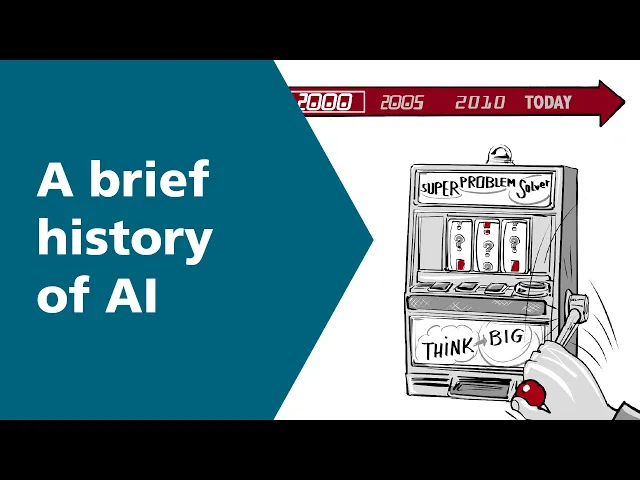
tasks requiring human intelligence the scientists also coined a new term for disability artificial intelligence the first AI program was able to prove mathematical theorems soon thereafter a programming language emerged for processing symbolic structures the AI pioneers of the 1960s were thinking big they dreamed of creating a super machine a general problem solver they researched into machine language translation and developed the world's first autonomous robot shakey moved around jerkily and carried out simple tasks in the laboratory at least the first chat bot Eliza was developed by the German American computer pioneer Joseph Weizenbaum Eliza simulated the
responses of a psychotherapist during a patient consultation and was deemed deceptively realistic by some as promising as these approaches were researchers always concluded the real world was far more complicated than the specific problems they were addressing the initial euphoria cool off research funding was withdrawn AI winter in the seventies scientists questioned whether AI systems could be truly intelligent or whether they merely simulated intelligence the focus only shifted back to more practical matters in the early 1980s when the first expert system started to combine the expert knowledge of individual disciplines to assess vehicle damage or diagnose
medical conditions for example travellers wanting to buy tickets could seek advice from chatbots over the phone ai was coming increasingly to the fore in Germany - the foundation was laid for outstanding application orientated research German scientists made a name for themselves particularly in speech comprehension imaging processing and robotics the autonomous vehicle developed by Ernst dikmen's was hailed as a pioneering achievement cruising along the motorway largely autonomous from Munich to Copenhagen in 1995 however there was still some way to go before series development could begin and AI remained a niche subject then in 1997 the world
press screamed robot beats reigning grandmaster Gary Kasparov at chess for the first time an expert system had proven superiority over a human as they were trained with more and more data industrial and service robots also became increasingly autonomous and adaptable they were evolving into self learning systems since 2010 we've been experiencing a worldwide boom in AI this is down to the way computing power and storage capacity have grown exponentially over the decades not to mention improved methodology for example the LS TM technology developed by German scientists is considered a crucial component of speech recognition these
days what's more the internet social media and built-in industrial sensors have suddenly provided access to huge volumes of data thanks to improved AI methods and computing power these unstructured treasure tropes can be analyzed in no time world-renowned applications have appeared in quick succession Watson winning the u.s. quiz Jeopardy against the show's long-standing champion assistance answering questions scheduling appointments and making calls in response to spoken commands and performing duties upon request throughout the home alphago beating a top player in go a board game far more complicated than chess the German startup Dipel reaching an entirely new
level of finesse in machine translations so what's next self learning systems promise to bring about a wide range of applications and boost productivity the commercial potential is huge at the same time some AI systems are producing results that humans are unable to decipher for many everyday tasks ai systems are not yet sufficiently reliable some people are fearful of robots as co-workers and others warn that AI could race out of control what's certain is that not everything that is technically possible should be allowed to be put into practice but we also have to recognize the opportunities
artificial intelligence promises to offer more precise medical diagnosis and improve treatments for patients AI helps us to overcome language barriers and it can improve the traffic flow in large cities reducing congestion preventing accidents and protecting the environment the task therefore is to shape AI for society's common good