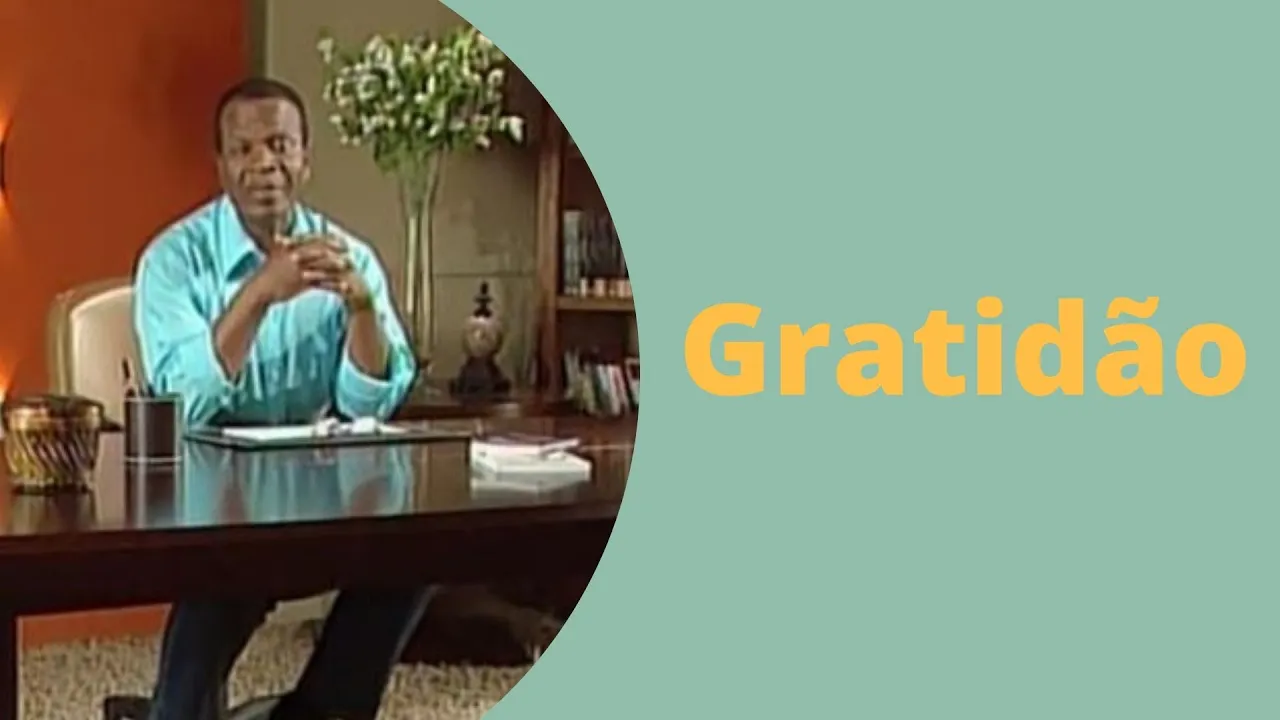
Life and values Gratitude We have found a remarkable teaching by Pablo de Tarso, the great Apostle of emerging Christianity, when he said: Thank God for all things. This teaching from Paul, naturally focuses on the issue of gratitude. The Apostle saw the importance of being thankful.
Naturally we realize that this is not a practice among human beings. We all like to receive. And we like it pretty much!
But the question is about the moment of being thankful. It seems that people who do things for us, that serve us in some way, in our deep judgment, they do nothing but their obligation, when it's not true. And then when we start to find horrible spectacles of ingratitude.
Ingratitude shows that often start inside our house, inside the home. How many times, talking with psychoanalysts, psychologists, and they speak up about complaints, grievances from many children related to their parents. It's very difficult to find children who have no complaints from their parents.
However, it's worth thinking that parents would also have complaints about their children, but because the parents love them, they tolerate the children. And in this way, we see with great surprise the ingratitude from the children to their parents. Many plead that their mother has defects A, defects B; others say their father has this or that defect.
Some say their mother doesn't care for them, they don't care, others say their mother drown them out. Others say that their parents they never hugged them, never kissed them. Others say that their parents they're very demanding, that the father claims a lot from them.
And we keep thinking. Naturally, those who complain so much from their parents, whether is the father, or the mother, never stopped to think that no matter how complicated our father, our mother can be, they have a virtue for which we'd have to be perpetually grateful. Yes, they were the ones who let us be born, so that I would have that vivacity that I have today, so that I would have that freedom that I have today, so that I could be like I am today.
I owe them, with all the defects they may have. It's natural to think those people who cannot thank their father, their mother that gave them physical life, who gave them the opportunity of a physical body, of life on Earth, hardly is going to thank to others, to strangers. The one who does not thank the parents, doesn't thank anyone.
Some say: But I don't love my mother. Others claim: But I don't love my father, that's another issue. Analyzing all this, within the reincarnationist approach, we can admit that most of the time, children and parents are antagonistic spirits, Spirits who had experiences not very happy in other existences and therefore when they arrive at the same home, under the same roof, the Divinity proposes that they get it right.
In this unconsciousness concerning to the past, in this oblivion that the past imposes on us in the new life, it's for us to get right and not to create problems with the issue of ingratitude. Therefore it is worth thinking that gratitude is a virtue of those who are able to love, but also of those who are able to ratiocinate. Many times, although we know we don't feel love by the person who serves us, but serves us.
So, we need to be grateful to them. Then, verifying that difficulty inside homes, when many children are ungrateful to their parents, we wonder what they will find along the way, what life will hold for them. Because if we're not able to dedicate that feeling of acknowledgment for life, for the physical body, opportunities, for home, for the schooling we had, even for the struggles that gave us value, who can't thank this How will thank for other things?
Gratitude, with no doubt is our demonstration of maturity, it's our demonstration of maturity face to life. All people that do us good, that help us to grow, especially who gave us the physical body, are worthy of our thanks. To thank is to serve life, it's a way to be happy.
Only when we are able to thank father and mother is that we extend this gratification to other people, because our closest friends are, our parents. But sometimes we find the lousy habit that has been implanted even inside homes, which is the habit of not teaching children to thank. Just because our children's relationships start with home servers, with the housekeepers.
And because they're housekeepers, goes through the collective imagination that these people should not receive an acknowledgement. Is that so? Of course they're getting a salary.
to serve us, to be useful to us, however every creature feels happy, gratified, when we thank them. Therefore it is worth to thank to every creature that somehow serves us. The domestic server put the food on the table: Thank you very much, so-and-so.
Removed our glass, our dish: Thank you, so-and-so. Because the creature can do it grudgingly. If we learn to thank, the person will be happy to serve us, will be happy to assist us.
And in all these relationships that we establish with each other, we can't lose sight the energetics issue, the vibratory issue. That creature that knows we are disdaining, will vibrate badly towards us, does things for us vibrating negatively. They are able to impregnate it in what they serve us, what they serve us with.
And it doesn't cost a thing to say to our housekeeper: So-and-so, Jane doe, please bring me some coffee. so-and-so, Jane Doe, thank you very much. It doesn't cost a thing, it's a word for each moment we feel bestowed.
How many times do we walk into a restaurant, we call the waiter boy, or waiter we don't know his name, Nor we have an interest in knowing, and we treat him as if he does no more than the obligation to serve us. That's true, he gets paid. to serve us, but as loving people, as people seeking peace in the world and they want to help with what is easier for them, it would not cost us a thing to thank the waiter who serves us at the table.
Surely, every time he comes to the table to serve us, he'll have a smile, he will feel a joy, he'll feel that satisfaction to put it on our plate, in our glass what we're asking for. The big issue for us is to work energetically on relationships, knowing how happy the individual feels when they get an acknowledgement. The clerk Who thanks the clerk?
He does not do more than the obligation, he's getting paid for that, that's the speech we use. But it's so good when someone serves us. After we got the clerk down all the products for us to check which ones we would take and sometimes, we don't even have it, after all that sacrifice we say: Thank you very much you were very kind.
How many times that creature, that's on the other side, serving at the counter, expect a word from someone in face of the human crises that is experiencing. Some time ago, leaving the airport from Galeao, in Rio de Janeiro, driving the car, I was with a friend and I passed for the young woman who charges the entrance to the parking lot, she charged the ticket. In that when I stopped the car.
and I gave her the ticket, and she told me the value, behind that girl I registered a spiritual presence. He was a white-headed gentleman, looking concerned, and he said to me: Cheer her up, play with her, she's from Ceará. And in that moment, I looked at that young lady saddened, bored, and I said: Hello cearense.
And she smiled. Sir, how do you know that I'm from Ceará? I said, By your way.
And she was happy, grateful. I said, Thank you very much, although she was there to attend to anyone who wanted to pay for parking. To thank shouldn't be an obligation, should be a joy, our duty of fraternity.
So, since apostolic times, Paulo de Tarso taught us concerning to God: Thank God for all things and when I thank my next, I'm thanking God that put him in my way.