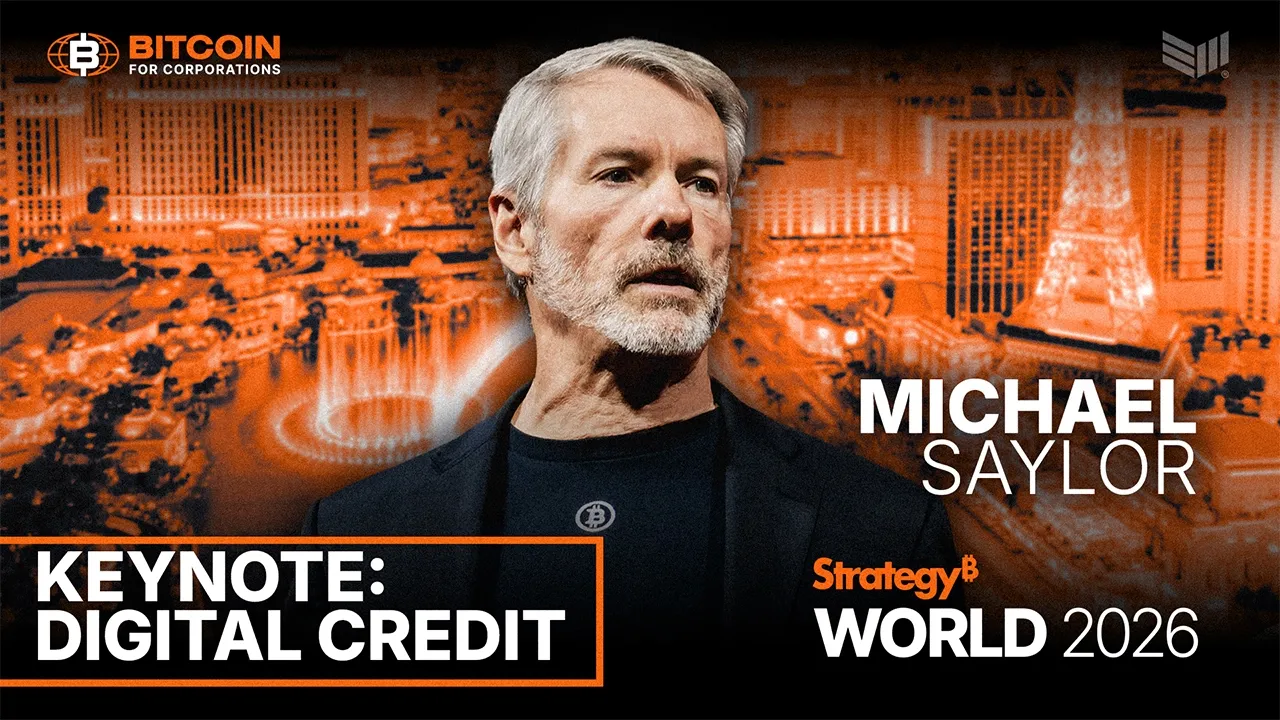
Thanks for joining me today. Uh this talk is uh about everybody's favorite subject. I'm going to speak with you about how to make money. Literally how to make money. How to make money for your family, for yourself, for your company, for your public company, for your country, for everything you love. And specifically, I'm going to talk about how to make money digitally. And the the title of the talk is digital credit. But really this is this is about a revolution in the way we think about money. So let's just start with uh the subject of
digital credit. You know what is digital credit? Well, digital credit is built on digital capital. Well, digital capital is Bitcoin. How do we create Bitcoin? Well, we we put together a bunch of technologies that were available. proof of work, public key cryptography, peer-to-p peer networking, distributed timestamping, some semiconductor technology. And of course, the fundamental question is what is Bitcoin? And people debate this at infinitum, but it just seems quite obvious. It is digital capital. What is digital capital? Well, it's it's economic wealth stored digitally. What is economic wealth stored digitally? It's the ability to move
something of value somewhere else on Earth over a digital rail. Right? People oftentimes ask, well, what's the use case? What's the value? Well, the value is if I can send a billion dollars from here to Tokyo, that's valuable. Try taking a billion dollars of land out of Tokyo, try to take a billion dollars of gold out of Tokyo, try to remove a billion dollars worth of companies from Tokyo or a billion dollars of mineral or oil and gas rights from Tokyo. You just can't do it. On the other hand, you can move a billion dollars
of Bitcoin into and out of Tokyo. And if you can do it, a computer can do it and AI can do it. And so it it seems very straightforward in the world of of digital that if everything we've got that's digital is better, whether it's digital photos or digital music or digital video or digital communications or digital intelligence, then when we finally have digital wealth, digital capital, it will be the basis of something that is extraordinary and beautiful. And Satoshi gave us this. Uh the truth is there's nothing deeply complicated about it. It's just putting
together it's an engineering breakthrough. Putting together a bunch of techniques that were readily available and well known in the day. It was the way that it was used that was an extraordinary breakthrough. Digital credit is very similar. There's nothing deeply complicated about this. Uh what we're doing is we're taking a common thing, a publicly listed company, a public security, a capital asset, digital capital asset in this case, a preferred security, the idea of a monthly dividend that's variable and a tax treatment return of capital that's been around since 1910 and then a ATM actively managed.
and you put together all of these components. No one of them is all that difficult. You pretty much could understand them if you're a sixth grader. You put all of them together and you create something which is much more than the sum of its parts. You you've created an extraordinary breakthrough in the entire world of credit. We call it stretch STRC. What is our company doing? What is strategy do? Our company is converting capital into credit. We're converting economic wealth into a stream of cash flows. That is the big breakthrough. You need an operating company
in order to take uh a block of economic energy and turn it into a currency, peg it to a currency, strip away the risk, damp the volatility, extract the cash flows in the form of yield and compress the duration to now. I don't want to wait 30 years to get rich. I just want you to give me money every month or every day forever consistently without risk. The former, right, is a capital investment. I buy a big chunk of Manhattan and I wait 30 years and maybe I get rich. The latter is a is a
a bond or is it a money market account? So, this is all about conversion of capital into credit. And uh you might wonder, well, how did we discover stretch? Sometimes people ask us this and and this is the most poorly understood concept. Most people don't really think deeply about capital at the first order but but STRSC is at the end of a long journey. I often times say we got a PhD in leverage at strategy. Well, let's just start with a basic question. How do I raise the capital to invest? If I want to invest
in real estate for 40 years, where's the capital come from? If I want to buy gold and hold it for 40 years, where do I get the capital? If I want to buy Bitcoin and hold it for 40 years, where do I get the capital? Well, I'm going to tell you the easiest place to get the capital. And it's the worst place. It's an exchange. You go onto an exchange and you use exchange leverage. So, I post $100 and I do a 50x levered Bitcoin buy. And when you lever up 10 to1 on an exchange,
they loan you $1,000 of capital against your $100. And when you lever up 50 to1, they loan you $5,000 of capital, right? Uh and of course, that's that's DeFi. That's crypto. People think this is a wonderful thing. If you look at my chart, you can see exchange leverage is one hour capital. If you think about if you think about the credit terms, the risk factors, the covenants on the credit and the optionality that you have for the credit when you enter into the relationship and you and you ask the question, how long do I have
the use of this capital on a probabilistic basis? Well, the engineer would say that's the stochcastic duration of the capital. What is the stochcastic? The likely time frame I have the use of the money for. Well, on an exchange, you might have that money for an hour. If you lever up 50 to1 and Bitcoin trades down 2%, you're going to get margin called. They force liquidate you and you get all your capital ripped away in an hour. So on one extreme is very short duration capital. What's the next big idea? Well, I do a margin
loan. I borrow the money under reggg t and I or I do asset back financing. I borrow against my bitcoin or borrow against a stock or an asset. How long do you have the capital for? Well, when you get the margin call, you've got no more than a day. You might have four hours, but that's about one day capital. That's like repo financing. When you read the history of long-term capitals bankruptcy or Lehman Brothers bankruptcy, the reason they're bankrupted is they were financing a hundred billion or hundreds of billions of dollars of long-term investments with
one day money, right? Okay, you invest the money for 10 years and you have the use of the capital for one day and you and you think what could go wrong. Okay, that's a duration mismatch. Well, we had some of that. We had a silvergate loan where we actually borrowed from Silvergate and when Bitcoin crash, you have to post more collateral. That creates extreme anxiety for your equity investors. It's reflexive. It'll unwind your company. That's why it's not a great idea to do asset back financing. The the next idea is senior debt. You go and
you borrow money from a bank or you borrow money via a bond that has covenants. Well, I've actually marked it stochastically as about one year money. And you're like, well, if it's a fiveyear loan, why do you think of it as one year of money? Well, the term is five years. The covenants are checked every quarter. You might get to the end of the quarter where you break the EBA do covenant or break a lean of some sort, at which point either the loan comes due, it accelerates, or the covenant prevents you from accessing the
capital markets anymore. So, you have lost the ability to raise additional capital because you tripped over a covenant. That means in order to grow the company, you have to pay off the loan. So, you thought you had a five, you have a seven-year loan, but you have to pay it off in order to raise any more money if your EBIT DAW ever falls by 2%. So, it's kind of a banker trick where I pretend I'm giving you a seven-year loan, but it's really a seven-week loan because I know you're going to have to continuously refinance
it. So senior debt is actually stochcastically much shorter duration than you would think. Junior debt is like a junk bond with no covenants. You've just got a big interest bill. And so you you've got it a bit longer, but it's still very expensive. Convertible debt uh is a bit longer because you've got a very low coupon. Maybe you've got a zero coupon or 1% coupon convertible debt. You can carry it for five or six years, but eventually you have to pay it back. So convertible debt is is a little bit longer duration on a probabilistic
basis. But as you can see as we march through these debt capital, we find something better. If if you ever credit default, if you default on your interest bill, if you can't refinance or if you bust a covenant, you lose the capital. In the extreme case, the equity goes to zero. The company's bankrupt, right? That's very uh dangerous, if not toxic capital. When you get to equity, right, if you look at a senior preferred like STRF, well, you have the money for a while, but you've got covenants and you got penalties if you don't pay
the dividend. So, it's a little bit longer. Um, but it's it's better than uh debt, but it's not as good as junior PRs. The junior prep doesn't have the covenant, so you can you've got more optionality, fewer covenants, longer capital. The convertible preps have a lower cost, fewer covenants, longer capital, and then when you get to a variable preferred, what's going on is the optionality is exploding. You're getting more optionality. You don't have the option to vary the coupon of a bond, but you do have the option to vary uh a monthly dividend. So, as
the optionality explodes, the duration uh lengthens. And so, what and of course the the last form of capital is equity. I sell $10 million of equity, I have the money forever. Well, from a net present value point of view, that means I've got economic benefit for about the next hundred years before the benefit becomes uh third order. So, if you look at the table, you can see if you want to invest for a long period of time, you'd really like to use equity, but if you can't get the equity, what's the next best thing? Well,
it's uh it's variable preferred credit. We discovered uh digital credit and stretch because we kept moving out this curve of risk and we found what we thought was the longest duration capital other than equity. Now what is digital credit? It's solving the investor dilemma. The dilemma of the investor is I either get double-digit returns and I get deferred tax treatment on equity and I take large volatility, large draw downs and I might lose my capital or I buy credit where I have uh principal protection, low volatility but I lose a double digit returns and I
have to pay ordinary income tax or I have to pay capital gains tax every time I receive anything in that year. So what if you wanted the benefits of equity and the benefits of credit and you wanted to get rid of all the liabilities of both? What we did with STRC was created this instrument which gives doubledigit returns uh deferred capital gains tax treatment, low volatility, principal protection all at the same time, right? And and that's the big unlock there, right? You don't have to make a compromise. And um who's it designed for? Well, it's
definitely designed for retail investors. It's also designed for corporations, but you can also offer it to institutional investor, a hybrid investor, or a cryptonative investor. So, there's lots of different uh classes of investors that might want this. Um, in the in the process of building the longest duration credit, we inadvertently discovered that all of the dividends for that credit are return of capital dividends. There are three types of ways to tax credit. You either tax it as ordinary income and you got to pay income tax upfront or it's taxed as capital gains or it's taxed
as uh as a deferred uh return of capital. You don't have a tax on it. Well, in order to create return of capital, you have to have a treasury company that doesn't have positive earnings and profit that would then that would create a tax liability that you'd have to pass on to your credit investors. So, what we discovered was we could create credit where the tax benefits go directly to the credit investors instead of acrewing to the issuer. And because as an issuer, we don't actually generate taxable cash flows, we don't need the tax benefit.
Most credit created by companies was always to the benefit of the issuer to the detriment of the investor. And we stumbled upon a new idea. What if we created credit which was the benefit of the investor? The best credit. The credit becomes the product, not the means to the product, right? Um well, so you create this and now the issue is how do I assess the digital credit? What's the mathematical framework for assessing credit risk? And really we created three metrics. BTC rating is the amount of collateral coverage. Like if you're BTC rated five, it
means you got $5 of equity for every dollar of credit outstanding. Uh BTC risk is the probability that you get underateralized at the end of the term. If you have $5 today, will you have only $1 of collateral uh at the end of the term of the credit? You know, to pay it back if you had to pay it back. And then if you calculate that BTC risk, you can back into a credit spread. What is the fair credit spread above the risk-free rate that you have to pay the investor to offset the risk? Right?
So there are simple formulas here for people that like formulas, but maybe the bigger point is the credit spread of investment grade bonds today is 78 basis points. That means you're getting paid 34 of 1% more than the risk-free rate in order to take the credit risk of a company like Apple or Microsoft. The credit spread of junk bonds or high yield, I guess, is 288 basis points. So those are the two benchmarks worth looking at. And now we move to the theory of asset back credit. What is it? Well, the idea is I buy
a capital asset that's going to return 30% and I strip off the first 11% and I pay it to the credit investors. Maybe I buy the S&P index, I expect to pay 12%, I strip off the first six and I pay it to the credit investors. If gold is going to appreciate 10% a year, I could create a preferred instrument that pays 5% a year and pay that to the credit investors. So, and you know, logic says you're not going to pay a dividend greater than the return of the capital asset over a 100 years.
that you're going to eventually run out of collateral, but you can certainly pay uh a dividend rate lower than the ARR of the capital asset. And that takes us to the question of what's really going on here? The signal processing. Okay, digital capital is highly volatile, growing in a in a a rate. If you look at that chart, that that uh orange line kind of looks like the Bitcoin price chart if you've looked at it over the past 10 years. It's doing this. The credit line is what is what most people want. People don't want
to get rich suddenly in the distant future, unexpectedly after a roller coaster ride. What they want is to get risk steadily with with very very low volatility, no anxiety. They don't want the fighter jet. They want the uh the jumbo jet airliner. and they want to recline in first class while they go to their destination. So digital credit is just stripping out that smooth 11% out of that very volatile 30%. Now where does the excess volatility go? There's a conservation of energy conservation of volatility. So if you want to if you want to take a
30% roller coaster ride and strip it down to 11% jumbo jet luxury ride then you have to put the volatility somewhere else. So what you can see is the excess volatility goes to common equity and what I've just shown you is basically digital equity digital capital digital credit is clearly digital stack. It's changing every 15 seconds. In our case the equity is MSTR. It's up 52% ARR. The capital is Bitcoin. We expect to be up 30%. The credit is the STRC. Now, what's the highest yield you can pay on digital credit? Well, if you expected
30% then and then you have to plug in the collateral coverage. What's the BTC rating? What's the duration? What's the volatility? Once you plug in your assumptions, what pops out is, well, in this case, I can pay 15% and still stay investment grade on that assumption set. You go up to 23% and you're still in high yield. But there is an envelope of dividends you can pay out or a dividend ratio you can pay out. That's just a function of the volatility and the performance of the underlying capital asset. So, what's this chart show? So
this chart shows if you're a skeptic and you think Bitcoin's going up zero, there's a very small amount of credit you can create and uh most of it is is low dividend yielding and you know a little bit of it is 5 to 10% and a very small amount is more than 10%. If you think Bitcoin's going up 10% a year like the S&P, you see you can issue a lot more credit and you can have a bit more flexibility on the dividends. As your view of the capital asset, whether it's gold or Bitcoin or
real estate or the S&P or whatever, as your view of that improves, as it as you think it's going to improve over time, your ability to issue credit and higher yielding credit is enhanced. And you can see what's going on here. When if you're a bull and you think Bitcoin's going up 30% a year, you can see you can issue quite a lot of high yielding credit that is investment grade. That's the big the big idea here. If you're staring at this and of course if you think about high yield, right, you're willing to accept
a a slightly higher risk instrument, then you can create a lot more credit. You can create exceptional amounts of credit if you think it Bitcoin is going to appreciate faster than the S&P. And of course, if you're a Bitcoin bull, you can see you can issue monstrous amounts of credit, even 1x collateralized at this level, right? And so the amount of credit you can create is really a function of those variables. Now, so how risky is STRC? What is stretch? Well, I put it on the chart. If you're a Bitcoin skeptic and you think Bitcoin's
going up zero, it looks like distress debt. If you think Bitcoin's, you know, a 10% grower, it's almost high yield. It's like it's kind of suboptimal high yield. But then as you start to have a a better view of Bitcoin, it starts to float into the high yield. And then of course, if you're a Bitcoin bull, it's investment grade. And so the what I've laid out here, we call the theory of digital credit, but really it's just a theory of asset back credit. You could do the same exercise with the S&P index, MAG7 stocks, you
know, uh, Nvidia stock, gold, real estate. Now, why haven't people? Well, because the Investment Company Act of 1940 prevents you from, uh, levering or capitalizing a publicly traded company on equity, portfolio, or securities. So, no one does this in the public market on securities. you'd have to go to gold or real estate. And the performance in gold and real estate has just been not compelling enough to be worth the trouble. Bitcoin is the first time when you have a nonsecurity asset which is outperforming the S&P where it's worth the trouble. And that takes us to
the question of, well, what's the performance of this stuff anyway? Well, since the all-time high four and a half months ago, Bitcoin's fallen 45%. That's the capital investment. If you're a capital investor, you got no dividends and you lost 45% of your wealth. Just wait for 10 years. You'll be fine. I'm okay with it, but your three-year-old's not okay with it. On the other hand, look at STRC, right? STRC is for everybody else. It's it's actually lost 0% of its value. It's paid 4.5% in dividends through a a a very bad big capital market draw
down since the beginning of the year. Same story. STRC holds its value and pays a dividend. Bitcoin's down 25%. Do people want this stuff? Well, it's trading 130x more uh liquid than the average preferred stock and 1,000 times more liquid than the over-the-counter preferred. This is in fact the most successful, most liquid preferred stock probably in the entire century. Okay? And this is six months old, right? And I would love to tell you we knew what we were doing, but what I what I just showed you was we were running from risk, from credit risk
until we got to press. And then we were chasing after the ideal product until we got to stretch. And so at the end of our journey after trying 10 different things, we found the 11th thing. And then the market told us they like this. We didn't know we like that they'd like this. Stretches seasoning. The health keeps improving. Here, what you can see is that each month that goes by, it spends more and more time in its target range. The volatility strips off. It holds its principal value much higher. And so, what are we competing
against here? You're competing against a multi-trillion dollar universe of credit instruments. Most of them yield three, four%. Most of them have long duration. The world of credit hasn't changed much in 50 years. You're trapped in the 20th century. Most credit instruments are created by issuers whose objective is to pay you the least amount they can with the worst tax treatment. Right? When a conventional credit issuer issues credit, they're keeping the tax benefit to themsel, they're minimizing what they pay you. And the irony is when it's over the counter, it's illegal for you to buy it.
Huh? Say that again. Most credit it's manufactured to be awful, very tax inefficient, and it's illegal for you to buy it. Well, why does that even happen? That's just the way the world was 30, 40, 50 years ago. What we've done is flipped it on its head and our view is, well, we actually want to pay you the highest possible dividend, make it tax deferred, and make it easy for you to buy it. Right? That is the credit revolution. So why do you have to wait 10 years to find out if you get paid back?
I strip the duration down to a much shorter amount. Uh increase the dividend and then make it easy for the individual. So what what's the tax equivalent yield on this? If you're a a company, well, let's just start with the the number. It's 11.3%. And if you're a company, that's the same as uh getting paid 14.3% because you don't have to pay corporate income tax on this. If you're an individual in Miami and you are able to defer the 37% federal income tax rate, it's like a tax equivalent yield of almost 18%. How's it compared
to everything else? Well, you can see it's it's anywhere from 50% to four times better than all the other credit in the world, right? The the next best thing is like private credit which is sort of illquid and it's half as good for a taxpayer and it's uh 60% as good for a non- taxpayer just on the basis of yield. What if you're lucky enough to be an individual living in New York City? Okay, digital credit is like a bank that pays you 23.3%. If you live in San Francisco, it's like a bank account that
pays you 22.6%. Okay. So, as you can see, this is uh you know, four, five times better. Okay. What else did we discover? Well, when you create an instrument like this, it's return of capital. It means that you collect a dividend, you uh you defer the tax on the dividend, you reduce your basis in the instrument, and after 10 years, you've reduced your basis from $100 down to zero. If then you die and pass this on to your heir, they get a step up in the basis and it steps up to $100 and they can
start the same depreciation again. So you actually get the benefit of shielding your 10 years of dividends and then your heir gets to shield another 10 years of dividends. Now, now I'm not suggesting that you run this on 10-year cycles, but what I am suggesting more to the point is the difference between investing $100 in a T bill and holding it 20 years versus investing $100 in stretch and giving it to your heir and them holding it 20 years is at the end of the 20 years, your heir has $922 of stretch and their income
each year is 100 bucks. versus $3.75. You literally have 25 times as much income after 20 years. If you're interested in generational wealth transfer, this is an incredibly powerful vehicle, right? It's like it's so powerful it kind of makes you sick to think you might pursue the alternative. And if you're a company, you can see that you know your choices collect 3.6% 6% from a money market or the equivalent of a digital bank that pays you 17% in New York City. So, you know, who are who are the real disadvantaged players in the credit market?
It's the individuals that pay their taxes and operating companies because your nonprofits, your endowments, your insurance companies, they just don't pay tax. The government doesn't pay tax. So, if you actually work for a living or your company works for a living and does stuff, you're the one that benefits from this kind of instrument and and uh you know, we've we've gone around the world talking to companies about buying Bitcoin. Well, what I've concluded is that Bitcoin for corporations is stretch. Like if you go to most companies with hundreds of millions of dollars of capital and
working capital, it's probably easier for them and better for them to buy stretch than it is to buy Bitcoin. It's very difficult for them to convince the board of directors that they should buy a 40 asset that with no cash flows that they have to mark to market every quarter because it might screw with their P&L. But on the other hand, convincing the board of directors that they should actually collect two or four times more cash flow and not have volatility, that's easier. It's like instead of you taking a hundred million and buying Bitcoin and
getting on the roller coaster, just give me the hundred million. I will accept all the risk. I will accept the roller coaster. I'll overcolateralize it. I will give you the 10 or 11% uh yield back. I'll solve the tax problem. and I promise not to sell the Bitcoin and and so we're in the business of not selling Bitcoin. We got very good at it. We have a PhD in hodling, you know, and so I figure why don't we just hodddle for the thousands of companies instead of try to convince everybody else to do what we're
doing and convince their shareholders and their board of directors. So then you see this this chart, right? And what is this saying? Look, if your time horizon is less than four years, you need the money in 12 months, you need the money in 24 months, you need the money in six months, you need the money to make payroll, that's working capital, you put that into a credit instrument like Stretch. If you don't need the money for four years, if you if you don't if you're a cap investor and you've got a 10 year or 20
year time horizon and you just want to get wealthy, well then you either buy digital capital, which is Bitcoin, because there's no counterparty risk and that has the most optionality, or you buy digital equity, amplified Bitcoin like MSTR, because there you're getting more Bitcoin. But you have to have a long time horizon. Four years is the minimum in my opinion. 10 years is a healthy or seven to 10 years is the right time horizon for that. And of course what you see which is not disputable is there's not a person in the world or company
on earth that doesn't have capital they need in the next four years. There's a huge amount of capital that's tied up in making payroll or paying the annual bonus to the sales people at the end of December. It's like I've got it sitting on the balance sheet. I'm I'm generating 2% after tax, but maybe I'd like to get 10% untaxed, right? Maybe I'd like five times as much. And so what's the impact of actually allocating a corporate treasury to stretch? Well, you can see here if you put 35% of your treasury into STRC, you double
your cash flow. It doubles the cash flow of a company to put 35% in. If you're a public company, you probably don't want to go above 40%. But if you're a closely held private company, you could go to 60 70 80%. The difference between holding T bills and holding stretch is 2.9 million versus 11.3 million a year. Right? It's like it's not quite it's almost four times as much cash flow. And what about the rest? Well, look, I was saying to a company, a company is in the Bitcoin space. I said, you know, you're in
the Bitcoin space. If Bitcoin goes to zero, you don't have much of a business. So, that being the case, you've already absorbed the existential risk of Bitcoin going to zero. So rather than collect 2.9 million a year, why don't you collect 11 million a year, right? You might as well make four times your money. You've already accepted the Bitcoin existential risk. So for people that believe in digital capital and digital assets, it's a no-brainer. Just quadruple your treasury or or double your treasury yield. That takes me to the issue of digital money and digital yield.
So I I told you I'd show you how to make money. Okay? I'm not saying just buy stretch as an individual or your company should buy stretch. Those are the two obvious ways to make money. But what we've observed is you can take digital credit and you can use it as the building block for digital yield and digital money. You can step it up or step it down. It's like sucralose. It's a universal sweetener, right? It is the active element of money making. So we're we've got a product which is 11% with like a 10
to 20. You can cut it in half and you can create uh an instrument that pays 7 and a half% with much lower or you can double it or triple it, amp it up in order to create something that pays 18% or 24%. Okay, so I can dial it up and down. But let's take this idea a bit further. Stretches digital credit. Digital money I would define as zero volatility daily liquidity instruments. If you give someone zero vol and liquidity every day, you've created high-powered money. Digital yield is non zero volatility or illquid. There's nothing
that says you can't lock up the money for three months, lever it two to one, right? And and maybe strip the ball or leave the volatility, right? You can do that as well, but I wouldn't call it money. Now we call it yield. Now the big idea is digital credit is programmable. And most people think programmable means like oh yeah I want to like do something computery with it. No, I've got a much bigger idea for you. Programmable means I take the credit and I create it. I turn it into a token, a private fund,
a public fund, an ETF, an ETP. I make it a bank account. I make it a crypto account. So I turn into a type of u of uh credit. Then I put it on a platform the NASDAQ, the the London Stock Exchange, Salana, Ethereum, Binance, Coinbase base. I can I can I put it on Aladdin. I put it on a Fidelity mutual fund system. I offer it through Morgan Stanley or JP Morgan's private wealth, you know, system or the Maril Lynch system. There are a lot of different platforms I can put that on. Then I
decide how much volatility I want. Turn it down to zero, turn it up to 25. You can strip the ball by creating a volatility buffer or a volatile reserve or you can leave the ball or amp the ball. That's a decision, right? You make then liquidity, right? You can offer people uh you can offer people hourly liquidity. You can even turn the yield into streaming yield. stream the yield every hour, every day, every week, right? So, or you can turn it into a hey, it's a one, it's a a private fund. It's a seven-year duration
and we'll give you the ability to act to extract 10% of your capital every quarter, right? You can create liquidity or staking time. You can stake it, by the way. You know, if you think about the DeFi idea, you can stake this for 30 days, stake it for a year, you can lock it up, you can unlock it, and then you decide how much yield you want. I mean, probably you're not going to crank it down to less than five or 4% yield. Although, you know, the guys at Hope, you know, they said, well, you
know, if we just take uh European money markets and we and we add 10% stretch, we go from a money market that pays 200 basis points in euros to 300 basis points in euros. 10% makes it 50% better in Europe, right? So you could actually create something which is a world beater right even with a small increments like how much sucralose do I have to put you know sugar or whatever how much do I put in the food or salt to actually make it taste good um so you can crank the yield up to 30%
you can crank it down to 3% you can convert the currency to yen and euros these are all opportunities to add value and then once you've done it All right. Then is it a fund? Is it a coin? Is it an account? How about your bank just pays 8% to everybody taxfree? Right. I mean, what was the big idea? Just wire me a hundred billion dollars. I pay 8% instead of, you know, JP Morgan pays 2% after tax. Well, what well are you going to do anything else? No. Just that like it's like my message
to the Emiratis is like you know the UAE has a$250 300 billion dollar a year gross national product why don't you just have you know banks in the Emirates pay 8% people will wire you 10 trillion dollars take 100 basis points of that and now you just increase the gross national product by 50% with 12 people. Well what are we going to do? we're just gonna collect their money and it's not it's like too simple, right? But oftentimes what you'll find is people will go jump through hoops when and juggle chainsaws and feel like they're
making progress, but when you give them the simple idea, it's like too good to be true. Like they're afraid to do the simple thing. Yeah, we just we'll just offer the bank account that pays you 8%. So with that, the digital credit ecosystem, it is emerging, right? Layer one, we can't take credit for. That's Bitcoin. Layer two, we're in the business of creating that credit instrument, right? What are we going to do at at our company? Well, we're just going to build the AUM of stretch as high as we can. Build the liquidity as high
as we can. Laser-like focus until people have a billion dollars a day liquidity, $2 billion a day liquidity, $5 billion a day liquidity. Strip the ball as low as we can. But we're never going to be able to offer pure digital money or digital yield in every possible flavor or package on every platform. Nor do we want to. So the layer three is that digital money, digital yield layer, and we're already seeing an exploding ecosystem of partners, Buck, Saturn, Apex, uh, Hope. It's very exciting. If you've got a Bitcoin treasury company, you got $500 million,
and you know, you're trying to figure out what do you do next? create an ETF, you know, upgrade and wrap stretch with it and then be and get the license to be the first the first company in your market to be able to offer this digital monetary or digital digital yield instrument, right? It's a license to print money. How do you make money? Well, you know, offer five, six% digital money in Japan to everybody and take a 100 basis points off it. And that leaves me with um you know the result of all this. If
you go about the process of creating digital credit then you create value for the digital equity. So MSTR is digital equity. You can see for the past five and a half years what's going on, right? Bitcoin is outperforming the S&P and gold. MSTR has amplified Bitcoin. If you can sign up for the V, you can actually get the reward. Now, amplification creates volatility. How much? This is the top 10 company, the most volatile companies in the S&P 500. I'm showing the top 10 to you, right? We're number three, right? There are two companies in the
S&P that are more volatile. But here's a more important chart. What you're seeing there is the the absolute open interest where we don't have the highest open interest, but we're one in the top 15, but what we are is the number one open interest market cap adjusted. So, in terms of the relationship of open interest to the underlying market cap, we are the most intensely interesting company in the S&P universe. And and if you look at the lot the bottom chart that's showing trading volume liquidity and what you can see is we're the most liquid
equity in the entire S&P universe. Okay. So that so did we actually spend money to get that? No. We didn't spend a dime. We'd spent no money to become the most liquid, most interesting company in the entire S&P 500 universe. That is the result of creating digital credit on digital capital, right? And and you know what is the uh what is the use of the capital? The use of the capital is to create the credit. What's the credit do? The credit creates amplification. The amplification creates Bitcoin per share. The Bitcoin per share creates the equity
premium. It is the function of the company. And if you turn up that amplification, you can double the Bitcoin per share over seven years. You might triple it over seven years. So if you're the equity investor, you're buying a company that generates Bitcoin per share. If you're the credit investor, you're you're buying a credit instrument to pay US dollar yield. But it's just a very simple swap of Bitcoin yield for US dollar yield. You can't have the one without the other. But as you can see here, this is a very powerful model. And um the
way it works out is once you crank up the amplification, you can expect to outperform the Bitcoin by anywhere from 30% to 100% or more and have a heck of a good time while you're doing it. It's definitely very interesting. Uh for those of you interested in the relationship of amplification to growth rate, here it is. It's not very complicated. And um on the subject of digital, it's all recorded. You can download that and you can you can screenshot that and study it. CJ will probably do one hour podcast on that formula. You know, ask
him. Um the big idea of digital is every 15 seconds we're creating value. Okay. In 15 seconds we might sell $10 million of credit, buy $10 million of Bitcoin, increase our capital by $10 million. Loop, rinse and repeat. We are synchronizing the capital and the credit. How do you build a $10 million building in 15 seconds? Right? We're doing it without people. We're doing it without labor. There's no tractors. There's no bulldozers. There's no land. There's no expensive long form contracts, right? You don't have all of the friction of the world, right? The the reason
that digital equity is so compelling is because you're creating digital property, digital capital, and digital credit instantly in a synchronized way, frictionfree in cyerspace, in digital space, in financial space, if you will. And that makes it the most transparent, most efficient, most compelling type of credit. And so what are you going to do if you look if I could snap my fingers and I could build a digital building in one second? Don't you think I would probably sell it to you cheaper than the guy that took a billion dollars to create an actual building in
10 years? If I can do this, I can I can give you a better deal. So what are we doing? Well, we're just making sure the credit's twice as good or four times as good. We can pay four times as much because we have the most efficient credit generator in the world. And uh I will just end with this thought of the reflexive flywheel. It's not not complicated but it's the credit creates the amplification. The amplification from the credit creates the volatility. That's what creates the open interest in the options market. All of that creates
enterprise value. You're doing something. You're accumulating capital. And the capital increases the size of the enterprise. The capital we're gathering is going into Bitcoin, creating capital appreciation. We're appreciating the value of the Bitcoin network. You can't buy $55 billion of Bitcoin without the value of Bitcoin being higher than if you didn't buy the 55 billion. We're also putting capital appreciation on our own balance sheet. The credit creates the equity premium. How are you not a Bitcoin holding company? Well, we're doubling our Bitcoin per share. Well, if you double your Bitcoin per share, I'll give you
100% premium, right? If I'm an equity investor, I have to have something to believe in. You're doing something. The credit business creates the equity premium. The equity premium attracts more capital. The credit thereby attracts new investor base. You get credit investors. You get you get retirees, you know, and corporate treasurers. They wouldn't have bought Bitcoin. new investors that diversifies all the macro correlations. The business is going to trade verse on the junk bond index or the investment grade index or the forward yield curve or the euro versus US dollar index or the relationship of Bitcoin
to gold or or uh people's view forward view toward Bitcoin or their view toward big tech or macro or something or maybe they just get excited about the future of digital credit. You've got a lot of different correlations. Each of those attracts new pools of equity. That's all of those things strengthen the brand. Everybody wants to talk about you. The brand is who wants to talk about you. So you're you're continually building awareness and that creates optionality, right? We have the option to sell the credit, not sell the credit, raise the dividend, lower the dividend,
right? uh more the more optionality creates more volatility, creates more equity premium and that creates trading because people disagree with you. It's like I think it's a bad idea. I think it's a good idea. I'm going to short it. It's too cheap. It's too expensive. Well, I don't mind if people if people short $50 billion of the instrument, they got to buy $50 billion of the instrument back at some point. That's creating the liquidity that creates credit. In this particular case, the credit attracts credit. And what I mean by that is people are more likely
to offer you loans against the stretch or against the MSTR because of the liquidity in the instruments and that attracts more capital. All of that brings arbitrageers who think that someone mispriced something and they want to sell that to buy that and hold that and then get rid of that. every guy with a Bloomberg that thinks he's smarter than you are, and maybe he is and maybe he isn't, but it doesn't matter, right? I mean, because they're bringing capital to the party. The entire thing is just a massive reflexive flywheel because the more stretch we
sell, the more Bitcoin goes up in price. The more stretch we sell, the more MSTR capital grows. the as capital and MSTR grows, liquidity grows, we raise more equity capital, the Bitcoin price goes up. So, we're driving MSTR, driving Bitcoin, driving Stretch, and of course, soon to be driving this entire ecosystem of digital money and digital yield. Everybody that's uh upstream to us lever to Bitcoin is in the ecosystem. Everybody downstream to us lever to stretch is in the ecosystem. Who are we competing with? None of those people. We're competing with undercolateralized junk bond issuers
that are going out of business in six months that are offering you 5% yield and somebody's buying that garbage, right? And so, yeah, at some point really distressed credit issuers or a liquid private credit, they will find it harder. Look now, nobody's gonna stop buying tea bills because of this stuff. You don't got to worry about that. We're not competing with the US government. We're competing with the marginal borrowers issuing illquid, lowy yielding, tax inefficient junk bonds, high yield bonds, private credit, and other types of garbagey credit instruments. A and then the ones that sell
things over the counter that you can't legally buy. And we're actually making it available to you. So, who wins? The world wins. The digital asset economy wins. Everybody wins. And uh how big is the market? Well, there's $300 trillion of garbagey credit right now and it's probably going to double over the next 10 years. So if you can get 5% or 10% of it, there's a 5060 trillion dollar opportunity. What do we need? Uh we need you. We need you to go tell tell people that this is an opportunity for the CFO or the treasurer.
Tell them, tell you know your retired dad that maybe this is an opportunity to put in the retirement account. Talk to your credit investors. Talk to digital assets investors. If you run a business, think about getting rich off of this. Create, you know, get the first license to sell digital money in Poland or the UK or France or the UAE or Japan or Brazil, you know, or put it on a crypto network or put it in an ETF, right? Uh what is the thing that everybody in the human race wants more of? Money. It's the
universal utilitarian product. Everybody wants more money. So I admonish all of you to go out and make some money. Either make it for yourself or make it for your customers or make it for your friends and family. And do it because it's the right thing to do and it could never be done before. and uh 30 years from now everybody will have been have already done it. Thank you for your time today and for your support.