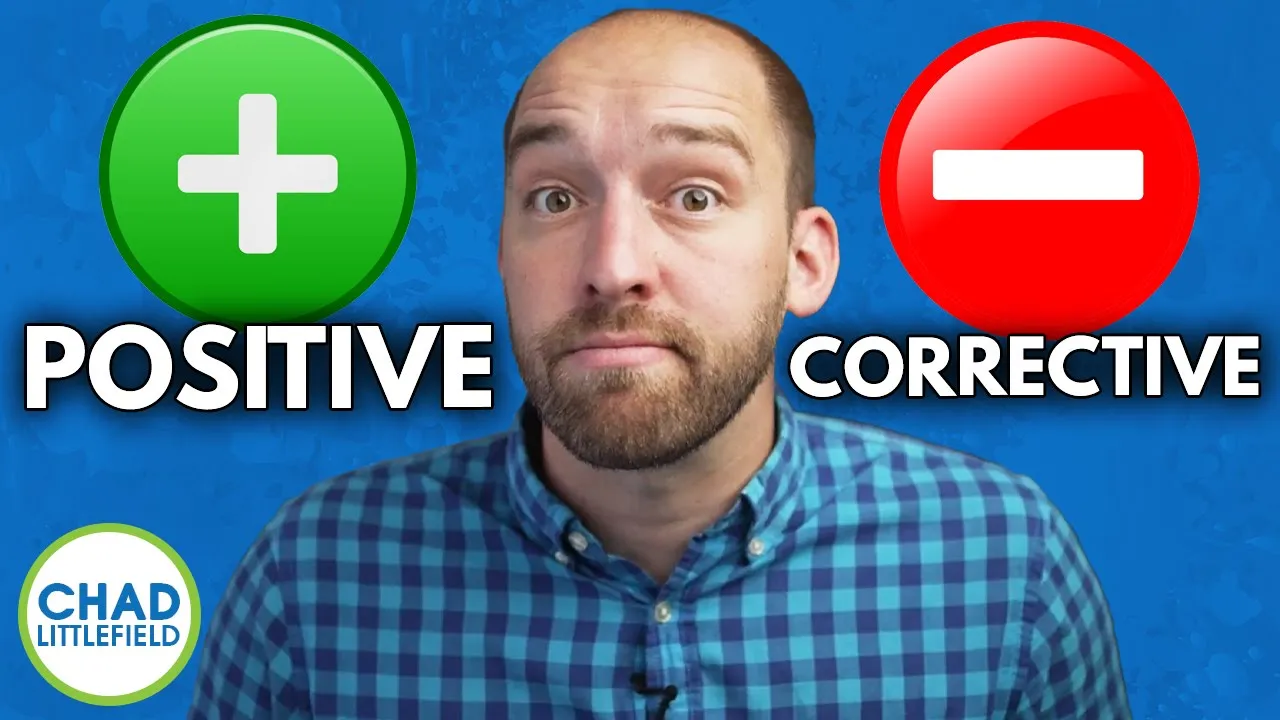
Did you know that people actually tend to prefer corrective feedback over just positive feedback? There are a lot of surveys that show this. One coming from the center for creative leadership.
To begin with, we hesitate to give corrective feedback. But a whole bunch of other data shows that we tend to hesitate to give feedback in general or we give feedback very rarely. Once a year.
Maybe once a quarter. If we're lucky perhaps, little like thank you for doing these little snippets here and there and so, in this video, I'm going to share one of my favorite models and frameworks, very. .
. simple. It comes from the center for creative leadership on how to give and receive feedback at work?
Also, right before actually recording this video I gave Steven who's behind the camera right now some feedback and I didn't even realize that this was the video that we were filming and so I'm gonna re-give him this live feedback. So, you'll see a live example of giving feedback. I have another video on that differentiates between affirmation and appreciation really awesome video on how to give positive feedback.
That's not what this video is about. This video is actually geared toward giving corrective feedback. It's a really simple framework.
It's called the SBI model. One of the things I like about the SBI model. One of the reasons is one of my favorite models for framework of many.
. . models is that it steers people and guides people toward giving more objective feedback rather than some of the more personal or emotionally charged feedback.
This SBI model guides you toward that. So, S stands for situation, is you're literally describing the situation. So, with Steven, we're sitting here we're filming a handful of videos all today all this morning and so I recognize that's the situation.
We're here in the studio filming multiple videos. It's kind of a rainy day outside. Steven has a flight later today that he's gonna be jumping on for another film project.
So, that's the situation. The B stands for behavior and so what did Steven actually do that I'm offering feedback on? In this particular case, I realized it's not the best example because I actually gave him positive feedback, not corrective feedback.
So, I'll rack my brain see if I have any corrective feedback for them. But what I said was, "I just really acknowledge and appreciate your stamina for film days like this. like, I don't know that I could stand behind a camera and mess with isos and lenses and things that I don't fully understand and you just do it with such grace", -Thank you Chad.
Appreciate that. -You're welcome sir. So, you share this situation which provides context.
So people know where this is coming from. It's not out of the blue. You've pointed out a specific behavior which up to this point all you've been doing is just kind of pointing at something that's been happening.
You're just like, see this? It's almost like you're recreating as if you were just rewinding a tape and saying, "This is what's happening", very objective, as objective as you can get. Naturally, you're observing the world through a subjective lens.
But you've just described the situation, the behavior. Now, for the I, you want to give the impact that it had. "Hey, Steven, we're here filming all morning.
It's a long morning. I really appreciate your stamina. Like, you just keep going you're really encouraging after each take after each retake etc it's really.
. . helpful.
The impact that it's had on me is it motivates me to keep going and whereas I might lose motivation on video number six of the day. " That's the SBI model. It's not rocket science.
We don't need to make this video any longer than it is. If you want to take this to the next step to offer a better positive affirmation and feedback to colleagues. Check out this next video very originally titled.
How to give positive feedback to a colleague? I'm Chad Littlefield, have an awesome day.