[Music] over the next few months we'll have some CFR experts explaining some of the recent changes and we are very excited and very lucky to have Bryan North AB to talk to us today but we'll also have an the recap Accardo will be giving a talk soon and Tim good yeah and now we've also asked some of our authors and to join in and give you some sessions which will be sort of practical classroom tips so we've got camera Reid who will be presenting in May we've got Lindsey Warwick and Daniela Clark all from Macmillan
so I see we've still got people coming in but I think we should probably get started so I believe Brian is is standing by and ready to go so yes I want to say a big thank you from Macmillan to to Brian it's really exciting for us to have him yeah as you all know he is one of the architects of the common European frame of reference and as also and recently managed and the project for the companion volume and brian is here today to talk to us about what's what's new and what's important from
teachers point of view so Brian if you're there would you like to say hello hello everybody what we're going to be looking at is the CFR companion volume which was which came out in the autumn and is now available on the Council of Europe website and will that the TFR companion volume has new descriptors which have been developed over the last four years for certain areas and it it clarifies model relation to seeing the learner as a social agent and in particular its developed descriptors for mediation I'll give you a an overview of the project
that we that we know so I'm not going to talk about the CFR levels there have been no changes to the to the CFO if we start off with the the CFR one of the points about the CFR which people over often overlooked is that CFR is not primarily about assessment to the title of the CF is the common European framework of reference for languages learning teaching assessment and in that order so in fact it is primarily about learning and teaching and one of the things that is sometimes not really understood is it it is
not primarily about assessment CFR is primarily about some curriculum reform and the same is true with the key component audio where the the companion volume has what it contains is first of all a text which explains key aspects the CFR for teaching and learning and secondly updated and new initiative descriptor scales so I'm going to actually talk about the descriptor scales but first I thought because this is the aspect that is new but first I thought I would remind everybody what what descriptors are actually good for well the main point about and descriptive descriptors using
can do descriptors is that they are a way of doing what is called backwards design backward design that you you think about what it is that you want the learners to be able to do what is the what are the objectives what is it that you want them to be able to do in the language and use select descriptors which describes them and then you work backwards from that in order to decide what you need to teach so it's a way of connecting your learning aims to real-world language use what you want people to be
able to do in the real world and thus give a framework for action oriented learning and in addition to that you can use descriptors descriptors bring transparency to what you're doing you can show people what you're doing you can show students what the objectives are and later you can help them to see what they can do in the language you can use the descriptors for self-assessment that you can also use descriptors to to tell parents or sponsors what students can do and another aspect is that the descriptors can be used for needs analysis that you
can use them for negotiated priorities with your learner's this can be done you can use a set of descriptors as a menu to discuss with us what their priorities at a more sophisticated level in for example company training context if you were working out what kind of course you wanted to give to a particular and you could use the different a menu of the different CFR descriptor scales to conduct a needs analysis to identify first of all the kinds of activities which the learners need to do then what level they need to be in all
these different but perhaps the the main role that the descriptors had is to inspire teachers inspire teachers to be able to choose classroom tasks normally classroom tasks will involve several descriptors it's not the case that you would have a task just on one descriptor if you look at the group of descriptors at the same level they tend that they tend to make you think of connections between the descriptors and and then you think I'd love to ask which will involve several and then finally you can use descriptors for assessment for criterion-referenced assessment because the descriptors
act as created as defined criteria with which you can describe the progress that students are making so these are the overall these are the overall functions of descriptors and they can they can give guidance to teacher assessment and they can also give students an idea of their own the new descriptors as I said the the companion volume that the bulk of the companion volume is a set of new descriptors and the the descriptors which we have developed for these following areas for online interactions which there are two scales for mediation different aspects of mediation which
I'll explain in a little more detail it there there are about twenty years ago then reactions to creative text including literature um there are two scales and for plural plural angle and pleura cultural competence where we have we have three scales in addition to developing new descriptors we also updated to the existing CFR descriptors I'd like to point out there have been very very few changes to the existing descriptors there are only about a dozen about twelve to twelve or fifteen descriptor existing descriptors that have changed and in almost all cases they were to do
with fact that we wanted to stop talking about the native speaker so there were some descriptors in the CFR which which they're mainly at the - when you talk about the fact that you could maintain relationships with nature instead of using the expression native speaker we've changed it to saying you could maintain social relationship speakers of the target language because today it's more and more difficult to decide exactly who is and who is not a native speaker of for example English what is the model nowadays English and the increased complexity people's life trajectories makes it
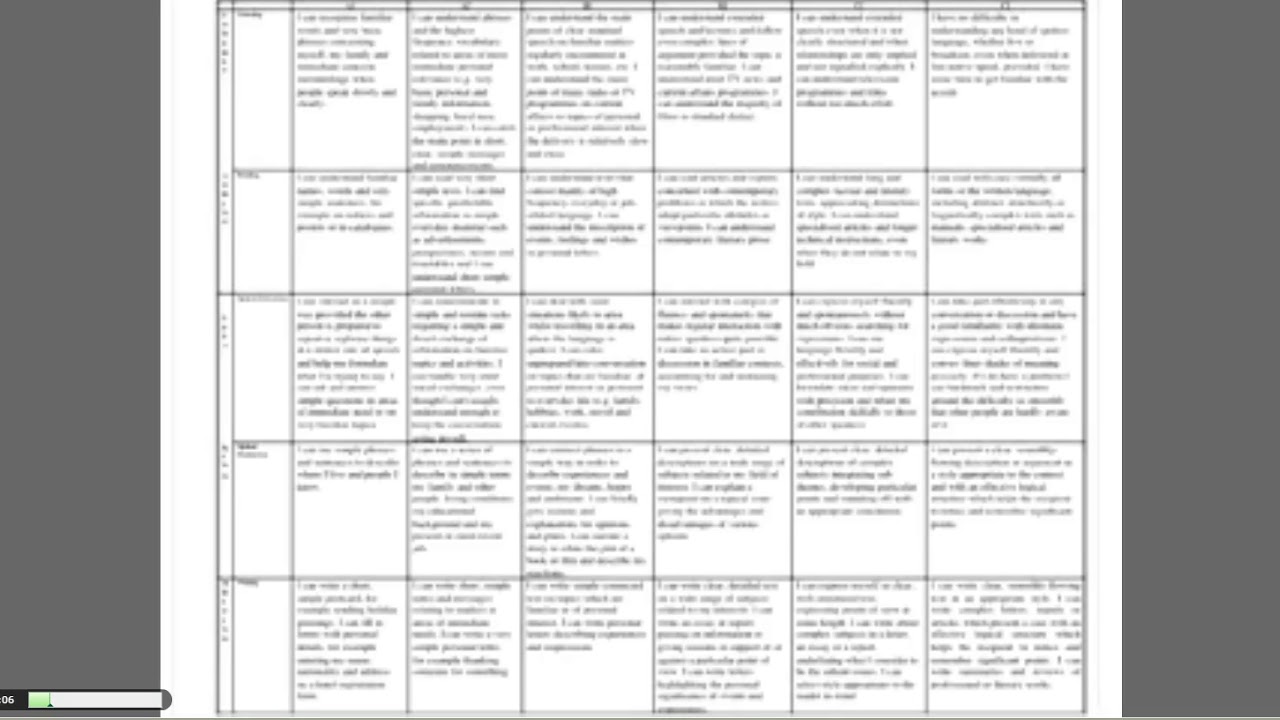
a more and more difficult but anyway in terms of updating the old scales what we've done is to fill in the gaps of where the descriptors were not previously available for example at the bottom they were not very many descriptors at the bottom of the scale we've there we've added a whole new level of pre a 1 and he added a considerable number of new descriptors that a 1 similarly at the top for C 1 and C 2 they are the description there is also in general terms there are more descriptors for listening and for
reading and there were plus as it said there the the scale for phonological control has been completely replaced a we have researched a completely new scale to replace the older and this this scale is in fact an analytic scale it has a overall scale and it also has a descriptors for sounds for articulating sounds one scale and descriptors for intonation stress and intonation a separate scale so there are now three little scales for phonology in a grid the overall phonological control last sound articulation plus prosody and there are a couple of other new scales like
for example there is a scale now for reading as a leisure activity in addition to reading for information instructions and all of these scales all of the scales now new scales and the old scales the there are no changes to the levels and there are no changes to the existing descriptors what we have done is to add new exciting stuff about online interaction mediation and reactions to literature early England very cultural all of the scales in the document have a little rationale which explains the thinking behind so if we take the the new scale reading
of the letter act it explains that reading is a major activity involves fiction nonfiction literature magazine articles newspaper articles blogs biographies etc different difference and there is a description of what the key concepts are operationalized in this case its length and variety of text the type of texts at the bottom you'll have simple descriptions and at the top end you get contemporary and classical writing in different genre including literature and topics you know at the bottom is everyday topics at the top it's a full range of abstract and literary topics types of language and simple
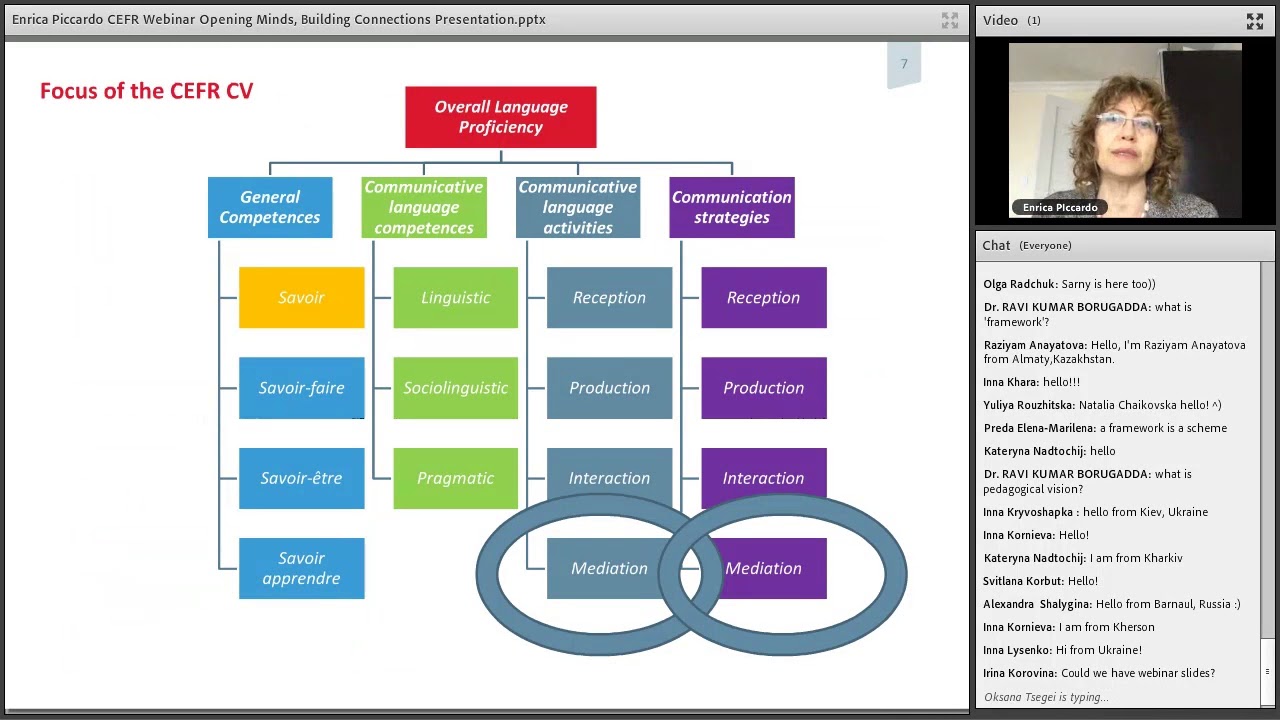
stylistic and the ease of reading the each scale boasts the listing scales previous scales and the new a rationale of this type so if we move now on to the significance of all of this the descriptive scheme to see if our descriptive scheme the if we start off with the fact there seems to be a slide into lost the slides but you may or may not know that the CFR has four main modes of communication reception production interaction and EDH and reception in production are basically four skills so the CFR doesn't talk about the four
skills listening reading speaking writing it talks about perception and production and here clearly we're talking about with we're seeing the learner the role of the learner in this model which is a a respectable traditional model which has been used since 1960 the model of the learner is as a speaker here focuses on your ability as an individual to print to understand and produce code code of the language and you talk about accuracy and fluency the focus is on the mobilisation of linguistic in the CFR that's described as reception and production that is it's the same
where the CFR moves forwards is in introducing interaction which is more as you know interaction is more than just the sum of reception of productions interaction is something because the role of the of the user user learner here it as a participant so they are actually taking part and focus is on the negotiation of meaning so you're getting onto the same wavelength as the other person in order to get your message across but the CFR also introduces mediation and this again this is a step further and in mediation the role of the the learner is
not as a participant but as a social agent somebody who has agency someone who is acting in the language and the focus is on the co-construction of meaning which can take various forms and here we're talking about learner as a social agent mobilizing their general as well as their linguistic competences so their general competences will be their knowledge of the world socio cultural competencies intercultural competence emotional CFR has a whole chapter on competences only half of it is about language group the other section section 5.1 is general and these are the kind of skills whereas
in the sixties we focused on the learner of an individual mobilizing their linguistic sources in order to understand the code of the language or to produce the code of our days we are more interested cause that is still important that is the basis of everything but we are we have moved on to what are sometimes described as 21st century skills where we're talking about interaction negotiation of meaning co-construction there are people are mobilizing air all of their competences over lighting general and plural English so it is a far more sophisticated model and the old four
skills model because one is talking of learning learning both using language and learning the land as being a social social process something which happens in our social context this is very related to various theories of language learning well in various theories of learning at all socio-cultural theory and concepts of collaborative learning and communities of practice and the idea of situated cognition and that you learn things through action you learn things through doing the idea is that you learn a language by using the language not just by learning it as occurred so what does this mean
then if we're thinking of the the user learner as a social agent which was an extract expression introduced in the CFR back in 2000 well seeing the learners are social agents implies some of these following things first of all it implies involving them fully in the learning process that means telling them as a minimum telling them what's happening and involving them in the sense of discussing with and what their priorities are and what they would like to do and giving them the opportunity to to act in the language in the classroom so recognizing that collaborating
with other learners way of learning recognizing the interaction between the social and the individual in the process because in such a cultural theory you learned through the social interaction all learning takes place in a social context after it also obviously means extensive use of the target language in the classroom if the learner is a language user at a social agent and they and they should be able to accept to to exercise their agency by accessing all of their linguistic resources and it the the the CFR philosophy there is no hard and fast these rules about
when to use l1 and l2 learners should be able to see their being their linguistic profile as a plural ingh wisdom profile where they can use their knowledge of different languages there are 1 their l2 l3 if there is one in order to focus on similarities and differences between life and improve increase their their language awareness which is a way of making and above all seeing learners as social agents implies using purposeful collaborative in the classroom asks where language is not the focus but that they are doing some planning a trip they are using they
set up a scenario in which they have a mission where they have to accomplish and tasks of this type collaborative tasks where the learners are working in groups and so in a solo shots in a problem-solving atmosphere where they have a mission they are fulfilling the necessities of the task this involves integrated skills they will be gathering information from somewhere which they to do that they will be listening to it or doing it and they will be collaborating together I mean guessing how to go about the task and what to do they'll be processing the
input that they have and turning it into a new form in order to create some kind of product which we obviously have some text in home language course and in the the prices of all of that they will be needing to explain input to each of that they have got from perhaps an internet reserve to each other caught in the product which they use at the end paying it to other people and during the process of working on the task a very important aspect of collaborative learning is helping the progress of the group and writing
other people in fashion linking what you say to what the people before you said that track and also helping to solve little problems and disagreements during the work and this is information those point they're more or less a simple definition of what mediation is and mediation developing scales for mediation was was the main focus of the project which took place between 2013 and 2017 who produced the and we ended up producing descriptors for three different types of mediation so we've got videos sorry we have descriptive scales for three different types of mediation I mean mediation
means a lot of things to to in different contexts the word is used in a lot of different ways but there are fundamentally three different applications of mediation the first one is in terms of creating creating facilitating communication managing tensions creating a safe space for people to be able to communicate or to learn it's part of the job of every teacher to mediate in their class and in that process you have to deal with tensions so this is the first focus of mediation in German that is actually what the word made yet field means that's
that's the only meaning they mean however there is a completely separate meaning of word mediation and that is the acquisition of knowledge it's used in dialectic philosophy actually comes from Hegel and then a socially social aspect is that it cannot ski and it's to do with the way in which you you mediate the the process of acquiring knowledge is a process of mediation you mediate you use light languages a tool that you use in order to to mediate new knowledge to yourself or to other people and there's a second aspect to that as well is
that in order to be able to do that then you need to manage relationships with holiday makes a fundamental distinction between this type of cognitive mediation which he calls the ideational language divides into transactional logical the distinction between this cognitive or ideational aspect on the one hand the relational aspect on the other terms of managing relationships and in order to mediate concepts in order to get other people understand concepts you need a little bit of the personal the managing the relationships as well as in order to create the conditions for the acquisition of knowledge this
this aspect of mediation is very relevant and then finally there is mediation in a in the in the sense which a lot of people in the language teaching under standard which is mediating texts this tends to involve reformulating transcoding alternate languages translanguaging code switching switching from oral to written taking information which is presented in one genre and and transferring it into another genre or combining text you have information which is in the form of a graph you explain it in words so that's lots of different ways of creating text and just to go over the
different scales which are which exist now in the companion volume under mediate under mediating communication there are three scales first of all the idea of facilitating plural cultural space creating a is a sort of safe third space in which people can and learn how to negotiate in between spaces between between different cultures this is very relevant in the multicultural in our situation secondly acting as an intermediary as a kind of informal interpreter as a linguistic and cultural intermediary between people who do not share a common language and finally facilitating communication in difficult situations situations then
the second group are mediating concepts here this is very much to do with directly connected with group work and classroom interaction classroom management the first two facilitating collaborative interaction with peers and collaborating to construct meaning concern work in small groups facilitating collaborative interaction with peers is more the relational helping the discussion along inviting other people in offering to play a certain role during the work whereas the second one collaborating to construct meaning describes more the the cognitive side where you are asking other people to clarify what they mean by something or asking questions in order
to persuade I would get other people to express themselves more clearly and then ii ii ii ii scales managing interaction and encouraging conceptual thought they they could be related small group work it is more concerned with what one does as a teacher or a trainer or an animate on the one hand the relational managing the interaction people cheering that they've got the right stuff forming groups or putting it back into play nuri etc and on the other hand encouraging conceptual thought is what's called the encouragement of dialogic thinking in American English you talk about probing
ask a question and then you ask another follow-up question another follow-up question in order to get people just to think something through logically these descriptors here are very relevant to the idea of of tasks projects it's a sort of thing which I was mentioning before where you where a group of students working together in order to create these these describe the sort of sort of things which they need to do in the group and then mediating texts is more conventional first of all relaying specific information from a text which could be an oral text it
could be it could be in listening to a public announcement and you didn't understand it so you asked the other person what did that say they pass on the information within it it's also relates to when you're looking but you look for something in a document and then explain it second one explaining data is pretty obvious you have some information which you'll form when you put it into words for other people processing a text there you have an entire text and you summarize it paraphrase may mean translating written text from one language to another listening
and note-taking and then the last two are to do with creative text expressing your reactions to creative tests and and analysis criticism of literature creative text that's the more academic the first one expressing a personal response is more the sort of thing that one does in secondary school with kids where you ask them you know which character did identify how did you feel at this point during a story compare the treatment of this story same story compared with the way it's treated in this work whereas analysis and criticism have created so the point really about
these things is that they can be all in the same language or they can be a cross line that will come back to that in a minute but in relation particularly to the text we've also created descriptors for mediating strategies if you want somebody to to understand something then it's a a good idea to link to things with previous knowledge to link to things that they already know or if what you're explaining is rather complicated it's a good idea to break it down into smaller pieces and of course to adapt your language to the person
that you're talking to the last two there are amplifying a tense text and streamlining of text are things that you do in order to improve the quality of a text so amplifying a dense text sometimes text is just difficult to understand because too much information in a small space what you do and there to examples illustrations it's the sort of thing that you do as a teacher take it and turn it streamlining a text is the officer streamlining a text is when you streamlining a text is when is when a text is going all over
the place and it's difficult difficult to actually follow it so you cut out all of the unnecessary information and parentheses and bring it back into a more linear all of those things we were talking about can either be across languages varieties and registers or within part kind of mediation scales there are also some some other scales on online interaction as I mentioned one is online conversation and discussion or on the interpersonal side the other one is goal-oriented online transactions in collaboration that's looking stuff online or ordering things or at a higher levels collaborating in project
work and then there are three scales for pure lingual of pleura culture building on building on cultural competence and also very lingual comprehension and here I put some descriptors for b1 some examples of descriptors for mediating concepts in collaborative good group work first one can use questions comments and simple reformulations to maintain the focus of the discussion and ask questions to invite people to verify their reasoning then in terms of facilitating Fleury cultural space and support an intercultural exchange using a limited repertoire to introduce people from different cultures and to ask and answer questions showing
awareness at some question may be different and the lingual one and exploit creatively his limited repertoire different languages for everyday context situation all of these new scales come with examples so what you're seeing now is some examples as his domain exam ever a one for a descriptor in online conversation and discussion and the the first and the first descriptor is relevant to all four domains of language use four domains being personal public occupational educational with this descriptor right very simple messages of personal online postings here is a short sentences about hobbies likes dislikes etc lying
on the end of a translation tool there that's relevant to the personal domain in terms of making contact online friends or family it's it's relevant in the public domain terms of public postings from a festival site and in the occupational domain you could be attributed to a simple social feed and in the education and it could be a question so in other words when every descriptor there are examples of application in the personal second descriptor there is only relevant personal education so finally a quick word about the project that produced all of this it was
a four year project with three main phases the first phase with development and that we analyzed returned sources that exist out there what you do when you start doing something like this is get your hands on everything relevant then there was a process of collation and formulation and classification each routing process of editing with feedback from external experts which went on over a period of about a year in iterative cycles of formulation and then when we when we thought that we we were at the point where we had some good descriptors we moved to qualitative
at validation and this was done through a whole series of face-to-face workshops which took place in 140 institutions about 30 different countries and their works people worked in pairs there were a total of 450 pairs so at least 990 people what they did was to look at the descriptors they were given the descriptors for about three or four categories and asked first of all to assign the descriptor to the correct category were they able to identify the category that this descriptor was describing could they put it in the right place secondly they were asked to
evaluate at the descript did they like they liked that it was it clear was it pedagogically useful did it relate to the way that people use language in the real world and I mean anything which got 70% or below threw away and then finally in a bubble they were asked to suggest reformulations how the descriptors could be better for me then after all of that going over all of that and revising quite a lot of descriptors we moved to the third and final phase which was quantitative validation which was to calibrate the descriptors to the
CFR levels to to double check that the descriptors were being put at the correct and this was done in two phases in the first phase people were asked to people were asked to to assign each descriptor to a level they were asked to say at what level what level could a person do what is described in this descriptor they had to choose enough and then in the and then in that background we had just under 1,300 people in unrelated ideas and the from then and then the next stage was which was completely separate was a
different survey in which the descriptors were used for assessment I understand of yourself for assessment of somebody who you know very well and there the task was to say who the person you're thinking of do what is described yes if you're thinking of yourself people are asked to think of themselves in their rural England personas think of yourself as a speaker French English and could you do what's described in this descriptor yes in fact it wasn't yes or no it was between zero and four oh one was well with some help - with yes in
normal circumstance three with yes even in difficult and four yes no problem and this this phase this assessment phase was replicating the research which had been done to produce the original mystery because the point was that we wanted to be able to relate new descriptors to the previous plate and then finally there was an extra validation phase for England so following that we had a consultation process which went on for pretty much a year first of all there was an expert meeting which took place in July to then over the summer a pre consultation with
experts survey and then from October 2016 2 February 2017 we have the main consultation which in which they were there actually three surveys the main there was a survey for individuals in which over 500 people completed and they the same survey was also given to two Institute's cost cultural institutes and networks and there was also a survey of the member states and the reactions from all of this consultation were extremely positive the descriptors all got an over 80% approval rate and many of the descriptive scales got over 90% and it also enabled us to finalize
make some decisions final decisions about the names of categories and to drop a few descriptors edit so and then following that there was a piloting phase which took place between January and July and there were about 70 pilots in over 20 countries the number of people taking part in the pilots varied from 1 to 20 they were piloted in quite a large number comments during the piloting one person said I think the new proposed scales will be very helpful to define curriculum aims for level a1 she was thinking in particular of the process dat text
and the collaboration is another comment was that the students were made more aware of how language can be used to collaborate take turns build a conversation and work towards a goal the descriptors helps to draw attention to the end results and the objectives were trying to achieve she went on we saw how the participants moved from needing to clarify and confirm mutual understanding which is more attraction to interacting more effortlessly by building upon each other's ideas and structure and then one person said the following which is very interesting for me as a teacher with the
help of the descriptors you are more aware of the question of what do I want my students to be able to do the teaching objective can be defined much better and more clearly for assessment can my students really do this have I taught them the necessary competence and for the students they were happy and very cool very cooperative to give feedback and they appreciated that I was interested one point is that every every single teacher in the piloting used the descriptors for services not just for they used them in order to think about an activity
for the classroom and also to look at the performance in thee they also gave the script just found this a very worthwhile so to conclude the companion volume is available on the Council of Europe web site can be download can be downloaded it undies the CFR cv underlines the core messages the CFR for teaching and learning with this very readable text a very readable text with lots of pictures it's only about 20 pages long and it explains all of the main points about the scene it also provides descriptors that can inspire more integrated richer collaborative
classroom tasks and it encourages the promotion of cross-linguistic creation early and it's available the companion volume is available at this web address which is the Council of Europe CFR website a reason I see of our website which has a fume which have a lot of interesting information and a link shirt there and if you look there you will see the full text of the original CFR plus the new companion volume and you will be able to at the moment you can access it in English and French the German translation is being done at the moment
it should be ready in a couple of months and other languages and stuff so it's quite a change to the CFR it's but the main point to make is that it is an addition the original CFR the original levels of the original descriptors all still say the same what we have done is to is to take account of some of the rich concepts which have developed over the last 20 years since the CFR published in order to provide descriptors I hope that you found it valuable and thank you for [Music] you [Music]







![Chris Langan - The Interview THEY Didn't Want You To See - CTMU [Full Version; Timestamps]](https://img.youtube.com/vi/9miVG2xT5jY/maxresdefault.jpg)