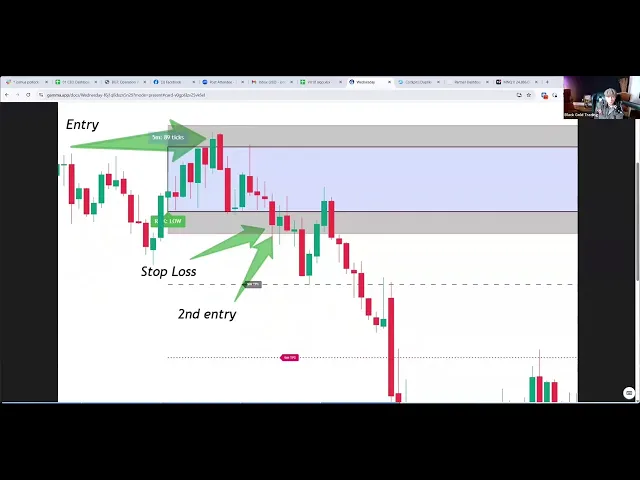
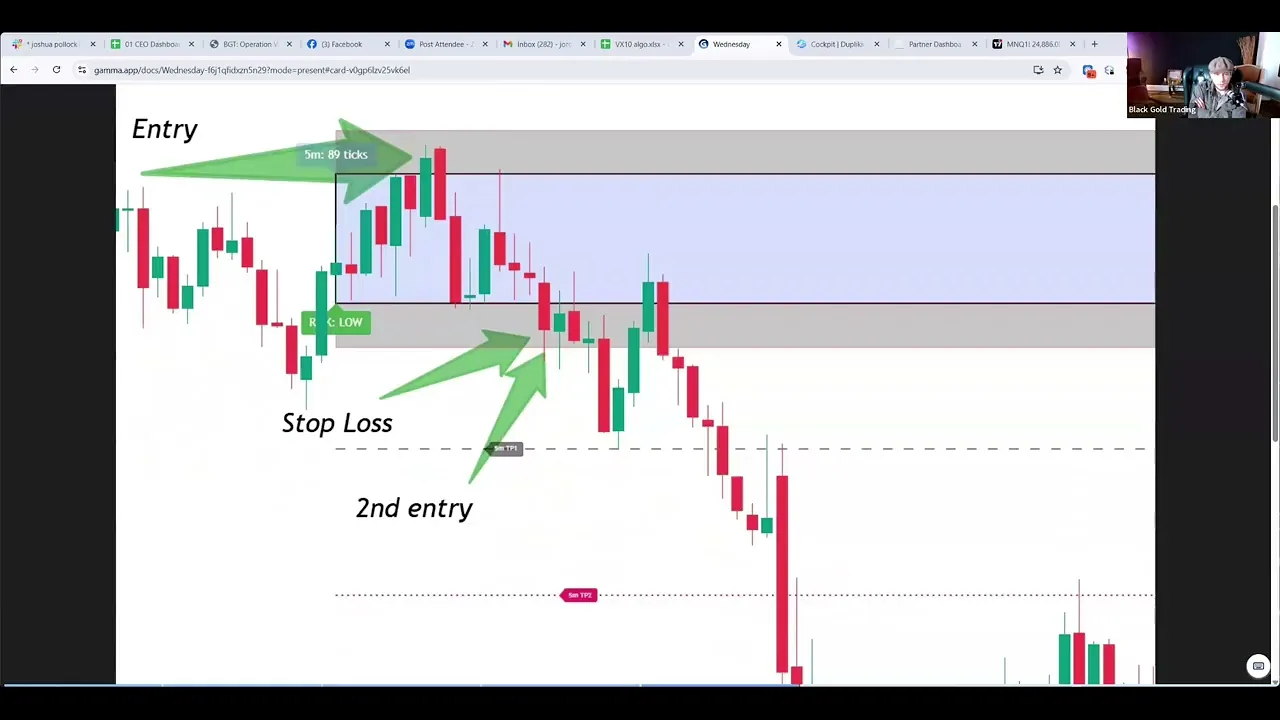
Uh we're going to go through multiple multiple different uh scenarios. Scenario one is normal exactly like it sounds. In fact, the trade today was normal.
Stop loss top of the box or within the buffer I should say. We entered qualifying candle at the bottom entry. Take profit one.
Take profit two. I'm not going to spend a whole heck of a lot of time on this one because this is just this is plain jane vanilla, etc. Quick question from Tiff.
Uh, after a loss, is there a second chance? Yeah. Yeah, I'll show that to you here in just a second.
That's like scenario two, I think. So, let's look at this real quick. Actually need to go back to the beginning.
So, this watch this play out real quick. So, we're right at 8:00. We're waiting for our box to form.
We're on the one minute. And guys, you can you can keep this on the 5m minute until your box is drawn. Personal preference here.
For me, in replay mode, if I click the forward button, it'll go forward 5 minutes at a time. That's why I'm on the 1 minute first. 145 tick box mid-risk qualifying candle right here.
Qualifying candle right there. We are going to enter. I think we're doing two contracts on this.
Quick question for you guys. If you do one contract, can you have a runner? Negative.
If you're doing one contract, there's no room for a runner. So, this one we do two. I don't think I'm doing a runner in this scenario.
This is just a normal trade right there. TP1. Pretty straightforward, guys.
Any questions on this scenario? Again, this is like everything works out exactly like we would want it to work out. Any questions on this?
These are often quick correct mark. It's got to it's got to close within that buffer zone. When looking for our second attempt, how long do we continue to look?
So, if we get into like 930, that's no longer an EAT trade. Okay, that point it's a completely different trade. I'm not taking it.
If we're in a trade and it goes all the way to 9:30, this is rare. Like maybe once a month. 808.
I think you joined late. I wasn't supposed to let you in, but we went over joining as a member. We went over the membership, mentorship, the indicator, and the automation.
I let you in out of the kindness of my heart, but uh to catch that part of it, you'll need to watch the replay here in a few. All right. So, let's go to the second scenario.
One and one. Now, this is really common. Really common.
In this scenario, we are going to lose the first trade and take the next qualifying candle. Now, guys, I want to make this very clear. You don't have to take a second trade.
For some reason, people think if I have two strikes, I have to take two trades. Not the case. In fact, during our live trading sessions with myself and Josh and Michelle, you guys will see us often only take one trade, especially as we get closer to the end of the week or the end of the month.
There's a lot of strategy that goes into winning every week or winning every month. Okay? It's not an accident that we've won every month.
It's not an accident that following our rules, we've never blown a prop. Joel says, "I usually trade with four to five contracts, which means no runners. " Uh, you can absolutely do a runner with four to five contracts.
I'll show you here in a second. Uh so here is scenario one and one. So scenario two we enter here at the top.
We go long on this qualifying candle. We get stopped out on this red candle. Now when this we got stopped out while this candle was still moving.
Question. Do we enter the second trade while this candle is still moving? Yay or nay?
It's got to close. So, this candle closed right here, right where I'm moving my mouse. Is that a qualifying entry right there?
That is the qualifying entry. So, we got stopped out here and then when this so this one candle stopped us out and it also qualified as our second trade when it closed and this trade obviously goes to the moon. So, let's watch it.
Yes, they're one minute candles, correct? Okay, qualifying candle for us to go long right here. So, stop loss.
I went right here below these wicks. These wicks are outside of our buffer zone. These don't count.
I went outside of these two right here. Take profit is always the same. Take profit one.
So here we get stopped out here in just a second. So that's our stop and also our qualifying for the next trade. So, same thing just in reverse.
Stop loss is going to go up here. Where would you guys put the stop loss? Would you guys put it right here?
Is that what you see? Within the buffer zone, but right above these two candles. Yep.
There we go. Now, this one went really, really, really far down. Any questions about the second scenario where we get stopped out, we re-enter the algo.
Yeah. The ALGO does re-enter. It takes up to two qualifying trades, two strikes in a session.
All right, guys. No questions at all. Everybody's good.
We got plenty of time. So, if you have any questions, just let me know. Tim asked, "Uh, I see your examples and member examples seem to be two contracts.
" Um, some of them are two contracts. It depends on the account size. So, now Tim, this is part of the strategy stuff that we'll teach you, you know, as we start working together.
if if we do work together. In my opinion, most people do prop firms wrong. In my opinion, most people don't know how to build a business out of this.
I think people can pick up the EAT cuz it's pretty simple, but just learning how to trade EAT is not the same as growing a business out of it. So Tim, you might see two contracts, but we might have 25 prop firms being copied. Random example or five prop firms being being copied.
So the dashboard does not necessarily account for all of the accounts. So we might have 2, 5, 8, 10. I mean, we have people on staff that have a million dollars in funding in past prop firm accounts, people on my staff.
Does that make sense? Um, does the algo move the stop up? There's no moving it up, but it does set it for you at the top of the box.
Can we just let the algo do it all? You could. It's meant to be a enhancer.
It's meant to be a tool. Um, Ninja Trader is one of the options, but you would need to copy it, and I walk you through how to do that. What do you do if a candle closes exactly at the top or the bottom of the buffer?
If it's within the buffer, it qualifies. It's if it's outside the buffer, we wait. Yeah.
And Tim, that's prop firms aren't required. It's just where a lot of people choose to start. I am more of a cash account guy myself.
Tony said, "I'm in the Eastern time zone. Would a possible learning strategy be to paper trade the Asian session at night for practice before moving? " Yeah, you guys can paper trade as long as you want.
What is the percent to win the second trade? It's high. But we we've got to shift our thinking a little bit.
Who can tell me why? Just take a guess. Why do I, Jordan, not care about win rate?
Why don't I care about win rate? And why is win rate irrelevant? You guys are nailing it.
What I care about is P&L, profit and loss. You guys know that there's people that have 90 95% win rates that are not profitable. They're literally not profitable.
So, we could have a terrible win rate. In fact, a lot of hedge funds don't have a very good win rate, but they're wildly profitable. That's what's important.
All right, guys. Uh, are we good to go to the next scenario? We're going to do it anyways.
So, here's a scenario where we get two strikes and we are out. We lose both trades. This is rare.
It does happen. It is rare. This is why position sizing is so important.
This like we do this in a way where we don't blow prop firms. Like there's just no if ands or buts. If you guys are blowing prop firms respectfully, in my opinion, you're not positioning yourself correctly.
And even more dangerous than that is if you are not positioning your size correctly and you do pass a prop firm. That's twice as dangerous. It's like giving a kid a candy and rewarding them if they do something bad.
There's no longevity in it. You might like some of these people their their whole goal is like one the one day I'm going to try to pass a prop firm in one day. That is the worst possible thing on the planet.
Your position sizing is out of whack. We've got to be looking longterm. We need to be thinking in years, not in days.
I had a post on Facebook. I'll just show you guys. It was uh wildly unpopular.
Was this one? Poor people stay poor because they want everything to happen instantaneously. They often need a quick return or something to happen fast.
Wealthy people are often slow, calculated, and thinking in decades. Break the cycle. This is why if if somebody wants to come in and they want me to mentor them, like guys, if you can't do it for 6 months, don't do it at all.
If you're thinking like daily, weekly, even even monthly, you're thinking too small. I'm looking at decades. I'm looking at generations.
Does that make sense? So, if you and I'm not calling anybody here poor. That's not I'm not here to do that.
I'm here to help you guys. But if you've struggled financially, either currently or in the past, most likely it's because we're not thinking in decades. We're thinking short term.
We're thinking paycheck to paycheck. How do I just survive today? How do I make as much money as possible today?
That's not what wealthy people do. I told you guys earlier, I I own a a a quant fund or if you're not familiar with that terminology, a hedge fund. You know, we're talking to people that have millions and millions and millions of dollars.
We have several hundred millions of dollars committed. These people are looking at decades. All right, off my soap box.
In this scenario, we lose both trades. We're done for the day. fairly rare but it can happen.
So we need to plan as if it will happen. So number one we enter here. Okay.
Um either one of these green green either of these three green candles qualify. Actually this first one does. We get stopped out on this qualifying candle right here.
Right where my mouse is. We re-enter. We go short.
We come up and get stopped out. Here's what it looks like. First entry coming up.
This is only a 56 tick box, guys. This is a $25 risk. Here's our first entry.
So on a $25 risk, like if this was real life, I would have been way more than two contracts. TP1 up top, stop loss down there. We're going to come down.
We're going to get stopped out. Remember, we never move the stop loss in this scenario. Real quick, guys, is the market consolidated?
If you guys look at this, all right, this right here market consolidated very much so. So, we got stopped out. We go at it again for our second strike.
And this one just maintains that consolidation. stopped out again. Again, it was only 56 ticks, so just over 25 bucks, guys.
At that point, we are done for the day. In fact, I turned my chart off. I'm out.
Any questions on that one before we jump into runners? So this is the going to be the classic let it run scenario where we do not move a stop loss for a long time. Runners is the only part of this that there's two things guys.
There is science and art. Science is black and white like the 30 tick buffer. TP1 is always 100 ticks.
Two strikes you're out. That's all science. That's all data driven science.
It's mathematical. Runners are a little bit more of the artistic side. This is why we we work with people for a while because this is it's an artistic thing, something that needs to be practiced.
It's the only thing that's not black and white. Now, you could make it black and white with a TP2. So let's just say that your TP1 is 100 and your TP2 is always 200.
Well, that would be black and white. But if you're going to go beyond a TP2, it becomes not black and white. The Mohammad the strike means you lose two trades or you lose one trade.
Two strikes you lose two trades. So guys, in this scenario, we obviously are going long. We get a qualifying trade almost immediately.
This is uh 1 2 3 4 five 6 7 8 minutes into this trade. 3 minutes after the box, we are getting a a trade. Okay.
So, couple things to keep in mind. Number one, we are not moving the stop loss. Stop loss is going to stay where it's at.
We're not going to move it for a long time. Don't ask me how long. It's a little bit of art.
I'll show you. But there's not an exact, oh, it's got to be 35 minutes and 30 seconds on the dot. It's not that.
Let me show you. And guys, if you're trading with us live every day, you'll you'll trade these runners with us. All right, party people.
We're getting ready for the trade. 125 ticks qualifying candle almost immediately. This one I go four contracts.
You'll see that I'm doing the one-click trading. So the sell limit, I'm not sure if I do this one first or not. The sell limit is your take profit.
Now this is important. Try to pay close attention. What I'm doing right now is I'm setting up for a runner.
If we start with four and then we close four, can we have a runner? Yay or nay? No.
So, we need to change this. It can't be four. Okay.
So, how I do it, you guys saw me right click on my on my chart. I did a sell limit and what I'm going to do is I'm going to change this from four to I don't know three two. So now if we hit our TP1 I will have two contracts open still.
Now does our stop loss need to be four or two in this scenario? Four or two for our stop loss. It's got to be four, at least initially.
So, let's roll. Now, I got to change this to four. You guys can see I clicked on the number four.
Clicked and made it four, I should say. almost hit our TP1. Not quite.
There's TP1. So guys, first thing you've got to do, we hit our TP1. You You'll notice that this is no longer four.
It now says two. We've closed two in profit. We have two left over.
We have to change our stop loss. Who can tell me what would happen if if I don't change this and it hits this four? What would happen?
Yeah, we'd have two short. So, it would close out two and then open two short. So, it's got to match.
Your stop loss always needs to match your current position sizing. Guys, I I I have done this 50 times. I have forgotten to do that.
Or worse than that, I will forget that I even have this down here on a runner. It'll close my runner. I'm like, "All right, done for the day.
" And I'll forget to close this out. So, we do have in the dashboard a pre-trade checklist and a postrade checklist. It's really important.
I've seen people that are winning the month and they blow their account because they forgot about something. Uh, Cairo says he doesn't follow. So, right now we are we've we had four TP1 closed two.
We're currently in two contracts, but our stop loss is four. If the price was to come down and hit our stop loss, it would close out the two that we're in and open two. So, think of this as like 5-year-old math.
Plus 2 - 4 would be minus2 would be too short. Does the algo close positions automatically? Sure does.
There's also a runner on it. Um, go back to the Monday call on why we don't use brackets. Let's keep on rolling here, guys.
808 says, "The entry is not clear to me. I've watched replays but I can't see wicks and it does not it goes too fast live when I can zoom in. It looks like you are entering even if wick closes outside of the buffer.
No, let me go back a little bit. If you're trying to watch on your phone, I can see how that would be difficult. Let's just go back a hair.
So, see how this this candle closes within this gray buffer? That's the qualifying trade. Any questions on this?
Like see how it's closing in the buffer. It's a qualifying trade. Even if this was a wick, I'll zoom if we have enough time.
I'll zoom in here after the call. All right, let's get back to it, though. Yeah, we're looking for the body of the candle to close.
All right, guys. That that is TP1. You can see I'm changing the stop loss.
Let's just go forward a bit. Yeah, I'm not kicking you out, man. You're getting disconnected somehow on your end.
All right, we're about to hit TP2. Guys, notice I have not moved my stop at all. Now we're at TP2.
So, we're several hundred ticks in profit. So, at this point, what I'm going to do is I'm going to move my stop up. So guys, we're we're coming up on like 300 ticks in profit.
So I don't want to get too greedy here. So I am moving it. And again, this is a little bit more of the art side, but I'm moving it kind of down to this recent low.
Now look at this. We just picked up probably uh 200 more ticks. So again, I don't want to be greedy.
So I'm going to move my stop up even further to the bottom of this candle. Comes right back down and stops us out. Now, you could have trailed this a little bit more aggressively.
Like you could have gone like way up here. I try to give it enough room to breathe. It could have been 8.
Well, we're actually at 9:30. This is market open. So, this is a scenario where we did hold a runner to market open.
The initial trade happened by 8:45. The initial TP1 and then the runner went to 9:30. Um, the remaining two contracts did not close at TP2 because I did not set them.
I did not do any sort of a pending order at TP2. I wanted to go above TP2. So in this scenario, I only had a TP1 and the rest was a runner.
So there's two approaches. Let it run. Don't move the stop loss until we are at least past TP2.
That's scenario one. Scenario two is you can trail a bit more aggressively if we are towards the end of the week or towards the end of the month to preserve capital and maximize the trade. Yes, as long as the body closes within the buffer zone, we do take the trade immediately on the one minute.
DJ, that's a little bit more on the art side. I make I'm more so making the position like we'll you guys will see this if you end up working with us. We do a pre-market every morning before we before we take our trade.
We're doing a pre-market setup. We are looking left. We're looking at the market.
We're looking at what happened overnight. It doesn't change the rules of the trade. Like nothing we see will change the rules of the trade.
However, looking left in our pre-market analysis will tell us if we believe that we're going to be doing a runner, how much of a runner, that type of a thing. One other thing I'm going to point out, and you guys will not see it on your on your screen here. What do you guys think was right up here?
Take a guess. What do you think was right up here? There was another box right up here on the one minute.
You won't see it. If I was to switch to the five, which I can't. This is a video.
If I was to switch to the five, you guys would have seen that there was a box right here. So, when we pushed up, I was very confident that we would be moving to this box. In fact, looking left, it had done this over and over and over again.
So, the pre-market analysis that we do every morning before we start trading is important. Doesn't change the rules, but it does influence how we do our runners. All right.
Um, I got one more for you. This is a bonus. It's an advanced topic that we would need to work on over some time.
Didn't draw the box. Um, the indicator draws everything for us. not recommended for complete beginners.
Okay, but there's a little bit of theory here. Number one, here's my theory and this is how I've I've gotten I mean guys, we've worked with 10,000 people. Okay, start small as possible.
Start as small as possible so your loss is as small as possible. Number two, add contracts when you have absolute confidence it's moving in your direction. Okay?
Now, I'm going to show you as an example. I'm not going to teach this to you this week. I'm going to show you an example and I'm going to overexaggerate it to prove a point.
Okay? Now, you guys probably would not do this exactly how I'm about to show it, but you guys are going to get the idea. So, this is again a little bit of our pre-market analysis goes into this, but this is me adding starting as small as I can, which is one micro, and adding to my winners.
And again, I'm overexaggerating this. is our qualifying trade. One contract only.
Now guys, normally I would move the stop loss, set the takeprofit, the whole thing. This is just an example, just a bonus video. Now, what's happening?
Did we get a replay video? It's already posted. Yep.
It was posted a couple hours after we after we did it. Now what's happening guys is I am adding contracts as I get confirmation that the trade is moving in my direction. What that looks like is candles are coming into the buffer zone and rejecting back out of the buffer zone.
Okay. Now we also if you guys can see my mouse we also have kind of a some consolidation here consolidation here. So, watch how I do this.
This is There's a lot more art on this. I just wanted you guys to see it. Okay, we rejected a big old wick.
We're coming out of it. I'm adding a contract. We're now in two contracts.
Okay, rejected again. Came out of it. Adding a contract.
This is confirmation that we're moving up. Think of it that way. Confirmation that we're moving up.
Okay, we reject it again. Coming out of it again, I add another contract. Coming out of again, I'm adding another contract.
You'll never guess. We rejected again, added another contract. We're now in five contracts.
You guys get the idea. This one ends up being about a $1,000 trade. Think I added one right there as well.
We're now in seven. This is an overexaggeration. We're up $500 here.
$700. That puts us well over a thousand to close out the position. 1,213.
Closing it. Tomorrow is a big day. I want to show you guys very explicitly how I got out of the rat race with passive income.
And I want to give you guys a blueprint for how you guys can do exactly the same. Okay, if you missed it, you guys jumped in late. One second.