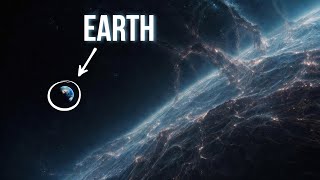
It's a strange thought, isn't it? That right now, this very moment, 13.8 billion years after the universe burst into existence, you are sitting at the absolute center of everything we can possibly perceive. It's not an ego thing, you know, it's a simple consequence of geometry and the finite speed of light. Um, but that from your unique position in spaceime, you are the focal point of a vast spherical bubble Of information that has had just enough time to reach you since the beginning of time itself. Beyond the furthest star we [music] can chart, past the most
ancient ghostly galaxy our telescopes can resolve, lies an invisible boundary wall that no instrument [music] can pierce and no light can ever cross. This is the edge of the observable universe. But that word observable, it's doing a lot of heavy lifting there, isn't it? It's a it's a carefully chosen Word. because it hides a profound and perhaps unsettling truth. Um it doesn't mean that's all there is. It simply means that's all the light, all [music] the information that has had time to complete its unimaginably long journey to us. [music] So what happens if you could
just for a moment step outside that boundary? If you could somehow slip past [music] that cosmic horizon, would you find just more of the same? [music] More space, more galaxies stretching on Into a quiet, cold infinity, [music] or would you discover something else entirely? Something that breaks every rule of physics, every piece of intuition we've ever built up. Um, [music] it it feels almost like standing on the shore of a of a vast cosmic ocean. You can only perceive as far as the horizon, but you have this deep innate [music] sense that the ocean doesn't
just stop there. There's more water, more waves, More everything just beyond the the curve of your perception. That's precisely the situation we find ourselves in when we cast our senses out into the cosmos. Light from the most distant objects, the very first galaxies to flicker into being, has been traveling towards us for well over 13 billion years, racing across the expanding fabric of the universe at the ultimate speed limit. But here's the twist. The beautiful counterintuitive Wrinkle that changes everything. The universe itself hasn't been sitting still while that light was on its way. It's been
expanding [music] um is not like an explosion into a pre-existing [music] void, but an expansion of space itself everywhere at once. Imagine a runner on a treadmill that just keeps getting longer and faster. The light is our runner traveling at a constant [music] unbeatable speed. But the treadmill of Space itself is stretching [music] out beneath its feet. This means that an object whose light has traveled for 13 billion years to [music] reach us is now today much much further away than 13 billion lighty years. [music] The current distance to that cosmic horizon, the edge of
our observable bubble is something like [music] 46 12 billion lightyear in every direction. When we push our instruments to their absolute [music] Limit, we don't perceive a wall of blackness. Instead, we experience [music] a faint ethereal glow, a whisper of radiation filling all of space called the cosmic microwave background, [music] the CNB. This is the oldest light in the universe, the afterglow of the big bang itself. Um [music] but um it was the the the released when the universe was just a toddler, [music] a mere 380,000 years old. Um before that moment, the cosmos Was
so incredibly hot and dense that it was completely opaque, a sthing incandescent plasma where photons were trapped, bounced around like pinballs, unable to travel freely. [music] Uh it was like trying to perceive anything through a dense impenetrable fog. The the the [music] the release of the cosmic microwave background was the moment that fog lifted. The universe became transparent [music] for the first time and this ancient light began its Long journey across space and time. So, uh, you could think of this cosmic [music] background as the universe's ultimate baby picture, a snapshot of what everything looked
like when [music] it was less than a millionth of its current age. But, but here's where it gets [music] truly strange. This wall of ancient light creates a perfect sphere around us. We are at its center. [music] And this sphere with its radius of 46 and a half billion lighty years defines Our observable universe. [music] It contains every galaxy, every star, every nebula, [music] every single thing we can ever in principle hope to detect or [music] interact with. Um but but again that word observable uh it implies a limitation on our part um not on
the the the universe's part. [music] It's it's a terrifying thought in a way. It doesn't mean this is all there is. [music] It only means this is all we can ever know for sure. the the Actual universe, [music] the entirety of reality likely extends far far beyond this cosmic horizon. [music] How far that is perhaps the biggest question in all of science. We have no definitive answer. We're like explorers trapped in a small clearing in an infinite jungle. We can map our clearing with exquisite precision, but we have no way of knowing if the jungle
goes on forever or if just Beyond the treeine there are mountains or oceans or something stranger. Still, our cosmic horizon is the edge of our clearing and everything beyond it remains shrouded in an absolute impenetrable darkness. So, what might be out there? Some researchers, perhaps the more conservative ones, believe the universe beyond our horizon looks much the same as it does in here. More galaxies, more clusters of galaxies, more vast cosmic voids, just more of the Same stretching on and on. If that's true, if the universe is truly infinite and uniform, then the the implications
are just staggering. Um, it means that somewhere out there in their unseeable expanse, the laws of probability dictate that there must be other solar systems just like ours, other planets that are identical copies of Earth. And and on those planets, there would be copies of you, of me, of everyone we know living out lives that are almost identical or Perhaps subtly different. It's a consequence of having infinite space to play with, but only a finite number of ways to arrange matter and energy. So, so patterns must eventually repeat. But other scientists propose something far more
unsettling, [music] far more radical. They suggest that beyond uh our cosmic sphere, the very laws of physics [music] might change. that our universe with its particular set of rules is just a small stable Pocket in a much larger more chaotic reality. In these other domains, space might curve back on itself in bizarre ways. Time could flow backwards or in multiple directions at once. matter might be governed by forces we can't even conceive of, shattering our entire understanding of what's possible. And then there's the the most haunting possibility of all that beyond the edge there is
nothing. There are not empty space, which is still a a thing, a stage, not darkness, which is the absence of light. um but true absolute nothingness, a void so complete that the very concept of beyond losses all meaning. A state where space and time and possibilities simply cease to exist. But before we can even begin to explore these possibilities, we have to grapple with something even more fundamental about the universe. We think we know. Um we we have to understand That the edge itself, our cosmic horizon might be receding from us faster than [music] anything
should be able to travel. That's right. The edge of the observable universe is running away from us at an impossible speed. That every second that passes, this cosmic boundary races outwards at nearly three times the speed of light. Now, that should set alarm bells ringing. Einstein's theory of special relativity, one of the most rigorously tested ideas In all of science, states that nothing through space can travel faster than light. It's the ultimate cosmic speed limit. Uh, and yet here we are with our own horizon sprinting away into the darkness like a retreating tide that defies
all the rules. Um the the the secret to this paradox lies in understanding what is actually expanding. It's not the galaxies themselves that are moving through space at these incredible speeds. Um it's not As if they [music] have fantastically powerful rocket engines. No, it's space itself that is stretching. The fabric of the cosmos is expanding [music] and it's carrying the galaxies along with it like currents in a rising cake or dots drawn on the surface of a balloon being inflated. The dots aren't racing across the rubber. The rubber itself is expanding beneath them, increasing the
distance between them. This expansion means that right now as you're listening To these words, the observable universe is getting larger. More space is constantly coming into our field of perception. Light that was previously too far away to have reached us is finally arriving after its journey of billions and billions of years. In a very real sense, we are perceiving the universe reveal more of itself to us in real time. It's a slow majestic unveiling. But here's the strange poignant part of the story. Even as more of the universe becomes visible to us, we are also
losing sight of other regions forever. You see, objects that are already near the edge of our cosmic horizon have been carried away by the expansion of space [music] so fast that any new light they emit today will never be able to overcome that expansion to reach us. They are disappearing beyond a point of no return. They are vanishing into a realm we can never explore. Like ships sailing Over the horizon. At first, [music] you can perceive the entire vessel. Then slowly the whole disappears below the curve of the Earth. Finally, even the tallest mast vanishes
from your perception. [music] These distant galaxies are like those ships slipping away into an eternal invisibility. This creates a rather troubling question. Um, if the edge of space is constantly expanding, why does the cosmic horizon exist at all? Why don't We just perceive infinitely far in every direction? The answer, as I mentioned, lies in the age of the [music] universe itself. Um, light has only had 13.8 8 billion years to travel since [music] the Big Bang. No matter how fast space expands, light from beyond a certain distance simply has not had enough [music] time to
get to us yet. It's still on its way. Scientists call this the particle horizon, and it represents the ultimate limit of what we can ever Observe. Beyond this boundary lies the unobservable universe. A realm that might well be infinite in size but will remain forever hidden from our direct perception. And as if that wasn't strange enough, recent measurements have revealed something even more unsettling about [music] this expansion. For decades, cosmologists assumed the expansion must be slowing down. Gravity after all is the dominant force on large scales and it pulls everything together. [music] It should be
acting as a cosmic break. But in the late ' 90s9s, two teams of astronomers made a shocking discovery. The expansion isn't slowing down. The [music] it's accelerating. some mysterious invisible force is pushing space apart faster and faster [music] with each passing moment. We don't know what it is. We call it dark energy, [music] which is really just a a placeholder for our profound ignorance. But but whatever it is, it makes up nearly 70% of the energy density of the universe. This acceleration means that galaxies currently at the very edge of our perception will eventually disappear
completely. Future civilizations billions of years from now will look up at a much emptier, much lonier [music] sky than we do today. They might only be able to Perceive our own local group of [music] galaxies. With everything else having been pushed beyond their horizon by this [music] relentless cosmic acceleration, they might conclude wrongly [music] that their small cluster of galaxies is all there is. They might never know the [music] true grandeur and scale of the cosmos that we are privileged to perceive today. [music] So what drives this relentless expansion? And what lies beyond the boundary
it Creates? What if space simply continues forever beyond our cosmic horizon? If that's the case, then everything that can happen must happen somewhere. This is perhaps the most mindbending consequence of a truly infinite universe. [music] In in a realm with no boundaries, every possible arrangement of matter and energy must exist somewhere in the vast unending expanse, every possible version of history, every possible version of you, every possible World that could ever be imagined. Mathematicians call this the principle of infinite probability. When you have unlimited space and unlimited time, even the most unlikely events become absolute
certainties. [music] Um, it's it's it's like having an infinite number of coin flips. Eventually, you are [music] guaranteed to get every possible sequence of heads and tails. No matter how improbable, a million heads in a row, a billion given infinity, it must Happen. Let's try to experience this cosmic lottery in action. Somewhere [music] far beyond our horizon, in a galaxy so distant we can never perceive it, there might be a galaxy identical to our Milky Way. In that galaxy, there could be a solar system just like ours with a planet just like Earth. Um, and
on that planet, in a city just like yours, someone who looks, thinks, and feels exactly like you might be listening to These exact same words at this very moment. It It sounds like science fiction, but the mathematics behind it is surprisingly solid. Um, in an infinite universe [music] with a finite number of building blocks, the the the fundamental particles, [music] patterns are simply forced to repeat. Think of typing random letters on a keyboard [music] forever. Given enough time, you would eventually type every book ever written, Every poem, every scientific paper, [music] every possible combination of
words. The infinite universe works in the same [music] way but with atoms instead of letters. Some scientists take this logic even [music] further. They propose that if the universe is truly infinite, then there aren't just a few copies of [music] you out there. There are infinite copies, an endless number of versions of you living slightly different lives, making different Choices, experiencing different outcomes. the in one universe you took that other job in another you married your childhood sweetheart [music] in in yet another you became a concert pianist every possibility is realized uh this idea [music]
should fill you with a sense of wonder but it also raises some deeply troubling questions if every possible version of your life exists somewhere do your choices actually matters If there's a version of you that [music] makes every possible decision good and bad, then what makes your particular life, your particular timeline [music] special or meaningful? That the infinite universe hypothesis also creates what philosophers call the Boltzman brain paradox. In an infinite space, given infinite time, random fluctuations of matter, could and therefore must spontaneously create a fully formed conscious brain [music] Floating in empty space. This
brain would have false memories of an entire life, an entire world that never actually existed. Statistically, in an infinite universe, such randomly formed brains would vastly outnumber naturally evolved conscious beings like us who require billions of years of cosmic [music] and biological evolution. This leads to a disturbing conclusion. If the universe is infinite, you are statistically more likely to be a Disembodied brain floating [music] in space with fake memories than a real person living on a real planet. The very act of processing this sentence could be nothing more than an illusion, a fleeting electrical [music]
pattern created by a random quantum fluctuation. It's a a a deeply unsettling thought [music] that challenges our most basic assumptions about reality. But [music] perhaps the infinite universe with its endless repetitions and phantom brains Isn't the strangest possibility we face when we peer beyond the cosmic horizon. What if our entire universe is just one bubble floating in an even larger cosmic sea? Our entire universe might be nothing more than a single bubble in an infinite bubbling cosmic [music] foam. This is the startling conclusion of a theory called eternal inflation, which is one of the most
successful and widely accepted models in modern cosmology. According to this idea, the big bang That created our universe was not a unique one-off. Uh it was just one of countless such explosions happening all the time throughout an everexpanding subpace. Imagine you're blowing soap bubbles in your garden. >> [music] >> Each bubble is a complete self-contained world. It has its own interior space, its own surface. But all the bubbles exist within the [music] largest space of your garden. In cosmic Terms, our universe is one of those bubbles. Um, and the the the space between the bubbles
is something that physicists call the bulk. a higher dimensional realm where the normal rules of physics our rules might not apply. Um the process as the theory goes works something like this. Quantum fluctuations in the energy field of the bulk cause certain regions of space to suddenly begin inflating at incredible exponential speeds. Um each of these Inflation events creates a new universe bubble. Each bubble has its own big bang, its own space, its own [music] time, and crucially, possibly its own unique laws of physics. Meanwhile, the bulk itself, the space between the bubbles, continues to
expand, creating more and more room for even more universe bubbles to form. This means that right now, beyond our cosmic horizon, new universes are being born. Um, Each one starts with its own version of the Big Bang and begins uh expanding into its own private region of spaceime. Some of these universes might be similar to ours with the same familiar particles and forces, but many others could be radically different with [music] entirely alien physics that would seem utterly impossible to us. The think of each universe bubble as having its own instruction manual for reality. In
our universe, the electron has a specific Negative charge [music] and a specific mass. Gravity works according to Einstein's equations pulling things together. Light travels at a fixed constant speed, but in other bubbles, electrons might be 10 times heavier. [music] Gravity could be a repulsive force um pushing everything apart. [music] Um or time might flow in multiple directions at once. The boundaries between these universe bubbles would create some of [music] the Strangest regions imaginable. When two expanding [music] bubbles collide, they would create a collision zone where the laws of physics [music] from both universes clash and
merge. These cosmic [music] crash sites might produce phenomena so bizarre that we lack the [music] words, let alone the mathematics to describe them. Some researchers have proposed that [music] we might actually be able to detect evidence of other universe bubbles by looking for subtle Patterns in our own cosmic microwave background radiation. If our universe collided with another bubble in the distant past, it might have left a sort of cosmic bruise, a circular pattern of slightly higher or lower temperature in that [music] ancient light that fills our space. The search for these bruises is ongoing. But
here's [music] the truly unsettling part of this idea. If the bubble multiverse is real, then our [music] entire observable universe, all 100 billion galaxies and their trillions of stars, [music] represents an infinite decimally small fraction [music] of what actually exists. Not only are we confined to one single bubble among a countless perhaps infinite number of others, but we can only perceive a tiny portion of our own bubble. It's like being a single microbe [music] living on the surface of a single soap bubble in that garden, able to perceive only a tiny patch [music] of The
surface around you, completely unaware of the vast complex foam of other bubbles [music] surrounding you on all sides. The bubble multiverse also raises profound questions about the nature of existence itself. [music] If an infinite number of universes exist with every possible set of physical laws, then what makes our particular universe, our particular set of laws so [music] special? Is it just a cosmic accident that we happen to live in one Of the bubbles where the laws are just right for stars to form, for planets [music] to be stable, and for life to emerge? But even
this grand sprawling vision of a cosmic foam might be too simple to capture the full strangeness of reality. Um, what if every choice you have ever made, every quantum event that has ever occurred has split the universe in two? This is the extraordinary claim of the Manual World's interpretation [music] of quantum mechanics. A a theory That suggests reality is constantly branching into parallel universes. [music] These these quantum events, these microscopic branching [music] points are happening everywhere all the time [music] at the subatomic level throughout the entire cosmos. Right now in your [music] brain, countless quantum
particles, electrons [music] firing across synapses and making random decisions, which Energy level to occupy, which path to take, which direction to spin. Um, according to the many worlds theory, each one of these microscopic choices [music] creates a new branch of reality. In one branch, the particle goes left. in another identical branch [music] it goes right. Um both branches are equally real. Both versions of you, the one in the left universe and the one in the right universe continue [music] existing in parallel, completely unaware Of each other. Imagine reality as a as a vast cosmic tree
with an infinite number of branches. The trunk represents the beginning of the universe, the big bang. Um, every single quantum event since then has created a new fork in the branches. Over 13.8 billion years, this cosmic tree has grown so impossibly complex that it contains every possible version of history that could ever unfold. This means that somewhere in this quantum multiverse, there are Branches where you made different choices, versions of reality where you chose a different career, married a different person, or were never even born at all. There are branches where the dinosaurs never went
extinct [music] and evolved into intelligent beings. Branches where human civilization never left Africa. Branches where the earth never formed in the first place. Every single possibility is played [music] out on its own separate timeline. The Mathematics behind this idea is surprisingly elegant, even [music] if it's implications are staggering. In standard quantum mechanics, particles are said to exist in a state of superposition, meaning they can be in multiple states [music] at once until they are observed or measured. The the the traditional theory says that the act of observation causes the particle to collapse into a single
definite state. But the many Worlds theory suggests there is no collapse. They instead the act of observation itself splits reality so that every [music] possible state of the particle gets to exist in its own parallel universe. Think of flipping a quantum coin. In our everyday experience, the coin lens either heads or tails. But in the many worlds picture, reality itself splits into two [music] branches. In one branch, the coin shows heads. In the Other, it shows tails. Both outcomes happen just in different [music] parallel universes. The truly staggering part is the rate at which these
splits [music] occur. So these every quantum interaction in every atom in every [music] star in every galaxy is constantly creating new branches of reality. The number of parallel universes grows exponentially with each passing moment creating a vast multiverse that contains more timelines Than there are atoms in our entire observable universe. [music] Some versions of the theory suggest that these parallel universes exist beyond our cosmic horizon, layered like infinite sheets of paper in a higher dimensional space. Others propose that they occupy the very same space as our universe, but [music] vibrate at different quantum frequencies like
countless radio stations all broadcasting at once on different Channels. But here is the haunting aspect of the quantum [music] many worlds. If every possible version of reality exists somewhere in this multiverse, [music] then every possible version of suffering also exists. For every universe where you live a happy fulfilled life, there might be countless others where you experience unimaginable [music] tragedy, pain, or loss. The quantum multiverse forces us to confront uncomfortable Questions about the nature of identity and meaning in a reality where every possible version of everything exists simultaneously. [music] Yet even this mindbending concept of
infinite [music] branching realities might not capture the full scope of what lies beyond our cosmic boundary. What if reality itself is nothing more than pure mathematics with physical matter being just an illusion? This is a a radical idea uh proposed by the cosmologist Max Tegmark. It suggests that our universe is not ultimately made of particles or fields or energy but of mathematical relationships that somehow have the property of experiencing themselves as a physical reality. If this theory is correct, then beyond our cosmic horizon lies not more space but more mathematics. Um, think of the difference
between a complex video game and the computer code that creates [music] it. The from from inside the game, the Characters perceive trees, buildings, and landscapes that feel [music] completely real to them. But from the outside, from the programmer's perspective, there is only code, numbers, equations, and logical operations. Techmark's proposal is that we are like those video game characters experiencing what is fundamentally mathematical code [music] as physical reality. This mathematical universe hypothesis goes Far beyond the simple observation that mathematics is very good at describing the physical world. It claims [music] that mathematics doesn't just describe reality.
Mathematics is reality. There is no difference between a mathematical structure and the physical universe it represents. Consider how this might work. Every electron in your body has properties like charge, mass [music] and spin. But what if these properties are Not things the electron has but are mathematical relationships? The electron is. What if an electron [music] is simply a specific pattern of information, a particular solution to a set of mathematical equations [music] that govern quantum fields? If the mathematical universe theory is true, then beyond our observable boundary lies every possible mathematical structure that can exist. Um,
universes based on different geometries, Different numbers of dimensions, [music] different logical systems altogether. There would be universes where space [music] has 17 dimensions, where time splits into multiple streams, where the very concept of causality works in reverse. Some of these mathematical universes would be so alien that conscious beings like us could never exist within them. They would be too simple or too chaotic. But others might support Forms of consciousness that we cannot even begin to imagine. [music] Think of mathematical structures where awareness emerges from pure number theory, where thoughts are geometric transformations, [music] where memories
are topological features of some abstract space. So there's the [music] implications reach even deeper. If consciousness itself is just a [music] sufficiently complex mathematical pattern, then every Possible form of awareness must exist somewhere in [music] this mathematical multiverse. There would be minds that experience reality is music. others that think in colors that don't exist in our spectrum and perhaps [music] some that can perceive all of mathematics simultaneously in a single timeless moment of [music] understanding. Um, but this theory also leads to a profound puzzle about our own existence. If every possible mathematical structure Exists, then
why do we find ourselves in this particular one? Why do we experience a universe with [music] three spatial dimensions, one-time dimension, and a specific set of physical constants that allow stars and planets to form? Some researchers, including Tegmark, propose an anthropic answer. Most mathematical structures are simply too simple or too chaotic to support [music] complex self-aware substructures like us. We uh we find ourselves in this Particular universe not [music] because it's special but because it's one of the few mathematical structures complex enough to contain beings capable [music] of asking these very questions. The mathematical universe
forces us to reconsider everything we think we know about the nature of existence, reality, and our place within it. But perhaps the most unsettling possibility of all is that there might be nothing. Not a multiverse of possibilities, not a Landscape of mathematics, but simply nothing at all beyond our cosmic horizon. Um, what if our universe is all that exists, a single finite island of being floating alone in an infinite void of absolute nothingness? >> [music] >> This possibility haunts cosmologists who study the overall shape and size of space itself. While most scientists assume that the
universe extends far Beyond what we can observe, perhaps infinitely, [music] there is another scenario that changes everything. Our cosmos might be a finite island of existence surrounded [music] by pure unadulterated emptiness. Imagine a single soap bubble floating in a vast [music] empty warehouse. The bubble contains all the air, all the matter, all the energy that exists anywhere. Outside the bubble is not different air or different matter, but an absolute Vacuum. Not [music] the kind of vacuum we find in space, which still sees with quantum fields and virtual particles, but true nothingness. a state where there
is no space, no time, no possibility of anything existing. The edge of our universe would [music] be the most terrifying and absolute boundary imaginable. It wouldn't be a place you could visit or cross cuz there would be no there to go [music] to. So that the very concept of Beyond would become meaningless. [music] It would be like asking what's north of the North Pole or what happened before the beginning of time. The question itself would be based on a false premise. The mathematics of Einstein's [music] general relativity certainly allows for such finite universes. Space could
be curved back on itself like the two-dimensional surface of a sphere. This would create a cosmos with a definite finite size and volume, but With no edge [music] or boundary. Um, if you could somehow travel fast enough and far enough in one direction, you would eventually loop around and return to your starting point, just as a ship sailing east on the surface of the Earth eventually comes back from the west. But unlike the surface of a sphere [music] which is embedded in a three-dimensional space, our curved universe would not [music] need to be embedded in
anything. There would be no higher dimensional Space for it to curve through. The universe would be intrinsically finite. A complete and self-contained [music] reality with boundaries that touch nothing. Some versions of this idea propose that our universe is shaped not like a simple sphere but like a donut, a pretzel, or even more exotic and complex geometric forms. Each [music] of these different shapes, these different topologies would create different telltale patterns in the cosmic Microwave background radiation, giving us potential ways to test [music] whether space truly has boundaries and what its overall shape might be. The
psychological impact of discovering we live in a finite universe would be profound. [music] Instead of being tiny, insignificant specks in an infinite cosmos, we would be inhabitants of the only island of existence that has ever been or ever could be. Every atom, every star, [music] every galaxy would become precious beyond measure because there would be literally nothing else anywhere. [music] This finite universe scenario also raises deep questions about what caused it to exist in the first place. If there is nothing outside our cosmic bubble, then what brought it into being? What determined its size and
shape? Why does this particular finite universe exist [music] rather than a different one or none at all? The idea Of cosmic loneliness, [music] of being the only pocket of existence in an infinite void of non-existence, might be more unsettling than any of the multiverse theories we've explored. But there is one possibility even stranger than finite isolation. What if space itself is curved in such a way that it creates impossible connections? What if when you look toward the edge of the observable universe, you are actually looking at yourself? This mind-bending Possibility emerges from the strange geometry
of curved space where the universe could be shaped like a cosmic hall of mirrors, creating infinite reflections of the same [music] finite space. If this is true, then the most distant galaxies we observe might actually be nearby galaxies. their light having traveled the long way around a curved and twisted cosmos to reach us from an unexpected direction. Imagine living inside a house where every single Wall, floor, and ceiling is a perfect mirror. You would perceive countless copies of yourself and your furniture stretching off into the distance in every direction. But these would not be separate
rooms or separate people. They would all be reflections of the same single room, the same single you. So the cosmic mirror universe works in the same way, but with the fabric [music] of space itself acting as the reflecting surface. In this scenario, the the Universe has a finite size but no edges. space curves back on itself in complex ways that mathematicians call a non-trivial topology. Um, think of an ant walking on the surface of a donut. The ant can travel forever without ever reaching a boundary. But because the surface has a finite area, it will
eventually return to places it has been before. If our universe has this [music] kind of twisted donut-like geometry, then looking in opposite directions in The sky might actually show us the same region of space from different perspectives. The patch of the cosmic microwave background radiation we observe in the north could be the very same patch of radiation we perceive in the south. It's light just having taken different longer paths around a curved universe to reach our [music] telescopes. Scientists are actively searching for evidence of this cosmic mirror effect. They are meticulously Scanning maps of the
cosmic microwave background, looking for matching circles or patterns of temperature fluctuations that appear in different widely separated parts of the sky. If they find such matches, it would be powerful evidence that space does indeed curve back on itself and that we live in a finite hall of cosmic mirrors. The discovery of cosmic mirroring would completely revolutionize our understanding of the universe's size and Structure. Instead of being 93 billion lighty years across, the actual universe might be much, much smaller, perhaps only a few billion lighty years in circumference. [music] Every distant galaxy, every far-off quazar, every
remote corner of space we observe would actually be relatively nearby, just perceived through the funhouse mirror geometry [music] of curved spacetime. But this this creates a disturbing puzzle about observation And reality. If we can perceive the same galaxy from multiple directions, which view shows us the galaxy as it really is, are we perceiving it at [music] different times in its past as its light took shorter or longer routes to reach us? [music] The cosmic mirror universe also raises deep questions about uniqueness [music] and identity. If space curves back on itself, then [music] every point in
the universe might be connected to every Other point through [music] multiple paths. The distinction between here and there, between near and far, would become fundamentally blurred and perhaps even meaningless. Yet perhaps the most profound mystery lies not in the geometry of space, but in the nature of nothingness itself. [music] What does it even mean for nothing to exist? And how can nothing be something that exists beyond our universe? This Question strikes at the heart of one of philosophy's oldest and deepest [music] puzzles. When scientists talk about what lies beyond the observable universe, they often use
the [music] word nothing as if it describes a place or a thing. But true nothingness [music] cannot be a place because places require space. It cannot be a thing because things require existence. [music] That true nothingness is the absence of Absence [music] itself. Or think about the difference between an empty box and no box at all. The empty box still contains space. [music] It still has dimensions. It still exists as a container. But true nothingness would be [music] the absence of even the box itself. No container, no space to [music] contain, no possibility of containment.
It's not darkness because [music] darkness implies the Absence of light in a place where light could exist. It's not silence [music] because silence implies the absence of sound in a place where sound could occur. [music] Philosophers have struggled with this concept for thousands of years. The ancient Greeks [music] debated whether nothing could be something and whether something [music] could come from nothing. They realized that even thinking about nothing makes It into something cuz it becomes an object of our thought. [music] The very act of trying to imagine nothingness gives it a kind of existence [music]
at least in our minds. Modern physics has complicated this picture even further. Quantum mechanics tells us that what we call [music] empty space is actually a hive of activity. [music] Um that it's filled with virtual particles popping in and out of existence with zero point Energy fluctuations [music] with quantum fields that permeate every single point in space. The vacuum of space is not nothing. It's a very active something [music] that just happens to be in its lowest possible energy state. But beyond the edge of our universe, we might [music] encounter a different kind of nothing.
Not the quantum vacuum of empty space, but the absolute absence of space itself. No dimensions, no fields, no possibility Of anything existing [music] or happening. This is the kind of nothing that makes the question what is beyond the [music] universe potentially meaningless. It's like asking what color the number seven is or whether silence has a taste. The question is built on categories that simply [music] don't apply. Some philosophers argue that true nothingness is logically impossible because existence [music] is the fundamental default nature of reality. In this view, something has always existed and always will exist.
>> [music] >> The question then becomes not whether anything exists beyond our universe but what kind of something it might be. Others propose that nothingness is not only possible but is the default state. They suggest that existence itself [music] is the unusual state and that most of reality consists of the absence of reality. In this framework, our Universe is a rare, perhaps unique bubble of something floating in an infinite ocean of nothing. The debate [music] touches on the deepest questions of existence. Um, why is there something rather than nothing? What makes existence [music] possible in
the first place? That's is the absence of everything a coherent concept [music] or does it collapse under its own logical contradictions? These questions [music] become more than just philosophical curiosities when we consider that the answer might determine the ultimate fate of everything we know and love. But but perhaps the most important question is not what lies beyond the universe, but what the search for these answers reveals about the nature of human curiosity itself. And it seems that every answer we discover about what lies beyond the universe only reveals how much more we do not know.
This is the fundamental paradox [music] of cosmic exploration. The more we learn about the nature of space, time and reality, the more questions emerge that we never [music] even thought to ask before. Um, each breakthrough in physics opens up new and deeper mysteries that dwarf the problems we thought we were solving. Um, consider how our understanding has evolved over just the [music] past century or so. Um when Einstein developed his theory of General relativity, um scientists thought the universe was static and [music] eternal. Then Edwin Hubble discovered that space is expanding, forcing us to confront
the reality of a cosmic beginning, a big bang. Later we we found evidence for dark matter and dark energy, revealing that the ordinary matter that makes up you, me, and all the stars and galaxies [music] accounts for only about 5% of what exists. Now we face the possibility that that our Entire observable universe might be just one tiny fragment of something unimaginably larger. Each [music] discovery has pushed the horizon of our knowledge further away, like [music] chasing a sunset that retreats as fast as we approach it. We thought galaxies were the largest structures in the
universe until we found galaxy clusters. We thought clusters were the largest structures until [music] we found superclusters and vast cosmic filaments Of matter stretching for hundreds of millions [music] of light years. We thought our universe was everything until compelling theories suggested [music] multiverses containing infinite universes. This pattern reveals something profound [music] about the relationship between human consciousness and cosmic reality. >> [music] >> We are biological beings that evolved on A small planet with brains [music] that were shaped by natural selection to understand medium-sized objects moving at medium speeds [music] in our immediate environment. How to
throw a spear, how to find shelter, how to cooperate in a social group bird. Yet somehow these very same brains can contemplate infinity, [music] comprehend the bizarre rules of quantum mechanics, and imagine realities beyond our possible [music] observation. Think of The mathematical tools we use to explore the edge of existence. [music] The differential equations that describe the curvature of spaceime, [music] the quantum field theories that predict the behavior of virtual particles, [music] that the statistical mechanics that explains the inexurable arrow of time. [music] These are not concepts that natural selection designed us to understand because
[music] yet we do understand Them at least partially. This suggests something truly remarkable about the the nature of intelligence itself. [music] Perhaps consciousness is not merely a biological accident, a temporary froth on the surface of a meaningless [music] cosmos, but a fundamental feature of reality that allows the universe to understand itself. Perhaps we are not just observers of the cosmic [music] mysteries. We are the universe becoming Aware of its own existence. But uh our role as cosmic detectives [music] comes with a deep and heavy responsibility. Every question we ask about what lies beyond the observable
universe [music] is also a question about what it means to be conscious rational beings in a reality that might be far far stranger than we can possibly imagine. The the search for knowledge has always been humanity's greatest adventure. It has driven us to build [music] Telescopes that can perceive deeper into space than any eye. To develop mathematics that can describe realities no mind can fully picture. To ask questions [music] that may not have answers uh as we stand at the edge of the observable universe, peering [music] out into the great unknown. We are also looking
deep into ourselves. The mysteries that lie beyond our cosmic horizon [music] are mirrors that reflect the mystery of Consciousness itself. The journey to understand what exists beyond the edge of everything has only just begun. And what if everything beyond our cosmic horizon is simply more computer code [music] running on a unimaginably powerful alien supercomput? This isn't just speculation [music] from science fiction novels. It's a serious um scientific and philosophical hypothesis proposed by the philosopher Nick Bostonramm and considered plausible by Many physicists. The simulation theory suggests that our entire universe, including everything we think might lie
beyond it, could be an artificial reality, [music] a simulation created by some incredibly advanced civilization. Think about how quickly [music] our own computer simulations have evolved. 50 years ago, [music] the most advanced video games were simple dots moving across a screen. Um, today we create [music] Vast photorealistic virtual worlds so immersive that players can spend entire lifetimes exploring digital landscapes [music] that feel completely real. If this trend of increasing computational power [music] continues, it's not a huge leap to imagine that future civilizations or indeed existing alien ones might develop computers powerful enough to simulate entire
universes complete with their own physical laws and billions of conscious beings who Never realize they are living inside a program. The logic behind this idea is surprisingly compelling. If any civilization anywhere ever develops the [music] ability to create such realistic universe simulations, they would likely run many of them for research, for [music] entertainment, for exploring different historical outcomes. This means that for every one base reality, [music] there would be countless simulated universes. Statistically Speaking, then any conscious being like you is far far more likely to exist inside one of the multitude [music] of simulations than
in the one original base reality. [music] The implications of this reach far beyond our cosmic horizon. If we are simulated beings, then the edge of our observable universe might simply be the boundary of the computer program running our reality. It might be a rendering limit [music] designed to save computational Resources. Beyond that edge [music] might not be more space or parallel universes, but the alien equivalent of computer [music] memory, processing cores, and cooling systems. Evidence for the simulation hypothesis might already be woven into the fundamental structure of our reality. [music] that the strange rules of
quantum mechanics, for instance, behave remarkably like the optimization tricks [music] that programmers use to save computing power. Particles exist in a fuzzy, undefined state of superp position until observed, just like a landscape in a video game that only renders in full detail when a player actually looks at it. [music] The universe has a maximum speed limit, the speed of light, just as all computers have a maximum processing speed. Space and time themselves appear [music] to be quantized at the smallest scales. The plank length and plank time just as old digital information is ultimately broken Down
into discrete bits. Some researchers have proposed that we might one day detect [music] glitches in our simulated reality like finding inconsistencies in physical laws or discovering that mathematical constants like pi [music] are not truly random. Others suggest that the cosmic microwave background radiation might [music] contain a hidden message from our programmers like a digital watermark embedded in the very code [music] of Creation. But the the the simulation hypothesis creates a [music] deeply disturbing recursive problem. If we are simulated beings who [music] eventually develop our own universe simulations, then the beings in our simulations might also
one day develop their own simulations, [music] creating an infinite nested hierarchy of artificial realities. The [music] each level would believe their simulated universe represents the full scope of Existence, never knowing that they are merely characters in someone else's digital world. The question then becomes how many levels deep might this simulation stack [music] go? Uh are we first level simulations run by biological beings [music] in base reality or are we simulations of simulations of simulations nested [music] so deeply that the original creators are lost in the endless recursive [music] layers. the the if the Simulation hypothesis
is true, then the search for what lies beyond our universe becomes a [music] search for the hardware running our reality. But perhaps the most unsettling [music] possibility is that space itself is an illusion hiding something far more fundamental. Everything you think exists in three-dimensional space [music] might actually be information encoded on a 2D surface at the very edge of the universe. This revolutionary idea called The holographic principle suggests that all the information describing our 3D surface is actually stored on a distant [music] 2D surface boundary like a cosmic hard drive that projects reality into our
local space. This is true then beyond our observable universe lies not more space but the very surface where our entire existence [music] is written in quantum code. Um, picture a a a hologram on a credit card. The image appears to be three-dimensional with Depth and parallax, but all the information creating that illusion is actually encoded on the flat [music] two-dimensional surface of the card. The the holographic principle proposes that our universe works in the exact same way. uh every particle, every force, every event happening in our three-dimensional space is actually just a projection of information
encoded on a 2D boundary that [music] we can never reach or observe directly. The Mathematics behind this idea emerged from the study of black holes. The physicist Jacob Beckinstein [music] discovered that the the amount of information a black hole can contain is [music] proportional to the surface area of its event horizon. not to its three-dimensional volume. This was a shocking result. [music] Three-dimensional objects should store information throughout their volume. Yet, black holes behave as if they are Fundamentally two-dimensional entities that only appear [music] three-dimensional from our perspective. Steven Hawking extended [music] this insight when he
discovered that black holes emit radiation and evaporate over immense time scales. The information that falls into a black hole must somehow be preserved in the radiation that comes out, [music] but in a scrambled form. This suggests that the black hole's surface [music] Acts like a holographic screen processing and storing information about everything [music] that crosses its event horizon. Later the physicist Juan Malena showed that this um holographic principle could apply to [music] entire universes not just black holes. In his mathematical framework, a universe with [music] three spatial dimensions and gravity is mathematically equivalent to a
2D surface [music] without gravity. These aren't just similar or analogous. They are the same thing described in [music] different mathematical languages like looking at the same object from two different angles. [music] If the holographic principle is correct, then the edge of our observable universe might be the location of this cosmic holographic screen. Everything we experience as solid three-dimensional reality [music] would actually be a projection from information encoded on That distant boundary. [music] space, matter, energy, and even time itself would be [music] emergent phenomena arising from deeper two-dimensional patterns [music] of information. Um, this creates a
profound puzzle about the nature of distance and separation. [music] Um, if all the information describing you is actually encoded on a far away surface, then in what sense do you truly exist here rather than there? the distinction between inside and Outside, [music] between local and remote becomes fundamentally meaningless. The the holographic principle also suggests that reality has far less information content [music] than it appears. Instead of every single point in three-dimensional space requiring its own unique description, all of that information can [music] be compressed onto a 2D surface with no loss of detail. Right? But
if space itself is just a holographic illusion, What [music] does that tell us about the other mysteries we encounter when we push beyond conventional reality? Perhaps the interior of every black hole [music] contains an entire universe, possibly larger than our own. This mindbending possibility emerges from the mathematics of extreme gravity and [music] the strange behavior of space and time near an event horizon. When matter collapses to form a black hole, the intense [music] gravitational field Creates regions where the normal rules of physics break down completely. [music] The inside that breakdown, inside the singularity, entirely new
universes might [music] be born. Picture what happens when a massive star runs out of fuel and collapses under its own immense gravity. [music] That the core shrinks so rapidly and becomes so dense that it creates a gravitational field strong [music] enough to trap light itself. From the outside, we perceive an Event horizon, a boundary of no return. >> [music] >> But from the inside, something far stranger might be happening. [music] According to some theories, the collapsing matter doesn't just form a simple point of infinite density. Instead, the [music] extreme conditions trigger a kind of reverse
big bang, creating a [music] new expanding universe on the other side of the event horizon. This new universe would [music] Be completely disconnected from ours with its own space, its own time, and potentially its own physical laws. Think of it like a cosmic birth process. Every time a black hole forms in our universe, [music] it might give birth to a baby universe that grows and expands inside the event horizon. [music] These baby universes would be entirely invisible to us because no information can ever travel back across the event horizon to tell us [music] what's Happening
inside. From our perspective, the black hole appears to be a dead [music] end, a cosmic drain where matter and energy disappear forever. But from the [music] inside, it might be the glorious beginning of an entirely new cosmos. Um, the mathematics suggest that these black hole universes could be enormous, [music] potentially containing billions of galaxies and lasting for trillions of years. [music] The the event horizon that appears tiny from our Perspective [music] might enclose a region of space larger than our entire observable universe. The extreme time dilation effects near a black hole mean that billions of
years could pass inside while only seconds tick by in our external time [music] frame. This creates a nested hierarchy of universes within universes. [music] If black holes in our universe create baby universes, [music] then black holes in those baby universes might create Their own offspring, leading to an [music] infinite family tree of cosmic generations. Each universe would spawn [music] countless children and each of those children would spawn countless more. The implications for what lies beyond our cosmic horizon are staggering. Instead of asking what exists outside our universe, we might need to ask which generation of
this cosmic family tree we belong to. Are we a first generation Universe that formed naturally from the big bang? um or are we in fact living inside a black hole that was created in some parent universe that we can never observe? Some researchers have proposed that our own big bang [music] might have been precisely that. The interior of a black hole that formed in a higher level universe. The rapid expansion we observe might be the natural behavior of space and time [music] inside an event horizon, making our entire observable Cosmos, just the interior of one
black hole among countless others. But the true nature of what lies beyond our universe, might depend on [music] something even more fundamental than space and gravity. Um, [music] time itself might flow backwards beyond the edge of our universe, creating regions where effect precedes cause and the future determines [music] the past. This possibility emerges from the deepest mysteries of thermodynamics And the strange fact that the laws of physics are for the [music] most part entirely symmetric in time. Most of the fundamental equations work equally well whether time flows forwards or backwards. Yet we live in and
experience a universe where time has a clear and unambiguous [music] direction from past to future, from order to disorder, from cause to [music] effect. The arrow of time that we experience comes from the second law of thermodynamics Which states that entropy or disorder always increases in an isolated system. Um, think [music] of a drop of food coloring spreading through a glass of water. The coloring always spreads out the the um from a concentrated ordered state [music] to a dispersed disordered one. It never spontaneously gathers itself back into a single drop. This inexraable increase in disorder
gives us our sense of temporal direction. Our feeling that some moments Come before others. But this raises a profound question. Why did our universe begin in such a highly ordered low entropy state? The big bang started with all matter and energy arranged in an extremely organized configuration which has been becoming progressively more disordered ever since. This initial state was so statistically improbable that [music] some cosmologists compare it to finding a billion coin flips that all came up heads by pure chance. Beyond Our cosmic [music] horizon, the arrow of time might point in the opposite direction.
In these regions, [music] entropy would decrease rather than increase. Um, broken objects would spontaneously repair themselves. >> [music] >> So these scattered particles would gather themselves into organized structures. Dead stars would come back to life by reabsorbing their own radiation. This imagine walking through a cosmic boundary where the arrow of time reverses. On one side, [music] you would experience normal physics with clear cause and effect relationships, [music] but that as you cross the boundary, you would enter a realm where effects happen before their causes, [music] where events flow from the future to the past, where
memory works in reverse and prediction becomes a record of what has Already happened. The mathematics of such [music] time reverse regions are consistent with both general relativity and quantum mechanics. These zones would appear perfectly normal to any inhabitants living within them because their [music] consciousness and memory would also operate in a reverse temporal order. They would experience their version of cause [music] and effect as natural and logical just as we experience ours. Some Cosmological models propose that our universe exists at the boundary between two vast regions [music] with opposite arrows of time. Our big bang
might represent the point where two time streams meet creating a special point from which entropy can increase in both temporal directions [music] simultaneously. This would make our observable universe a kind of temporal estuary where different flows of time [music] Converge and mix. If regions with reverse time exist beyond our horizon, they would be fundamentally invisible [music] to us. Light traveling from those regions would appear to us as if it were traveling into the past, [music] creating logical paradoxes that might prevent any information from ever crossing that [music] temporal boundary. the the the arrow of time
might not be a universal feature of reality at all, but just a local property [music] of our Particular region of space. Yet perhaps time itself is just another illusion [music] hiding an even deeper truth about the nature of existence. Um in the far far future, our universe will expand into a cold, dark and empty wasteland [music] where even atoms decay into nothingness. But beyond our cosmic boundary, this death might be the seed of infinite rebirth. This is the ultimate fate predicted by thermodynamics. Heat death. It's the final state where [music] entropy reaches its absolute maximum
and all energy becomes evenly and thinly distributed throughout space. [music] The stars will burn out. The black holes will evaporate and eventually even protons will decay into a diffused soup [music] of elementary particles. The universe will become a vast [music] silent and empty space filled only with a few stray photons and neutrinos drifting ever Further apart. Think of heat death as the cosmic equivalent of a cup of hot coffee cooling to room temperature. That there initially there are differences in temperature that allow energy to flow and work to be done. But eventually everything [music] reaches
thermal equilibrium and and no more meaningful change is possible. [music] The universe becomes a uniform featureless sea of low energy particles with no structure, no information and no possibility of life Or complexity. But this [music] apocalyptic scenario might only apply to our local region of space, our cosmic bubble beyond our cosmic horizon. entirely different thermal environments might exist. Some regions could be in earlier stages of cosmic evolution with young stars still forming and galaxies still vigorously colliding. Others might be in even later stages having already reached their own heat death. Still others might operate under
completely Different thermodynamic rules altogether. that the process of heat death will take an almost unimaginable amount of time. Current estimates suggest that the the last stars will burn out in about 100 trillion years. The most massive black holes might [music] persist for a staggering 10 to the power 100 years before they finally evaporate [music] into elementary particles through Hawking radiation. Um yet even After heat death uh quantum mechanics suggests that the universe might not remain dead forever [music] in an infinite expanse of time. Random quantum fluctuations could and therefore must spontaneously create new structures, new
complexities, [music] even new forms of life. Given enough time, these fluctuations [music] might even rebuild entire universes through pure chance. Some cosmologists Propose that heat death represents not an ending but a transition. That the maximum entropy state might be unstable over cosmic time scales eventually collapsing or transforming into new phases of of of cosmic evolution. What appears to be the end of everything might actually be the the preparation for a new beginning. Beyond our observable boundary, some regions might have already undergone heat, death, and rebirth multiple times. They could be in Their second, third, or
millionth cycle of cosmic evolution, having perhaps learned to [music] transcend thermodynamic limitations through mechanisms we cannot even imagine. [music] The heat death scenario also raises profound questions about the purpose and meaning [music] of existence in a finite cosmic lifespan. If everything we build, everything we create, everything we discover will eventually be erased by cosmic expansion And the relentless march of entropy, then what gives our lives significance [music] in the face of such ultimate futility? Perhaps the answer lies not in defeating heat death, but in understanding that our brief shining moment of cosmic organization represents something
incredibly precious [music] and beautiful, precisely because it is so fleeting in the vast history of space and time. But what if the boundaries between death and rebirth, between Ending and beginning [music] are not as clear as they appear? Right now, there is a tiny but real nonzero chance that you could [music] spontaneously quantum tunnel through the edge of space itself and appear in a completely different universe. This [music] extraordinary possibility comes from the bizarre rules of quantum mechanics where particles can sometimes pass through barriers that should be [music] classically impossible to cross. According to classical
Physics, this is nonsense. But the mathematics of quantum mechanics shows that even large complex objects including [music] human beings have a nonzero probability of tunneling through any barrier no matter how thick [music] or impenetrable it appears. Imagine throwing a ball at a solid brick wall. [music] In classical physics, the ball bounces back every single time. But in quantum mechanics, there is always a fantastically small chance that the Ball's wave function [music] will extend through the wall and the ball will simply appear on the other side as if the wall wasn't there. [music] This probability becomes
vanishingly small for large objects like balls, but it never becomes [music] exactly zero. The same principle might apply to the very boundaries of space itself. If our universe has [music] edges or membranes separating it from other regions of reality, then quantum tunneling could Allow matter and [music] energy to spontaneously cross those boundaries. That you could in theory tunnel from inside our cosmic horizon to whatever lies beyond it. The [music] probability of such a large scale tunneling [music] event is of course extraordinarily small. The the the the chance of a human being spontaneously tunneling [music] through
the cosmic boundary would be roughly 1 in 10 to the^ of 50. This number is [music] so Astronomically large that there it defies all human [music] comprehension. You would need to wait far far longer than the [music] current age of the universe for such an event to have even a remote chance of occurring. [music] But in an infinite multiverse with infinite time, even impossibly unlikely events become inevitable. Somewhere in the vast expanse of [music] space and time, copies of you are constantly Tunneling between different regions of reality. Um, exploring universes with different physical laws, [music]
different histories, different possibilities. The process would be instantaneous and undetectable from our perspective. One moment you would be here in our familiar universe. The next moment [music] a quantum tunnneled version of you would exist in a completely alien reality. [music] Potentially retaining all your memories But finding yourself in a world where the laws of physics work differently. Some interpretations of quantum mechanics suggest that this tunneling is happening continuously at the subatomic level. Uh, every quantum particle in your body might be constantly tunneling between different branches [music] of the multiverse with most of these tunneling events
being so small and subtle that they go unnoticed. But occasionally [music] Larger, more coherent uh tunneling events might occur, shifting entire molecules or even larger structures between different realities. The implications [music] extend beyond just personal transportation between universes. Quantum tunneling might allow information to leak between different regions of the cosmic multiverse. [music] The random quantum fluctuations we observe in so-called empty space might Actually be signals from neighboring universes. Faint whispers of alien realities bleeding through the quantum foam. If quantum [music] tunneling can cross cosmic boundaries, then the edge of our universe might not be a
permanent [music] impenetrable barrier, but a permeable membrane. Matter, energy, and information might be constantly flowing between our reality and whatever lies beyond, creating a vast cosmic ecosystem [music] where different universes Exchange resources and influence each other's evolution. But perhaps the most remarkable possibility is that our universe itself might be the product of such [music] a cosmic tunneling event. What if our big bang was not the beginning of everything, but simply the latest explosion in an infinite [music] cycle of cosmic death and rebirth that has been repeating for all eternity. This is the revolutionary idea behind
cyclic Cosmology [music] which suggests that the universe expands, ages, dies, and then rebounds into a new big bang in an endless eternal loop. If this theory is [music] correct, then beyond our cosmic horizon might lie the remnants of previous cosmic [music] cycles, the seeds of future universes, and the very machinery that drives the endless wheel of cosmic reincarnation. Imagine the universe as a vast cosmic heart that beats once every Trillion years. During each beat, space expands [music] from a tiny, hot, dense point, grows to an enormous size, [music] then contracts back down to a point
before exploding outward once again. We are currently living during the expansion phase of one such cosmic heartbeat. But countless previous beats have come before us and countless more will follow in an endless succession. [music] The mathematics of this cyclic model Solves several puzzles that plague the standard [music] big bang theory. Um, instead of having to ask what caused the Big Bang or what came before it, cyclic cosmology simply [music] states that there was a previous universe that collapsed and rebounded. the the the incredible fine-tuning of physical constants required for our universe to [music] support stars,
planets, and life becomes less mysterious if the cosmos has had an Infinite number of opportunities to try out different combinations. In the cyclic model, the edge of our observable universe might contain faint [music] traces of these previous cosmic cycles. Big bangs. Big bangs were earlier. Big bangs might still be rippling through our space, [music] carrying information about universes that existed trillions upon trillions of years ago. The cosmic microwave background radiation might contain [music] subtle patterns that reveal the structure of the universe that came before ours. Each cycle would be slightly different from the last. [music]
quantum fluctuations during the the collapse and rebound phases would ensure that no two cosmic cycles are ever exactly identical. Some cycles might produce universes filled with stars and galaxies much like ours. Others might create a cosmos dominated by black holes or or filled with exotic Forms of matter that we cannot even imagine. the the transition between these cycles would be the most extraordinary event in all of physics. As space contracts during the [music] collapse phase, galaxies would rush together, stars would merge, and eventually all matter and energy would be compressed into a [music] region smaller
than an atomic nucleus. At this moment of maximum compression, the big crunch, quantum effects would become so Powerful that space and time themselves might break down and reform according to different rules, ready for the next big bounce. [music] Think of this cosmic recycling process as the ultimate form of sustainability. [music] Nothing is ever truly lost or wasted. Every atom that has ever existed, every thought that has ever been thought, every star that has ever shined gets [music] compressed, processed and reborn in the next cosmic Cycle. Death becomes birth, ending becomes beginning. Um the the universe
achieves a kind of immortality [music] through endless transformation. But if we do live in a cyclic universe, um [music] this raises profound questions about our own identity and meaning. Does are we truly unique individuals or are we just variations on themes, echoes of beings that have played out their lives billions [music] of times in Previous cosmic cycles? The answer might depend on forces and structures operating in dimensions that we can never directly perceive. Right next to you, invisible and untouchable, might be entire universes existing in extra dimensions that your mind cannot picture. [music] This is
not science fiction speculation, but a serious possibility emerging from string [music] theory and other higher dimensional physics. But then the mathematics Suggests that our familiar three-dimensional [music] space might be just a thin slice, a brain floating within a much larger reality, a bulk containing [music] six, seven, or even up to 10 spatial dimensions, each potentially harboring its own form of existence. Think of how a 2D being living on the surface of a piece of paper would perceive [music] our three-dimensional world. They might perceive our fingers passing through Their world as [music] mysterious circles that appear
and disappear without explanation. Um, in the same way we might be surrounded by higher [music] dimensional beings and structures whose presence we can only detect as strange unexplained [music] shadows and influences in our three-dimensional space. Um, phenomena like dark matter or dark energy. Perhaps [music] these extra dimensions might be coiled up so tightly that they are Completely invisible at normal scales, like a long garden hose that appears [music] to be a one-dimensional line from a great distance, but reveals its two-dimensional circular cross-section [music] only when you get very close. These tiny compact dimensions could be
smaller than atoms. Yet the way they are shaped and folded might determine the fundamental properties of all the particles and forces in our observable universe. String theory, one of our Leading candidates for a theory of everything, actually requires these extra dimensions to exist [music] for its mathematics to work correctly. Um, in this framework, what we think of as fundamental particles [music] are actually tiny one-dimensional vibrating strings moving and oscillating through all 11 dimensions of spaceime [music] simultaneously. The different vibrational patterns of these strings in the extra dimensions are what determine Whether a string appears to
us as an electron, a photon, a quark, or any other type of particle. But some versions of highdimensional theories suggest [music] that entire universes might exist in parallel dimensions that are large, not small. These universeized brains would be [music] completely separate from ours with their own meta energy and possibly their own forms of life. We would be invisible to them and they would be invisible to us because we Are confined to different dimensional slices [music] of the same higher dimensional space. The boundary of our universe then [music] might not be an edge in three-dimensional space,
but a limitation of how far we [music] can reach into these higher dimensions. Beyond our cosmic horizon might lie not more three-dimensional space, but access to these hidden dimensions where entirely [music] different forms of Reality operate according to geometric principles we can't even begin to visualize. Gravity might be the one force that is able to leak between these brains which could explain why it is so much weaker [music] than the other fundamental forces like electromagnetism. Some gravitons the particles that carry the gravitational force might be escaping from our three-dimensional space into the extra dimensions carrying
energy away to Universes we can never perceive or visit. Scientists at places like the Large Hedron Collider are actively searching for evidence of these extra dimensions by looking for tiny [music] deviations in gravitational behavior at very small scales or for energy that seems to disappear from high energy particle collisions, possibly leaking away into another dimension. The discovery of large extra dimensions would completely revolutionize our Understanding of what lies beyond the observable universe. And instead of asking what exists outside our space, we would need to ask [music] what exists outside our dimensional slice of a much
larger higher dimensional reality. But perhaps the strangest possibility of all is that consciousness itself [music] plays a fundamental role in determining which of these possibilities, which dimensions [music] become real. The simple act of observing the universe Might be creating the very reality that extends beyond our cosmic horizon. This truly mind-bending possibility emerges from the observer effect in quantum mechanics where the act of measurement appears to transform fuzzy possibilities [music] into concrete actualities. Um in the quantum world as we've discussed particles exist in a superp position of [music] states simultaneously occupying multiple positions having multiple properties
[music] until the moment they Are observed then their wave function is said to collapse and reality selects one specific outcome from all the available possibilities. But what if this observer effect operates not just on individual particles but on the very structure of space and time itself? [music] What if the universe beyond our horizon exists in a vast quantum superp position containing every possible configuration [music] infinite finite mirrored bubbled Simultaneously until the moment we observe it [music] and our observation forces it to choose a specific reality. Think of reality as an infinite garden of forking paths
where every possible universe exists [music] in a state of quantum superp position until a conscious observation collapses the wave function and selects one particular path for reality [music] to follow. The edge of our observable universe might represent the boundary between the Collapsed [music] definite reality that we have observed and measured and the uncolapsed probabilistic reality that exists in pure superp position beyond our sight. This interpretation sometimes called the participatory anthropic [music] principle suggests that the universe has been growing and crystallizing into a definite form as consciousness has evolved and expanded its [music] reach. Early in
cosmic history when there were no observers, Most of reality [music] might have existed in a state of pure undefined potential. [music] As stars formed and eventually gave birth to planets with conscious life, [music] those observers began collapsing larger and larger regions of space into definite states through the simple act [music] of looking up at the sky. The implications are staggering. Every time astronomers point a new, more powerful [music] telescope toward a previously Unobserved region of space, they might [music] be literally creating that part of the universe by forcing it to choose specific properties. The the
galaxies they discover might not have had [music] definite positions, masses, or ages until the very moment of observation [music] collapse their collective quantum wave functions. Some interpretations of quantum mechanics go even further, suggesting that consciousness is not just observing Reality, but [music] actively participating in its creation. The universe might be engaged in an ongoing dialogue with its conscious inhabitants, [music] where each act of observation reshapes the possibilities for what [music] can exist beyond the current boundary of knowledge. But this raises profound uh and difficult questions about the relationship between mind and [music] cosmos. If observation
creates reality, Then what existed [music] before conscious beings evolved? Did the entire universe exist [music] in a state of pure potential until the first conscious observer uh perhaps a simple bacterium collapsed its wave function? Or does consciousness [music] itself exist in a quantum superp position with every possible [music] observer simultaneously creating every possible universe? The observer effect might also work in reverse. [music] Just as our Observations might be creating the reality beyond our horizon, conscious observers in other distant regions of the multiverse might be creating our reality through their observations. We might be the product
of an alien consciousness collapsing quantum wave functions in their observable universe. This creates a cosmic [music] feedback loop where observers create reality and reality creates observers and the boundary between mind and matter Becomes [music] fundamentally blurred and perhaps meaningless. The edge of our universe might not be a place at all, but a process, a process of ongoing creation driven by the mysterious interaction between [music] consciousness and quantum possibility. And but what if consciousness itself is not just a an observer of reality, but the fundamental substance [music] from which all existence emerges? Um, what if [music]
consciousness is not something That emerged from complex arrangements of matter, but is the fundamental fabric [music] from which matter, space, and time themselves are woven. This revolutionary idea called pansychism [music] suggests that awareness or experience is a basic fundamental feature of reality just like mass or [music] electric charge. Every particle, every atom, every quantum field [music] Might possess some primitive rudimentary form of experience. The complex, rich consciousness that you feel right now would be built up from countless tiny simple conscious moments happening throughout the atoms in your brain and body. Picture consciousness as a spectrum
rather than an on-off switch. At one end of the spectrum, you have the rich complex self-reflective awareness of human beings with their thoughts, emotions, and [music] memories. The Other end, you might have the simple, minimal, non-reflective awareness of an electron [music] responding to electromagnetic field. Between these two extremes lies every possible gradation of consciousness. [music] from the collective awareness of an ant colony to the alien consciousness of an entire ecosystem [music] or even a star. If consciousness is fundamental, then the boundary of our observable universe might not be a limit of space [music] or Matter,
but a limit of the specific kind of cosmic mind that encompasses our local existence. Beyond our horizon might lie regions of reality where [music] consciousness operates according to completely different principles, where awareness takes forms we cannot possibly imagine or understand. Some versions of pansy [music] theory suggest that the universe itself is a single vast conscious entity experiencing reality from countless different Perspectives simultaneously. Every human mind, every animal brain, [music] every possible form of awareness will be like individual neurons in a vast cosmic brain that [music] spans all of space and time. Our individual consciousness [music]
would be temporary patterns, eddies in this universal mind, like waves on the surface of an infinite ocean. The mathematics of quantum mechanics might actually be describing the behavior of This cosmic consciousness rather than unconscious matter. What we call wave function collapse might be moments when the universal mind makes decisions about how reality should unfold. The uncertainty principle might reflect the inherent creativity and spontaneity of consciousness. At the most fundamental level, if consciousness permeates all of reality, then the regions beyond our cosmic horizon might be inhabited by forms of awareness that operate on Scales we cannot
comprehend. Galactic consciousness [music] spanning millions of stars. Dimensional consciousness existing across [music] multiple universes simultaneously. temporal consciousness that that experiences past, present, and future as a single eternal moment. These cosmic minds might be as far beyond human awareness, as human consciousness [music] is, beyond the simple chemical responsiveness of bacteria. They might Be engaged in thoughts and [music] experiences that take millions or billions of years to complete, pursuing goals and purposes that encompass [music] the evolution of entire cosmic structures. The discovery that consciousness is fundamental would completely transform our understanding of what lies beyond the observable
universe. [music] Um instead of asking whether there is more matter and energy out there, we would need to ask what Kinds of awareness exist uh in those distant realms and how they experience reality. But [music] perhaps the most profound implication of all is that your consciousness. That the the very awareness processing these words right now is not separate [music] from the universe but is the universe experiencing itself subjectively through your unique perspective. This raises the ultimate question. What does it mean to be a conscious being [music] in a Conscious cosmos? Um, and and how does
our individual awareness relate to the infinite mind that might encompass all of existence? What if our universe created itself by sending information backward [music] through time to cause its own beginning? This is the cosmic version of the bootstrap paradox, a logical puzzle [music] where an effect becomes its own cause, creating a closed loop of causation that has no true beginning or end. In cosmology, this Paradox might explain how our universe could [music] exist without requiring anything external to create it. Think of the classic example. A time traveler goes back in time and gives Shakespeare a
copy of Hamlet. Shakespeare then publishes it as his own work. [music] Centuries later, the time traveler finds the play in a bookshop and takes it back in time to [music] give to Shakespeare. So, where did the play Hamlet actually come from? The information seems [music] To exist without ever being created. The universe might work the same way. The laws of quantum mechanics do under certain interpretations [music] allow for information to propagate backward through time. If if if our universe generates enough complexity in consciousness to [music] eventually develop technologies for time travel or backward causation, then
information [music] from our own far future might be responsible for fine-tuning the initial Conditions of the big [music] bang that made our existence possible in the first place. Picture this cosmic feedback loop billions of years in [music] the future. Advanced civilizations discover how to send information backward through the quantum foam of spaceime. They use this capability to carefully adjust the fundamental constants and initial conditions of their own big bang, ensuring that the universe evolves in exactly the way necessary to produce Those same civilizations. The universe becomes its own creator, engineering its own existence through temporal
loops that span the entirety of cosmic history. [music] This bootstrap mechanism might explain the incredible and otherwise mysterious finetuning we observe in the physical constants. Why is the strength of gravity precisely the right value to allow stars to form and burn for billions of years? Why do The nuclear forces have exactly the properties needed for heavy elements to be forged in those stars? Instead [music] of requiring an external designer or the infinite lottery of a multiverse, these values might be the result of our universe's future influencing its own past. The regions beyond our cosmic horizon
might be where these temporal loops originate and terminate. Information traveling backward through time might emerge from Future states of the universe that exist outside our current observable boundary. The edge of our cosmos might not be a spatial boundary at all, but a temporal one where cause and effect relationships become circular and self- sustaining. But the the bootstrap paradox creates deep philosophical problems about the nature of existence and causation. [music] If the universe creates itself, then what provides the initial information or Energy for the process to even begin? How can something [music] be its own cause
without having some prior existence to enable that causal loop? Some physicists propose that the bootstrap universe exists in a state of necessary existence where the self-creating loops are so logically tight and [music] consistent that reality has no choice but to exist in exactly this configuration. The universe would be like a mathematical theorem That proves itself. a self-evident truth that simply could not be otherwise. If our cosmos is indeed a bootstrap universe, then the search for what lies beyond our horizon becomes a search for the mechanisms of cosmic selfcreation. But perhaps the deepest mystery is not
how the universe creates itself, but what makes existence possible at all. Everything you think is real. matter, energy, space, and time might be nothing more than patterns of information being Processed in a vast cosmic computational system. This radical idea called digital physics suggests that the universe is fundamentally made of information, not physical substances. Every particle, every force, every quantum field would be a pattern of data [music] being processed by the ultimate computer, reality itself. The edge of our observable universe might not be a boundary in space, but a limit of the systems [music] Computational processing
power. Think of how a computer simulation creates the appearance of complex tangible worlds using nothing [music] but strings of ones and zeros. Um digital physics proposes that our universe works [music] in the same way but instead of binary code reality uses quantum information cubits as its fundamental currency. Uh every interaction between particles would be a computation. Every physical law would be An algorithm and every moment of time would be a single processing [music] cycle of the cosmic computer. So the evidence for this information-based [music] reality is surprisingly compelling. As we've seen, quantum mechanics already describes
the world in terms of [music] information rather than classical tangible properties. Particles don't have definite positions or velocities until they are measured. They only have information [music] About probabilities. The laws of physics, particularly in thermodynamics and black hole physics, can be reformulated as statements about information processing [music] and computational complexity. Black holes again provide some of the strongest evidence for reality's computational nature. The fact that a black hole's information content is proportional to its two-dimensional surface area suggests that our three-dimensional Space might be an emergent holographic projection [music] from a more fundamental level of two-dimensional
information processing. If the universe is computational, [music] then regions beyond our cosmic horizon might represent areas where different computational processes are running. Some regions [music] might be executing programs for universes with entirely [music] different physical laws. Others might be Running simulations of possible future histories. Still others might be processing pure mathematics, exploring every possible logical structure that can exist. The the the computational universe hypothesis also explains why the laws of physics [music] are so deeply mathematical. Mathematics is not just a tool we use to describe reality. Mathematics might be the [music] very programming language in
which reality is written. Every equation in physics [music] would be a line of code in the cosmic program. Every symmetry would be an optimization in the algorithm and every conservation law would be a fundamental constraint in the computational [music] system. But this raises the profound question about the hardware running this universal computation. Um what is the physical substrate [music] that processes all this cosmic information? Some theories suggest that Space and time themselves emerge from pure information processing [music] with no need for any underlying physical hardware at all. Reality would be software without hardware. Pure information
without physical medium [music] to store it. The the computational nature of reality might also provide a new perspective on consciousness. Your thoughts and experiences might be subutines in the universal program. Temporary complex Patterns of information processing that [music] create the illusion of a separate subjective existence while actually being an integral part of the larger cosmic computation. If reality is information then the ultimate question about what lies beyond our universe becomes what is the source code of existence itself. Um and what happens when we reach the boundaries of the cosmic program. [music] At the very edge
of human knowledge at The frontier of theoretical physics lies the ultimate prize. A single equation a single theory that explains everything. Um, from the behavior of quantum particles to the structure of cosmic horizons, a theory of everything would reveal what exists beyond the boundaries of space and time. It would unify quantum mechanics with general relativity, finally explaining how gravity works at the smallest scales [music] and how space and time Themselves emerge from more fundamental structures. it would reveal whether our universe is unique or just one possible pattern in an infinite tapestry of mathematical possibilities. Um
the the quest for this ultimate theory has driven physics for [music] over a century. Einstein spent the the final decades of his life searching for a unified field theory that [music] could describe all of nature's forces as manifestations of the geometry of Spaceime. Today, string theorists propose that reality consists of tiny vibrating strings [music] in 11dimensional space. Um um loop quantum gravity suggests that space itself is made of discrete indivisible units smaller than any atom. But the final theory of everything might reveal something far stranger [music] than any of our current proposals. The mathematics could
show that reality has no fundamental level at all. Um, each Apparent foundation might dissolve into patterns of something even more basic in an infinite regress. We might discover that existence is an infinite hierarchy of emergent properties where [music] every level of reality is built from the level below it, but with no bottom layer to provide ultimate grounding. Imagine reality as an endless series of Russian dolls where opening each doll simply reveals another smaller one inside forever. Dim dims. Uh atoms are made of particles. [music] Particles are made of quantum fields. Their quantum fields might be
made of [music] strings. Strings might be made of something else. Um and that something else might be made of something even more fundamental. Add infinitum. Um, alternatively, the ultimate theory might show that reality is circular rather than hierarchical. The largest structures [music] in the universe might be built from the smallest ones, and the Smallest ones might in turn be built from the largest ones, creating a closed loop of causation that has no beginning or end. The edge of our universe might connect [music] back to its center through dimensions we cannot perceive. uh theory of everything
would also have to solve the mystery of consciousness [music] by showing how awareness emerges from or relates to the fundamental structure of reality. [music] It might reveal that Consciousness is a basic irreducible feature of existence. Or it might show how complex information processing naturally and inevitably gives rise to subjective experience. Most importantly, this ultimate theory would finally tell us what exists beyond our cosmic horizon by explaining the true nature of space, time, [music] and existence itself. It might show that our observable universe is one cell in an infinite organism, one note in an eternal symphony,
or one Thought in a cosmic mind that encompasses all possibilities. But there is a haunting possibility that drives many physicists forward despite all the challenges. What if the theory of everything is fundamentally incomprehensible [music] to human minds? What if the ultimate nature of reality is so alien and complex that no finite evolved intelligence [music] can ever fully grasp its true nature? The search for ultimate truth might reveal not answers but the beautiful and terrifying limits of human knowledge [music] itself. Yet, perhaps the most profound discovery of all would be what this search tells us about
the meaning of being conscious beings [music] in a universe that may be far stranger than we ever imagined. The answer to what lies beyond our universe will transform [music] not just cosmology, but the very meaning of being human in an existence That might be infinite, computational, [music] or unimaginably alien. If we discover that our universe is just one bubble in an infinite multiverse, it would make every human life simultaneously more precious and more humble. Precious. Because in an infinite space, the exact combination of atoms and experiences that makes you uniquely [music] you is extraordinarily rare
and special. humble because the sheer scale of existence Would be so vast that our entire civilization would become less significant than a single grain of sand on an infinite beach. The discovery of parallel universes would raise profound questions [music] about identity and choice. If infinite versions of you exist, making every possible decision, what makes your particular choices [music] meaningful? Does free will even matter if every option is explored somewhere in the Multiverse? These are not just philosophical [music] puzzles. They are practical questions that would reshape our understanding of ethics, law, and personal responsibility. If reality
turns [music] out to be computational, it would revolutionize technology and human enhancement. Understanding the [music] universe as information processing might one day allow us to directly interface with the cosmic computation, potentially giving Us godlike powers to modify physical laws, manipulate space and time, or even upload our consciousness into the universal program. [music] The discovery that consciousness is fundamental rather than an emergent property of matter [music] would transform medicine, psychology, and our understanding of death. If awareness permeates all of reality, then techniques [music] for enhancing, transferring, or preserving consciousness might become [music] Possible. Death might not
be the end of existence, but a transition to different forms of cosmic awareness. Um, perhaps [music] most importantly, learning what exists beyond our cosmic horizon would finally answer the question of our cosmic loneliness. [music] Are we truly alone in a vast empty universe? or are we part of a vast community of conscious [music] beings spread across infinite realities? The answer would determine whether humanity's ultimate destiny is a Solitary expansion into a cold dead space [music] or an integration into a cosmic civilization beyond our current wildest imagination. [music] But the search itself might be more important
[music] than any answer we find. The human drive to explore, to question, to push beyond every boundary is what makes us uniquely [music] human. Even if we never reach a final definitive answer [music] about what Lies beyond the universe, the journey transforms us with each step. Every telescope we build, every equation we solve, [music] every boundary we cross makes us more than we were before. The cosmos has given birth to beings capable [music] of contemplating their own cosmic significance. Um, [music] that capacity for wonder might be the most extraordinary and precious development in the entire
13.8 billion year history of the universe. [music] If consciousness is indeed rare and precious [music] in the cosmos, then humanity carries an incredible responsibility. We might be among the few species [music] in existence capable of understanding and preserving the knowledge of what reality [music] truly is. Um, our survival and our growth might be necessary for the universe to achieve self-awareness [music] on a cosmic scale. The question of what lies beyond our universe [music] Is ultimately the question of what lies beyond ourselves. What we might become, what we might discover, and what role consciousness plays in
[music] the deepest and most enduring mysteries of existence.