as we consider this subject of enzyme behavior let's look more carefully at the nature of the active site where enzymes exercise their incredible catalytic muscles we might ask some relevant questions about the nature of the active site and how that relates to enzyme activity which amino acid residues occur in the active site and how do they participate in catalysis is the relative position of these residues also important for catalysis how does it actually work let's return to a familiar friend chymotrypsin we know what it does in terms of the hydrolysis of peptide bonds we know
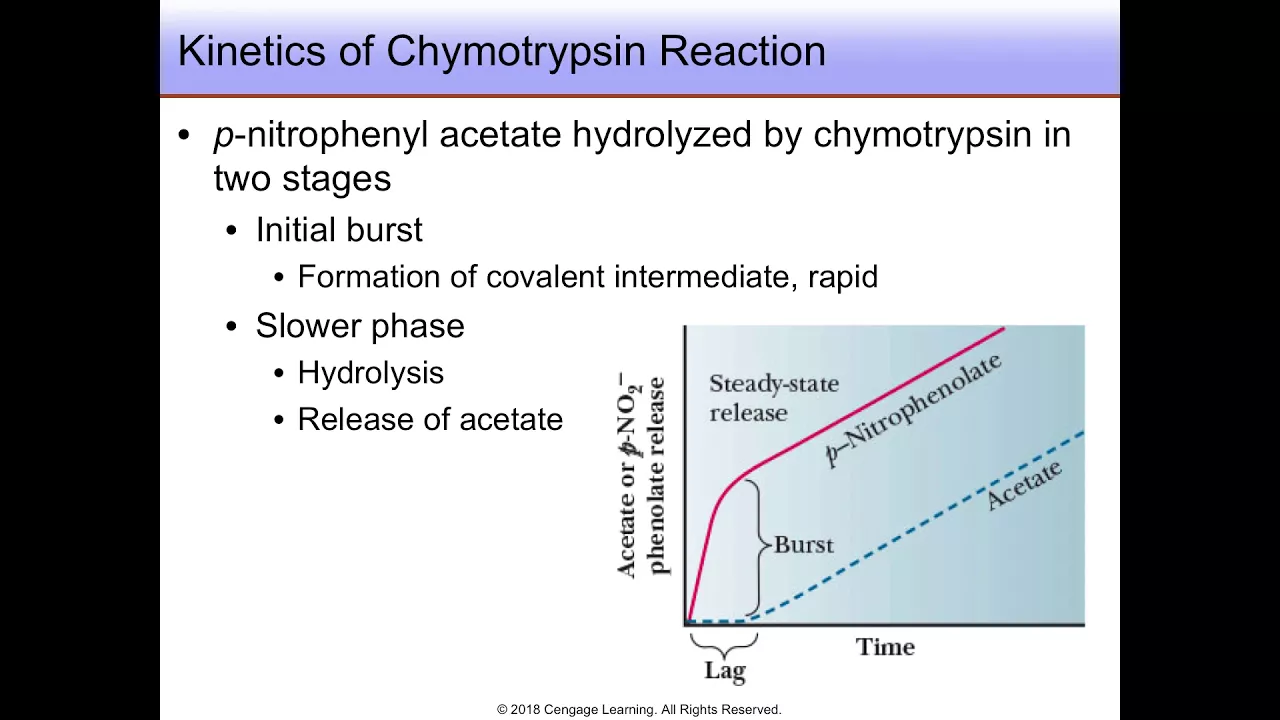
what to consider how it accomplishes this we've already seen that it can use the artificial substrate para nitro phenyl acetate to produce para nitro phenyl 8 and acetate as this enzyme was studied it was found to employ a two-step mechanism in step 1 the enzyme breaks the bond and releases the first product in the process the acetyl group becomes covalently attached to the enzyme the second step involves breaking that attachment to release the second product acetate and return the enzyme to its original form if we follow the release of the two substrates over time an
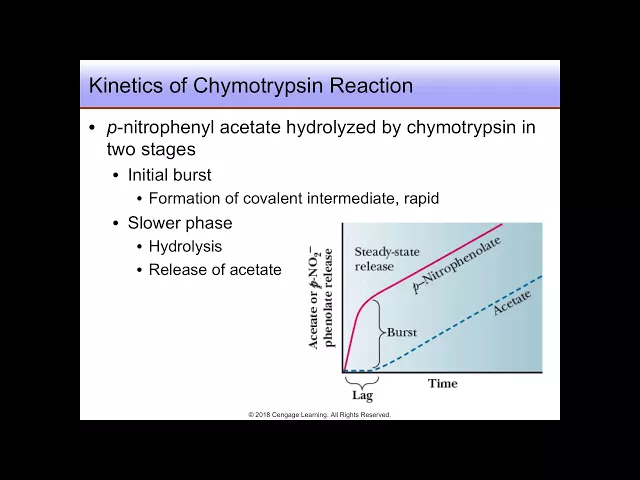
interesting pattern appears as the red curve below shows there is an initial burst of activity demonstrated by a steep slope to the curve the release of the para nitro phenyl 8 molecule occurs more slowly after this initial burst a shallower slope now notice the blue dashed line showing how this correlates to the release of the final product acetate from this we can see that the initial burst has to do with formation of the covalent bond with a so teal notice that no acetate is released during this phase the second step of acetate hydrolysis is slower
in other words the population of enzyme molecules readily binds substrate and releases the nitrogen light product that's our initial burst but because hydrolysis of acetate is slow the enzyme molecules must wait for that to occur before they can bind another molecule of substrate and release more nitro Finley chymotrypsin is an example of a class of enzymes known as serine proteases which use an active site serine residue in the catalytic hydrolysis of peptide bonds studies were conducted to prove the presence of a particular Syrian residue in the active site and the key role it plays in
the mechanism diisopropyl phospho flora de or di p AF was reacted with the enzyme resulting in covalent attachment of a portion of the reagent to the active site serine this covalent attachment rendered the enzyme inactive since the oxygen atom must be unattached and available for nucleophilic attack another important residue in the active site is histidine 57 this was also confirmed by covalent attachment of a chemical group from T P seek a ketone this attachment also resulted in the loss of activity thereby proving it's essential role in the catalytic mechanism aspartate 102 was the last of
the residues to proven to be critical for catalytic function x-ray crystallography revealed that these three residues form a spatial unit within the active site as shown below note that though they are far apart in primary structure they have been brought into close proximity due to the tertiary fold of the enzyme these active site residues are referred to as the catalytic triad composed of serine histidine and aspartate each with their part to play clearly the architecture and composition of the active site has everything to do with how an enzyme functions