we looked at ways to release cellular proteins from extraneous cellular components in our last lesson let's look at some of the early stages of protein purification and see what are some typical results the early stages of protein purification often involve methods that are broader application and intended to remove a significant amount of contaminating proteins one very common technique of purification is referred to assaulting out purification is based on differences in the solubility of proteins in salt solutions a protein solubility relates to the net charge of the protein the ionic strength of the solution and the
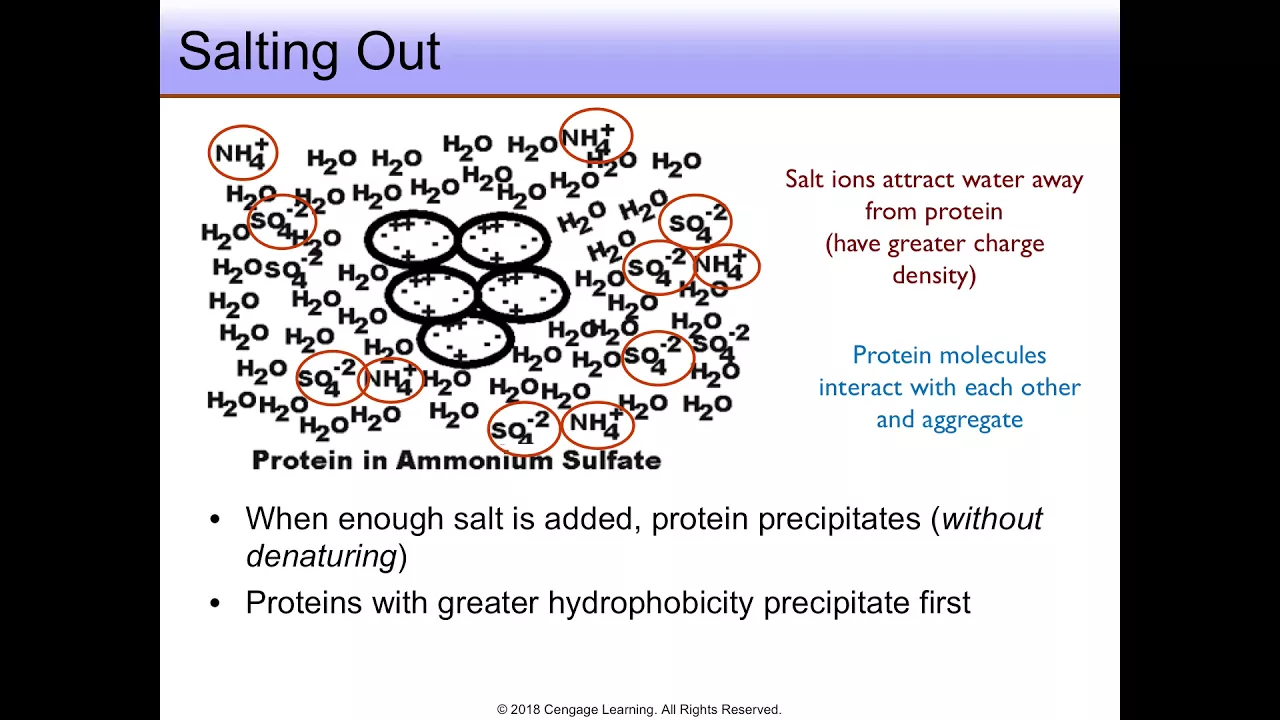
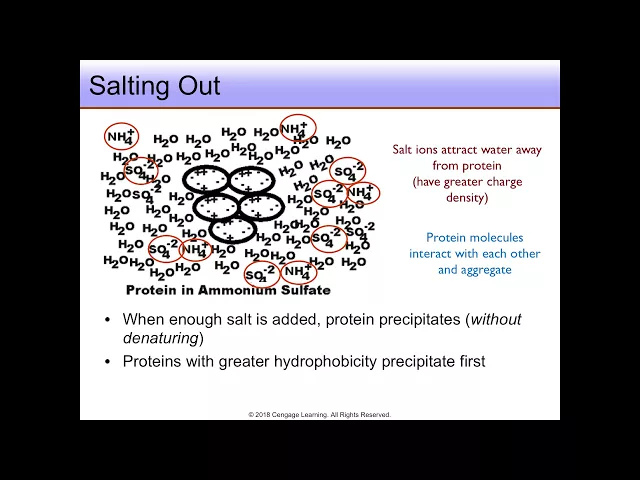
polarity of the protein the most common salt used in this process is ammonium sulfate this particular salt is preferred because a high salt concentration may be achieved with little change in solution density this is an important consideration for centrifugation and also means that we can add a large amount of salt and a small volume of solution this is important so that we don't overly dilute our sample that makes the purification more difficult the presence of the salt ions draws water molecules from the solvation sphere that surrounds the proteins as illustrated here this causes proteins to
aggregate and precipitate out of solution but without denaturing them those proteins that have a greater overall hydrophobicity are the least soluble and therefore precipitate first the goal is to perform multiple salt fractionation typically with increasing salt concentrations in order to eliminate contaminating proteins following each application of salt the sample is centrifuged at high speed to pellet the precipitate into the bottom of the tube the fluid supernatant represents those proteins that are still soluble here is a sample purification table showing some common steps in protein purification the first column of the table lists the fraction of
the purification process note that we begin with a crude extract representing the soluble fraction after the cell membrane has been ruptured and removed the first step in our purification process was salt fractionation the second column of our table gives the volume of the sample and the third is the total amount of protein in milligrams total activity represents the total amount of target protein in the sample specific activity is the total activity divided by the total amount of protein this would represent the proportion of our target protein as compared to all of the proteins present and
is therefore a measure of protein purity notice that with each step the total amount of amount of protein and milligrams decreases as more of the contaminating proteins are removed notice how the purity is increasing with each step as we gain a higher degree of sample purity you can see that the price we pay is in the amount we can actually recover from our starting sample protein purification by these messes methods can be a very laborious process albeit successful in obtaining a pure sample purity of the sample is essential to the accuracy of the data obtained
from our studies of the proteins structure and function












![I Replaced ALL my ADOBE APPS with these [free or cheaper] Alternatives!](https://img.youtube.com/vi/5EfqHg49kMk/maxresdefault.jpg)