The vast majority of the cosmos is voids. Gigantic, unfathomably large spaces of empty nothingness. Bubbles of eternal night, stretching hundreds of millions of light-years, almost entirely devoid of galaxies, stars, or light.
The loneliest places in existence. Voids are not just the absence of stuff but weird worlds of darkness that are growing, drifting, colliding and merging with each other – Inside them space itself is stretched violently and it's almost impossible to enter them. Simply put: voids are weird and scary.
But they sculpt the entire universe and may ultimately decide its fate. Today we know of over 8,000 voids and supervoids, and we keep discovering more. No matter how large a cluster or supercluster of galaxies gets, there always seems to be an even larger void nearby.
Let’s jump off the cosmic cliff and drop into the heart of cosmic nothingness. Before we enter inescapable darkness, let's take a last detour to the kurzgesagt shop. Our new Space Souvenir Drp is here – a collection designed for anyone who wants to travel the universe in style.
Stay warm in our Solar System Hoodie and commemorate your vacation on Titan with our Saturn Surf Shirt. Our new Earth Shirt keeps you connected to our home planet no matter how far you travel. Pair it with an actual piece of Mars set in a super shiny pin and this brand new set of mission patches – a reminder of our adventures together.
Looks like you’re all set to continue your journey in style. Thank you for traveling with kurzgesagt space tours. Oh, looks like we’re taking off.
Strap in! The Loneliest Place in the Universe You are zooming away from Earth, at thousands of times the speed of light, leaving our solar system and our solar neighborhood behind. Now we see the entire Milky Way with its 200 billion stars and dozens of dwarf galaxies zipping around it.
2. 5 million light-years away on a collision course is giant Andromeda and its own swarm of satellite galaxies. We are now moving a million times faster than the speed of light, seeing the local group of over 50 galaxies woven together by gravity, rivers of gas, and invisible scaffolds of dark matter.
This is our pocket of the universe, 10 million light years across, no human will ever leave it. Except for you apparently. As we zoom away even faster we see the Virgo Supercluster, a colossal wall of more than 2,000 galaxies spread over roughly 100 million light-years.
Careful now, you are right on the edge of the cosmic cliff where the true, deep darkness begins: the Local Void – a gigantic, empty bubble 200 million light-years across. If it was a bright thing and not absolute darkness, it would fill 40% of the night sky we see from earth. All around us are dozens of other superclusters and gigantic voids filled with suffocating emptiness.
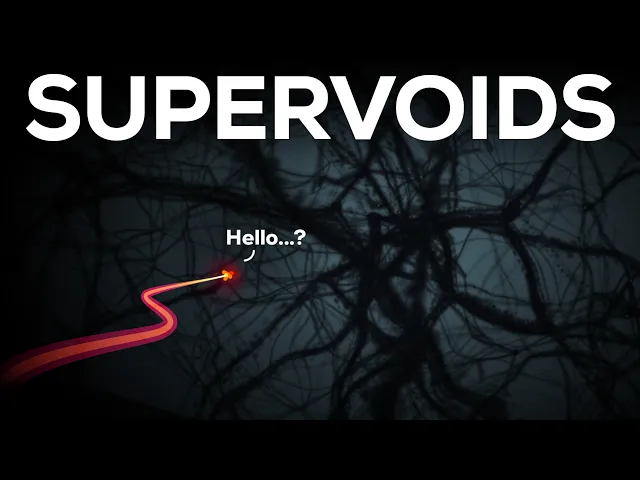
You are now traveling towards the greatest and emptiest nothing in existence – right into the center of the Boötes Supervoid. A cosmic desert around 300 million light-years wide. So gigantic it should contain thousands of galaxies.
But instead, what do you see? You are surrounded by perfect darkness, the most absolute blackness the human mind can conceive. There is no up or down.
No motion. Nothing to orient yourself. There is not a single sign that the outside universe even exists.
It’s an inescapable prison. And this isn’t some exotic corner of the cosmos. This is how the vast majority of the universe feels to human eyes.
Just silent blackness without any movement. Everywhere. Forever.
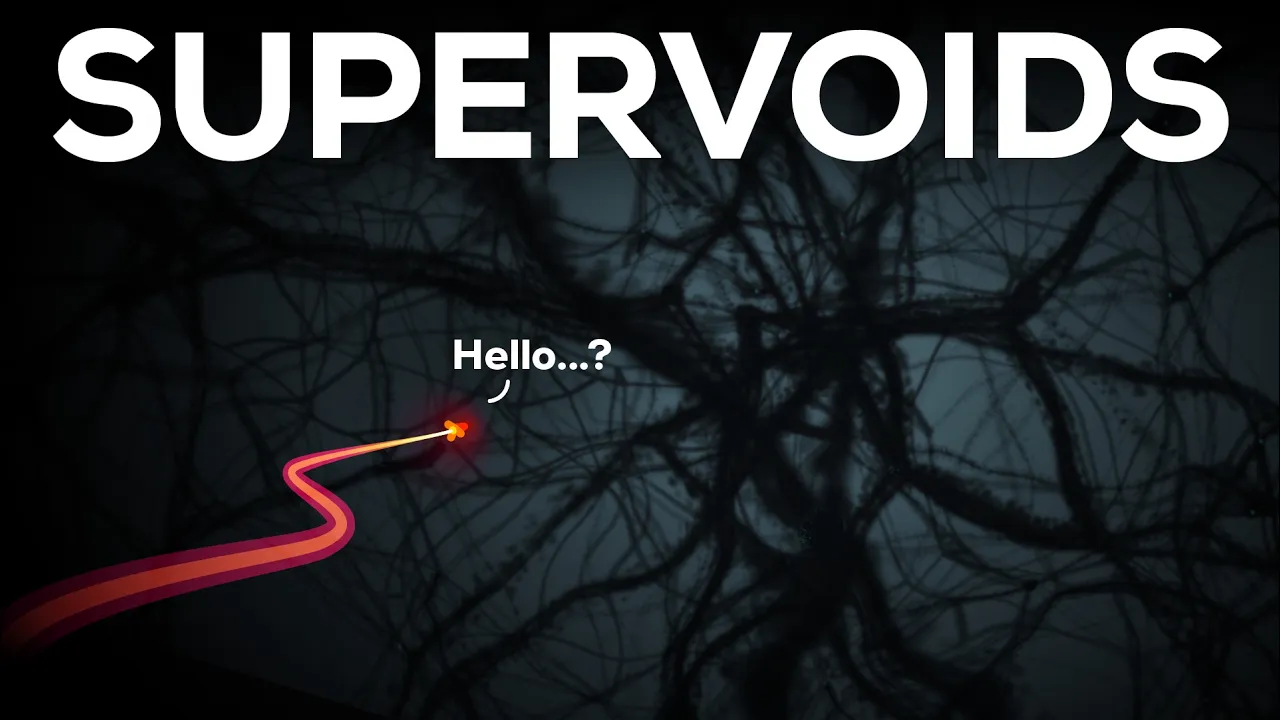
Although there is something mysterious hiding in the dark – faint tendrils of dark matter, penetrating into the void like cosmic lichen. A miniature echo of the much larger forest of dark matter filaments that forms the scaffold of galaxies and galaxy clusters outside the void. And at their tips we find faint blueish specs in the ocean of darkness: Void galaxies, lonely fireflies unable to light up the night.
The rarest galaxies we know, very isolated, very lonely. A Universe of Bubbles Before we could look deep into space, astronomers thought we lived in a uniform cosmos with galaxies spread out evenly. But instead, we found that galaxies, cosmic gas and dark matter were arranged into a vast cosmic web.
A recurring pattern of sheets and filaments, organized around enormous empty gaps, meeting at dense knots with galaxy clusters and super clusters. But this structure is not static, it just seems to be because the distances between galaxies are so incredibly vast. In reality galaxies shoot through space at speeds of millions of kilometers per hour.
They are on collision courses, orbiting each other, moving towards the center of larger galaxy clusters millions of light years away. But they always seem to stick to the rims of voids like reflections of light on soap bubbles – which is kind of weird. If they are this dynamic, shouldn’t a galaxy shoot into a void occasionally?
Well voids are actually extremely hard to enter for galaxies from the outside – at least naturally – because gravity becomes weird at their edges and even weirder deeper inside them. If you didn't know better, you might think voids spit out anything trying to get inside, pushing galaxies to the edge. The way gravity works is that everything with mass in the universe attracts every other thing with mass.
And since there is almost no mass inside, the cosmic web of galaxy super clusters on their edges are pulling things out of voids. The emptier a void is, the harder gravity is pulling on what remains. It's really like a tug of war where one side isn’t even trying.
Over time voids are really only getting even emptier and the walls and knots around them denser and brighter. Would it be hard to fly into a cosmic void with a spaceship? Well not technically, the hardest part is escaping the gravity of your home galaxy.
It also doesn’t make much sense because… what exactly do you want to visit inside a void? It makes sense to fly into a void if you want to hide. Like really, really hide.
But what cosmic horror would be scary enough for a civilization to try to escape into a cosmic void? Galaxies in the crowded cluster regions like our milky way are very active, since its neighbours’ gravity tugs and pulls at it, they collide and merge. Void galaxies are so isolated that they are aging in slow motion.
They tend to be smaller, bluer and full of gas, birthing new stars slower and calmer. So void galaxies could be the last places that will stay habitable in our dying universe. The last star in the universe will likely be born here.
So maybe in a 100 trillion years or so a desperate alien race will embark on an impossible journey to stretch their existence just a bit longer inside a void galaxy. There is one more thing that makes voids unique places: Dark Energy. The mysterious force that most scientists think is accelerating the expansion of the universe and will ultimately cause its demise.
We can’t see dark energy do anything inside our galaxy or inside clusters because there is too much stuff pulling things together via gravity – but we can see its effects inside voids. Here dark energy blows up the bubbles of nothing. This is where the acceleration of cosmic expansion becomes visible.
As voids are getting larger and larger, they are breaking the structure of the universe, the beautiful galaxy filaments are slowly being ripped apart. As the emptiness encroaches, walls of thousands of galaxies are thinned out and pulled towards the edges – attracted by much denser regions at the margins, giving space to the emptiness of two void bubbles becoming one. In the far, far future supervoids will take over the observable universe.
Crushing clusters, and expanding further and further, until the entire observable universe is nothing more than a gigantic void of nothingness. The loneliest place in existence. Let’s head back to Earth.
When we land, please exit through the gift shop and pick up a few souvenirs. We created this latest Space Souvenir Drp for all of you who have been travelling with us for so many years now. While you’re there, take a look around, you might discover a unique product dedicated to your favorite science topic.
Everything is created with lots of care by our team of scientists and designers to inspire you and spark your curiosity. Thank you for traveling with kurzgesagt space tours.