Thou art Peter, and upon this rock I will build my church. But notice it is on this rock I will build my church. He doesn't say to Peter, then to Andrew, James, and John, build me some churches, some denominations, and then in a couple thousand years, we'll see if we can reunite them.
No. Christ made a promise that he has kept, and he's going to fulfill it until the end of time. And so to be a Bible Christian for me means to become a Catholic Christian.
In verse 13, we read that when Jesus came into the district of Cesaria Philippi, he asked his disciples, "Who do men say that the son of man is? " And they said, "Some say John the Baptist, others say Elijah, and others Jeremiah, one of the prophets. " And then he put for them the question, "Who do you say that I am?
" Simon Peter replied, "You are the Christ, the son of the living God. " By this point, that should come as no surprise because that's really two ways of saying the same thing. If he's the Christo, the Messiah, then by Davidic logic, he is the son of the living God as well as being the son of David and all of the other things.
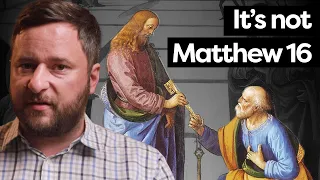
And notice how Jesus responds. Jesus answered him, "Blessed are you, Simon Barjonah, for flesh and blood has not revealed this to you, but my father who is in heaven. And I tell you, you are Peter Petros, and on this rock I will build my church, and the gates of Hades shall not prevail against it.
I will give you the keys of the kingdom of heaven, and whatever you bind on earth shall be bound in heaven, and whatever you loose on earth shall be loosed in heaven. So here we find a convergence of aspects of the Davidic kingdom covenant, particularly as they apply to the prime minister. When you go back to the book of Isaiah in chapter 22, you hear about this one prime minister named Shvna who is deposed and replaced by Eliakim.
And we read in verse 20, in that day I will call my servant Eliakim, the son of Hilkaya, and I will clothe him with your robe and bind him and then commit your authority to his hand, and he shall be a father to the inhabitants of Jerusalem and to the house of Judah. and I will place on his shoulder the key of the house of David. Now that's not the master key to the doors of the home.
That is the key of ministerial authority over the dynasty or the kingdom of David. He shall open and none shall shut and he shall shut and none shall open. And so what I propose is that this is the source text.
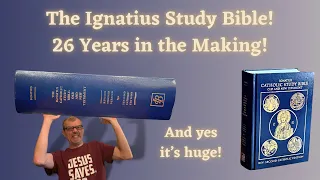
This is the tradition. This is the background that Jesus and Peter and the others assume that Matthew's readers all know and understand. And as you look at the notes of the Ignatius Catholic Study Bible, and I hope you do, I want to underscore not only how much we put in, but how much time we took because connecting these particular dots for me was really the breakthrough that enabled me to see the Old Testament background in the kingdom for the New Testament church that we call Catholic.
Catholic doesn't just mean global or international. The primary meaning of Collocus as you might know is universal. That is it's cosmic.
So the center of the kingdom of heaven is not on earth but in heaven. Not in the Vatican but wherever the risen savior is enthroned as the son of David, as the son of God, as the king of kings. And so through the gift of the spirit empowering the successors of the apostles, they're able to continue the work that Christ has given to them and also us.
So in the note that we find for Matthew 16:18, I will build. Jesus portrays the church as a temple, a spiritual temple. As Solomon was the son of David and the anointed temple builder in the Old Testament, so Jesus is the Davidic son of God and the anointed Messiah who builds the church in the new.
Jesus elsewhere sees himself as both similar and superior to King Solomon, greater than Solomon as we saw in 12:42. So Matthew alone uses the word here in verse 18, then again in 1817 the word for church eklesia. The word is used often in the Greek Old Testament for the lurggical assembly, the congregation of Israel, united to God.
Jesus uses it in a similar way for the new covenant community. On this rock, I will build my ecclesia, my church. So, you would expect on this rock I will build my temple like Solomon built the temple.
But because the temple is not made of stones but living stones, the apostles and all believers, it's appropriate for Jesus to say, "On this rock, I will build my eklesia. " But in the Old Testament, the principal use of eklesia was the lurggical assembly that would gather in the Jerusalem temple for the purpose of worship. So the temple is magnificent, but the faithful who assemble as the children of God to worship their father, that is far more precious in the eyes of God.
So on this rock I will build my church and the gates of Hades shall not prevail against it. And once again the note in the Ignatius Catholic Study Bible for the gates of Hades in the Old Testament had also called Shaol or the pit is the place of the dead where souls descend through its gates. And I give you a number of passages.
It is not the same as Gehenna or hell but a temporary realm where souls are detained until the last judgment. By extension, Hades is also the habitation of evil forces that bring about death and deception. According to Jewish tradition, the foundation stone in Hebrew, Evanchetya, of the Jerusalem temple capped off and sealed a long shaft, the abuses, the abyss that led down to the netherworld.
The temple resting securely on this foundation stone on the rock was thus the center of the cosmos. The junction between heaven and earth. Drwing from the background, Jesus guarantees that the powers of death and deception will not overcome the church that is the new temple built on the living rock that is Peter.
He enables he empowers Peter and his successors to hold air at bay and faithfully proclaim the gospel. How? Again the dynastic key that is the keys of the kingdom of heaven.
So the note for 1619 reads the keys that is a symbol of the teaching authority. Jesus consecrates Peter as the church's chief teacher whose office will continue on through successors. The plural use of keys implies a connection with the plural gates.
Why? Because the keys fit into the gates so that the heavenly kingdom can plunder the underworld and deliver the souls of the faithful departed throughout the Old Testament into the kingdom of heaven. As we'll see in Matthew 27:es 51 and following where the tombs of the saints are opened.
When Jesus ascends into heaven, he takes them with him and repopulates heaven with the saints of the Old Testament. There's so much here. You know, I'm trying to squeeze an ocean through a funnel like Corson.
I do that every time. But going on with that note, in the Old Testament Davidic Empire, the king appointed a cabinet of ministers for specific tasks in the kingdom. First Kings 4:es 1-6, 2 Kings 18:37.
Of these, a prime minister was elevated to unique status of authority, ranking second only to the king. This government structure was common among kingdoms in the ancient near east. I give examples.
Jesus here evokes Isaiah 22:es 15 to 25 where the prime minister's office is handed on to a successor by the symbolic act of handing on the key of the house of David. In Matthew, Jesus is the new Davidic king who appoints Peter the prime minister over the kingdom of heaven in the church. As in Isaiah 22, Peter's position is designed for him and his successors.
The office is meant to endure as long as the kingdom itself. Entrusted with the keys, Peter wields Christ's own royal authority. And when the language is used, whatever you bind on earth will be bound in heaven.
Whatever you loose on earth will have been loosed in heaven. And notice that if you look closely at the grammar, it isn't the tail wagging the dog. It isn't what Peter is doing on earth that determines what is going on in the kingdom of heaven.
Whatever you bind on earth will have been bound in heaven. Whatever you loose on earth will have been loosed in heaven. And so this metaphor carries several connotations.
First, it signifies teaching authority and the ability to render binding decisions. Rabbis were said to make binding interpretation of the law. Second, it denotes authority to include or exclude members of a religious community.
Third, it signals the forgiveness of sins, binding and loosing. The verb loose is used in this way in Revelation 1:5 to be freed and by the early church fathers as well. Peter is thus invested with Christ's authority as the kingdom's chief teacher and administrator.
Through him, heaven governs the kingdom on earth, which is the church. the mystery of the kingdom of heaven as we saw in the seven kingdom parables earlier there in Matthew 13. Now, I am summarizing literally decades of my own study that led me as a non-atholic, as an anti-atholic, as a vehement Calvinist anti-atholic to recognize that if I'm going to read the new in light of the old and see how the old is fulfilled in the new, I'm going to have to follow the steps of the early church fathers, not only as they interpreted scripture in that unified way, but as they bound themselves to Christ through his vicer, the bishop of Rome, the successor to Peter, and all of the other successors to all of the apostles that we refer to as this episcopal college, the bishops themselves.
Oh, I just wish we had more time to marinate in the Old Testament background generally and the Davidic covenant in particular to see how it is that Alfred Lozi was wrong for the right reason or you could say he was right for the wrong reason. This famous French Catholic biblical scholar who ended up leaving the church drew this conclusion of the end of his book on the gospel and the kingdom that Christ promised a kingdom but he left us the church and that felt to lose as though it was a broken promise or at least a postponed fulfillment. He promises a kingdom but he gives us the church.
Well, I would say this that the church is Catholic and so that means universal. It is in heaven every bit as much as it is on earth and far more. And so when he gives us the church, you don't reduce it to the structures on earth, the temporal institutions that all radiate outward from the Vatican or the sea of Peter.
No, it's the throne of Christ. We're not the body of the pope. We're the body of Christ.
Though the pope is the head of the church on earth temporarily for as long as he lives in this mortal life, Christ alone is the permanent head of the mystical body of Christ. And so he is able to work through fallible instruments like Peter through the power of the spirit. He's able to use them so that when they wield the authority from the chair of Peter given their universal jurisdiction which is exercised actually seldom but at the same time as they give voice to the ordinary magisterium they're fulfilling Christ's purpose his intention his own declaration here thou art Peter and upon this rock I will build my church but notice it is on this rock I will build my church he doesn't say to Peter, then to Andrew, James, and John.
Build me some churches, some denominations, and then in a couple thousand years, we'll see if we can reunite them. No. Christ made a promise that he has kept, and he's going to fulfill it until the end of time.
And so, to be a Bible Christian for me means to become a Catholic Christian, to recognize that in the Catholic Church, you have the kingdom of heaven extended to earth by the power of the spirit. Read Vatican 2, especially Lumensium. the dogmatic constitution of the church.
Because by the time you get to the third section, you're going to see early on where this mysterious convergence, this tremendous identification that the Catholic Church is the kingdom of heaven in mystery on earth because it is inseparably united to the kingdom of heaven. And that is where the Catholic Church is centered. [Music] The book of the genealogy of Jesus Christ, the son of David, the son of Abraham.