Most people think success is about working harder or being smarter. But after spending years inside billion-dollar boardrooms and working with some of the most successful CEOs, I started to see a third pattern, a deeper set of rules the top 1% actually play by. These are principles I have seen repeat across every arena.
And almost no one talks about them. They shape how the top 1% think and operate, how they learn, how they make decisions. We'll cover science-based actionable principles you can start using today to escape the 99% and stay ahead of everyone else.
First, listening to the ghost notes. Most people listen to confirm what they already believe, but the top 1% listen to what's not being said, and that's where they find the truth. Back in 1943, the US military faced a crisis.
American fighter planes were getting shot down as they flew over Germany. So, the military brought in a team of scientists and mathematicians from Columbia University, and the generals laid out all the photographs of the planes that returned. And they pointed at the bullet holes on the wings on the fuselage, and they said, "They're hitting us here.
What should we do? How do we put more armor on these specific areas? How do we protect them?
One of the mathematicians, Abraham Wald, shook his head and he said, "If you do that, you'll make things worse. " And then he slowly pointed to the engines and the cockpit where there were no bullet holes. And he said, "You're only looking at the planes that made it back home.
The ones hid in the engine or cockpit never survived and they never returned. " That's where we need more armor. Most people make the same mistakes the generals made.
They trust the data they can see. We're terrible at processing what's absent. Yet, that's where the real insights live.
Sometimes top musicians always listen to the ghost notes. Now, ghost notes are those invisible subtle sounds that you feel more than you hear. In business and in life, the ghost notes are the data points that never show up.
If the CMO talks for 10 minutes about amazing retention but never once mentions how much it costs to acquire these customers, that's a ghost note. If a candidate in an interview can list every win but struggles to talk about a real failure, that's a ghost note. And you have to train your mind to listen for those ghost notes to look for that absent data.
This is called basian filtering. Updating your beliefs based on evidence that never appeared. And this shows up in everyday meetings.
But history is full of disasters where investors and board members ignored the invisible. So the top performers don't get hypnotized by the stage show. They look behind the curtain.
So here's something you can try in your next important meeting. Don't just stare at the slides everyone else is looking at. Instead, write down three things that logically should have been there but are missing.
And then with calmness, with curiosity, ask one or two questions about those gaps. Most people will focus on the loudest parts. The 1% will focus on the silence where the ghost notes are.
Now that we know how to see differently, let's talk about how the 1% learn differently. The second principle sounds backwards. The top performers don't try to get things right.
They optimize for getting things wrong. In 1990s, a neuroscientist named Michael Morzenic ran a series of studies that changed everything we know about learning. He found that when you repeat a task that you're already good at, the brain almost stops rewiring.
Somehow the same neurons fire in the same patterns and no new pathways are formed. But the moment you make a mistake, your brain releases specific neurochemicals that create this feeling of agitation. And this is where the new neural pathways start forming.
No errors, no learning. The more highquality mistakes you make and correct, the faster you learn. And that's what top performers know intuitively.
Don't optimize for efforts, optimize for errors. This is exactly how AI learns, right? In machine learning, the system spots the error and learns faster by reducing the error in the next cycle.
It minimizes its loss function and it does it billions and billions of times over. It doesn't care about feeling good next time. It doesn't get upset when it makes mistakes.
It only cares about one thing, being less wrong next time. But we humans try to avoid mistakes at all costs. That's why so many talented people plateau after years of excellence.
They keep doing the things that make them feel good or even worse look good. When I was learning music from my teacher, he would give me these exercises and compositions and I would play it while staring at him, waiting to see if he likes it or not. And he would always say, "Why are you looking at me?
Don't look at me. Look at your hands. They are your best teachers.
" And he was right. When I focused on the tiny mistakes that I was making by looking down at my own hands, yes, I felt horrible. I was annoyed.
I was frustrated. I was embarrassed. But that's when my brain started minimizing the loss function of my own mental model.
Getting to mastery then is all about structured boredom filled with embarrassment, discomfort, and a lot of error corrections. Here's how you build your five-step loss function loop. Step number one, define the metric.
What does better actually mean in your situation right now? Is it about speed, clarity, accuracy, retention, learning rate? Number two, predict the outcome.
Before you start, guess how well you will do. Give yourself a number. Number three, now you deliver.
Go slowly enough to notice what you're doing. You'll always spot mistakes when you go slower. And number four, find the exact failure point.
That's your loss function. That's your goal signal. You'll hate it, but you need to see it clearly.
And then finally, number five, adjust one variable and repeat. Either adjust the speed or the technique, tool, approach. Change only one thing and then run the loop again.
Most people get stuck because they're trying to feel good at what they're doing every day. The top performers just try to be less wrong every day. Principle number three is becoming comfortable with adaptive tension.
Most people spend their careers and their lives dodging hard conversations and decisions. But the top 1% do the opposite. I learned this by watching someone who I believe had ice water running in his veins.
Years ago, I was in a room with my CEO negotiating a major acquisition. Now, our company was already worth over half a billion dollars. So, the expectations of the company we were trying to acquire were naturally quite high in terms of what we were going to pay them.
But that's not what we were willing to pay. So bankers and lawyers had tried for weeks to bridge this gap. Finally, we put the two principles in the same room.
Our company's CEO and the other company's chairman. I still remember the tension was so thick and palpable. And after 2 hours of back and forth, it was time to wrap up.
And my CEO leaned forward and said very calmly, "We really believe the two companies should come together. We will be unstoppable if we do that. How about we agree on X million?
Based on what I've heard from you in this meeting, I believe that it's a higher offer and it's a fair offer. And then he leaned back and went completely silent. After what felt like ages, the chairman finally smiled and said, "Chris, I think I'll be willing to take this to my board.
" We treat friction and tension like a predator. Any difficult conversation like asking for a raise, giving hard feedback, getting hard feedback, all of it triggers the same circuitry your brain uses when it sees a tiger in the bushes. We have to reframe that feeling.
So how do you train for this capacity in a safe manner? We can use a communication framework I call the core protocol. Our first move is curiosity.
In any tense conversation, people shut down or attack the moment they feel blamed or judged. Instead of declaring what everyone is missing or pointing fingers, you could say, "I might be missing something, but is there a lesson from the last attempt we should bring in here? " Or something like, "Would it help us to look at the patterns behind the delays?
" You're not accusing. You're signaling that there's something here worth digging into. O is for objectivity.
High tension conversations blow up when we argue about stories instead of facts. So instead, calmly and objectively, you can shift the spotlight from people and their stories to facts of the process. You could say something like, "Where should we adjust the system here?
Is this really a challenge about resourcing or talent? " Humans get defensive. Systems do not.
By starting with facts and processes, you can lower the threat level for everyone in the room. R is for reassurance. In tough conversations, the real question is never, "Are you right or am I right?
" It's always, "Are you with me or against me? " You want to make your intent very explicit. I'm asking because I want us to work together to improve the steps.
My goal is not to slow us down or point fingers. You're signaling mutual purpose. And finally, empathy.
Friction and tension is easier to handle when people feel seen. That doesn't mean that you have to agree with everything they say or suck up to them. It means that you acknowledge their experiences and respect their perspective.
You could say something like, "I see how hard you worked on this and I appreciate it. I appreciate you always outline what your real intentions are and what your intentions are not. " You're telling the room, I care about the outcome and I care about you.
When you run this in real time, you're doing exactly what the best negotiators and the leaders do in crucial conversations. And over time, you'll be known as a person who can walk into any difficult meeting and keep everyone calm and focused. Principle number four is the time horizon advantage.
If you're willing to operate on a 7-year horizon, you're suddenly playing a game most people don't even know exists. There's a story from New College at Oxford that captures this idea and this ideal so beautifully. The college was founded in 1379 and their dining hall had a ceiling that was held up by these gigantic oak beams.
About a century ago, those beams finally began to rot. The administrators started panicking because buying oak of that size was nearly impossible. They called in the college forester and asked if there was anything they could do.
How could they raise money for new beams? He surprised them by saying, "Sir, we already have the replacement trees. " And the forester explained that when the college was founded, the original architects knew the beams would rot in about five centuries.
So they planted a special grove of oaks explicitly intended to replace the beams hundreds of years later. The founders were thinking 15 generations ahead. Cathedral thinking solving problems for generations that aren't even born yet.
We want social media in seconds, new skills in a week, bonus in a quarter, promotions in a year. But when you look at the largest private equity or venture funds, they invest in companies with a 7-year cycle in mind. Long-term horizon and patience is the key part of their investment thesis.
So your career, your startups, your impact. They will test your endurance. Your skills and your reputation behave just like any index fund.
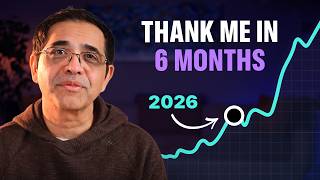
Painfully slow and flat at first and then explosive later. The problem is that most people don't keep investing during this flat part of the curve and they change directions right before the inflection point hits. The ones who stay in the game and keep investing long enough get almost all the upside.
Just take this YouTube channel for example, the MIT Monk. For the first four, five, 6 months, we had very few people watching. I had two goals from day one.
One, I wasn't going to worry about audience traction or monetization. and two, I had a 10-year plan. When no one was showing up and the numbers were flat for a long time, what did we do?
Nothing different. We kept focusing on making the videos that I wish someone had made for me when I was in my 20s. Week after week, I asked a simple question.
Would the 22year-old version of me find this video useful? If the answer was yes, I would make it. when would the channel grow or if it would grow at all was never in my hands.
That's decided by the viewers and the YouTube algorithm, which is a beast. You can't reverse engineer that. So, we kept showing up every week.
That's the upside of long-term planning. So, here's a simple framework to check your time horizon that balances speed with endurance. Think in three timelines.
First, for your 90-day timeline, be visible. Ask yourself, what am I doing in the next 90 days that will make me more visible to others? This is your proof of work and contribution.
Second, for your 12 to 18 month timeline, be valuable. What am I going to build in the next year that will still be valuable to others and to me for years to come? This is your compounding engine.
You know, building skills, systems, products, companies, relationships, reputation. And for your five-year timeline, be a visionary. What are my long-term bets?
This is the marathon of transformation in skills, in your career arcs, in entrepreneurship, even in your identity. When I think about that oak story, I always ask myself, am I planting flowers or am I planting oaks? Flowers look great for a season and then they're gone.
Oaks hold up for centuries. But there's one final principle that the top 1% rely on because thinking long-term only matters if you have the identity to sustain it. And that is the fifth principle.
Over time, your skills may change, your titles may change, even the industries around you will mutate faster than you expect. Your identity is the only continuity, the only constant that you can architect on purpose. This leads to the question that splits all performers into two camps.
Most people ask what will this decision get me? But a very small group will ask a harder question. What will this decision make me?
The first question is about getting more than what you deserve. The second is about deserving more than what you get. The problem with optimizing for titles and money is that you can extract more in the short run.
You might lack the capacity to sustain it forever. What's our action item here? Before any major decision, ask if I make this choice, what kind of a person will I become?
And is that someone I'm proud to become? Why ask that question? Because if you want to take risks, you'll need that strong and stable sense of self, your identity.
If losing a game means losing yourself, you'll always play it safe. And a life where you play it safe is a life without real pain, but it's also a life without real joy. When I was in my late teens and early 20s, I was a total mess.
I didn't know who I was, what I was good at, if I was good at anything, what I could become, nothing. And that's when I found an old monk who took care of me with great compassion. He told me, "You're not lost.
You just can't see around the corner yet. You're meant for so much more, for a different world. " Those words have always stayed with me.
They guided my identity because nothing shapes you more than someone believing in you more than you believe in yourself. So now I want to pass that wish on to you in case you ever need it. No, you're not lost.
You just can't see around the corner yet. You're meant for so much more for a different world. Go find it.
If you enjoyed this video, you'll probably enjoy this one, too, on lessons I learned during my years at MIT and how it shapes the way top performers think.