Sorry, I'm not going. . .
. No, take your time. You can take your time if you want.
I'm editing anyway. Yeah. *cricket* *cricket* Can you just repeat the question.
Noice! No YOU suck. Here's what's wrong with YOU.
*manic laughter* I run out of storage. . .
. Yeah. I'm going to wait a second for the blender.
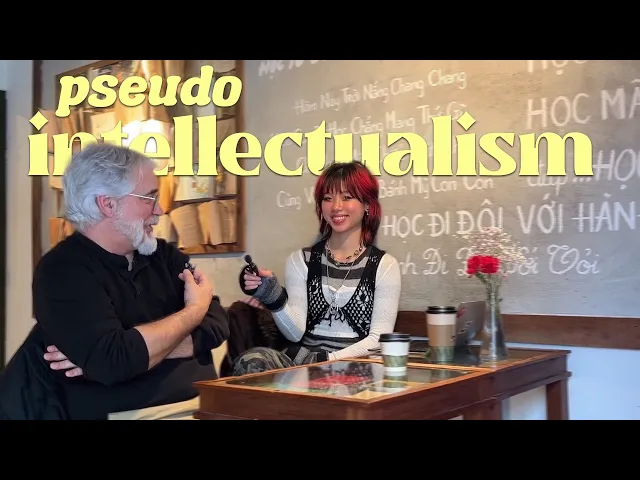
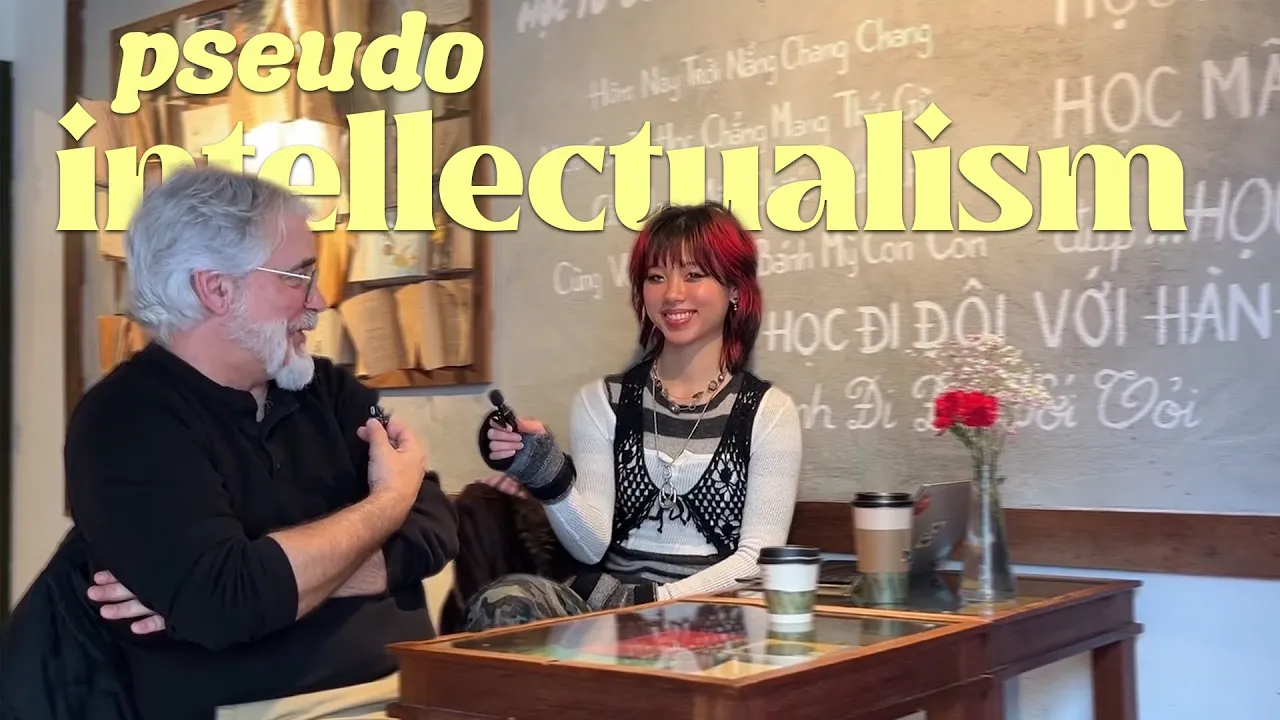
So for those philosophical-- Hello. I'm here today with a professor from TMU. I'm Andrew Sepielli.
I'm a philosophy professor here at the University of Toronto. My name is Youngbin Yoon. I am a lecturer at the University of Pennsylvania, where I just got my PhD.
My name is, Thomas Hart and, I teach at TMU. I'm Boris Hennig, as she said, I'm a Professor at TMU for philosophy, ancient philosophy. And we're here to talk about pseudo intellectualism.
What do you think differentiates an intellectual from a pseudo intellectual? Are there different types of intellectuals and pseudo intellectuals that we should distinguish, or can they be categorized under their umbrella terms? When you call someone an intellectual, it's because you think that they know a great deal about a great deal.
And that's where that title comes in. And it's a title that you can't put on yourself. That's one of the categories of pseudo intellectual.
And when people look at someone and say, well, that person is really intellectual, what they mean is they not only have the knowledge, but they have the ability to apply that knowledge in a broader context. And that's when I teach philosophy, especially ancient philosophy, I try to explain to my students that wisdom is knowledge and application. It's not just knowing.
You have to be able to use that knowledge for the - whatever - for the improvement of society, for the betterment of your family for the security of your situation, etc. and that is what brings it out of the academy or out of the ivory tower, if you like. Are you an intellectual?
🤨 "And it's a title that you can't put on yourself" No (phew) Testing you, testing you Okay, okay. I think of an intellectual as somebody who traffics an idea in such a way that's predictibly conducive to achieving understanding. And so a pseudo intellectual is somebody who sort of purports to be doing that or presents themselves as doing that, but is, in fact doing something else.
What do intellectuals do? They think, they pay attention to arguments. They pay attention to evidence, and they try to make sense of things and so on.
If you do these things not for the purpose of - actually, you know, it's difficult to describe what the real, the right purpose is - but if you do that for like for the wrong kind of purposes, for political purposes, for financial purposes and so on, that, I think, is a common motive for being a pseudo intellectual. And that's what they, you know, what they actually usually do sometimes involuntarily. Like sometimes someone has deep seated prejudices and tries to justify them by intellectual activity and is obviously avoiding, like, everything that might speak against those.
So that's, I think, what a certain species of pseudo intellectual looks like. Is it possible, like if someone was "intellectual," but was doing it for some instrumental purpose, like money, fame, do you think they should be categorized as pseudo intellectual, or can we still think of them as like an intellectual in some sense? That's a good question.
So I was thinking about this so originally when I was formulating my definition of a pseudo intellectual in my head, I put it in terms of like what you're trying to do, but I think if you were to like, you know, read Nietzsche's private diaries and find out that he was just doing all of his philosophy for money, I wouldn't think of him as not being an intellectual. So the first answer I was drawn to, and I kind of suspect it might be the like the natural one that the one that everyone's jumps to is something like, you know, real intellectuals like, pursue knowledge for the sake of knowledge, whereas, you know, intellectuals pursue knowledge for some other end. But I think about, like the canonical cases of intellectuals, like even like many of the professors here, they're deeply intellectual, and they would fit in this definition.
They would pursue knowledge for the sake of knowledge. But I also think they're hoping to make gainful employment from pursuing knowledge. So it also seems like they're pursuing knowledge for the sake of, say, money.
So with a slight variation: I actually think intellectuals are people who choose to develop their intellectual capacities or cognitive abilities, etc. , for the sake of truth. And I think pseudo intellectuals are people who choose to develop their cognitive capacities for the sake of something like gain, money, etc.
the reason that I think this works better is I no longer think it's true that we'd say, like someone who's just trying to memorize facts in an encyclopedia is trying to develop their cognitive abilities. They're really just trying to memorize a bunch of facts. So I go like, yeah, I can now preclude that from the definition of intellectual.
Also for like the professorial cases, a standard piece of advice that we tell people all the time who are thinking about going into the PhD is there's not that much money in it you will not be rich from this. and there's a really good chance you won't be very famous. So this is your - you said you're living.
. . can you give us a tour of your car?
Do it. Do it if you really want to like, become smarter. You want to learn these things.
You wanna become a more intelligent person for the sake of the truths that you might get to it. Not for these other things. I think in that way I get to keep that strong division we intuit between intellectuals and pseudo intellectuals.
With that said. . .
Okay, there's a caveat! I think "pseudo intellectual" has a pejorative attached to it. We generally think this pseudointellectualism is bad.
I'm roughly in agreement, but I just want to flag the way that I think that sometimes pseudointellectualism could be totally awesome because I go: some people, I think wanting to pursue their intellectual capacities to share information with the world, that's not exactly for the sake of truth in and of itself. It's some sort of like service act, or it's for entertainment, like it's fun to learn things and sometimes it's fun to share that information with other people. There is a way to look at this channel, I might say as that thing, though, I wouldn't ever accuse you of being a pseudo intellectual.
It's okay, people have. But I go like, one thing that's kind of awesome about that is that how do you get people excited about academic pursuits? How do you get people excited about learning?
Well, someone has to do the work and be like, "oh, here's what's cool about it. " And showing it the people who know nothing about it. And it's actually also, in that sense, I think your channel is great because it does, in fact, I think spread knowledge, ideas, philosophy, excitement out there.
I think that's wonderful. I mean, one of the things that I've watched over the course of my last sort of 15, 20 years is the rise of the sort of intellectualism on the right. And so the idea of social conservatism comes couched in all the language of the Academy, but really is a kind of code, for there are certain types of people that I don't want to admit exist.
And so I'll call myself a social conservative, and then I don't have to consider research is not about political ideology unless you're researching political ideology. So a conservative philosopher, for example, it kind of sounds like they're not interested in any other truth than the one they are already interested in. And that is what I would call a pseudo intellectual bordering on solipsism, when it gets right down to it, because they've decided that there are certain things that count and are legitimate, and others that don't, and they're not going to talk about those.
You also have the increasing use of academic language in political spheres as a way of dressing up opinions as legitimate opinions within debate. Now, anybody who studies philosophy or anybody who studies ethics for that matter, knows that part of the ground is that there are an agreed set of concepts and terms like right and wrong and good and bad, and what seems to be the case now, especially within the political domain, is that people use the terminology of ethics to defend arguments that are really defenses of what ethics would call "the Bad," or those things that are not morally acceptable. I don't think that pseudo intellectual is like a type of intellectual.
Pseudo just means that something is made to appear a certain way, but not really genuinely that thing. A pseudonym is a fake name, but there is no distinguishing feature by which you could tell which one is a pseudonym and which one is a is a real name. They don't look different.
It's not a distinction in what they do, it's a distinction in the surroundings and whether what they do is genuine. The other thing is that in order to figure out whether someone is a pseudo intellectual, you would have to be an intellectual. It's a title that you can't put on yourself.
You have to treat people as intellectuals. And then after a while you might find out that, yeah, it wasn't really worth the time, but you can't just begin by saying those are pseudo intellectuals because of this and that, that they say. Some of the stuff that people say on the internet and so on is clearly recognizable as bullsh*t.
But then also, like intellectuals in history have said, a lot of things that seem like nonsense to their contemporaries. So there is a sense in which you should always be careful, even in cases where it looks obvious. The next question is who is an example of a pseudo intellectual in your opinion?
Yeah. name-drop time! I had this question on paper, and I don't know, I don't think I can name or I want to name examples because I just said in the sense you have to be careful, like you.
Yeah, you can't really tell who is a pseudo intellectual or not. Yeah. I just implicitly did describe Jordan Peterson I have a few friends and things like that.
And the name Jordan Peterson keeps coming up. He has a legitimate expertise within the field of psychology. But he came to popularity, as you know, at the University of Toronto, over the question of gender identity and the use of pronouns which he called 'compelled speech.
' Now, that's a view that he's entitled to hold, but he's not entitled to use his academic credentials to make that legitimate. His argument at the time was with the legislature, not the university. The university simply obeys laws that are passed by the legislature, but instead of going to the legislature to register his argument, he went to the steps of the university.
And that created the kind of buzz around his work and things like that, to the point where, last seen at Mar-A-Lago, he's opened up a private university in the United States, which teaches the kind of social conservatism that he supports. But that has nothing to do with psychology. With him [Jordan Peterson], I'm not actually quite sure.
I think he wants something genuine sometimes, and he is smart in some things, but he's really like a psychologist, and he does these outlandishly mistaken interpretations of myths and fairy tales and so on where you can see on the page, that's obvious bullshit. And he did not actually put time into into any of this. He's not doing the job.
He's just trying to present the results without doing the work. Usually when I've come across people who I think of as being pseudo intellectuals, there are no real feedback mechanisms that are kind of helping them to think in a way that seems to advance understanding. So like maybe they're talking to like a very specific audience, and that audience basically just wants to hear their own opinions parroted back at them, right, and they don't have like an editor, they don't have a thesis advisor.
. . nobody who is going to, like, look at their work in a way that's sort of objective and neutral and hold them to some kind of rigorous standard.
The person who's, you know, a traditional conservative, and they only talk to traditional conservatives and they just want people to be like, "yeah, you're the best. " Or the person who is - their whole shtick is that they're anti-anti-Trump or something. I mean, you could come up with a lot of examples of different communities.
I think Malcolm Gladwell is just an outrageously talented writer. I think he is so, so good. The thing with Malcolm Gladwell that I think, is that sometimes when he presents ideas, they're a little bit simplified or they're like lacking nuance or they're like devoid of their context.
And so people walk away thinking they have this really strong sense of the topic at hand. But in fact, I think they're like, actually, if anything, you know, worse epistemic position afterwards because they think they get it, but in fact, they really don't. But again, I'll flag it's not like blanket true in my view, that all pseudo intellectuals are like bad or something.
The other person that comes to mind, I'm one of those people who picked up chess during the pandemic, and I was like, oh, you know what? I should use an example from YouTube. So there is some like famous, chess YouTubers.
One I'll mention is, a guy named Levy Rosman. Levy has some content that's geared just for education. Like, he's like, they're just people who want to get better at chess.
And he goes, those videos don't do very well. So he has all these videos that are geared towards just like entertainment. He'll recap games.
He'll be like, oh, this is so exciting. He has a little bits where he'll shout like, “Oh, the rook! ” or whatever.
I go like, fair. I think that insofar as the majority of his content is geared towards that kind of entertainment, I think it's a pseudo intellectual pursuit insofar as we can say chess, like learning to get better at chess in of itself is an intellectual pursuit. Again, though, I actually don't think that's a bad thing.
If you care about chess, you want chess to expand in the world. You want people to get other people excited about chess. I think he does a great job at that.
So those would be two examples of pseudo intellectuals. Some people think that philosophy is a pseudo intellectual field. It can be jargony, because they feel like philosophy might overanalyze things that don't need to be explored that deeply, or it doesn't engage with the "real world.
" How would you respond to those sentiments? And is there any part of those sentiments that you agree with? Well, yeah, I mean, that's that's always that's the perennial argument against philosophical discourse, right?
Is it's not part of the real world, but philosophy itself thinks it's looking for the real world, that that's what the truth is about. It's about reality in itself, the essence of being. You know, if you want to take from Martin Heidegger or Heraclitus or whatever, that's not something that public should really be interested in because it doesn't have the impact - It's not the impactful side of the philosophical question, but it is a necessary understanding in order to get to that impactful side.
So, for example, if you think in terms of, philosophical ethics, I was recently talking to my, PhD supervisor and I made the statement that philosophical ethics is sort of failed because it simply doesn't effect politicians, the public, the people that are in charge of making decisions about the environment, about our health, about all these different things. And he agree, he said, because it has become ivory tower elitism. So it's the structure of arguments in philosophical ethics that counts as important rather than the meaning content of an ethical position.
I'll start by with a little humility. There's truth to these claims. I think sometimes it is within professional interests to make things more complicated or more interesting, or seem bigger than that, and like it naturally needs to be just to get the explanation off the ground.
But I'll also say, I suspect that's the vast, vast minority of cases. Like I do think that happens like it exists. But for the most part, in my experience, most people are just a little underappreciative of how complicated things might actually be.
So a friend of mine works on like, conceptions of naturalness and what does it mean for something to be natural. Here's a really intuitive view: "Natural" just means not been touched by humans. Okay, but then you go to like national parks or nature preserves, and those things only exist through incredible amounts of human endeavor to maintain the environment in that way.
It's absolutely been touched by human beings. But are we going to deny things like Banff or like Yellowstone National Park? Are those not natural things?
It seems like the category breaks down a little. It's not like fully clear. So I'd go.
I think there's truth to the claim that philosophy over complicates sometimes, but I think the vast majority of times it's just actually appreciating the way in which things are deeply, deeply complicated. I find the idea of like, an entire field of intellectual activity "pseudointellectual" slightly weird as I said, like, I don't think there is any distinguishing feature of what pseudo intellectuals do as opposed to what real intellectuals do. So it would depend on how people do philosophy, not on whether they do philosophy.
About the "going too deep": you only know whether something is too deep when you know how deep one should go, and you find that out by going as deep as it gets. What I find very important in my own activity is whenever I get into something, I think, the first year or something, thinking about that, that I have ideas and solutions and so on, and then I spend like maybe 5 or 10 years finding out how shallow my thinking was and how mistaken I was, how much there is to know about those people. That's most of the books that I buy are books that I have to buy because someone thought something very similar before, and they came up with all the arguments against what I thought was just obvious.
So it is really important to go deep. And in my experience, there is no such thing as too deep because at every level it's important to realize that you're not done yet in principle. There was a third thing, about the real world.
Define "real world. " Like what does it consist of? Does it really only consist of like, chemical, molecules or like particles, or does it not also consist of, injustice or metaphysics?
Like is metaphysics not part of the real world? Do people - like people think. They have like intellectual problems, they have questions.
They they might be skeptics or solipsists or idealists and so on. I think this is part of the real world. So if people engage with that, it might be far away from like, rocket science or like physics or car engineering or whatever, but that might in some cases make it even more important.
I do think a lot of philosophy is, at a certain level, pointless or boring or just kind of misguided or whatever, but I don't think that's like pseudointellectualism. I just think at some point, if you have some kind of you know, worldview, like some kind of inchoate picture of things, you have to work out, like all the little details to see if it could actually be made to work. And when people are working out the details of worldviews that you don't accept, of course you're going to look at these attempts to work out the details as boring or pointless or whatever.
But that's just because, like, you've kind of already gotten off the bus earlier on, and I would bet that those same people would look at my attempts to work out the details of my world pictures as, as, sort of pointless too, but I just think that that's kind of inevitable because philosophy is a clash of very different worldviews. Like, that's one of the things that's like wonderful about the discipline. What drew you to philosophy?
When I was in high school, I had this I had this friend -- I don't know how old you were in like, I don't know like 2009 2009, I was seven years old. Okay, okay. Fair enough.
I was on Chatroulette at that time because of the age I was. And that roughly dates me. Okay.
And I met this, this girl, we became friends, like, no, nothing romantic. We were just, like, pen pals, essentially. And then after a while, like, a couple months, I hadn't heard from her and I wrote on her Facebook wall, because back then, that's what you did.
I apologize, I'm old. I had Facebook too. I had Facebook too.
I understand what that's like. And then, I got this message, from this woman being like, oh, how do you know this girl? Like, oh, no, we're just pen pals.
She's like, oh, I'm her mother. She actually died. I go -- What?
Yeah. . .
. As it turns out, she'd been hit by a drunk driver. Oh my gosh.
[rest in peace] And then the mom was obviously and like, totally reasonably grieving in a certain way and she was kind of like questioning me about like, oh can you tell me about, like, how great my daughter was? I go like, I understand that instinct, you know, your daughter just died. Like I get that.
The thing is, I didn't really have anything to say. We're pen pals. We're not that close.
Like it was just - I wrote her, like, roughly once a month. Yeah. But then I was faced with an ethical dilemma, like Because on the one hand, you can comfort a grieving mother, but you have to just blatantly lie to her face, or you can just be like, "I don't know anything.
" But then you're like, you're not comforting a grieving mother over the death of her child. And like, that feels bad. And I learn, like I faced what I took to be an ethical dilemma.
And that's the first time I ever faced an ethical dilemma in a real poignant way. And that got me very, very interested in ethics. I can't just let other people tell me what's right and wrong.
I think that's what everybody like, at least as a, as a teenager, discovers, that you don't want other people to tell you what to do. Teenage angst. Yeah, I was a teenager in the 90s and in the 90s, like the big policy issue was, single payer or as some people call it, "socialized" health care.
And whether that was a good idea, whether it was just and, you know, I was somebody who thought that it was a really good idea. I would have all these debates with my friends about it, and I would listen to radio shows. People would argue that that it was not a good idea.
So I got really interested in this policy question. And when I got to university and discovered philosophy, I just saw that, okay, there's this field that allows you to like, tackle the absolute, like deepest like foundational questions having to do with, you know, single payer health care or whatever the policy matter of the day is. In a certain way, like, philosophy's so pure, right?
Like there are other disciplines where if they're talking about something like free will, it'll be like, okay, what does this scholar say about this fiction writer's depiction of free will? It's like so circuitous and it's like you have to be like enculturated into it, whereas philosophy is just like, okay, is free will possible or like, does God exist or like, how do we know that we're not living in the matrix or whatever the issue is, right? What's right?
What's wrong? Some people don't like that, right? Yeah.
Some people think it's like philosophers get in the way and it's like, I want to talk about the policy issue. And you just like bringing it back to these questions about the good life or whatever. But, I mean, for some people, it's like, you can't - how can you avoid talking about these fundamental questions?
What is philosophy good or useful for in your opinion? I think the question like what is philosophy good for might already be like the wrong - Yeah. I don't want to answer that question because - it's not instrumental.
It's not for anything. It's for itself. But that doesn't mean that it's isolated from other things.
It's with sports or music and so on or art. People do that for their own sake, and that doesn't mean that it's meaningless. And even mathematicians do math for the sake of mathematics, and it's very useful, it turns out to be very important.
Some of it, at least some of it doesn't. But you can't tell the difference when you're doing it. Actually, I think philosophy does deal with real world problems.
It's just that like sometimes when you're thinking about questions like, all right, you know, what's the best way to distribute, like health care or resources or whatever? You're going to be pushed back to these questions in like, abstruse moral theory, at least that happens to me. Right?
Right. Like, I think about this stuff for like a little bit and then I'm like, right back in like Philosophy 101 being like "is utilitarianism true? " Right.
So if you want to understand why a particular course of action is right or wrong, there are a lot of details involved. Most of us most of the time, don't think of those details. We have what everybody calls an intuitive sense of what is right and wrong.
There's no such thing as an intuitive sense of what is right, and wrong. It's a result of how you were brought up, the culture that you're part of, the religious faith that you might have, or whatever else. You make your decisions based on those things.
But when you unpack those in the academic setting, there are a lot of details that involve essences of things. And so the public discourse can be brought back around to the public understanding if that bridge is made to explain, it. Okay, there are details - the essence of being, for example, - is important in academic research, but it's not important for understanding what the next government is likely to do in terms of our freedoms, our rights, etc.
, etc. but there are things in philosophy, political theory, and all those sorts of things that do help us understand those things. And that's what philosophers need to be doing.
I think one thing philosophy's really good at is constructing and refining concepts. So let's say you're interested in the sciences. You want to know what causes some phenomenon.
You're relying on the concept of causation. But what do you mean by causation? That's actually a huge literature that stems, at least to David Hume.
How can we promote trust in academics while also acknowledging the worries about obscurantism and elitism in academia? If I knew the answer to this I'd be a lot more famous, than I currently am. I think that one popular answer people are going to give is something like transparency.
Like, oh yeah, the expert should just be transparent. Except and I'm not the only one that thought this. I think transparency is a very limited answer.
It's just that sometimes, like by the nature of what expert-like knowledge is, it won't be fully accessible to the general crowd. So what I kind of suspect what's going to have to happen is we're going to need some sort of like value alignment. We need people to tell others like, "this is what the experts are doing, and here's why it makes sense.
" Again, I actually think formats like your YouTube channel is pretty good for that thing. I'm getting so gassed up right now like (⸝⸝๑﹏๑⸝⸝) I just like, know you go around, you talk to experts who talk about their work and you present it accessibly to people. That's a wonderful thing to do.
And I think that, like, all right, if some of these ideas make sense to the audience, they now have a better understanding and a little more trust in philosophers. People accept elites and they accept, people doing obscure stuff. So everyone knows that about physicists.
People know that about musicians or about baseball players, like, they do stuff that we can't do. We even don't know how they do it. And it might even not have an apparent purpose, like baseball.
Still, we like it. We appreciate it. We approve that they get a lot of money for it.
So I don't think the issue is that everything that is kind of out of reach for people like that, they don't know how to do themselves and that is done by a certain elite and that's therefore untrustworthy. That doesn't seem to be the issue. So the issue must be that people actually do know and do have experiences and this knowledge and those experiences are just dismissed by what they call 'the elite.
' It's a more complicated, kind of distrust. It's distrust in the system, not necessarily distrust in the discipline. Because of the over specialization that is required of graduate students and things like that so as the fields become narrower and narrower, graduate students work on smaller and smaller domains, and PhDs become absolute experts in very, very little.
And that's where the public perception that there's something going on here that isn't entirely legitimate comes in, because the reciprocal side of that is that people with PhDs - that's the qualification for teaching at the university - you have to teach more than the people that want to study what you want to study. And so if our education program to produce intellectuals keeps them from being intellectuals, by narrowing them to such a degree that they can't educate, then we're into bad territory. So I sort of have, I guess, a controversial view about this.
I think that academics have to be a lot more willing to go out there in public, including like YouTube or whatever, and have discussions and debates with people. Like you're doing right now! Like I'm doing - we're not even having a debate.
Yeah. Exactly. Right.
It's not like this is an adversarial interview, but I think even things that are adversarial, first of all, people need to be shown that what you're doing is valuable and the way you show it is by presenting it in front of lots of people and having some pushback and showing that you can deal with the pushback and have some counter argument, right? That you're not just like some paper tiger. Maybe I'm going to get a hate mail for this but like I remember during the Covid pandemic when there was a scientist, I think, named Peter Hotez, he was challenged by RFK Jr to have a debate on Joe Rogan, and he said he wouldn't do it because he thought RFK Jr is a charlatan.
And like, maybe he had some questions about the forum, about like The Joe Rogan Show or whatever. I watched that whole kind of back and forth and thought if I were Peter Hotez, like, if I were not a philosopher, but instead a virologist or whatever, I would totally accept that debate invitation. I think you look like you are like full of yourself, and also that you can't really defend yourself if you don't accept stuff like that.
I don't think Joe Rogan is like a hostile forum, right? Like even if you don't like the show, like, I think it's not something where Joe Rogan is screaming at you and you can't get a word in. And I don't think like RFK Jr is like some, like, raging asshole, right?
I think he's wrong about stuff, but that's like an example. And I feel like academics should do a lot more of that. And I would love to do that.
Joe Rogan! Yeah! No, yeah, Joe Rogan, if you want to have like a metaethics debate, Hit me up.
The last question I have is about social media. Social media algorithms play a big role in deciding who gets a large platform and hence who gets to influence people's beliefs. Do you think this has led to net positive or negative effects or.
You know, I'm sure it's complicated in every aspect as well. I wish it was. Maybe it's complicated, but like and I realize that we are looking at people who look at YouTube or something.
Whenever I have the impression that something is done by an algorithm, I try to get as far away as possible from it. Oh, I trapped you in this YouTube interview then. Um.
. [it was at this moment that he knew] No, I'm fine. Like, I would recommend to everybody to just turn off the device and go outside and look at the sky or something like that.
If I look at something on YouTube and the next recommendation seems to be recommended because of some. . .
I feel like I went to a party and I'm surrounded by, like, drunk and aggressive people. I want to get out. I want to have something that I can actually rely on that's more genuine and more trustworthy.
Doing what intellectuals, philosophers or scientists also do is to actually go deep into something that you don't, you didn't even know a year ago existed. And how would that be done on the internet? It's done in conversations and like sitting in libraries and thinking and so on.
If you can make a 20 minute video about it, it's not deep. Yes, none of my videos on my channel are deep guys. Read a book (i mean it).
I don't know what your connection is to social media. Do you have any social media accounts? I did, I had all of the various accounts, but I ditched them all after that internal research from Meta came out.
I have four daughters, and I decided that if I have a vote in social media, it's to exclude myself from contributing to that negative impact on women in our society. At the same time, I did have a quick moment, for a hot minute when I went back to X because I thought what was going on with Donald Trump was absolutely ridiculous. So I tweeted that "this is what you can expect in your country from dimwits like this.
" And I got banned for using the word "dimwit. " You can use whatever racial slur you want on X but you can not call people a dimwit. I think it's a fundamentally negative thing in our society.
Because it's rewarding all of the wrong behavior, if you call it the rage algorithm or whatever else. Social media companies have absolutely no interest in the good of society. They have an interest in their bottom line and whatever serves that.
And you can see that very clearly with what Elon Musk is doing in the United States right now. I don't even believe that he's concerned about the economics of the United States. I think he sees it as a play toy, and that's what it leads to, is the sort of disingenuous jumping up and down and shouting simply because you have the platform to do so.
Currently, I think it's been a net negative, but I don't think it has to be that way. It's like any other tool. Like if you use it well, it can be awesome.
If misuse it, it can be horrendous. Just think of a knife: cutting up zucchini? Great.
Stabbing people? Terrible. Here we are.
[big thumbs down] We're against that. Yeah. We're not afraid to admit it.
Part of what is at issue is that what goes viral is not based upon, like, you know, what's true or what's good or anything like that. It's about like, what drives the most, like attention 'grabbiness. ' It's just not a great metric by which we want things to go viral.
Until we change that fundamental issue of like, what we propagate is something that like could be beneficial to everyone in like a meaningful sense, I think this problem will persist. The trouble, of course, just lies in the fact that, like, how do you do that without like obviously censoring too many things. Not trying to flatter you here, but I think it's like a rare person who can like deal with that if, I mean, if I were being looked at that way all the time and people knew me from YouTube or some other public forum before they had met me, like I would be drinking myself to sleep every night.
I'm-I'm sorry to say that. It's actually- I've gotten better at handling it over the years. I'm a big time hate reader and hate viewer.
Some of these channels, like they just have like the most incendiary and like obnoxious title. Yeah. And so I'll click on those because I'm like, "I can't believe that somebody actually thinks this!
" Oh, I've done this many times. Yes. Yeah, those people get a lot more exposure.
And then, you know, the algorithm feeds them back to you. And then after like a few months, your YouTube feed is just a slew of like things that are not insightful and make you feel shitty about the world and so on. I forget who the person was.
I'm sure there's more than one person. People who have left Silicon Valley and are saying, "yes, I agree that social media algorithms right now are unethical, but if we have ethical business models that would change things. " Do you think that's possible?
It's very hard for me to conceptualize at least. Well this is it. I mean, it's an argument that is always made by people that want to change the sort of business model.
Right? So the people that are not making the money that they would like to make need to do something that is not currently being done. So advertising an ethical business model or algorithm is simply a way of saying, I'm going to do something different than what they're currently doing.
It's not to be ethical. It's, I mean -- "give me money" in a different way. Yeah.
That's it. Well, I mean, this is what's going on globally, I think in economics is the old guard of capitalist rape and pillage types have been replaced by the robber barons of Silicon Valley. It's still the same capitalism.
It's not going to feed more people. It's not going to house more people, and it's not going to make more people healthy. And so it's a simple kind of logic to say, okay, well, if we had a business model that was ethical, then we'd have ethical business.
But that's that's just a tautology, right? There isn't a group of people that are willing to push the boat out that far and say, "we are going to suffer losses until we have an ethical business model. " That won't happen.
Do you think that pseudo intellectualism should be a crime? Okay, so though I've taught philosophy of law, that doesn't actually make me a lawyer. You know where you can find lawyers?
Morgan & Morgan. That's right. Morgan and Morgan is America's largest injury law firm, with over 1000 attorneys operating in all 50 states.
That means they have the resources to fight to get you the best results. And when you're seriously hurt, your injury could be worth millions. Unlike most insurance companies, Morgan and Morgan don't settle for lowball offers.
They achieve significant verdicts. In the past couple of months for victims involved in life altering car crashes, such as $12 million in Florida, 34 times the highest insurance offer, and $26 million in Philadelphia, 40 times the highest insurance offer. There are no upfront costs.
No sign up fees. Their service is absolutely free unless you WIN. All you have to do to submit a claim is to visit the link in my description and fill out this short form.
Know how to protect your rights and take action and get that bag. You can start your claim now with Morgan and Morgan at: forthepeople. com/oli found in the description, or by scanning the QR code on the screen from your phone's camera, that's forthepeople.
com/oli or the QR code somewhere here on screen. Thank you so, so much to all the Patrons who support this channel. Rohan Prasad Harmony.
Loik Lusignan Not sure if I'm supposed to pronounce it in that French way or not. Pink Bowie. Porus.
Sean C. Joseph Rahming Burro Fiddle. Fransciszek Stefanek.
zkh. Justin Hollingsworth. William Bowen.
Riallo. Cyrus Orion. malpertuis.
Lukas Kaiser. Farmaan Pannu. Joao Goncalves.
bonzo and Dhruv Singhal. There are some OGs on that list. Shout out for real.
Bye! ! !
Because I work on ownership, I do a lot of Marx currently and that's why I have to read all these like, you know, they are behind you. Almost four bookshelves now of Marx books. Or this column?
Marx and Marx and, Marx. And that's after Marx. One of the things that I would really love to see is media outlets, whether they are traditional legacy media or new media, is reaching out to academics in earnest.
In an honest kind of way, to be curious about what's going on in universities. There's an increasing number of people that get university degrees in our society, and in a sense that has a watering down effect on the quality of those degrees, because they have to pump out as many as they do, but at the same time, instead of us, instead of academics being irrelevant to the society, media outlets have the opportunity to make them relevant by putting questions. Why is the funding legitimate?
Why should the society continue to fund the kind of thing that you do? Not to punish anybody, to make a clear picture of what it is that academics do. Thank you!
And now. . .
Thank you for watching.