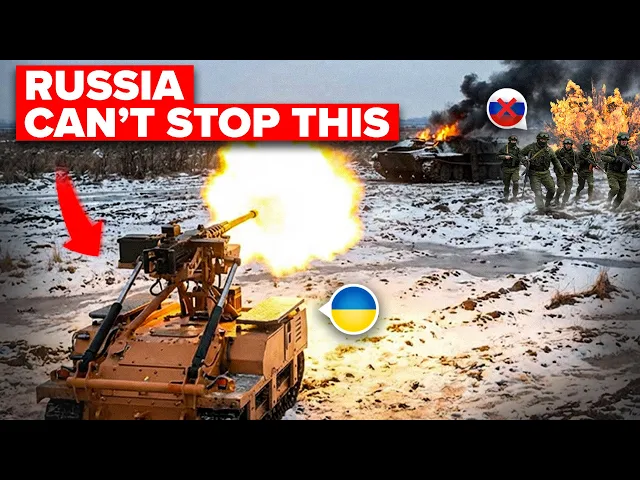
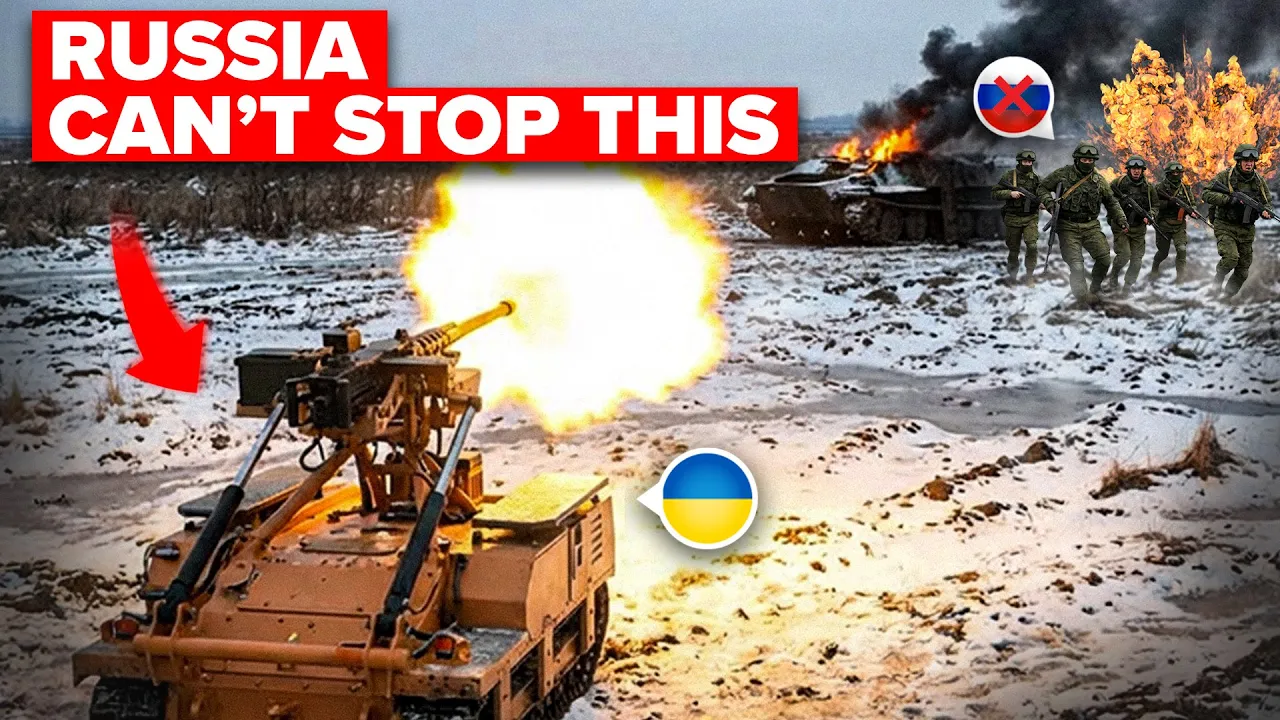
Ukraine isn’t trying to match Russia soldier-for-soldier anymore. Instead, the country is building something that sounds like science fiction: A robot army. We’re talking about unmanned ground vehicles crawling through trenches, delivering supplies under fire, evacuating wounded soldiers, and even driving straight into Russian positions packed with explosives.
All while keeping Ukrainian soldiers as far from the kill zone as possible. And the wildest part of this is that much of this technology is being developed in garage workshops, Soviet-era warehouses, and makeshift facilities just miles from active combat zones. Let’s dive into how Ukraine went from having basically no robotics capability to pioneering the future of ground warfare in less than three years, and why every major military power on Earth is now scrambling to figure out what this means for the future of war.
When the war kicked off, Ukraine’s unmanned capabilities were limited to about 20 Turkish Bayraktar drones and some volunteer units flying consumer quadcopters. There were no ground robots. No autonomous systems.
Nothing. Fast forward to December 2024, and Ukrainian forces conducted the world’s first documented all-robot assault on Russian positions. No human soldiers were involved in the actual attack, just drones in the sky and unmanned vehicles on the ground, working together to take out enemy positions.
By July 2025, Ukraine’s 3rd Assault Brigade went even further. They conducted an entire operation using only drones and ground robots that forced Russian troops to surrender. Zero Ukrainian casualties.
That’s a glimpse into how wars might be fought in the future. But these headline-grabbing operations don’t tell the full story of how Ukraine got here. To see that, you need to visit places like the workshop run by Oleksandr, a platoon commander with the Antares Battalion operating out of an old Soviet warehouse in Donetsk Oblast.
Oleksandr’s story is the story of Ukraine’s ground robot revolution in microcosm. He built his entire unit through personal connections, fundraisers, raffles, and donations from civilian networks. His platoon only keeps a handful of robots for themselves.
The rest go to other brigades that need them more. The work never stops. When manufacturers deliver new unmanned ground vehicles to units like Oleksandr’s, they arrive with a fatal flaw: default analog communication systems that Russian jamming tears apart like tissue paper.
So Oleksandr’s team strips them down completely, welds new frames, rewires everything, and installs Starlink terminals, LTE networks, or encrypted digital links before they’re combat-ready. Converting a single UGV (or unmanned ground vehicle) costs between $750 and $1,000, and that’s not counting the Starlink hardware and subscription. Then there’s the constant maintenance.
These machines take brutal punishment in the field and need servicing after every mission. But here’s the thing: it’s worth it. Because once upgraded, these robots can do things that save Ukrainian lives every single day.
Let’s talk timeline, because the evolution of Ukrainian unmanned systems has happened at breakneck speed. In early 2022, Ukraine’s robotics capability was essentially zero. By mid-2022, volunteer units were converting DJI consumer drones into makeshift bombers.
Slow, vulnerable, but effective enough to take out million-dollar tanks. Then came the FPV drone revolution in 2023. Ukraine produced close to 600,000 first-person view drones that year, descendants of racing drones that could zip through trees and slam into targets with surgical precision.
By 2024, that number jumped to 1. 5 million FPV drones. In 2025, Ukraine is on track to produce 4.
5 million FPV drones alone. That’s more than 12,000 every single day. But while aerial drones grabbed headlines, something quieter was happening on the ground.
Small-scale experiments with unmanned ground vehicles were taking place across multiple brigades. Some units were testing wheeled platforms. Others tried tracked designs.
Everyone was learning what worked and what didn’t through trial and error on active battlefields. By late 2023, ground robots started appearing in combat footage. Small machines delivering supplies to forward positions.
Slightly larger ones evacuating wounded soldiers from trenches under fire. December 2024 marked the turning point with that first all-robot assault. Then Ukraine announced plans to deploy at least 15,000 ground robots by the end of 2025.
These weren’t prototype systems, but fully operational combat robots integrated into brigade-level operations. And in 2025, Ukrainian soldiers were constantly finding new uses for these systems faster than anyone could catalog them. The Meduza report from March 2025 showed soldiers from the 5th Assault Brigade with combat robots that looked like small ATVs, capable of maneuvering through wreckage and attacking Russian positions with overhead drone guidance.
The August 2025 breakthrough came when Ukraine’s 28th Mechanized Brigade unveiled what they claimed was the war’s first air-defense UGV: a ground robot mounting an Igla MANPADS system to shoot down aircraft while keeping crews under cover. Suddenly, these weren’t just logistics platforms anymore. They were becoming weapons.
Now let’s break down exactly what these ground robots can do, because the variety of applications is genuinely stunning. According to Oleksandr Yabchanka, head of robotic systems for Ukraine’s Da Vinci Wolves Battalion, there are at least eight primary uses. And he told Business Insider that one of them is the “most promising” for Ukraine’s forces: using the robots as bombs.
The logic is simple: ground robots can carry way more explosives than aerial drones. The biggest aerial drones max out at around 22 pounds of payload. But the smallest ground robots Yabchanka works with can carry more than 48 pounds, with larger models carrying significantly more.
And they can get much, much closer before detonating. Videos from the battlefield show these robots driving directly into Russian trenches, into dugouts, even into basement positions before exploding. Yabchanka described one mission where his unit sent a robot carrying 66 pounds of explosives into a Russian basement.
It detonated inside the actual structure, killing Russian infantry. That’s the kind of precision that humans simply can’t achieve safely, and that flying drones can only do with a lot of attempts and losses. But kamikaze missions are just one application.
Let’s talk logistics, because this is where ground robots are making the biggest day-to-day impact. Ukraine’s expanding kill zone has pushed more than 10 miles past the front line, fueled by the proliferation of drones on both sides. According to Army Technology estimates, drones now account for up to 80 percent of Russian battlefield casualties.
But the reverse is also true, as most if not all Ukrainian injuries are drone-related, according to Colonel Kostiantyn Humeniuk, Chief Surgeon of Ukraine’s Medical Forces. The most dangerous task isn’t engaging the enemy anymore. It’s simply moving supplies in and out of frontline positions.
Ukraine has lost so many pickup trucks during logistics runs that units face serious vehicle shortages. Enter the ground robots. These machines can deliver food, ammunition, and medical supplies to forward trenches without exposing soldiers.
They operate primarily at night when they’re harder for Russian FPV drones to spot and destroy. And speed matters less than you’d think, as even 10 miles per hour is considered fast when the battlefield is swarming with deadly drones. On rough terrain, they’re more likely to flip or crash at higher speeds, so slow and steady they go.
Some robots are fitted with communications relay masts or electronic warfare modules. Others mount remote-controlled turrets or mortars for fire support. But the critical distinction is this: every ground robot mission means one less Ukrainian soldier has to drive a truck through the kill zone.
Then there’s medical evacuation, which represents both the most life-saving and most technically challenging application. Tracked ground robots can evacuate wounded soldiers from trenches without risking the eight-person teams typically required for such operations. The robot approaches the position, the wounded soldier is loaded on, and it drives them back to safety.
The problem? If the robot loses communication while carrying a casualty, it leaves a vulnerable soldier stranded in the open, visible to Russian drones. According to Yabchanka, his unit only uses robots for casualty evacuation as a last resort for exactly this reason.
The risk of communication loss is too high to make it standard practice. Yet soldiers keep pushing the technology forward. Because when it works, it saves lives in situations where human recovery would mean multiple additional casualties.
Ground robots are also being used to lay mines, which Yabchanka describes as “quite dangerous” for soldiers when Russian drones are constantly overhead. The robots can carry more mines than soldiers and deploy them without exposing human operators to enemy fire. On the flip side, ground robots can also de-mine areas.
Unlike aerial drones, they can move ahead of advancing troops to check if routes are clear. If they hit a mine, the machine takes damage instead of killing a soldier. It’s brutal calculus, but the math is clear: better a damaged robot than a dead Ukrainian.
The collection of fallen soldiers’ bodies represents another grim but necessary application. Recovering casualties typically requires eight soldiers and puts them all at risk from the same things that caused the first casualty. Robots offer an alternative, though it’s not perfect.
The machines can lose connection or hit mines themselves, meaning soldiers still often need to intervene. Intelligence gathering rounds out the primary uses. Ground robot cameras can provide reconnaissance, though not as effectively as aerial drones.
Even simple obstacles like tall grass can limit their effectiveness. The low-to-ground perspective just doesn’t offer the same battlefield awareness as eyes in the sky. But if you combine ground robots with aerial drones providing overwatch, and suddenly you have a coordinated unmanned system that can operate semi-independently of human soldiers.
Now let’s talk about the soldiers actually building and operating these systems, because their stories reveal just how grassroots this revolution really is. Visit the 5th Assault Brigade’s positions near Donetsk, and you’ll find soldiers like “Agronom” and “Moped,” both using call signs for their families’ safety, working in makeshift workshops to modify ground robots. They showed Current Time journalist Oleksiy Prodayvoda footage of a recent battle.
A ground drone from their unit maneuvered past wrecked armored vehicles before attacking Russian positions. The enemy couldn’t understand what was happening or where the fire was coming from. “The drone is about the size of an ATV, and you can only hear it when it’s within 30 meters [or about 100 feet],” Agronom explained.
“We would quietly roll into the gray zone and open fire on their positions. ” Moped walked through their latest upgrades: new frames, relocated cameras for better visibility, thermal imaging for night operations, turret mounts for machine guns or small-caliber cannons. These aren’t factory specifications.
These are battlefield modifications designed by soldiers who understand exactly what they need. They’re also working on tracked versions that move more smoothly than wheeled models, making them better for evacuating wounded soldiers. The tracks handle rough terrain better and provide a more stable platform.
They repeatedly disassemble and reassemble these robots, testing each iteration in field conditions. It’s continuous improvement driven by combat feedback, happening in real-time just miles from active fighting. Compare this to traditional Western procurement, where it could take years to go from prototype to something usable, all being tested in controlled environments.
And across Ukraine, there are dozens of similar workshops. Each unit has teams modifying, improving, and experimenting with ground robots. In total, Ukraine is estimated to have well over 500 companies producing drones of various sizes and functions, from backyard operations to entire factories with supply chains.
All of this is powered by Ukraine’s intelligence-sharing and awareness service Delta, which coordinates where drones are needed and how to get them there. But while Ukrainian ingenuity is impressive, it’s not operating in a vacuum. Russia is learning too, and the technological arms race is accelerating.
After years of getting pummeled by Ukrainian drones, Moscow has finally started developing its own ground robot fleet. Russian state media showcased a UGV armed with four rocket-assisted thermobaric launchers in August 2024. Late to the game, but they’re playing catch-up fast.
And that’s because Russia has an inherent advantage when it comes to military procurement: Oil and gas revenues. Russia currently uses about 8 percent of its GDP on its military, while Ukraine uses about 35 percent. Russia’s economy is stronger (despite sanctions), and there’s still a sentiment that Putin can throw money at the problem until it starts disappearing.
Plus, Russia has China watching and is potentially willing to share technology and manufacturing capacity. Which brings us to one of the biggest challenges Ukrainian ground robots face: electronic warfare and communication disruption. Russian jamming technology has evolved dramatically over the course of the war.
Early in the conflict, electronic warfare was primitive and localized. Now it’s sophisticated and widespread. Jamming systems can turn on and off in 15-minute intervals, forcing operators to wait for windows of opportunity.
“The conditions on the ground dictate their own rules, and we have to convert all drones to digital control,” Oleksandr explained. That’s why his team strips out the analog systems and installs encrypted digital links or Starlink terminals. But even those solutions aren’t foolproof.
Fiber-optic-controlled drones represent Ukraine’s creative workaround to the jamming problem. These platforms trail hair-thin fiber optic cables behind them, up to 12 miles long, providing completely jam-proof connections. It’s a 20th-century solution to a 21st-century problem: physical cables that can’t be electronically disrupted.
The downside? The cables themselves are vulnerable to being cut or snagged. And soldiers have started finding bird nests made from discarded fiber optic cables from downed drones, which is both hilarious and a little sad.
Connectivity loss remains the nightmare scenario. According to Yabchanka, when a robot loses communication, it becomes “just an expensive pile of metal scrap. ” And even worse, that piece of scrap metal could be seized by Russia and reverse-engineered or broken through so the military can know what to do against it.
As a fallback plan, there are promising results with developing AI systems to let robots operate autonomously when communication is lost, but it’s a constant development race. The technology exists, but making it reliable enough for combat conditions is another story altogether. But here’s where things get really interesting: Ukraine’s success with ground robots isn’t just changing this war.
It’s changing how militaries around the world think about warfare itself. Ukraine’s government established the national Unmanned Systems Forces in February 2024, with Colonel Vadym Sukharevskyi appointed as commander in June, now replaced by Major Robert Brovdi. This is an entirely new branch of the military, on par with the Army, Navy, or Air Force.
Think about that for a second. A country created a separate military branch for unmanned systems in less than two years. Russia followed suit in December 2024, announcing its own unmanned systems branch to integrate autonomous and robotic technologies across all military branches.
NATO established the Joint Analysis Training and Education Centre, or JATEC, in Poland specifically to study Ukrainian innovations. The alliance that spent decades perfecting expensive, sophisticated weapon systems is now trying to learn from a country building tank-killers in garage workshops. The United States launched the Replicator initiative, with the Pentagon’s two fiscal year budget including $1 billion for expanding attack drone production while cutting funding for traditional helicopter programs.
The U. S. is literally replicating Ukraine’s approach of producing large numbers of low-cost autonomous systems.
Retired Army General Mark Milley, former chairman of the Joint Chiefs of Staff, has predicted that within ten to fifteen years, up to one-third of the U. S. military could consist of robotic systems.
That assessment was almost certainly informed by observations of technologies fielded in Ukraine. China reorganized its entire Strategic Support Force, creating three separate branches focused on the kind of integrated drone-electronic warfare operations that Ukraine has perfected. So it’s safe to say that the West, but also China, is watching this war very carefully and all are adapting at breakneck speeds in order not to fall behind the other.
And this is the really scary part for Western militaries. Ukraine didn’t choose this path because it was interesting or experimental. Ukraine chose it because it had no other option.
When you’re fighting a larger adversary with more manpower and more resources, you innovate, or you lose. Now every major military power is trying to figure out how to incorporate those same innovations into forces that were built around completely different assumptions. The economic model alone is revolutionary.
Traditional military procurement operates on the assumption that you build the best possible system, regardless of cost, because quality matters more than quantity. A single F-35 fighter jet costs around $80 million. A Patriot missile system costs hundreds of millions.
Ukrainian FPV drones cost $400 to $500 each, or up to a few thousand with choice upgrades, and can take out tanks worth millions. Ground robots cost a few thousand dollars and can accomplish missions that would otherwise require dozens of soldiers and expensive vehicles. The cost-exchange ratios are so favorable that traditional military economics simply don’t apply anymore.
When the defender has to spend millions to stop thousands of dollars in attacks, the attacker can win through pure economic attrition. Ground robots flip that equation. A reusable UGV that costs $10,000 and can complete dozens of missions represents a completely different value proposition than a one-time-use missile or a human-operated vehicle that puts lives at risk.
But let’s zoom back to the human level for a moment, because these aren’t just numbers and systems. These are technologies that are keeping Ukrainian soldiers alive. One soldier from the 3rd Assault Brigade, going by the call sign “Kostas” or “El Greco” to protect his family’s safety, explained the reality to journalists: “For now, their main task is logistics and medical evacuations.
To expand to assault or fire support, we need to lower costs and simplify operations. ” That’s the next frontier. Making these systems cheap enough and simple enough that they can be deployed at a massive scale for direct combat operations.
Then there’s one other problem. Yabchanka from the Da Vinci Wolves described Russia’s inevitable adoption of Ukrainian innovations: “The question is not if but when Russia will do the same. So the question is, who will do it faster?
We need to scale all these things up quicker than the Russians do. ” He urged European industry to work closely with Ukrainian troops and manufacturers to innovate fast. Because this isn’t just about winning today’s battles.
It’s about maintaining the technological edge that lets Ukraine survive against a larger adversary. And maybe that’s the most important lesson from Ukraine’s ground robot revolution. When you’re fighting for your country’s survival, innovation isn’t optional.
You find ways to do more with less. You turn consumer technology into military systems. You build weapons in garage workshops because waiting for traditional procurement means losing.
Ukraine’s goal of deploying 15,000 ground robots by the end of 2025 might sound like a pipe dream, but it’s actually conservative compared to what they’ve accomplished with aerial drones. They went from basically zero drone production to 4. 5 million FPV drones annually in three years.
Applying that same growth curve to ground robots, we could be looking at tens of thousands of unmanned ground vehicles operating across Ukrainian front lines within the next few years. Ukraine obviously sees these unmanned ground vehicles as a cornerstone of a future robotic army, one that could help offset the country’s manpower shortages and keep more soldiers out of harm’s way. It’s part of a larger strategy to create a technology shield that reinforces Ukraine’s defenses and ensures that Kyiv can stay in the fight for as long as necessary.
The work happening in workshops like Oleksandr’s, in facilities run by organizations like Dignitas Ukraine, in the field with soldiers like Agronom and Moped, isn’t just about winning battles. It’s about fundamentally changing the nature of warfare itself. And whether the rest of the world is ready or not, that change is happening right now, in real-time, on the battlefields of Ukraine.
Russia had the numerical advantage at the start of this war. But Ukraine found something more valuable: the ingenuity to build a new kind of army that could multiply its capabilities while keeping its human soldiers alive. Thank you for watching.
If you want to check out the extent of Ukraine’s aerial and naval drone revolution, check out this video. And if you want to stay updated on how the War in Ukraine continues to reshape global military strategy and technology, subscribe to The Military Show for daily videos.