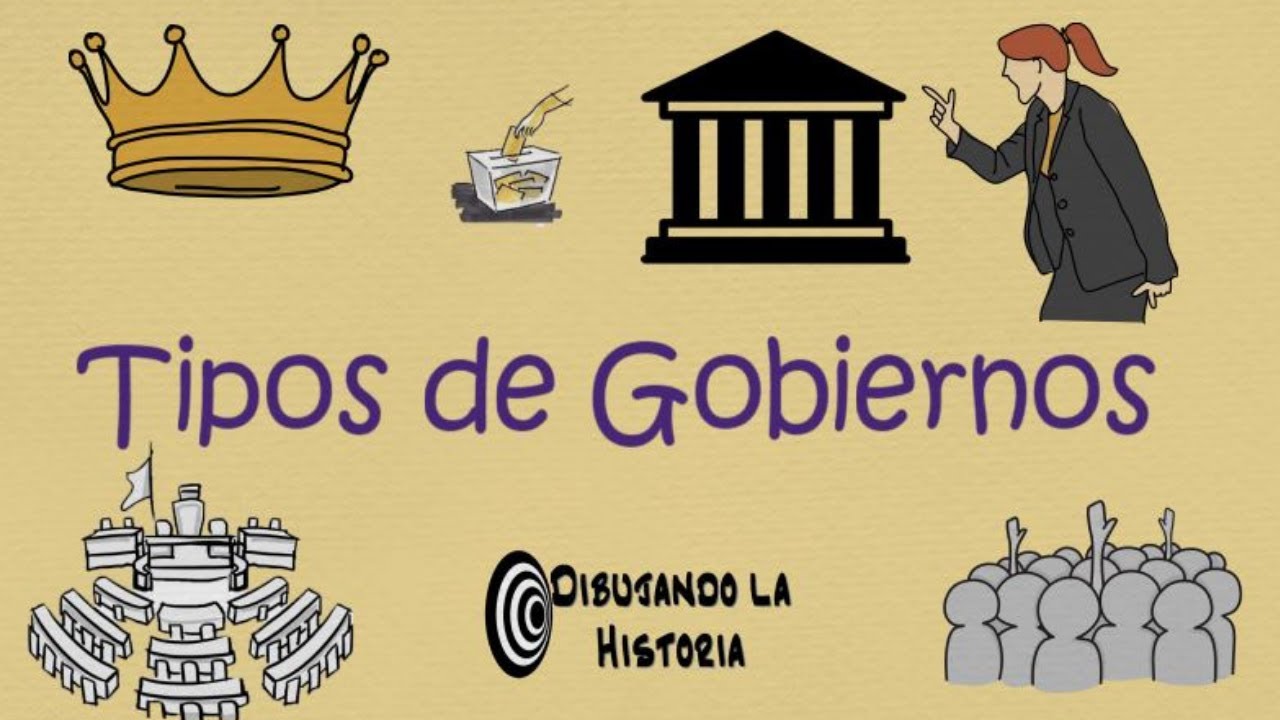
Hello, students, teachers and families! I am Brian Perez from Teaching and Digital Tools and in this video we will see What are the forms of government? and What are their classic typologies?
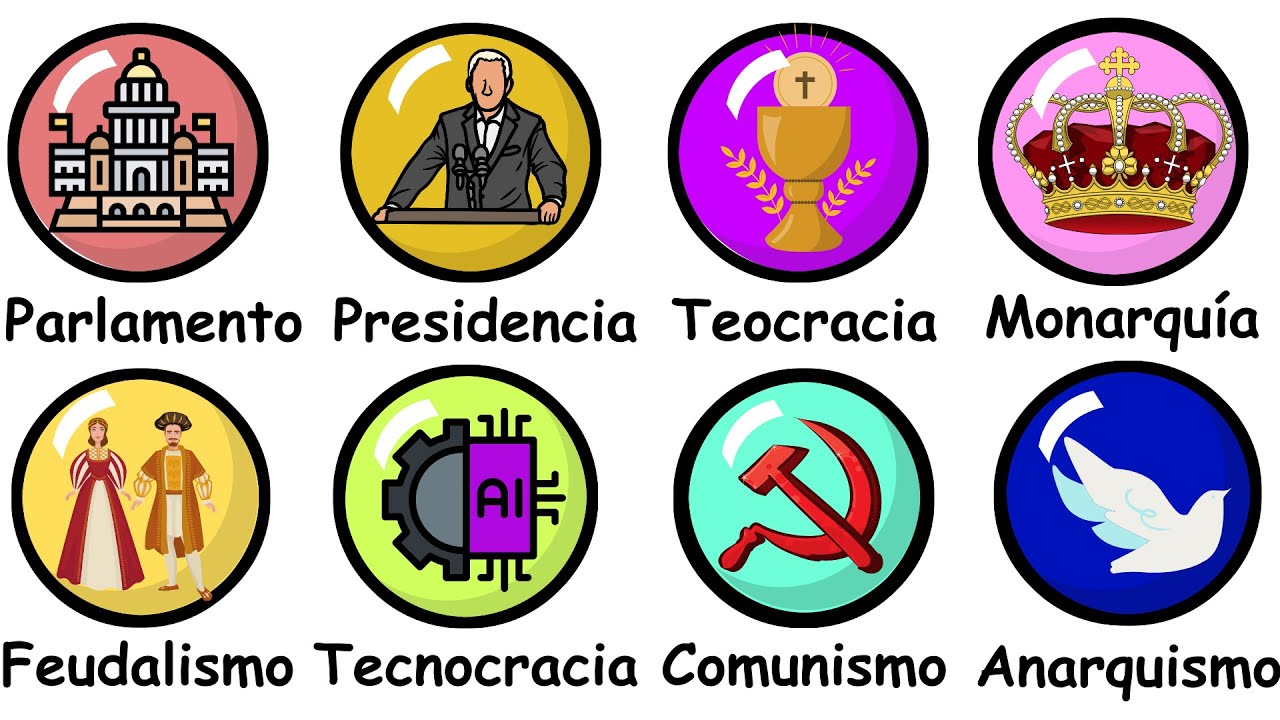
They are ready? (Chorus) Yeeeeehhh! The forms of government are ideas, models or systems of how to govern a State.
They refer to the number of people who govern, in what way they exercise power, what organs or institutions of government exist in it, what functions each one fulfills and how they are related to each other. Now we will see the classic typologies. Knowing them will help us better understand the forms of government that exist today.
A typology is a model or categorization of elements that allow a classification, which makes it easier for us to systematically compare and differentiate them, according to the selected criteria. That is, according to what aspect we are going to analyze. In this case, there were different thinkers, who throughout history, approached the forms of government, according to their perspective and the particularities of their respective times.
Contributing ideas, theories and useful knowledge, that other thinkers, would go back to perfecting the different ways in which States are governed. The classic typologies of the forms of government are three; That of Aristotle in the 4th century BC, that of Machiavelli during the 15th century, and that of Montesquieu in the 18th century. Aristotle classifies the forms of government according to two criteria: First, the number of rulers: One, few or many.
And second, the interest they serve. mmm . .
. this point is sometimes more difficult to understand. But let's keep the following guidelines in mind.
If the rulers serve the common good, they will seek to favor the whole community, satisfy the needs of the people, guarantee their security, correctly apply justice, promote peace and prosperity. When this occurs, the forms of government are considered pure forms. Or on the contrary, if the rulers pursue their own benefit, they will concentrate on accumulating wealth, increasing their greatness, fame or reputation, taking advantage of the advantages, or benefits, that power offers, even at the cost or at the expense of people interests.
In these cases, impure forms, deformations or corrupted versions of the same are considered. Remember that integrity is value, that it dictates the correct way of doing things and that corruption is its counter-value, its opposite. I make these clarifications, because whenever we analyze a form of government, it is convenient to ask ourselves.
For the benefit of who is governing? Then locate other characteristics, specific to each one, and thus it will be much easier for us to orient ourselves. So, according to Aristotle, when a person governs, a king, for the benefit of his people, it is called Monarchy, the government of one.
Whereas if that king, pursues his own interests, neglecting his people, he becomes a Tyrant, and his form of government will be a Tyranny. Whoops! .
. . Too bad .
. . .
When a few people, exceptionally trained and qualified in certain subjects, experts, or also called "the elite", are brought together to make the most convenient decisions, for the benefit of the people, it is an ARISTOCRACIA, government of the best. However, if this group makes decisions thinking only of their own benefit, we will find ourselves with an Oligarchy, a government of few. Finally, when many people participate and are responsibly involved in decision-making that favors the majority, but without neglecting the interests and rights of minorities, the form of government will be a democracy, government of the people.
What . . .
for it to work properly, it requires an educated population, both in scientific knowledge, as well as in values and citizenship. Besides . .
. he/she needs a political memory, and a lot of experience. For this reason, it sometimes happens, especially in third world countries, that citizens do not want, do not commit, or cannot participate in democracy.
With the lack of interest or capacity of the people, in the control of public affairs and the functioning of democratic institutions, they begin to operate with certain flaws. Allowing demagoguery to occur, leading the people, where the political class will easily manage to manipulate or deceive them with false promises. In the 15th century, Machiavelli reduces the forms of government to two, according to who holds power: What he calls a "principality", which would be a Monarchy, in which power is concentrated in a single person; and Republic, the public matter, which concerns us all: In which power can be distributed in a group of people, the Aristocratic Republic, or in the entire community, the Democratic Republic.
For Machiavelli, it does not matter if a few or many participate in a republic, the important thing is that, in both cases, decisions are taken in assembly, respecting the interests and will of the participants, through majority rule. Which differentiates both from the Monarchy After three centuries, and many monarchs who exercised absolute power without limit, harming and oppressing their people. Ahh that's the most evil thing you could imagine .
. . Montesquieu was concerned with limiting and controlling the power of the rulers, returning to a typology of three, based fundamentally on the distinction between governments with respect to the laws, the Monarchy, and the Republic, in front of governments "Without law or brake" reflected in the absolutist monarchies.
This typology combined the distinction of Machiavelli, Monarchy or Republic, with the value distinction of Aristotle, pure forms or corrupt forms. In addition, to avoid despotism, He thought that it was necessary that power should control power. And so that it would not be corrupted, it should not be concentrated.
So, Montesquieu would begin to think about how to separate power, into different organs or government institutions with specific functions, an idea that was evolved, and today, we recognize the existence of the executive, legislative and judicial power in most states of law. Thanks to the theory of se paration of the powers of the state. Supreme .
. . I hope this information is useful to you.
In future videos we will continue to develop these topics. If you want to support us to continue creating content like this, subscribe to the channel, like the video, comment on it and share it so that it reaches more people. Until next time!