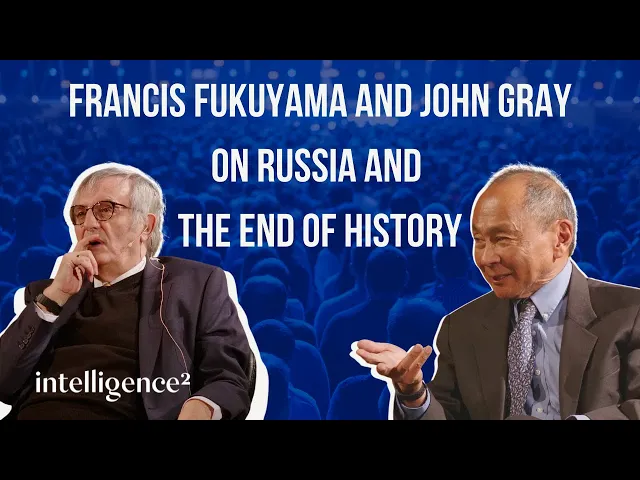
i want to go back because frank you have a you know what a very rare achievement which is that all of this conversation is happening in the shadow of your work and your thinking and the end of history is an often misquoted misremembered book can you refresh us on what you were actually arguing them yet because it's the end of history with a capital h right which is very important but what was the central thesis of that book yes well let's see if i can think of that argument i i usually get asked it once
or twice a day for the last 30 years so that is the price yes i'm afraid yeah i have a lot of practice well uh first of all i would i would explain what the end of history those words mean so history is history with a capital h today we would call it something like modernization or development that is to say the slow evolution of human social organization over the millennia as you go from hunter-gatherer societies to tribal societies to i don't know feudalism to you know an industrial society and then wherever we are today
that's history and then the end is not a stopping it is the direction that that progress is uh pointing us towards and um there was a well karl marx had a you know he bought into the idea that there was history in this progressive sense and he also talked about an end of history for him the end of history would be communism because that was the highest form of human organization that resolved all of the contradictions of prior forms and my observation back in 1989 was we weren't going to get there we weren't going to
get to this higher stage that we could get to liberal democracy connected to a market economy but it wasn't clear that there was another stage in social evolution higher than that better than that and that that's you know where we would uh end up uh i did not predict that everybody would end up being a peaceful you know democracy but i said that there is this larger process you know call it modernization that is valuable you know people don't want to live in poor chaotic less developed countries they want to live in you know switzerland
or canada or you know britain that has a high level of wealth where you can you can educate your children you don't have to worry about your physical security the way you do in many uh poor societies and you know that's really what the meaning of the end of history was which then leads me onto the question of why didn't that happen to russia after the end of a cold war why didn't it become a liberal democracy well i do think that there are uh you know cultural traditions that can get in the way i
mean so many factors one of them was just bad policy and i really do think that a lot of the especially the american economic advisors that were talking to russian policymakers after the soviet union fell apart gave them bad advice they made a much too rapid transition to a market economy they didn't have the and it was based on a really fundamental misunderstanding they didn't understand you need a state in order to have a market economy a functioning state and the you know the soviet union had just dismantled its state and so that was part
of it i think that you know just the shock of losing an empire that rapidly was deeply traumatizing to a lot of people it shouldn't been because i i believe there's a country in this neighborhood that lost an empire at some point in the not too distant past and it didn't go into this big revenge you know effort to reconquer lost territories but i do think that there is a tradition in russian national identity that understood its own identity in terms of the domination of its region and that simply just didn't go away and then
you know i think uh part of it is just the luck of particular leaders and i think we've got a lunatic running this country right now who is just fixated on that what he regards as a historical uh injustice but you could have imagined other outcomes you know boris yeltsin could have appointed somebody other than you know a kgb agent to be the next president of russia and we may have been on a very different path there's a great error actually an extremely dangerous error being unfolding at the moment which is to say that um
putin is mad now he may be solid he may be isolated he shows many of the characteristics of isolation there may be people not telling him the bad news that might be why he'll sleep scapegoats for the failure he'll feel sack a lot of his people he already has military and and intelligence but when one says that one is making the the classic error of liberals which is to say that underneath all human beings are rational in the sense that liberals understand rationality what they really want is freedom peace prosperity always i think wolfovitz said
about iraq he said two years from now they'll all be sitting reading the wall street journal and checking their stock prices didn't happen um and not only because of american um um mistakes uh this can lead to catastrophe because it leaves out the possibility of that uh um a ruler like putin with goals uh goals about reviving uh russia in its bizarrest or perhaps its soviet form uh unifying it uh having it as not being as a kind of a world historical uh force in the world um um in in human affairs there is goals
and we leave out the possibility which has been many times exhibited in history that people will put as human beings leaders and even some of their followers will put away put on one side these liberal goals but apply um some other goals instead i think he is rational he's been preparing this for a long time um he's um turned the economy into a fortress it's in people say it's in free fall now well they can probably still feed themselves because 80 of their food is domestically produced it'll be other parts of the world the developing
world that face shortages and and hunger you