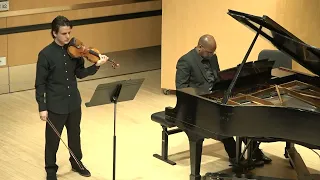
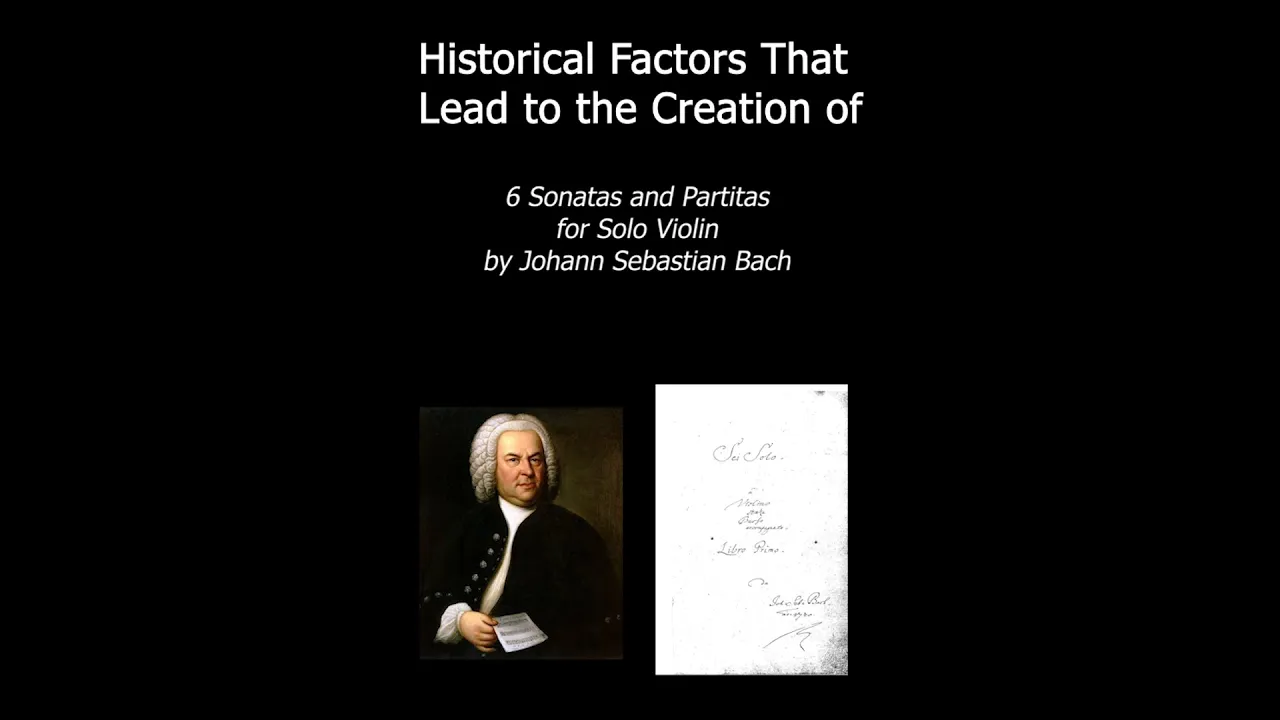
hello my name is christopher balduc and today we'll be discussing various historical factors that led to the creation of johann sebastian box six sonatas and partidas for solo violin in this presentation i will touch on topics ranging from the history of violent as a whole to historical documents that discuss the potential origins of the sonatas and partidas with their respective manuscripts we will also look into various pieces by other composers which buck was familiar with and potentially took influence from since the 14th century there have been written accounts of musical instruments played with the bow
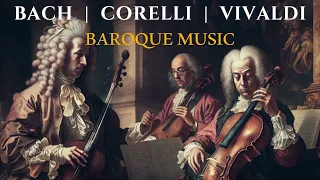
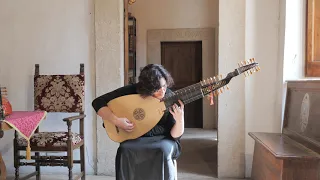
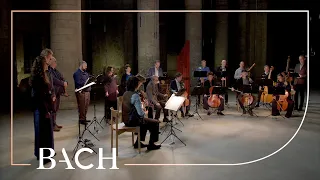
which was animal hair held between two ends of a stick in order to cause a string to vibrate the creation of the violin was a result of evolution it started with the vile family beginning with the bass vial viola de gamba and aviolo dibraccio the picture on the top is an example of the various instruments in the vial family through experiment and trial and error over details like sound production size string amount and playability the violin was born the credit for the first violin is usually given to the creminese luthier named andrea ahmadi who had
made his name originally as a loot builder he created at least two three string violins in the 1540s the primary woods used in violin making are spruce and maple spruce is chosen for the top also called the front table or soundboard it is light and weight yet longitudinally strong and laterally flexible to the eye the most prominent feature of a spruce top is the darker vertical graining maple or poplar is cut 10 gently on the ribs and used for the back the figure the flame or curl is the most prominent feature of maple spruce or
willow are used internally for blocks and linings the base bar and sound poster spruce the fittings including pegs tailpiece and end button are made of any dense hardwood most commonly ebony rosewood or boxwood for fingerboards and tailpieces the early italian makers used maple or other lighter hardwoods like poplar covered with maple or dyed wood veneer since ebony was hard to find italy has long been the center of violin making the ahmadi family were credited with solidifying the modern conception of a violin and then other makers experimented with their models from there the neck of a
baroque violin is straight versus a modern neck which is angled down because of mechanisms due to physics a neck angled down means more sound production the main difference though is in the choice of strings modern strings are covered with a synthetic lining either silver or titanium baroque instruments use animal gut strings made from either sheep or cow gut strings produce a much more nutty raw and complex sound baroque strings are also much more unreliable and don't stay in tune as well the soundpost in baseball in a modern violin is also slightly thicker which helps the
lower register project more baroque violinists didn't use chin rests the violinist louis spore invented them in the early 1800s to allow for more hold the chin rest was invented because there was a need to hold the violin more securely because of an increase in virtuosic shifting passages above is an excerpt of henrik sharing playing the brahms violent concerto which was completed in 1878 well past the time of bach the music requires the solas to play up and down the fingerboard in order for a large downshift to occur the violinist must hold the instrument with his
or her neck to allow the arm to relocate to a different position hence the creation of the chin rest [Music] the frequency of the base a has changed throughout the years baroque tuning was somewhere around a equals 415 hertz which differed from place to place in time to time where the modern violin is tuned anywhere from a equals 438 to 445 hertz baroque bows were mostly made with snake wood modern bows are crafted with print and buco wood both have horse hair attached which is the tool in which violin is generally used to create sound
the sound is created when a player glides the bow hair across the string at various speeds and pressures that allow the string to vibrate modern bows are longer than baroque bows and have different fittings the baroque bow is tapered off at the edge so you get a different generally softer attack also because it is made from a denser less flexible wood than pernambuco there are many different styles of baroque bows the bow wasn't standardized until the 1800s the bubble is one of the fundamental impacts on the development of sound and tone projection in the 18th
and 19th centuries now we will discuss the history of johann sebastian box six sonatas and partidos for solo violin they were often transcribed for other instruments and there is a possibility that bach himself actually transcribed the movements for keyboard instruments some scholars suggest that these compositions were intended as practice material for violinists others believed that they were meant for performance either as dance suites or played in churches sonatas or song without words contrast with cantatas which were written for singers often with accompaniment for the church over time the sonata acquired the meaning of referring to
a work for solo instrument and possibly an accompanied one usually by a piano each have four movements beginning with a slow movement and ending with the fast one each have a central pair of movements one a fugue and one a slower more graceful movement partita meaning divided into parts are dance suites written for a solo instrument parte meaning part or section partita was originally the name for a single instrumental piece of music johann kunau and other later german composers used it for collections of musical pieces which became essentially a synonym for the suite the partita
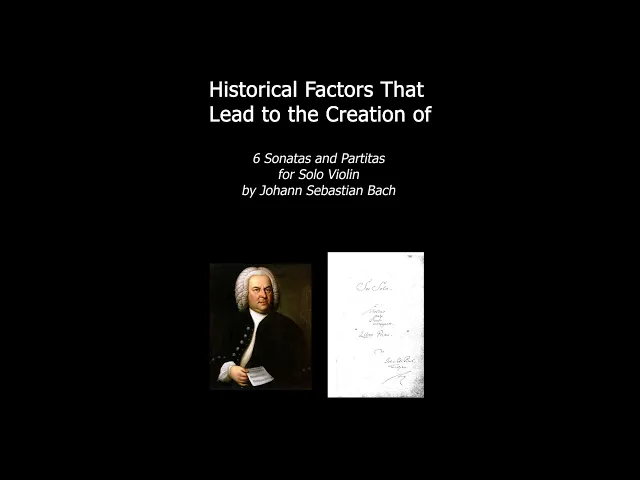
could have perhaps been one way that freed bach from limitations of form the partita appeared to be a place where he could let his imagination soar the bartidas also showed that bach had knowledge of dance forms which originated in other western european countries despite the fact that he only lived in germany for his entire life now onto the origins of the manuscripts for the solo violence sonatas and partidas bach's original manuscript of these works were dated 1720 entitled say solo which means you are alone there is no conclusive agreement on the year of the composition
but it surely was in 1720. it is probable that bach produced this manuscript for his own use the handwritten score is available on imslp to everybody for free this score is thought to be lacking in articulation marks in other conventions but is nonetheless the go-to for players when confronted with musical and technical concerns we can assume this manuscript as shown above belonged to bach's granddaughter christina luisa bach eventually this manuscript came into the possession of wilhelm rust in 1890 this manuscript is considered to be the one with the highest authority by most scholars another manuscript
is a copy of the original by anna magdalena buck's second wife it contains markings by the violinist george heinrich ludwig schwannberg likely for his own use this source also dates a copy of the cello suites it is thought that the manuscript dates no earlier than 1723 some scholars suggest the year 1727 like the wiener urtext edition another source is handwritten from one of box pupils george gottfried wagner it is likely he copied the score sometime between 1723 in 1726 in leipzig this source was once in possession of pianist george pilchao eventually the manuscript found its
way to the stacho bibliotheque suberlin in the paul chao collection another copy was made by johann peter kellner a german organist composer and collector of box works this source only contains parts of the sonatas and partitas three sonatas and a few movements from the second and third partita substantial deviations from the other sources reduced the manuscript's reliability a final manuscript was made in curtin presumed to be organist emmanuel librette gotcha in or around 1720 it is based on box manuscript a second person is to have thought to completed the notes and added extra articulation markings
johann sebastian bach was the eighth and youngest child in his family his father johan ambrosius bach likely taught him violin in basic music theory his mother and father died before he was 10. after his parents died johan sebastian moved in with his eldest brother johan kristoffbach johann kristoff exposed the young johann sebastian to some of the great composers of the day some of which include johann johann jacob froberger jean-baptiste luli louis marchand maren mare and girolamo frescobaldi in 1708 bach returned to weimar it is clear by this period bach familiarized himself with works written by
violinists of the time antonio vivaldi archangel corelli george philip telemon and giuseppe torelli to name a few a list of his archived transcriptions are shown here johann paul vestoff was a german baroque composer and violinist one of the most important exponents of the dresden violin school he was among the highest ranked violinists of his day and composed some of the earliest known music for solo violin he worked as a musician and composer as a member of the dresden hof cappell from 1674 to 1697 and at the weimar court from 1699 to 1705. vestav wrote six
suites for solo violin which marked the beginning of the performance repertoire for the instrument they are the first known multi-movement works for solo violin and as such their importance and influence can hardly be overestimated their publication in 1683 of one suite and in 1696 of the set of six suites are for certain to have been known to johan sebastian bach and must have influenced his three sonatas and three partitas for solo violin in the beginning of his sweden a minor vestoff introduces a long short theme with dotted gallop-like rhythms note the counterpoint in his use
of double triple and quadruple stops almost instantly making use of all strings available on the violin note the chromatic nature of the opening of the jig and how vesthof develops the music as it goes on [Music] see how this compares to the opening of box fugues in a minor and c major upon the entries of the chromatic counter subjects [Music] uh [Applause] [Music] [Applause] [Music] so [Music] the opening of vestoff suite in b-flat major introduces a stepwise alternating ascent descent baseline notice the similarities of this writing to the opening of the alemond from box b
minor partita [Music] so so [Music] [Applause] [Music] johann george pisendell was a german baroque musician violinist and composer who for many years led the court orchestra in dresden at the time known as the finest instrumental ensemble in europe peace endowment bach on his way to leipzig and weimar in 1709. piece indel was also introduced to george philip telemon and was an enthusiastic member of the student collegium musicum founded by telamon taliman and piezendell became close friends peace and del's compositions are few in number but high in quality piecendell's music takes influence from the italian school
but is also injected with a german baroque style he wrote a solo violin sonata in a minor which is suggested as an influence in bach's own solar writing for violin this sonata has a lot in common both technically and harmonically with box solo violence sonatas and partitas piscindell's violent sonata begins simply and slowly in the first bar and unfolds introducing more melismatic gestures around larger harmonic and rhythmic pillars there appear to be similarities particularly in the melisma and pillar-like writing of this music in box g minor sonata and a minor sonata [Music] foreign [Music] um
[Music] um [Music] time [Music] so in the second movement marked allegro piecendell uses small motific cells that bach uses all the time these slurring pairs are also very commonly seen in box solo violin sonatas and partitas [Music] [Applause] [Music] [Applause] good [Music] do [Applause] [Music] [Applause] [Music] so [Music] uh [Music] [Applause] compare the codas at the end of these movements by piece and dell and bach both are very similar to each other but piece and dell starts his on the key of the fifth scale degree and box starts his in the home key [Music] so
[Music] these are a few of my findings based on the seemingly endless discovery of various influences and historical factors that led to the creation of johann sebastian box six sonatas and partidos for solo violin i hope you all found this video enjoyable and were able to learn something new like and subscribe for more content like this in the future [Music] you