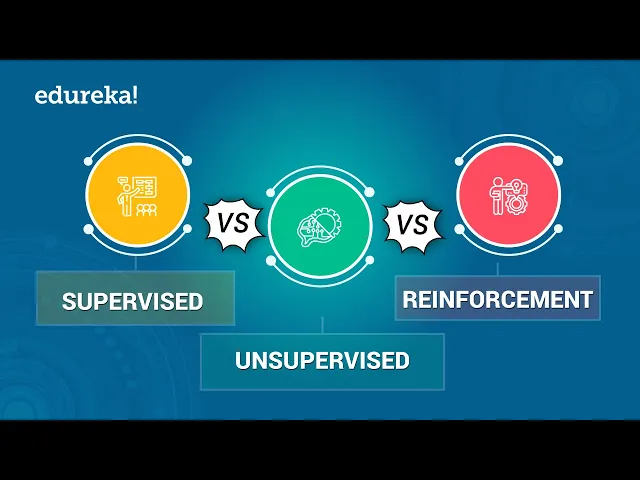
[Music] hi guys this is Laker from a Judaica the evolution of AI has changed the entire 21st century in terms of technology ai has told in the spotlight and it's advancements are quicker than we predicted with such an exponential growth in AI machine learning is becoming the most training field of the 21st century it is starting to redefine the way we live and it's time we understood what it is and why it matters in this session we'll be discussing the different types of machine learning and we'll compare them to each other so let me run
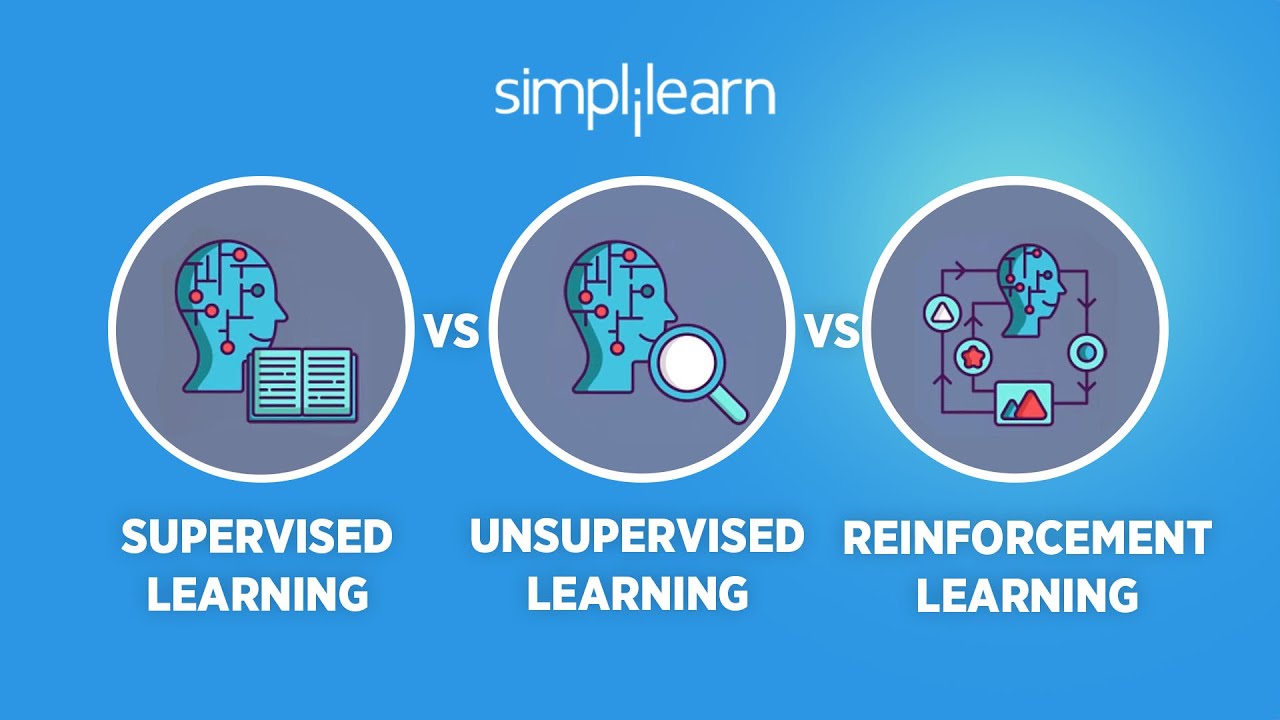
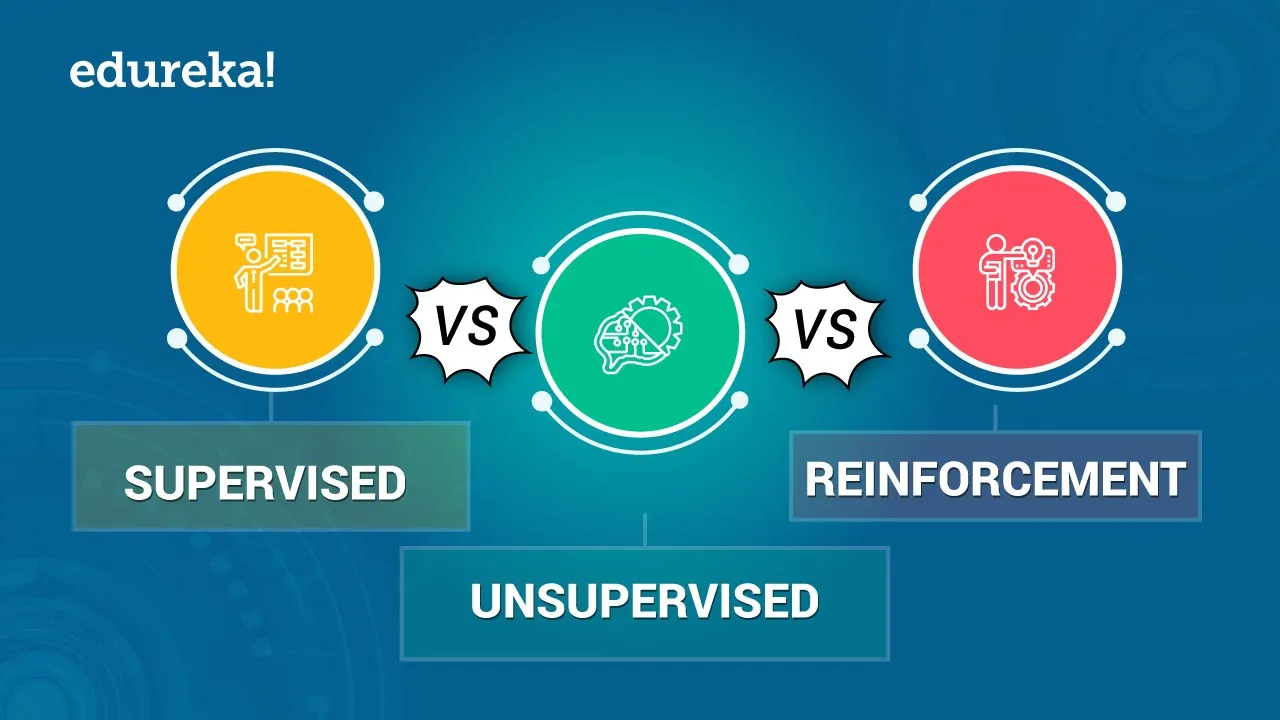
you through today's agenda we're going to begin the session with an introduction to machine learning next we will discuss the types of machine learning after that we'll compare supervised unsupervised and reinforcement learning based on a few key parameters we'll finally end the session by discussing a few example problems that can be solved using supervised unsupervised and reinforcement learning algorithms so without any further delay let's get started so guys machine learning is the science of getting computers to act by feeding them data and letting them learn a few tricks on their own without being explicitly programmed
now this sounds awfully a lot like a human child so let's consider a small scenario to understand machine learning now as a child if you had to distinguish between fruits such as cherries apples and oranges you wouldn't even know where to start because you're not familiar with how the fruits look now as we grow up we collect more information and start developing the capability to distinguish between various fruits the only reason why we are able to make this distinction is because we absorb our surroundings we gathered more data and we learn from our past experiences
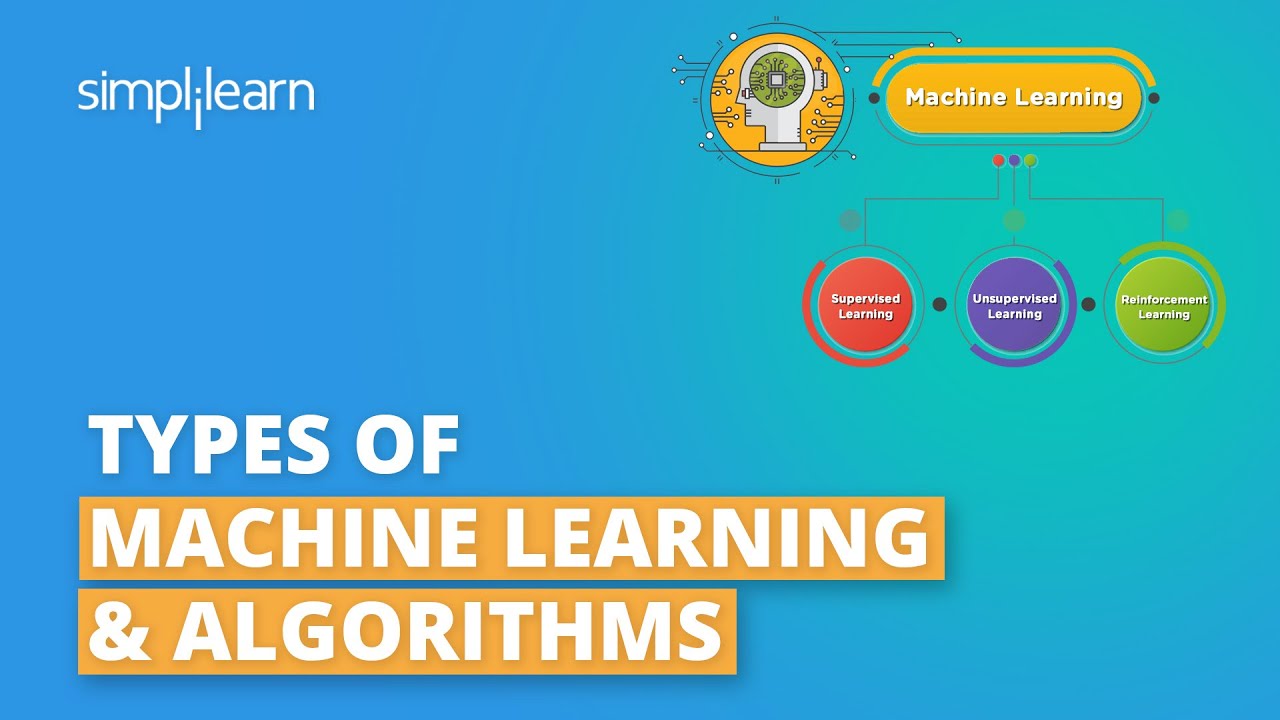
it's because our brain is capable enough to think and make decisions since we have been feeding it a lot of data and this is exactly how machine learning works it involves continuously feeding data to a machine so that it can interpret this data understand the useful insides detect patterns and ident my key features to solve problems this is very similar to how our brain works now let's move ahead and take a look at the different types of machine learning so first of all we have supervised learning now guys supervised means to oversee or direct a
certain activity and make sure it's done correctly in this type of learning the machine learns under guidance so at school or teachers guided us and taught us similarly in supervised learning machines learn by feeding them label data and explicitly telling them hey this is the input and this is exactly how the output must look okay so the teacher in this case is the training data next we have unsupervised learning unsupervised means to act without anyone's supervision or without anybody's direction now here the data is not labeled there is no guide and the machine has to
figure out the data set given and it has to find hidden patterns in order to make predictions about the output an example of unsupervised learning is an adult like you and me we don't need a guide to help us with our daily activities we can figure things out on our own without any supervision finally we have reinforcement learning now guys reinforcement means to establish or encourage a pattern of behavior let's say that you were dropped off at an isolated island what would you do now initially you'd panic and you'd be unsure of what to do
where to get food from how to live and so on but after a while you will have to adapt you must learn how to live in the island adapt to the changing climates learn more to eat and what not to eat so here you're basically following the hit and trial concept because you new to the surrounding and the only way to learn is experience and then learn from your experience this is what reinforcement learning is it is a learning method wherein an agent which is basically you stuck on the island interacts with its environment which
is the island by producing actions and discovers errors or rewards and once the agent gets trained it gets ready to predict the new data presented to it now let's move ahead and look at the differences between supervised answer and reinforcement learning so let's begin by looking at their definitions now like I mentioned earlier supervised learning is a type of machine learning wherein we teach the machine using label data so an input and your output is label next we have unsupervised learning over here the data provided to the machine is not labeled and the machine has
to learn without any supervision so that's why it should discover hidden patterns and trends in the data finally we have reinforcement learning now the basic concept behind reinforcement learning is that there is an agent now this agent is put in an unknown environment so the agent has to explore the environment by taking actions and transitioning from one state to the other so that he can get maximum rewards now the next parameter to consider is the type of problems that are solved using supervised unsupervised and reinforcement learning so under supervised learning we have two main categories
of problems we have regression problems and we have classification problems now guys there is an important difference between classification and regression basically classification is about predicting a label or a class whereas regression is about predicting a continuous quantity now let's say that you have to classify your emails into two different routes so here basically we'll be labeling our emails as spam and non-spam mails for this kind of problem where we have to assign our input data into different classes we make use of classification algorithms on the other hand regression is used to predict a continuous
quantity now a continuous variable is a variable that has infinite number of possibilities for example a person's weight so someone could be 180 pounds or they could be 180 point 10 pounds or 180 point 1 1 0 pounds now the number of possibilities for weight are limitless and this is exactly what a continuous variable is so regression is a predictive analysis used to predict continuous variables here you don't have to label data in two different classes instead you have to predict a final outcome like let's say that you want to predict the price of a
stock over a period for such problems you can make use of regression algorithms coming to unsupervised learning this type of learning can be used to solve association problems and clustering problems association problems basically involve discovering patterns in data finding co-occurrences and so on a classic example of Association rule mining is a relationship between bread and jam so people who tend to buy bread also tend to buy jam over here it's all about finding associations between items that frequently co-occur or items are similar to each other apart from Association problems unsupervised learning also deals with clustering
and anomaly detection problems clustering is used for cases that involve targeted marketing wherein you are given a list of customers and some information about them and what you have to do is you have to cluster these customers based on their similarity now guys Digital AdWords use a clustering technique to cluster potential buyers into different categories based on their interests and their intent anomaly detection on the other hand is used for tracking unusual activities an example of this is credit card fraud where in various unsupervised algorithms are used to detect suspicious activities then there is reinforcement
learning now this type of learning is comparatively different in reinforcement learning the key difference is that the input itself depends on the actions we take for example in robotics we might start in a situation where the robot does not know anything above the surrounding it is in so after it performs certain actions it finds out more about the world but the world it sees depends on whether it chooses to move right or whether it shows to move forward or backward in this case the robot is known as the agent and its surrounding is the environment
so for each action it takes it can receive a reward or it might receive a punishment now the next parameter is the type of data used to train a machine when it comes to supervised learning it's quite clear and simple the machine will be provided with a label set of input and output data in the training phase itself so basically you feed the output of your algorithm into the system this means that in supervised learning the machine already knows the output of the algorithm before it starts working on it now an example is classifying a
data set into either cats or dogs alright so if the algorithm is fed an image of a cat the image is labeled as a cat similarly for a dog so guys this is how the model is taught it's told that this is a cat by labeling it after the algorithm is taught it is then tested using a new data set but a point to remember here is that in the training phase for a supervised learning algorithm the beta is labeled alright the input is also labeled and the output is also labeled in unsupervised learning the
machine is only given the input data so here we don't tell the system where to go the system has to understand itself from the input data that we give to it so it does this by finding patterns in the data so if we try to classify images into cats and dogs in unsupervised learning the machine will be fed images of cats and dogs and at the end it will form two groups one containing cats and the other containing dogs now the only difference here is that it won't add labels to the output okay it will
just understand how cats look and cluster them into one group and similarly for dogs coming to reinforcement learning there is no predefined data the input depends on the actions taken by the agent now these actions are then recorded in the form of matrices so that it can serve as a memory to the agent so basically as the agent explodes the environment it will collect data which was then being used to get the output so guys in reinforcement learning there is no predefined data set given to the machine the agent does all the work from scratch
the next parameter to consider is training in supervised learning the training phase is well defined and very explicit the machine is fed training data where both the input and output is labeled and the only thing the algorithm has to do is map the input to the output so the training data act like a teacher or a guide over here now once the algorithm is well trained it is tested using the new data when it comes to unsupervised learning the training phase is big because the machine is only given the input and it has to figure
out the output on its own so there's no supervisor here or there's no mentor over here in reinforcement learning there is no predefined data and the whole reinforcement learning process itself is a training and testing phase since there is no predefined data given to the machine it has to learn everything on its own and it starts by exploring and collecting data the next parameter we're going to discuss is the aim of each of these machine learning types the main aim or the end goal of a supervised learning algorithm is to forecast an outcome now obviously
that is the basic aim of all these machine learning types but the whole supervised learning process is built in such a way that it can directly give you a predicted outcome because supervised learning algorithms have a very well-defined training phase unsupervised learning is all about discovering patterns and extracting useful insights now since the algorithm is only fed the input it has to find a way to get to the output by finding trends and associations in the data coming to reinforcement learning the agent here is a lot like a human child just like how a baby
is clueless about the world initially the agent also has no idea about its environment but as it explores the environment it starts learning it learns from the mistakes it makes and it basically learns from its experience now let's look at the approach followed when it comes to supervised learning it's quite simple like I mentioned earlier all that the algorithm has to do is map the known input to the known output in unsupervised learning the algorithm has to find patterns in data trends in data and keep exploring the data until it reaches the output the approach
followed by reinforcement learning is a trial and error method the trial and error method best explains reinforcement learning because the agent has to try out all possible actions to learn about its environment and to get maximum rewards the next parameter is feedback now in supervised learning there is a direct feedback mechanism since the machine is trained with build input and output for unsupervised learning there is no feedback mechanism because the machine is unaware of the output during the training phase now in reinforcement learning the feedback is in the form of rewards or punishments from the
environment so when an agent takes a suitable action it will get a corresponding reward for that action but if the action is wrong then it gets a punishment so rewards and punishments can be thought with respect to a game now in a game when you win a state you get extra coins but when you fail you have to go back to the same state and try again now let's look at some of the popular algorithms supervised learning has algorithms like linear regression which is mainly used for regression problems it also has algorithms like support vector
machines decision trees and so on and these can also be used for classification problems coming to unsupervised learning we have algorithms like key means C means for clustering analysis and algorithms like a priori and Association rule mining to deal with Association problems now reinforcement learning is just being explored recently a few algorithms include Q learning and the state action reward state action algorithm next up we have applications so guys supervised learning is widely used in the business sector for forecasting risks risk analysis predicting sales profit and so on coming to unsupervised learning so guys the
recommendations you see when you shop online like for example if you buy a book on Amazon right you get a list of recommendations now these are all done by unsupervised learning algorithms other applications include anomaly detection credit card fraud detection and so on now reinforcement learning is used in self-driving cars in building games and all of that one famous example is the alphago game I'm sure all if you have heard of that so guys those were the major differences between supervised unsupervised and reinforcement learning so now let me give you a few examples of problems
that can be solved using supervised unsupervised and reinforcement learning algorithms all right so our first use case is to study a bank credit data set and make a decision about whether to approve the loan of an applicant based on his profile so here we are going to be given a bank credit data set now the information that you see over here is for each of the customers so every customer's account balance purpose credit amount value savings everything is given in the data set and you have to predict whether you can approve the loan of an
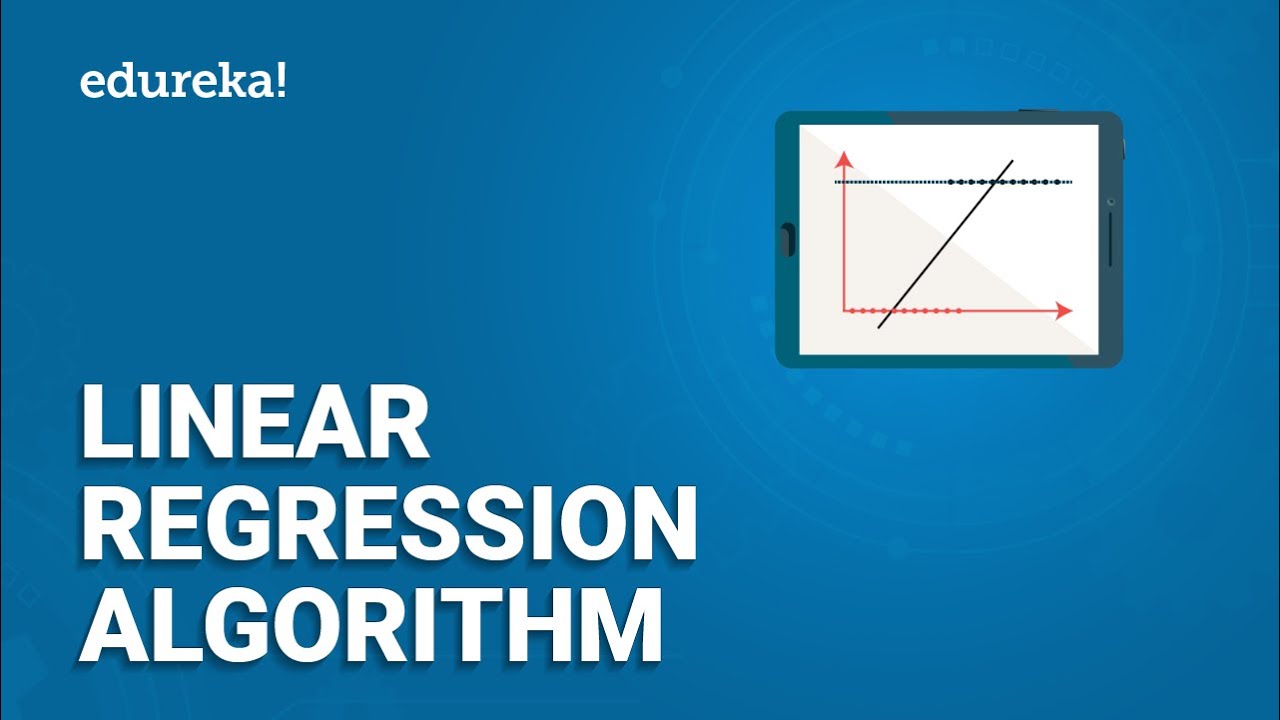
applicant based on his bank account balance based on his purpose his credit amount and his savings so for this problem you can make use of the supervised learning algorithm known as key and an algorithm or key in your is neighbor algorithm now let's look at our next use case now here we have to establish a mathematical equation for distance as a function of speed so basically over here you're going to predict the distance that a car can travel based on its speed so guys the best algorithm to use for such a problem is the linear
regression algorithm so the linear regression algorithm is basically used to predict continuous quantities and in this case we have to predict the distance which is a continuous quantity and like I mentioned earlier a linear regression is a type of supervised learning algorithm okay moving on to our next few skills now the problem here is to cluster a set of movies as either good or average based on a social media outreach all right now if you read the problem statement properly you can see the word cluster alright this clearly means that this is a clustering problem
and clustering problems fall under unsupervised learning so here we're going to make use of a algorithm known as k-means algorithm to form two clusters okay one cluster is going to contain popular movies and the other is going to contain non popular movies based on their likes on social media now moving ahead the our next problem statement is to perform Market Basket analysis by finding association between items bought at the grocery store again over here you can see the keyword association this means that this is an association problem now Association problems fall under the unsupervised learning
algorithms and here we can make use of the a priori algorithm to do this so here what you have to do is basically if and find association between different items so if a person bought bread and butter together it means that there is an association between these two items so in this problem you just going to find the association between different items and you're going to make use of the unsupervised learning algorithm cause the a priori algorithm so guys this is the last use case and over here the problem statement says that you're going to
place an agent in any one of the rooms and basically the rooms are represented as 0 1 2 3 4 & 5 and the goal here is to reach the outside of the building now this is clearly a reinforcement learning problem all right to solve this you can make use of the cue learning algorithm and your end goal is to reach room number 5 so guys here you can see that there is no data set because the data set is going to be developed by the agent itself so guys over here the agent is responsible
for collecting the data all right he's going to explore the environment collect useful information and then he's going to use this information to get to room number 5 so guys that was it for our use cases and with this we come to the end of today's video I hope all of you enjoyed it if you have any doubts or any queries regarding the session please leave them in the comment section and we'll get back to you at the earliest so guys thank you so much for watching this video have a great day I hope you
have enjoyed listening to this video please be kind enough to like it and you can comment any of your doubts and queries and we will reply them at the earliest do look out for more videos in our playlist and subscribe to any rekha channel to learn more happy learning