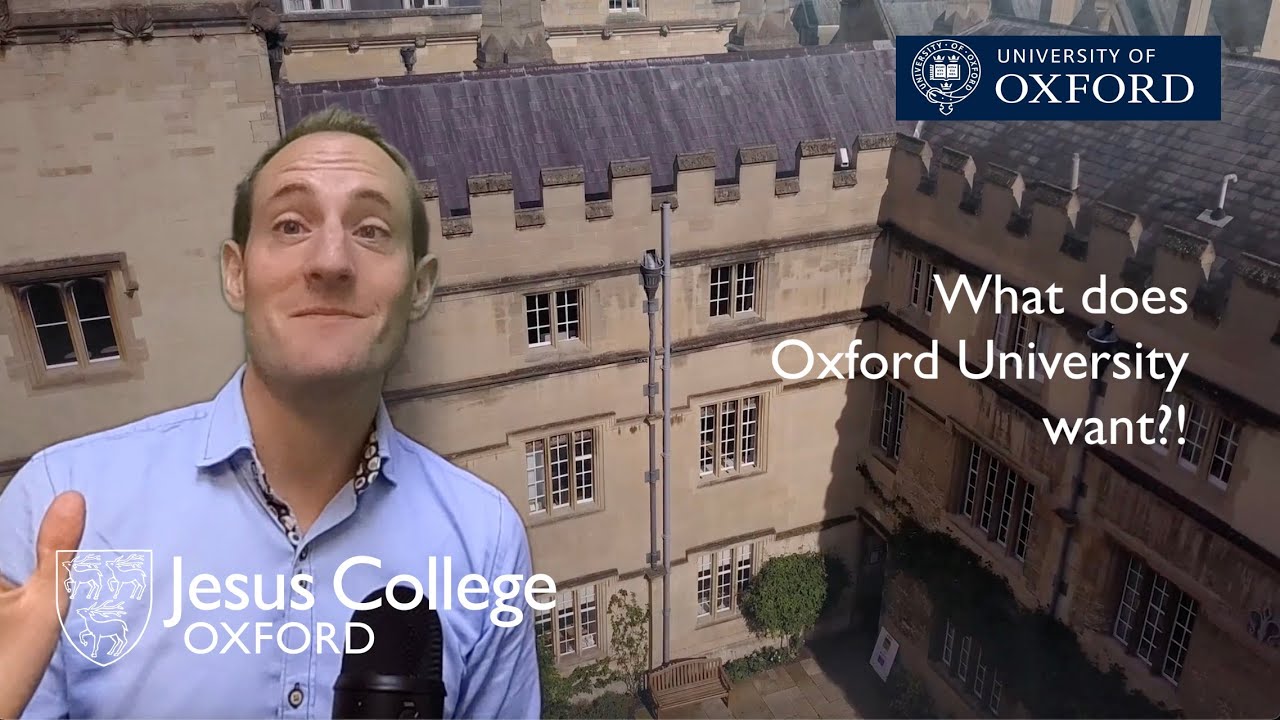
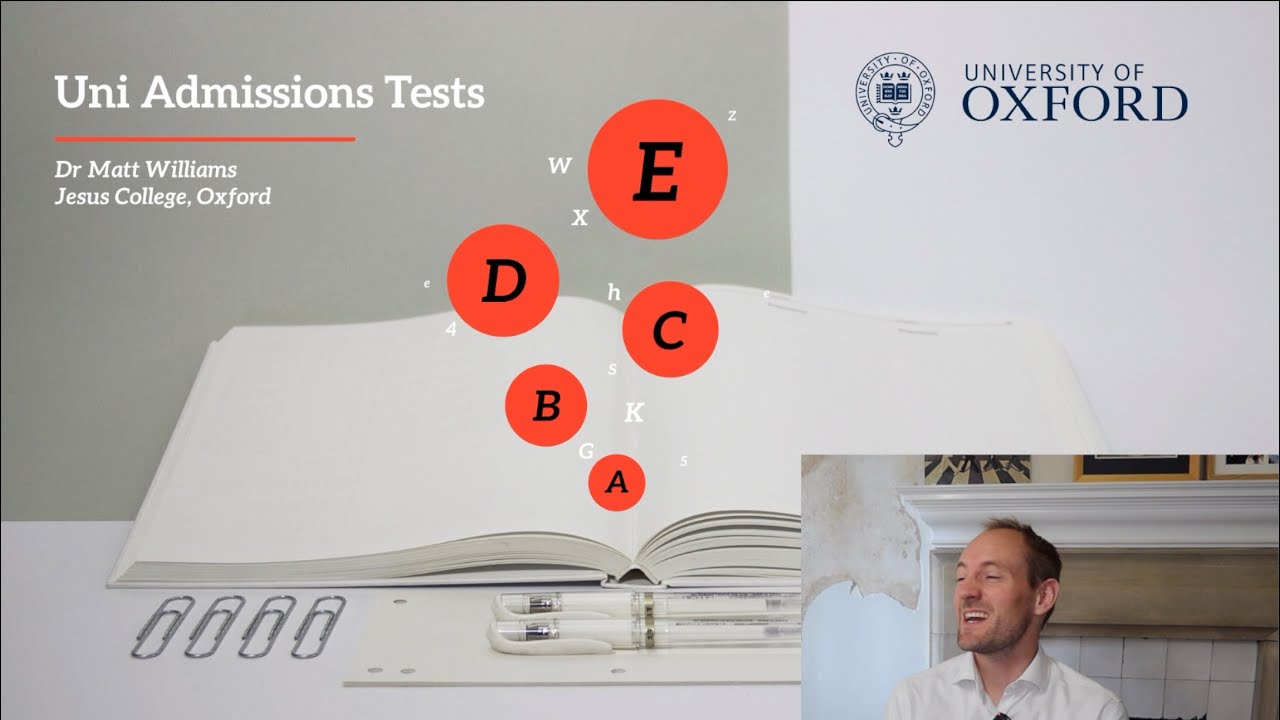
Hi my name is matt williams i'm the axis fellow at jesus college of the university of oxford i am an academic in politics but i've been involved for many years in both politics and history admissions and today we are going to be talking about the history attitude test or the hat test and how you can best prepare for it so the way i'm going to structure this talk Is i'm going to start by talking about the what's the whys the wherefores the hows about the test then i'll talk about my three p's of preparation you
may have heard me talk about some of these in other videos so you can always skip ahead because in the final section we're going to go through a past paper in some detail so i can give you my top tips on how to maximize your performance in that Okay so to start off with the how's the what's the why is the wherefores let's start with the where so i'm just going to share my screen so that you can see what i see and we're going to go online to the oxford university website okay so here's
the his uni website so there's quite a lot going on here so if you just go to ox.ac.uk you'll find all of this and you scroll all the way down to the Bottom you'll see undergraduate admissions click on that and then scroll down and you'll see courses click on that okay and then you'll see admissions requirements and this tab here table of admission requirements is the most useful you can of course just google table of admission requirements oxford university and you'll come up With the same thing okay and then this will provide you with all
of the information you need as to the admissions requirements for all of our undergraduate degrees and it's very helpful so what we'll do is we'll scroll down to history and pardon me sort of craning in because i'm half blind so i have to get very close so there we go so history and you can click on this for further information about the history Degree itself and there's also all of the history joint honours degrees so history and economics history in english and you'll see in the fourth column here there's a link to the various admissions
tests that are required so here's hat so we'll click on that in a second but just to know that if you are planning on taking any of the joint honours Degrees with history such as say history and economics here you have to take not only the hat but also the tsa which is the thinking skills assessment so if that applies to you we've got videos on the tsa on the jesus college oxford uh youtube channel so do check those out if you need to also if you're doing history in a modern language then you need
to take the mlat which is the modern language Aptitude test okay so just be clear what it is that you need to take but if you're doing single honors history then you're only required to take the hat so we click on that and it'll take us through to this website and so this will give you some of the give you answers to some of the primary questions that you may have on this particular test on what it is how we use it Why we use it but it won't give you quite such an honest assessment
as i'm about to give you now so first of all why why do we use these tests are we sort of psychotic in oxford that we like to punish teenagers for their temerity in wanting to apply to our university no of course not uh the reason that we have instituted tests for many of our degrees not all but many of our degrees Is because the applications we receive are so good everyone that applies to oxford is really really good and we need a way of differentiating between them that's fair part of our misgiving is that
public exams so things like say a levels in the uk or the international baccalaureate or scottish hires these are decent metrics of someone's Performance but they also correlate a little bit with someone's privileges so those that go to better schools tend to perform better in those public exams not taking anything away from those people but we want to have a metric that also gives us a sense of how well someone's someone performs regardless of their context in their background so we instituted the tests as a fair way of assessing Someone's potential to be a good
historian okay so please don't look on these tests as some sort of encumbrance some sort of hurdle in the way of people especially people from poorer backgrounds or from state schools i've often heard that argument that we've somehow designed these tests in order to put certain people off especially people from more disadvantaged backgrounds actually The motivation is almost precisely the opposite so please don't look at this as some sort of dastardly conspiracy against uh more disadvantaged uh people it's not um how do we use the test well we use the test as a as a
data point amongst several so we make a holistic judgment of all applicants so we'll look at your a levels usually predictions but Sometimes people apply with a levels or equivalent obviously we have applicants from about 140 countries so if you don't have a levels that's fine whatever your high school qualifications are and we look at your personal statement about yourself and your academic interests we look at your teacher's references so one of your teachers will have written something about you We will look at any relevant contextual information so these days on the application form the
ucas form we get a lot of useful information about what part of the world you're coming from whether or not you have uh had any disadvantages in your life such as say a disability or coming from a school that has been underperforming for several years or if you've come out of a care Environment or if you were on free school meals we get information on that uh that we can help that can help us understand if perhaps one of your school grades isn't as competitive as in another application we can sort of understand why that
might be the case because of relative advantages and disadvantages and then of course Amidst all of that data we also use the aptitude test to help us work out who we ought to invite for interviews okay so we get a lot of data and we use it holistically so it's not like one piece of data trumps the rest of them it's not like the hat test can demolish your performance elsewhere in your applications that's not how it works but the hat test Is a good predictor of who gets invited to interview it's not to say
that a poor performance on the hat test will completely destroy your chances of admission because of course a poor performance can be explained by lots of things that may have been beyond your control for example one year when i was doing admissions for politics uh a young man was taking the tsa which is a test for Ppe and part of the test center he was in fell down mid-test obviously that wasn't his fault and fortunately he his school got in touch with us to explain the situation very quickly and we were able to make um
you know accommodations so sometimes the test doesn't go your way and it's beyond your control and it would be unreasonable of us to completely dismiss your application on Those grounds also sometimes given the contextual information we have on candidates we can't necessarily expect them to have excelled on the hat test so we do take a lot of data and we look at it holistically but given all of that the hat test is a useful predictor of someone's performance and so it is a strong predictor of who's going to be invited to use at oxford and
Therefore the upshot is you ought to practice and take a lot of time in preparing for it okay so here is the where as well where can you find information about it and how can you register all of that information is here and perhaps the most useful uh tab here is going to be the how do i prepare because this gives you lots of information about Uh what sort of stuff you should be doing now in the lead up to the test itself there's a particularly useful hacked webinar which i highly recommend you watch it's
been made by the team from unique which is uh an oxford um organization that encourages people to make competitive applications to the university so that is going to be extremely useful There's also quite a few past papers it's worth noting that the syllabus for the test changed in 2018 so from 2018 onwards there was only one question in the test previously there were more questions and nonetheless the older papers you can still use question three as a guide to what future papers will look like it states all of this here but you should be fine
provided that you Realize that there's been a change in the rubric of the exam in recent years okay particularly useful besides the actual past papers is the marking scheme which will tell you how to evaluate a strong versus a slightly weaker performance and this will give you a sense of what the examiners are looking for and it's always a good idea to get your self into the examiner's mindset i'll walk you through some of that A bit later in this video but just so you know that's where you can find it okay right and then
let's just sort of really clarify on what the test is the uh here we go so the hat test tests the following skills and attributes the ability to read carefully and critically so what you get is a long essay about two and a half three pages and you need to be able to read that comprehend it and make some Critical reflections on it the adoption of an analytical approach so what that means is not just tell us what the text what the essay says but also explain its significance and try and give us some sort
of argument based off a question prompt that and analyzes the text so just saying this is what the text said that's description saying why it's Important why it's revealing that's analysis and we're looking for clear analysis okay we're also looking for the ability to answer a question relevantly you will be given a question about the essay and lots of people tend to sort of veer away from the question they don't answer it very in a very focused way and that is a very quick and easy way for examiners to think This is someone who's not
sufficiently disciplined we can dismiss their application the ability to handle concepts and select evidence to support points so concepts might be ideas such as society culture economy power and your ability to use evidence from the text to support a point that you're trying to make is very important we're also looking for a degree of originality and independent-mindedness So don't try and necessarily think down tram lines try and sort of look underneath the text if that makes sense so not only what the text says textually but also subtextually what is it hinting at what what deeper
themes might it be evoking we're also looking for precision and clarity of writing and i'll explain exactly how you can do that in the latter part of this session now it's important to note that this is Not not not a test of your knowledge it's a history aptitude test so whether you know particular historical facts is not relevant indeed you will be penalized if you try and draw on historical knowledge that you may have about the text that you may think is relevant to the text okay so it's not only not a test of knowledge
but if you try and just present knowledge You'll be penalized for it so please be very clear on that all of the source information you need is in the exam itself you don't need any extraneous knowledge this is a test of your your raw skills and abilities okay not a test of your knowledge because to be frank testing knowledge isn't very useful to us as a university Knowledge acquisition and faithful recall is a relatively straightforward intellectual skill the capacity to utilize skills and to present a case that's much harder and that's therefore why we tend
to try and test that okay so please be very clear on that demonstrating that you know lots of stuff such as historic facts or particular historians And their interpretations of these events will only do harm in this particular exam okay and that again is a way that we try and level the playing field to make it as fair as possible for people that may not have been taught to as higher standard as others okay so that's the sort of the what's the wise the way for us lots of information online Obviously if you have any
follow-up questions for goodness sake get in touch never a problem we are employed to help you out so if you're gonna say get in touch you can either contact the history faculty itself or you can contact the college that you're applying for we're very happy to help please don't just sort of suffer in silence and wonder what you should be doing just reach out we're very happy to Okay so now i promised to give you my three p's for good preparation which should hopefully just act as a guide for how you can best set yourself
up for a great performance okay these are quite generic so they're not specific to the hat test so the specifics of the hat test will come in about five minutes if you want to skip ahead but they should be useful nonetheless so the first p is Physiological preparation now this might sound like a slightly odd thing to emphasize but these tests that we use at the university are as much testing your cognitive endurance as they are testing your cognitive abilities now by that i mean your capacity to maintain a heightened degree of concentration of focus
of analytical skill for a sustained period of time without Losing form so that requires energy and that requires motivation and that requires the capacity to control the focus of your mind and those are physiological uh attributes in other words they will be a function of how well you've treated your body so you need to think very carefully about how you are treating your body so first of all how much sleep are you getting Of good quality are you getting at least seven or eight hours per night and are you sleeping in regular cycles so-called um
circadian rhythms because if you're not if you're breaking those cycles if you're sleeping in little snatches here and there and you're not sleeping regularly or well then you will be you will be creating a degree of fatigue and you will lose insurance And that's obviously going to impair your performance so you must think about your sleep cycles and how effectively they are contributing to your work the next part of physiological preparation is is nourishment food the brain is an extremely energy greedy organ it requires a lot of calories to work and it also requires lots
of vitamins so You need to make sure that you're eating sufficiently so you're not dieting unless there's some particular medical reason for doing so and that you're eating lots of vitamin-rich food because the brain requires that it needs it to perform at its ultimate it could be that you are say at 80 85 neural capacity and that to unlock that final bit would Just require an improvement in your diet and i'm not trying to patronize anyone here my diet could definitely be improved as well but it's something that i've spent a long time working on
so that i can hopefully pass on the message to you now so you don't make some of the mistakes that i made when i was a teenager the third part of a physiological preparation besides sleeping and eating Is of course drinking water hydration is very very important to put it very simplistically if you're dehydrated your blood is thicker and thick blood is not terribly good at servicing your organs including your brain so if you are expecting your brain to work optimally you need to make sure that you are well hydrated as well um so you
know these are important Considerations because as i say these tests are testing your endurance not just your abilities and indeed your abilities may be impaired by how you're treating your body so that's something to bear in mind so that's the first p physiological preparation second p is psychological preparation that is to prepare yourself to to Prepare your attitudes to prepare your expectations the test in short is hard really hard and that's not a reflection on you or your abilities or lack thereof that is a reflection of the test simple as that pretty much everyone who
applies for the test tends to come out of the test center thinking that they've done badly because it is so hard and it's fine to feel nervous and it's Fairly normal to reflect maybe slightly negatively on your performance but what you don't want to do is to slip into a degree of self-doubt that impairs your performance where you start sort of saying to yourself oh i find this hard because i'm not oxbridge material i find this hard because i am some sort of idiot and i i shouldn't have applied and and this sort of negative
energy will Just drain your uh you of that energy that you need to perform at your best so you need to try and push those thoughts out of your mind and the best way to do so is to first of all realize that there isn't anything wrong with you the test is just hard and that's that's the end of it it's nothing to do with your abilities is that the test is designed to be difficult So just leave it at that and secondly to practice because practice will make you feel much more comfortable because you
know what to expect and therefore that leads me on to the third p which after physiological and psychological preparation is practical preparation and that's the most obvious one practice practice practice i think the only thing that really needs to be emphasized is that You need to practice a lot and to be perfectly frank if you don't go through all of the past papers that are available on this website you don't really want to study history at oxford and you may not have realized that yet and it may be a useful realization because there's nothing wrong
with not studying history at oxford but i i want to be absolutely clear this Is a pretty decent way of working out who's really serious and who's not is whether or not you are going to carve out the time to prepare yourself to practice all of these past papers to get a sense of all of the resources that are available to you because the admissions test is a really important part of our of the process it is a good predictor of who gets invited to interview so if you want to make sure You perform as
well as possible you need to utilize all of these past papers to your benefit practice practice practice the reason i'm slightly sort of emphasizing this point is because i have seen so many incredibly talented people who for a variety of reasons have not sufficiently practiced and they've just been de-selected they haven't even been invited up to Interview which they don't deserve they deserve better than that and there are some good reasons why people may not have practiced but often there are some quite bad reasons as well i mean perhaps the worst reason that people don't
practice is complacency that they think i don't need to practice this is a test of aptitude and my attitude will be Invariant depending regardless of whether i take the test today or in 50 years time and so i might as well just go into it cold the obvious problem with that is that there are rudiments to the test the way that the questions are framed that you can of course prepare yourself for so for goodness sake don't be complacent the other source of complacency is that especially when you're A big fish in a small pond
you might think well i'm the best person in history that i've ever met so i'm gonna base this test the issue there of course is that you're gonna be up against the best people in history from around the world and so you need to make sure that you're up to that sort of level you no doubt can get there anyone can Get there pretty much but it takes practice just like you wouldn't expect you know world-class footballer to just be able to phone it in to just walk onto a pitch and just be amazingly world
class without any effort you can't expect to just pull out an amazing performance from nowhere you have to practice so complacency is a very bad reason to not practice Another reason that sometimes cited is that you're just too busy and you know i can understand that you've got a lot going on at this time in your life you've got your uh you've got to prepare your ucas uh applications you've got to prepare uh your a level and school work you've got to do various sort of extracurricular activities you want to have a social life Completely
reasonable none of that is you know surmountable however you can always carve out some time to prepare for these tests and you must do that all we're really talking about is about half an hour a day carving out a little bit of time little and often to get yourself up to speed with these tests and once you've run out of Materials and you've watched all the webinars and you've read all of the stuff about the test then go and start just looking up historic sources and analyzing those go on to a website like pro project
gutenberg and just type in some random sources and just see what comes up and just think about them just keep practicing practicing practicing little and often Half an hour or so a day that will sort you out nicely it's worth doing at least one test under time conditions but i wouldn't recommend that you do all of the tests on the time conditions because you'll probably completely demotivate yourself so try and keep it interesting try and look at it as a as if you're doing say a crossword puzzle you're just gonna sort of dip in and
out every day you can do a little bit it's Just gonna sort of keep your mind sharp um and then move on to do something else okay but practice makes all the difference so please for goodness sake do practice okay so those are the three p's uh so now let's go through the test itself so that you can get a bit more of a sense of how it is structured and how you can best maximize your performance so i'm going to Start sharing my ipad okay so here we go you should be able to see
uh the test all right so let's uh let's sort of zoom in just so that we can uh be clear on all of this so you have got um a separate eight page answer booklet and in this particular booklet there are four blank pages so you've got Plenty of space to do lots of planning i'll emphasize the importance of planning a bit later but it's just worth knowing what you've got you've got one hour which is not a terribly long amount of time given that you've got to read this essay and write a response to
it all in one hour uh we recommend that you read the paper before beginning to write your answers Seems fairly obvious spend about a third of your time on reading thinking and planning the rest of your time writing that's a good guide so about 20 minutes of your time needs to be spent reading if that creeps over so be it you're likely to write far more efficiently if you've given yourself enough time to plan your response i'm going to be emphasizing this quite vehemently but failure to plan means that you ought To plan to fail
it's very obvious in a lot of cases when someone has not sufficiently planned their essay in response to the prompt and those are the essays that that tend to get discarded as the weakest so if you give yourself at least 20 minutes to read the source and write you and prepare a plan fine but if it becomes a bit longer than that that's also fine Quality always comes above quantity you don't need to fill the eight page answer booklet in order to be taken seriously much better to have a better organized more focused response to
the question than a ream of incomprehensible verbiage okay so please be clear on that all right um what else does it say if you find the text difficult and unfamiliar don't worry the Exercise is intended to be challenging but we hope that you also find it thought-provoking there is no right answer to the question you'll be judged on the intelligence of your argument how clearly you make it and how effectively you support it you should use your own words in answering the question okay so here's the source itself and as you can see it's two
in a Bit pages long all right and there's the question at the end so let's start by reading the emboldened text first of all no this test is made up of one question based on a passage from a primary source you do not need to know anything about the author of the source all the contents in which he was writing to answer the question candidates will be penalized for making use of any outside knowledge all right Um now what i suggest first of all before you read the source itself is that you read the question
now the reason for doing that is that it just makes your your reading of the text of the source far more focused because you know what you're hunting for what some people do is that they read the whole thing the whole excerpt and then they read the question and then of course they have to read the Whole excerpt again just to find some points that are relevant to the question that's obviously a desperately inefficient way of doing it it's far better if you read the prompt first and then go back to looking through the text
okay and the examiners are looking for a focused and relevant response to the question so you also need to highlight parts of the Question that are obviously the most important what i call the hook the hooks of the question that is what you're going to dangle your response from now just so that i'm absolutely clear as to what i mean by this concept if you imagine you're a barrister in court and it's a criminal trial the hook the thing that you and the prosecution are debating is whether or not your client is not guilty or
guilty That is the core conceptual pivot around which you are both going to be arguing and essay questions will similarly have at least one such pivot point a word or a phrase around which all of your analytic focus needs to be trained obviously the whole question will also have relevance to it but it will be feeding into this core component this core hook Okay sometimes there are multiple hooks but often there's just one and you need to highlight the specific word used by the examiners not your own synonyms not your own language when someone's asked
you a question for goodness sake make sure that you focus on that question wording what you don't want to be is akin to one of those annoying politicians on the Tv who when asked a straight question starts to just go off on in a different direction because they don't really want to talk about that they don't want to answer that question directly don't do that okay you must always answer the questions directly so let's have a look at the question let's highlight some of the bits that look important so what can we learn from this
pasta siege about the social and Cultural values of the author's time okay so the hook word here is values all right okay so values is the hook because if you were fighting a trial over this with two opposing teams of barristers you'd be fighting over what values we can learn about from this passage and the examiners have been so kind as to further specified that they're Interested in social and cultural values so i'd take it take a breath before you actually read the excerpt to even think about what you would understand by social and cultural
values what do you think that means in an abstract sense just completely decontextualized from any time period when someone talks to you about values when they talk to you about social and cultural values what sort of stuff are they getting at And what's the difference between a social value and a cultural value because a cultural value will often be based in some sort of social familiar some social context so how can we just disentangle what's cultural from what's social now i suppose what is a social value might be something such as uh social structure so
the hierarchy by which we organize societies so those With leadership positions and those in followership with decisions it might also pertain to the organization of an economy it might pertain to i don't know the the distinction between different genders so those are social attributes that in some contexts are valued in other words people think that they are not only uh reality but they are valuable Aspects of reality so having some sort of strict hierarchy between let's say a lord and a peasant might for some people be not only just the way society is but also
the way society wants to be and therefore be considered a social value now a cultural value will also pertain to various social facets but it might also uh be more Reflective and more imbued with with ideals derived from say philosophy or art or religion morality can play a role so culture could be to do with how societies create narratives in order to better understand the way they are organized so society is organized in a certain way and then those societies create a culture in order to help them Understand why they are arranged in a certain
way so culture is a little bit like the stories that are told in order to justify a certain social organization and that social organization also has its own uh evaluative components okay so just sort of think quite abstractly about what it means for something to have a social and cultural value and please we're going to say do focus On those words because that's what the examiner wants you to focus on okay so now we know what we're looking for we can read the text now i'm not going to read the entire text here and now
because that will be a little bit boring for you but what i will do is give you an insight into how you can maximize the efficiency of your reading now what is common is that people tend To read and highlight awful lots within the text and that's fine i mean obviously it's quite a personal approach to highlighting you want to be original you want to stand out so you know far be for me to dictate to you some sort of optimal means of highlighting a text but one thing to think about in order to perhaps
improve the efficiency is how to stop Your mind drifting out of concentration okay now you are such seasoned readers all of you that the temptation when you're reading a piece of text is for your mind to start to sort of wander off because it's such a familiar activity to you you need to try and find some way of constantly concentrating and that's more difficult than it may seem to do give you a little bit Of the neuroscience around this people that are highly skilled at something they tend to utilize their brain somewhat less in that
activity than those who are new to that activity so take for example driving if someone's learning to drive they're really concentrating ferociously like right right where does the gear need to be and what are my feet doing and where are my Hands on the on the steering wheel and bloody blood they're really sort of thinking through it's tiring it's all-consuming but those who've been driving for for years it's automatic they just do everything and their brain has has got it as a part of what you sometimes call muscle memory now you can actually measure the
effects of this those brains that are highly Trained at a particular task emit what are known as alpha waves and alpha waves are evidence of hypo frontal cortex operation so the frontal cortex of the brain is is sort of working at a lower level those that are concentrating emit beta waves and these betaways can be used you know you may have seen some people wearing headsets and by concentrating they can uh raise And lower a little remote controlled helicopter and the heli the little headset is detecting beta waves and it's allowing helicopters to rise and
lower depending on their concentration levels and so those people that are concentrating more emit more eater waves now the upshot is is that because you are such a seasoned reader chances are that your brain goes into a Little bit of automatic pilot and that can be to your detriment because you start missing vital details so one way to try and avoid that is to give yourself a little intellectual task whilst you're reading to keep yourself sharp and to make sure that you're emitting those beta waves and so one thing you could do is that rather
than just Highlighting huge reams of text in a fairly sort of passive way you could give yourself the task of identifying all adjectives and adverbs within that text and highlighting just those there's a number of reasons why you do you would do that first of all because it will retain your concentration to a far higher degree so you're not going to drop in concentration levels or you're much less Likely to secondly because adjectives and adverbs tend to be the points in a sentence where the author betrays their subjectivity where the author sort of gives away
an evaluative statement and given that we're trying to work out the values the social and cultural values we can learn from this passage it's a good idea to try and isolate those parts of speech Where the author betrays their sense of evaluation okay so that's a tip you might want to use but you know it's not for everyone so just sort of have a think about it for yourself anyway let's go through the uh the text now first of all let's read the um the italicized part quickly uh this passage is an extract from the
notable men and women of our time written in the late 1520s by paolo uh giorgio an italian amount of letters it's written in the form of a dialogue now maybe worth just being absolutely uh clear with that because it's important to talk about the form that the um source is written in as well as the contents now this dialogue is of course not an adjective or an adverb but this is just explaining the text so You can forgive me for that this is an imaginary con conversation between real individuals the general alfonso de ablos the
statesman antonio muscatola and giorgio himself the setting is isiah an island near naples at the estate of the noblewoman victoria kolona over three days the men explore the estate and the small offshore islands discussing their notable contemporaries At the end of the last day they discussed their hostess okay um now i've probably completely mangled all of those pronunciations so do forgive me for that but remember the key thing is that you're not being tested on whether you know any of these characters i don't know any of these characters it doesn't matter in fact the examiners
deliberately choose a source that they are fairly confident no one will have Come across before so that they can level the playing field right so now we're into the the source proper and we can start to try and train ourselves to look for adjectives and adverbs okay so let's have a look davolos what fine tools there we go straight off the bat like those are the highest kind of sculpture will allow us to depict the true likeness uh image and character of Our victoria colonna for this one woman prevails over all others and this description
is certainly not composed to flatter her but will be recognized as absolutely true by the universal consensus of all women and men okay so hopefully you can see that for a start we're not overly highlighting we're not sort of creating reams and runes of highlights that can be difficult to decipher when You have to go back and find some things that you want to quote and evidence that you need for your text we're also highlighting those bits of the text which tend to betray the evaluative assessment of the author so what fine tools fine is
a really good example of what i'm talking about that this person is talking about what approach can we do [Music] To allow us to depict the true likeness of vittorio colon so that's what they're trying to work out and this description is certainly not certainly not uh composed of flatter hair how can he be that confident right see by really focusing on the specific words you're getting a much more close textured analysis of the source rather than just glossing over it which many people do You're really getting into the weeds of it how can he
be so certain how can the author know with certainty what his assessment means it will be recognized as absolutely true by the universal consensus so within one sentence we've got certainly absolutely an universal extraordinary level of confidence okay so anyway the point being by Highlighting adjectives and adverbs we've i think focused on the really important parts of this text so let's move on just to sort of reinforce the point let us speak later about her renown brilliance and modesty okay um now those were technically nouns in this context so we should probably move on but
you could highlight those if you wanted which is Safeguarded by the by conspicuous reminders of her morals and achievement and by unwavering public opinion okay public is an adjective right now we need to describe her beauty in this way those who are absent or don't know her but revere her from reports of her other virtues now other is technically an adjective and so that could be something that you could focus on Um well it's a comparator but it's very close to an action may more fully admire her beauty from our brief description in this woman
there are three things which nature playful uh amid its serious business appears to have fashioned for all the purpose of admiration uh namely her eyes hands and breasts uh in those sites most of all as the poets relate shameless desires Have been accustomed to dwell while they lie in ambush but unfortunate mortals and from there they let loose the arrows and flames of love okay so i'm just going to read the next paragraph as well then i giorgio these are indeed the rare endowments rare endowments of a noble girl and they entice young men uh
rather than old ones there exist in Her far more outstanding and splendid attributes which men advanced in age and her closest friends admire groups that include not least both musketola and myself but you know all these things perfectly well since you were raised with her almost from the cradle okay so i won't labor the point you can hopefully see what i'm getting at this is just a Device that of highlighting adjectives and adverbs that can work to improve the efficiency of your reading and text highlighting it can also as i say maintain your a greater
degree of concentration to make sure that your brain is emitting those beta waves and utilizing the frontal cortex more rather than lapsing into just alpha wave Emission low concentration thinking obviously this is a personal approach it's up to you but that's why practicing these tests can really help so that you can work out what's going to be the best technique and what might be sub-optimal okay now when you've read the text you then need to plan a response okay and it has to be tethered to the question So you have to write something that is
relevant to the question wording it's focused and is easy to read and hence why i emphasize that you need to spend a decent amount of time planning your response fail to plan plan to fail it's as simple as that okay so what sort of things should you put into a plan well uh fairly straightforwardly you're going to need to and please Pardon my terrible handwriting here you're going to need to have an introduction uh you're going to need to have some definitions of key terms this is just my finger so it's going to be a
little bit sort of childish in its writing clarity okay and then you need to break down the concept of values because values is the hook word of the question and therefore needs to form this the main element of your essay Then you might need to explore some caveats so this is some parts of your analysis that you think may be weak okay and then you need a conclusion okay now what do i mean by caveats this is where you have responded to the question about what we can learn from the passage about the social and
cultural values there will be certain social and cultural values that you may suspect other people Would be more likely to focus on that your essay has omitted or elided and you to you need to explain why you've omitted or allied at those particular points why your case is still the best now again reaching back to my barrister analogy if you've got a court case and you've got you're the defense barrister and you're against the prosecution if your defense Was simply my client is not guilty that would be fine but it would be even more robust
as a defense if you said here's why my client's not guilty but here's what the prosecution reckon in terms of her guilt and here's why they're completely wrong okay so by doing so by discussing caveats you're not trying to give your opponents some leeway You're trying to smash their pe their case to smithereens okay so we're not sitting on the fence here we are exploring alternatives so that we can dominate them okay so that's the way to think about it the exploring of caveats is not to diminish your case but to strengthen it okay and
it's also good because then it shows you're sensitive to what could be some limitations in your your Piece okay now introduction what needs to be included here is a straightforward answer to the question and it needs to be relatively efficient so focused on the question wording itself and coming within the first paragraph would be most helpful so what can we learn from the passage about the social and cultural values of the author's time We can learn x from the uh social uh about the social and cultural values of the author's time from the passage so
try and be as clear and straightforward as possible in the definition section this is where you need to define what you think social and cultural values are now don't be beholden to some sort of existing definitions of those terms Remember you're not being judged on your knowledge so if you are somehow able to recite dictionary definitions of social and cultural that wouldn't do you any help you're much better off defining those terms for yourself and don't be worried if your definitions are not necessarily completely mainstream of course you need to be able to defend your
definition you can't completely misdefine those words but at the same time It's not a problem to try and define them in a way that you feel is reasonable provided you can encourage other people to similarly think they're reasonable okay then the main bulk of your essay is going to be pertaining to the various values because this is what you're trying to make a case about is the is what we can learn about the social and cultural values now Of course you're going to have to subdivide this into particular paragraphs and it would make sense to
subdivide them in the way that the examiners have suggested in other words starting with social values and then moving on to cultural values so you could have let's say you're sorry in front of space you could have let's say two paragraphs On each probably speaking okay and then you want to further subdivide social into perhaps uh uh the um organization of a power or you could talk about the organization of the economy or you talk about the organization of uh gender roles so those would if you like be social values uh cultural values as i
mentioned earlier would pertain to similar themes But would be more to do with how the social reality is reflected in some sort of shared understanding some shared narrative storytelling so that could be to do with morality that could be to do with philosophy it could be to do with religion okay so that that's perhaps a way to break things up all right so during the plan you would work out how you would order all of your Paragraphs what points you're going to make in each paragraph it's also a good idea to identify the parts of
the text that you're going to utilize as evidence because it's not good enough to simply assert that the text says something you need to provide us with some proof of it okay and then once you've planned all of this then it's sensible to try and find the binding unifying Thematic point that you're trying to make that that underpins your entire analysis now what i mean by that is that you're going to be making a lot of separate points but how do those points cohere together to make a singular case just as the barrister who's defending
her client will try and work out all of the different reasons why that client is not Guilty that they would also want to cohere all of those points together so that the jury understands that this person really is not guilty okay similarly it makes your essay a lot clearer if you can pull all of your points together okay so try and work out what is the primary the fundamental the base thing that we can learn about the social and cultural values of the Author's time from all of the little bits of evaluative evidence that you've
taken from the text okay so we're looking for some sort of i don't know x factor some sort of uh core value from which all of the other values are derivative if you like um so you know it could be for example that this is a dialogue between men referring to a woman so something to do with say assessments of Gender might be something that if you like that the ultimate kernel of what we can learn this is perhaps the most useful thing we can learn from the passage about values is that they are heavily
gendered that every sort of assessment of social status of the economy of uh power of culture religion morality all of these tend to be viewed through a gendered Lens if you like would be one such sort of example of an x factor if you like okay so it's up to you obviously you need to sort of think about it for yourself but it's useful if you can sort of summarize what you think is the anchor point that helps bring all of your points together otherwise you'll be likely to give us a bit of a shopping
list of points without giving us a recipe of How those points blend together to create something whole okay so that's broadly speaking how to to plan an essay you start by identifying the hook of the question that which the argument the debate needs to pivot around you break that hook up into different parts and if the examiners helped you such as they have here to break it into particular conceptual bits then that's more the Better you need to work out how you can order those parts so that your readers can follow your train of thought
don't order them in an arbitrary way try and order them in a way that makes sense you might want to build from smallest to largest point or largest to smallest point it's up to you just provided it's clear why you're going in that direction you need some definitions so that people Are clear what you mean by the words that you use you need some exploration of the limitations of your argument or what other people might perceive wrongly as the limitations of your argument in a caveat section and then you need to conclude and in the
conclusion you simply reiterate your primary points just so that the readers are absolutely certain what it is you've said Okay now before i um before i move on to reading the marking scheme so that i can give you some evidence of how the examiners thought about people's attempts at this uh i want to just uh be really clear as to five very common mistakes that people make in essay writing which tend to cause uh a depletion of marks And these are called the five eyes okay now the first of which is that uh authors are
irresolute in other words they are not coming down clearly with a case so going back to my barrister analogy this might be that uh you're being asked as a barrister is your client guilty or not guilty and you sort of say oh i don't know you know that's bad news you're for your client because if their barrister doesn't know whether They're guilty or not guilty then how on earth are you going to convince the jury you know that's not good enough you're being asked to solve an intellectual puzzle so if we're going to say try
and solve it saying i don't know is absolutely unacceptable so being your resolute is the first eye big problem and you're you're likely to do badly linked to this is being indecisive now Being indecisive is where you are kind of it's kind of the same thing as a resolute but at least with indecisive you're sort of saying well it could be this or it could be that so you're trying to offer various solutions but at the same time you're not making it clear which solution you would favor so with regard to this question you might
sort of say well uh the passage teaches us These sorts of things and these sorts of things about social and cultural values but i'm not really going to steer you in any particular direction i'm just going to sort of show you uh the buffet of what's available rather than telling you this is what i would choose again it's not really good enough because you're not helping us solve the problem We want you to tell us what you think we can learn from the passage so by all means explain to us the range of lessons that
could be taken away but try and sort of focus our attention on what you think is the most important lesson that can be taken away okay um so the third eye is imprecise right now this is where someone doesn't Focus their answer sufficiently on the question so for example if you start using synonyms for words like social and cultural or synonyms for words like value in other words words that don't that aren't exactly the same the examiners will start to think that you're not focusing sufficiently on the question okay um so for example If going
back to my barrister analogy you're being asked is your client guilty or not guilty and you start saying oh my client's not a bad person the jury and the judge are going to think yeah but are they guilty or are they not guilty you know answer the question pose don't start answering your own question because that's really annoying you know you've been asked a specific Question with a specific wording you start drifting off the point and people are going to start to think that you're intellectually imprecise and that's a really bad sign okay so make
sure that you are precisely answering the question posed you're not answering a question you wished you'd been posed okay and the fourth eye is inconsistency now inconsistency is where you might start the essay arguing one point and Then finish it arguing a very different one so you might start by saying that the dialogue tells us an awful lot about the gendered prism through which people tended to view social and cultural relations but then you finish it by talking about uh militarism or or uh something to do with parochialism and geography and geopolitics so you're going
from one point to another now again there's no harm in Mentioning both of those things but you need to anchor it all to one particular thesis that is clear to understand and if you start saying one point and you finish saying another then people might think that you've basically changed your own mind as you as you were writing and that is just obvious evidence that someone has not planned their essay sufficiently because they didn't Really know what they were going to be arguing until they started arguing it again with the barrister analogy if you are
starting a trial by saying that your client is not guilty but by the end of the trial you're sort of wondering well maybe they are guilty this could be very bad news for your clients uh the fifth eye is quite rare but not unheard of is indignant now what i mean by that is where someone sort of thinks that The question's slightly beneath them and they get a bit indignant about being asked it um so the way this manifests is that someone might say something like well this isn't really what we should be talking about
this question we should be talking about something else that i've got a better question than this now uh as i say this is quite rare but It happens every year in a reasonably large number of cases and it's obviously a big problem because you're not answering the question posed so again with the barrister analogy you know the the judge is saying well is your client guilty or not guilty and you sort of say back to the client that's not really the question we should be asking yeah i don't think that's a very good question i
think we should Really be answering this other question about whether my client is a good parent and the judge will say is your client guilty or not guilty that's the question we're arguing here don't start you know trying to tell me that you've got a better question just answer the question pose okay so don't be indignant don't be inconsistent don't be imprecise don't be indecisive and don't beat your Resolute if you avoid those five eyes then chances are you'll write a good essay and if you really want to check the quality of your essay well
usefully the examiners have provided you with a framework that you can utilize so if you go back to the hat website um and how do i prepare and you scroll down once you've looked at the past papers Look at the marking scheme because this tells you in some detail as to what the examiners are looking for okay so for example uh higher level indicators with regards to historical insight and perceptiveness grasps that the portrait of kelowna is idealized but also that it may nevertheless oh sorry may nevertheless reflect social uh contemporary social and cultural values
Registers of the passage makes revealing assumptions about gender um class power forgiveness sorry keep using the page um addresses genre specifically the problems posed by the passages use of dialogue uh detects and articulates nuance grasping that the passage contains unresolved sorry unresolved ambiguities intentions registers that there are other things That that one might wish to know about the work expresses conclusions therefore with some caution and that's an important point so although i said that you need to be resolute that doesn't mean you need to be completely blinkered to alternative possibilities so that's why we would
include a caveat section so that you can say well you know here are some other ideas That may some may feel is stronger than my ideas but with respect here's why i would nonetheless uh conclude as i do coverage covers a good range of the material efficiently okay chooses evidence carefully and represents it accurately uh interprets the evidence without imposing too much moral judgment this is very important okay the um the text from a contemporary from You know from a 21st century perspective is monstrous he makes all sorts of points about the position of women
and about the role of other members of society in a way that these days we would consider almost tantamount to a hate crime so but you're not meant to judge it right because as a historian you're just trying to assess the past from the perspective uh from that perspective so don't look Backwards from 2020 and sort of say oh gosh what terrible people these were because then you're not learning the lessons from the text you're you're telling yourself something about yourself rather than something about those people in that context okay very very important um don't
sort of commit an anachronism whereby you judge the standards of the past From the standards of the present okay um treats the evidence in its own terms without uh intruding external knowledge so i've made this point several times if you start putting external knowledge into a text you'll be penalized for it so just don't do it please captures and epitomizes material independently using different pros so it's a good idea not only to say Quote long sections of text but actually to interpret them in your own words and capture and epitomize the material as it says
make selective and pertinent use of quotation okay shape structure and style answers the question directly as i've said with a clear focus on values right because that's the hulk word takes a critically engaged approach to the category social and cultural Organizes the material coherently into thematically arranged paragraphs right as i was suggesting with the planning selects material from different parts of the passage to illustrate themes writes clearly now by rights clearly just means you know clearly planned and structured but also using straightforward and comprehensible vocabulary I think some people assume that if you want to
be taken seriously at a place like oxford you need to write in this sort of incredibly flowery language with very long syllables it's really not necessary and actually can make it harder to understand what you're trying to say okay so also work worth reading through the lower level indicators but many of them are basically the Opposite of what we've just discussed okay but still this is a really useful guide as to what the examiners are looking for okay so i'll stop that so i think one of the key uh thematic points of this very session
is a discussion of what is history and this is a question that's worth spending some time thinking about anyway because it quite often comes up in interviews either explicitly Or subtextually in the guise of another conversation which is you know what do historians do how do they utilize source evidence from the past in order to make some sense of it in order to work out and learn some lessons from it these hat tests will typically adopt that methodology well they'll give you a little excerpt And they'll say what can we take away from this and
that's in essence what the historical method does is that it takes fragmentary evidence and it tries to work out some sort of plausible narrative that can help us understand that time period so i mean to take a relatively extreme example ancient historians may have access to literal fragments Of pottery from which they need to try and infer a bigger story a bigger picture about a particular civilization at a particular time under particular pressures and whatnot and so historians have to do a lot of work they have to leverage bits of evidence in order to help
them build a bigger picture and so that to my mind is one way we could assess the historical method obviously there's Lots written about this and you know it's worth thinking about for yourself but these tests are trying to get to grips with your with your abilities to think and act like a historian to take a little bit of evidence and work like sherlock holmes and infer from that evidence some sort of bigger story some bigger picture okay and the more you can practice it the better you'll get because just like with Cooking or basketball
you may have some raw abilities but if you want to be world class it takes work it takes grit and it takes guts and the people that perform worst on this tend to be those that are either complacent or for various other reasons don't sufficiently commit to it so if you take any message away from this please please practice because it makes a big Difference anyway thank you very much for watching i hope this has been helpful if you've got any comments do uh stick them below and i'll try and answer them and i wish
you the very best in whatever you pursue thanks so much bye