hello again ma 3181 level number three as you recall lap number three is going to be a critical one because it is considered a key assignment so the lab report number three is going to have special importance for from our perspective as faculty from your perspective is just another lab report but the benefit is that you already have the opportunity to turn in a first lab report in which you learned how to prepare a lab report you have talked with you the opportunity turning the second lab report which hopefully gave you an opportune to do
something much better to do much better job at it now it's time to talk about this third experiment or set of experiments and then the lab report that you're going to be prepared so the objective of this lab is to perform a measurement of strain using strain gauges and we're going to discuss what strain gauges are and then to leverage strain gauge technology for the purpose of performing actually a very interesting experiment that deals with four point bending of an IV and specifically I will come back to that to discuss in more detail what the
objectives of that one let's start with strain gauges strain as you remember is measured is defined as epsilon is equal to Delta L divided while this initiative engineering strain marbled strength and as you see the definition is very useful in understanding what strain means and what steering stands for but it is not particularly useful when it comes to computing stress or measuring stress simply because the uncertainties in measuring length using instruments that we normally use for measuring length and changing length rulers are near calipers micrometers and so on the uncertainty of those measurements get in
the way and as I pointed out during the the previous lecture the uncertainties result in an uncertainty in strain measurement that is unacceptably large even in the case of the best instruments so in general the measurement of strain by using the definition of strain is not a good idea instead measurement of strain is performed by using some instruments that transform the measurement of strain into a measurement of a different type that can be performed more accurately and more precisely so more specifically one such kind of conversion is from measuring strain to measuring voltages the transducer
to be used for that is a strain gauge an electrical resistance strain gauge so let's talk about electrical resistance strain gauges what is such a strain gauge before we get to that let's discuss about the principles so let's turn our attention in this screen I have a number of slides that I'm going to be using so I hope that you can see it these slides are going to be provided to you over email by the TAS so the basic idea of electrical resistance based strain measurement is the fact that we start with a wire with
a given length that wire will have an electrical resistance define that are now if that wire is stretched the length becoming bell plus the bell dial or plus VL in this case anything in CSS it will change as a result of the change in life there will be a change an infinitesimal change in resistance so initially the length of the wire is L the resistance is our after stretching the wire the length becomes L plus Delta L whereas the resistance is going to become R plus Delta R or beyond the strain that the wire undergoes
is defined as epsilon defined as V L divided by the definition nothing new at this point now the electrical resistance of the wire R is defined by Ohm's law R is equal to Rho which is the electrical resistivity of the material you may remember from physics that that is a material characteristic it reflects the extent to which the material opposes the passing of electrons the passing of electric current so the electric relativity Rho naught the density of the material write times L the length of the wire divided by 8 which is the cross sectional area
of the wire so that's the expression that provides for the computation of the resistance of a Y ro electric times L divided by D now let's assume that there is an infinitesimal change in electrical resistance d R which is computed at the differential so let's take a differential of this expression here so the R which is the left hand side of the differential of the left is equal to the differential the right hand side the Grove elaborate and using the rules from calculus this leads to zero times L where a plus Rho times DL over
a plus Rho times L times minus 1 B a over a square this is simple calculus I'm sure that the over men taking this differential BR and dividing it by the resistance itself are we can compute the r divided by r which would be their relative change in resistance so BR divided by r is their relatives infinitesimal relative change in resistance and that becomes after you do the calculations be Rho divided by Rho plus V L divided by L minus da divided by 8 so this is a very interesting expression out so far we haven't
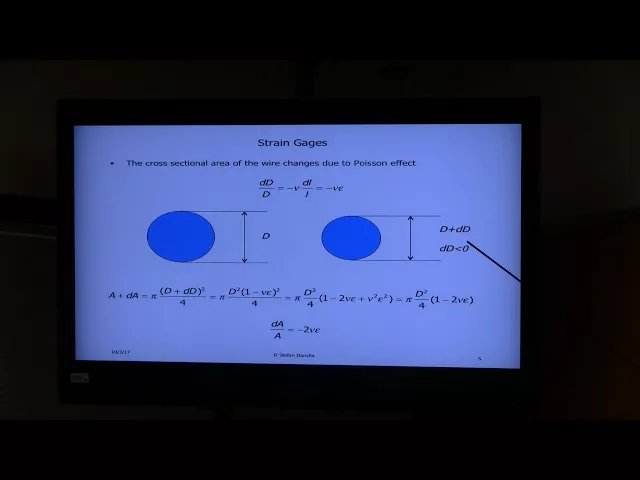
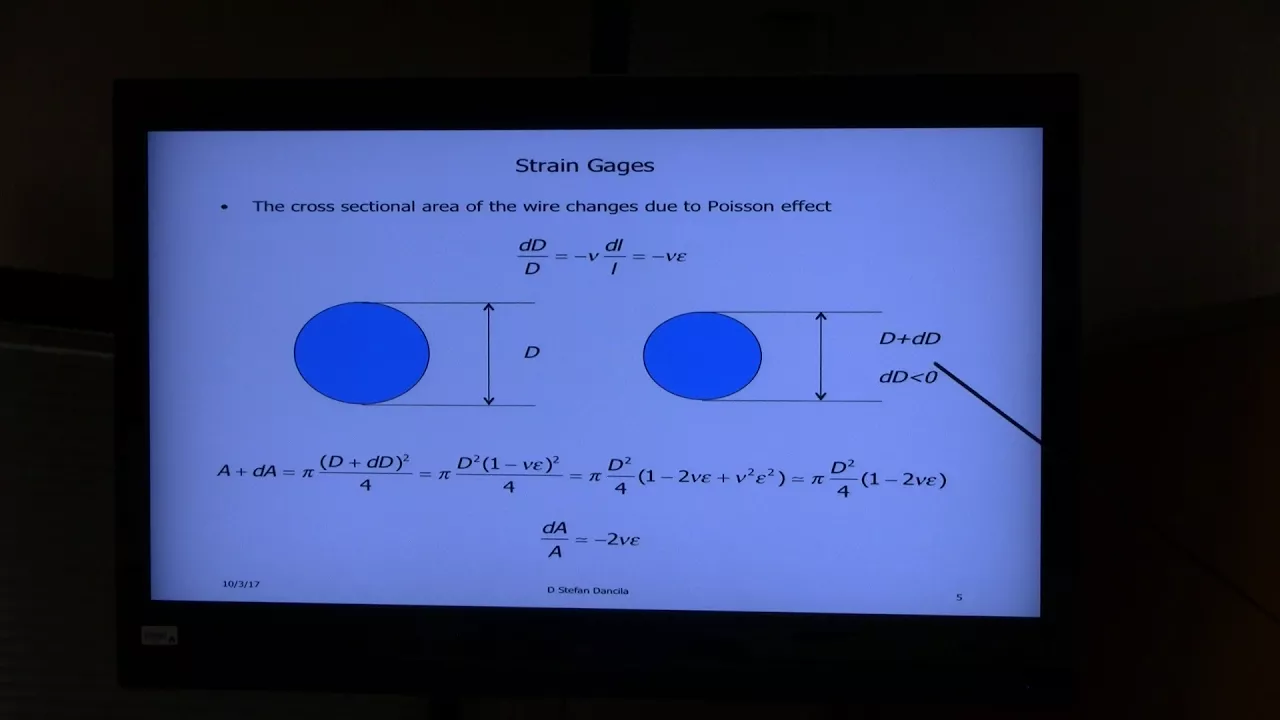
accomplished very much but barely you remember from the first experiment and from your twenty-three-twelve course that whenever the bar is being stretched there's going to be a longitudinal strain we should denote as epsilon and then as a result of the Poisson effect there's going to be a transverse strain as well in the transverse strain is defined as - new Poisson ratio times Epsilon the one who did not strength so that means that the diameter of the wire which initially was capital D is going to change as the result of our stretching the water so for
the same reason for which the wire undergoes a positive strain epsilon the diameter is going to undergo a strain and the diameter P is become the plus DP it's an indexical change in diameter but this infinitesimal change is not the positive quantity is a negative quantity specifically the relative change in parameter DV divided by D represents the transverse strength of the wire and the transfer strain of the wire is negative Pistone's ratio times the longitudinal strain in the wire the L over L therefore D D over D is equal to minus mu times epsilon since
we know what the relative change in diameter is let's not try to figure out what is the relative change in area so the area of the of this wire was originally by this where divided by four after information you have a plus da which can be computed as pi times P plus VB squared divided by four which becomes pi times d squared times 1 minus mu epsilon squared divided by 4 which further becomes pi times D square divided by 4 and now we expand this final square 1 minus 2 nu Epsilon plus nu square epsilon
square and now I'd like to draw to your attention the fact that epsilon which is Delta L divided by L divided by L is considered we consider it in this case to be an infinitesimal change in other words epsilon the strain that we amount the stretch of the wire this plot is good no strain on the wire is considered to be a very small quantity in a small quantity which means that if you take that small quantity and you square it as in this term it becomes a very very very small quantity so a plus
Delta a is equal to this is equal to that is strictly speaking evil to that but this term here new squared epsilon squared in fact can be disregard can be neglected so this becomes approximately equal to this last step is approximately equal to pi d square divided by 4 times 1 minus 2 nu absolutely that's a plus da so if we subtract 8 and then divide by 8 we obtain PA the vector divided by 8 which is their relative change in cross sectional area which is equal to minus 2 nu Epsilon so if you go
back one slide this first term here the L divided by L is equal to epsilon and this term here we have discovered is equal to minus 2 nu Epsilon so let's put things together PR divided by R is equal to D Rho divided by R or we don't know that yet we don't know what that is is the relative change in resistivity which is a material characteristic divided by the original resistivity plus this term the longitudinal strain - the relative change in area substituting PR divided by heart becomes approximately zero divided by Rho we don't
know this term yet plus epsilon minus minus 2 nu Epsilon one more step it becomes equal to zero divided by Rho the relative change in resistivity because of straining plus epsilon times 1 plus 2 do we define now what we call a gauge factor for the wire the gauge factor is defined as this ratio between the rapid change in resistivity VR divided by R divided by the strain that causes it so the gauge factor again is the relative change in the resistance electrical resistance for the wire / the strain that causes this relative change so
taking this expression and substituting it here we obtain two terms