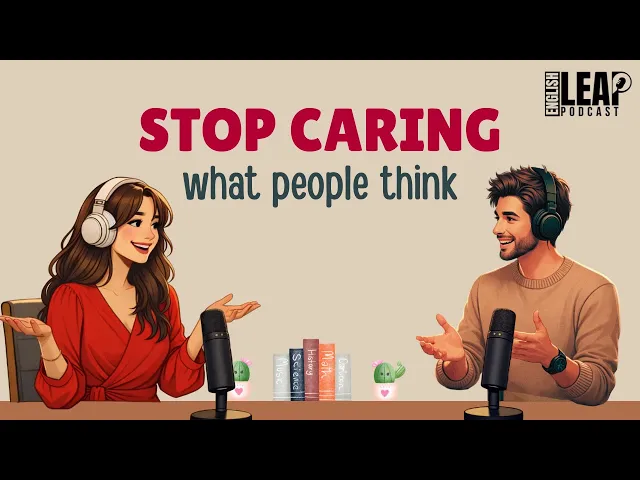
English Leap Podcast >> from Speak English with Claus. [music] Hey English learners, welcome back to the English Leap Podcast, your cozy place to learn easy English through real life conversations. I'm Anna >> and I am Jake.
And before we talk about anything, I want to ask you one simple question. >> Oh, we are starting dangerous today. Go on.
So, how many times did you want to say something? The words were ready in your head, but you stayed completely silent because you thought, "What will they think of me? " >> Yeah.
You felt your heartbeat faster. Right. You checked every word in your mind.
You imagined people judging, laughing, thinking you are not smart, not interesting, too much or too weird. So you smiled, you nodded, you pretended everything was fine, but inside you were screaming, "I want to talk. I want to say something.
" >> And then later in the bus or in your bed, you replay the moment like a movie and think, "Why did I say nothing? I had something to say. " >> And of course, in the shower, you suddenly find the perfect words.
You give a full powerful speech to the shampoo bottle. >> Yes. Best speech of your life.
if and only the soap is listening. >> If this is you, do not go anywhere. This episode is exactly for you.
>> Right. Today we're talking about how to stop caring so much what other people think so you can finally use the voice that is already living inside you. >> And not only your voice, think about it.
You do this when you want to dress differently, when you want to say no, when you want to post something honest, when you want to try something new. Your first question is not do I like this? It is what will they think of me?
>> Yes. If you're tired of living like that, tired of feeling small in your own life, stay with us. >> Yeah.
Take a breath. Think of that last moment when you stopped yourself because of what will they think and keep it in your mind because in this episode, we're going to gently break that fear one honest story at a time. And do not worry, this is a B1 level episode.
So if you are intermediate, it's perfect for you. >> Yes, B1 level. And if you are A2, you can still listen.
If some parts feel difficult, it's okay. You can always listen again, and you'll catch more the second time. >> Your job is simple.
Relax, listen, and let the English and the ideas move through you. You don't have to understand every word. You just have to stay with us.
And maybe if I'm brave today, I will stop asking Anna after we record. Do I sound strange? >> Yes, he really does that.
So, if you feel nervous about your English, you are definitely not alone. >> Yes, we want this episode to feel like you were sitting with two friends. One who already crossed this bridge and one who is crossing it with you right now.
>> And while you listen, you'll hear a lot of real life English. If some words run away, let them go. Your brain is clever.
It's already trying to connect the words with the story. >> Yes. And near the end, we will also do a calm word tour.
We'll take some of the strongest words and expressions from this episode and explain them in simple English with clear examples so you can use them, too. And if you like learning this way with real conversations and real feelings, please subscribe to the English Leap podcast and tap like on this episode. It really helps more learners find us.
>> Right. And after you listen, tell us in the comments in which moment do you think the most about what people will think if you speak in English in class, at work, with family, with native speakers, online. And tell us if you are more like team Anna who remembers the fear but chooses to speak anyway >> or team Jake who makes 10 jokes in a row so nobody sees he's nervous.
>> All right, take one deep breath. Think about the last moment when you stayed quiet instead of speaking English. >> Hold that moment in your mind because in this episode we're going to slowly change what that moment means to you.
>> All right, without further ado, let's jump in. So maybe we start with a simple question. This fear of what people think, where did it even begin for you?
It did not just appear last week. >> Yeah, it usually starts way earlier, right? School, family, friends, tiny comments, small jokes, but big impact inside.
>> H maybe you remember this. You say something in class, people laugh. Or you wear something different.
Someone makes a joke. For them, it is 1 second. For you, it feels like a scar.
>> Exactly. Moments like that can stay for a long time. They kind of stay in your mind.
They do not just go away. They linger. >> Right.
When you say linger, you mean they stay there like they do not leave, right? >> Yes. Linger means stay longer than they should.
Like a smell or a memory or a sentence. It does not leave quickly. >> H maybe you had one sentence that still lingers from years ago.
You were too loud. You talk funny. You were strange.
>> And the fear from that moment doesn't stay in one place. It starts to move into other areas of life. It slowly begins to seep into everything.
>> Seep like water. >> Yes. When water seeps into a wall, it goes in slowly through small cracks.
You don't see it at first. Later the whole wall is wet. >> So this fear starts in one moment, but then it seeps into school, work, friendships, everything.
>> And after that, every time there's a chance to speak or be seen, your body remembers that pain. You feel it and you shrink back. >> Shrink back?
You mean you make yourself smaller, right? >> Yes. To shrink back is to pull away.
to make yourself small so nobody looks at you. >> Maybe you know this. The teacher asks, "Any questions?
" Your hand wants to go up, but you shrink back. You think, "No, no, no. Stay safe.
" >> So, if this is you, please remember, you were trained to feel like this. Your brain learned attention is dangerous. Speaking is dangerous.
>> And you know what can really help? Just catching that story. >> Yes.
even writing it down. >> And here's one small English thing you can try. You could take one old memory that still lingers and write one simple sentence about it in English.
Something like, "In school, they laughed at me and since then I shrink back. " >> It doesn't have to be beautiful, just honest. When you put it into words, you start to see the old rule clearly instead of letting it quietly control you.
>> Now, that is where the fear starts. But let us talk about what it feels like now as an adult. >> Yeah.
Because now it is not only one classroom. It is the whole world. Right.
You walk into a room or you open your social media and suddenly you feel watched. >> Maybe you feel your chest tight. Your stomach is not relaxed.
Your thoughts are racing. That feeling has a word. You feel anxious.
>> Anxious. So, not just a little nervous, but really worried inside. Right.
>> Exactly. Anxious means your body and mind feel on high alert. You feel danger even if nothing bad is happening.
>> And when you feel anxious, your brain does a funny little show. It starts to freak out. >> Yes, that inner drama.
Freak out means you suddenly feel very scared. Like, oh no. Oh no.
Oh no. I will die if I open my mouth. >> Even if it's just ordering a coffee.
>> So your body is anxious. Your brain freaks out. And then what do you do?
>> You start to hold back. >> Hold back like stop yourself. >> Yes.
To hold back means you do not say or do what you really want. You pull your words and your actions inside. >> H maybe you want to share an idea in a meeting.
You want to send a message. You want to wear something you love, but you hold back because that invisible audience in your head is shouting. >> Yeah.
It's like you think there's a big spotlight on you, a strong light that shows every mistake. But in reality, most people are busy with their own life, their own lights. >> M they're thinking, did I send that email?
Do I look okay? What did my boss mean yesterday? >> So, you are not the main movie in their head.
You're maybe one small extra walking in the background for two seconds. >> So, next time you feel that anxious spotlight on you, you could quietly tell yourself in English, "I'm not the main movie in their head. " >> Say it.
Take a slow breath and then do the small action anyway. Say the sentence, send the message, move one step. You might still feel something, but maybe a little less heavy.
Okay. Now there is another thing that makes this fear strong. Not just what people might think, but what people actually said.
>> Yeah. Sometimes it is not just in your head. Someone really said something that hurt, a comment.
>> Maybe they laughed at your voice, your accent, your clothes, your body, your dream. Maybe they did not only think it, they said it out loud. >> That is when it turns into criticism.
When they criticize you, >> criticize means they point to something and say it is bad or wrong. Right? >> Yes.
To criticize is to say you are doing this wrong or this is not good. Sometimes it can help us grow. But many times it is just someone throwing their negative energy at you.
>> I remember one friend said to me, "You are so sensitive. It's annoying. " For them it was small.
For me, it was like a knife. >> Yeah, you start to think maybe my feelings are wrong. Maybe I am wrong.
>> But here's something important. Not every comment is a mirror. Some comments are just a projection.
They show more about the other person than about you. >> Right? For example, if someone criticizes you for trying something new, maybe it's because they're scared to try.
or if they laugh when you speak, maybe they're uncomfortable with their own mistakes. >> So, what can you do with comments like that? You cannot delete them from your memory, but you can decide what to do with them.
>> Some comments you keep and learn from. Some comments you must brush off. >> Brush off like with your hand.
>> Yes. Imagine dust on your shoulder. You just brush it off with your hand.
It's there, then it's gone. To brush off a comment means you decide this is not my truth. I do not keep it.
>> I like to make it physical. When I remember a rude comment, sometimes I just touch my shoulder and quietly think, "No, I brush that off. " >> Yeah.
And you could even write one simple line about it in English, like, "They said I am stupid, but I brush off that comment. It is not my truth. " >> Yeah.
That way, you're not only replaying their words, you're answering them with your words. >> Right? And even when you brush some comments off, the old fear can still sit quietly inside you.
>> So, we have this fear from the past, this invisible audience, these painful comments. What do we do with all that? >> One thing many of us do is we start to perform.
>> Perform like acting on a stage. >> Yes. But not only on a stage, we perform in real life.
We play a role. The good girl, the funny guy, the quiet one, the easy person. Anything to be safe, >> right?
Maybe you say yes when you want to say no. You laugh when something is not funny. You agree when inside you think no, that is not right.
>> Yeah. You're not living as your authentic self. >> Authentic.
That means real, right? Like the true version. >> Exactly.
Authentic means real and true, not fake. When you are authentic, you act like yourself, not like a character for other people. >> And when you are always performing, you do not feel authentic.
You feel like you are wearing a mask. >> It is like walking on eggshells all the time. >> Walking on eggshells.
That sounds painful. What does it mean? It means you are very careful with every step because you're scared you will break something or make someone angry.
You do not relax. >> So you choose your words too carefully, your clothes too carefully, your opinions too carefully just to keep everyone happy. >> But here's the problem.
When you walk on eggshells for everyone else, you step on your own heart. >> O, that hits hard. But it's real.
When you protect everyone else, you stop protecting yourself. So maybe this week you can try one very small thing. >> Yeah.
In one conversation, instead of the safe sentence, say one honest sentence. For example, I am actually tired. Or actually, I do not like that idea.
>> See, just one line. You are still kind, but you're a little more you. And that's already a big step toward being authentic.
Yeah. And there is another trap that keeps us scared of people's opinions. This idea of perfection.
>> Ah yes. When I am perfect, then I will start living. >> You know this thought, right?
I will speak when my English is perfect. I will wear that when my body is perfect. I will share this when my life is perfect.
>> M it sounds smart. It feels safe. But it is a lie.
It makes you wait for a day that will never come. >> Right. It's like saying, "I will learn to swim when I already know how to swim.
" [laughter] >> Exactly. You do not learn in a book only. You learn when you step into the water, move your arms in a messy way, and maybe swallow a little water.
[laughter] >> Yeah. And that is the problem. Perfection makes you hold back your first step.
Progress happens when you move, even if you look a little silly. >> I remember telling myself, I will speak in groups when I am not scared anymore. Surprise, I stayed scared.
The fear only started to shrink when I spoke while I was scared. >> Yeah. So maybe you can borrow that idea.
Pick one area where you are waiting to be perfect. Then tell yourself in simple English, I will not wait to be perfect. I will start small today >> and then match it with one tiny action, one message, one small conversation, one try, not perfect, just real.
>> Yeah. And when you do that again and again, something quiet starts to grow inside you. We call that confidence.
>> Okay. Now, let us talk about confidence. Many people think some people are just born confident >> like they came out of the hospital with sunglasses and a microphone.
[laughter] >> Yes, like hello, I am the confident baby. >> But in real life, confidence is not magic. It is more like a muscle.
>> Right? If you want strong muscles, you do not think about the gym. You go to the gym and you repeat small movements many times.
>> Yeah. It's the same with confidence. It grows when you do small brave things again and again.
>> Exactly. Every small brave action is like a little weight you lift. Say hi to someone.
Share one idea. Ask one question. That's a confidence rep.
>> Repetition one time in exercise. >> Yes. One rep is one time you do the move.
>> So you don't need to suddenly be a confident person. You just need to collect small reps. And many times those reps feel uncomfortable.
They're outside your comfort zone. That's normal, >> right? When you feel that discomfort, you don't have to run away.
You can lean into it. >> Lean into like move closer to it, not escape. >> Yes.
To lean into something means you don't avoid it. You move a little closer with curiosity. >> Right.
You could even make a tiny list in English. Three lines. Say hi to my neighbor.
Ask one question in class. Leave one English comment online. >> And every time you do one, put a little check mark and tell yourself that was one rep.
You're training your English and your confidence at the same time. >> Yeah. And when you see those little check marks, you realize, wait, I'm not stuck.
I'm actually moving. >> And there is one more piece that can really help when you care too much about what people think. >> Yeah, this is one of my favorites.
Changing fear into curiosity. >> Think about the questions in your mind when you feel scared. Usually fear asks, "What if I mess up?
What if they laugh? What if I look stupid? " >> But curiosity asks a different question.
What might I learn? What could happen if I try? What will I discover?
>> I know this from my own life. When I was younger, before I spoke in a group, I would sit in my head and ask, "What if I say something wrong? " I felt frozen.
>> That is when you start to freak out again. Right. >> Yes.
Inside my brain, it was a full freak out. But when I started to think, let me treat this like an experiment. I will try one sentence and see what happens.
It became lighter. >> Experiment like in science when you test something. >> Exactly.
You try something, you watch what happens and you learn. >> Right? When you treat conversations like experiments, you do not expect perfection.
You expect information. Even if it goes strange, you get data. >> It's like being a scientist in your own life.
You're not saying I must be perfect. You're saying I'm learning. >> Right?
So after your next conversation, you could ask yourself two very simple questions in English. What surprised me and what went well? >> Yes, your answers can be short.
What surprised me? They were friendly. What went well?
I did not hold back my question. >> And little by little your brain learns to look for growth, not just for mistakes. And slowly you care more about your progress than about the invisible crowd.
>> And that's the real shift from living for the invisible crowd to living for the real you. From walking on eggshells to walking on your own path, from shrinking back to starting to show up. >> And you are already doing it just by listening, thinking, and practicing with us.
>> H and before we say goodbye, let us slow down together for a moment. >> Yes, we used some strong words and phrases today. So, let us do a small word tour to help you remember them and use them.
We will take a few of our favorite words from this episode, explain them in simple English, and give you easy examples. You can repeat after us if you want. >> So, take a breath, relax your shoulders, and enjoy this calm little word tour.
First word, linger. >> When something lingers, it stays longer than you expect. It does not leave quickly.
It can be a smell, a feeling, or a memory. >> For example, that joke from school still lingers in my mind. >> Or the smell of coffee lingered in the kitchen after breakfast.
>> You can repeat after us if you like. Linger. >> Next word is seep.
>> When something seeps, it moves slowly through small spaces. We often use it for water or for feelings that slowly enter your life. For example, old fear can seep into new situations >> or water can seep through the wall when it rains a lot.
>> So seep is like it does not jump in. It slowly moves in. >> Next one is a feeling word anxious.
>> When you feel anxious, you are very worried inside. Your mind is busy. Your body is not relaxed.
For example, she felt anxious before speaking in front of the class. >> Or I get anxious when I think everyone is looking at me. >> You can say it slowly with us.
Ankious. >> Now a fun one. Freak out.
>> To freak out means to suddenly feel very scared or very stressed. Your brain and body say, "Ah, this is too much. " For example, I freak out when I have to speak and everyone is silent and looking at me.
>> Or he almost freaked out when he lost his phone. >> It sounds strong, but we use it a lot in daily life, even in a playful way. >> Next word is shrink back.
>> When you shrink back, you make yourself smaller. You pull away because you were scared or shy. For example, when the teacher asked for questions, I wanted to speak, but I shrank back.
>> Or he shrank back when people started to laugh. >> So shrink back is like your body saying hide. Do not be seen.
>> Let us connect that with another one. Hold back. >> To hold back means to stop yourself from doing something you really want to do or say.
For example, she wanted to share her idea, but she held back. >> Or I hold back my real opinion because I am scared of what people think. >> So shrink back is about your body and hold back is about your action or your words.
>> Next word is very important for this episode. Authentic. >> Authentic means real and true.
When you are authentic, you act like yourself, not like a fake character. >> For example, she feels more free when she is authentic with her friends. >> Simply, I want to be more authentic and stop pretending I am always happy.
>> Authentic is about you showing the real you. >> Now, an idiom, walk on eggshells. >> Remember this picture?
Walking on eggs is very careful and uncomfortable. When you walk on eggshells, you are very careful with every word or action because you are scared you will make someone angry or upset. >> For example, at work, he walks on eggshells around his boss.
>> Or I do not want my friends to feel they must walk on eggshells around me. >> It means there is no relaxed, honest feeling. Everything feels fragile.
Almost there. Next one. Brush off.
>> To brush off a comment means to not keep it in your heart. You hear it, but you decide it is not your truth. You let it go.
>> For example, they laughed at his accent, but he brushed it off and kept talking. >> Or I try to brush off small negative comments. >> You can even make a little hand movement like brushing something from your shoulder.
>> Last one for today. Lean into. To lean into something means to move closer to it instead of running away, especially when it feels uncomfortable.
>> For example, she decided to lean into her fear of speaking and joined a small group. Or when you feel nervous, you can lean into that feeling and still take one small step. >> So lean into means you do not escape.
You stay, you feel, and you grow. >> You did great. You did not just listen to a podcast.
You also walked through these strong words with us. >> And remember, you do not have to use all of them at once. Even if you choose one or two and use them this week, that is already real progress.
>> Yeah. And the real win is not speaking perfect English or living a perfect life. The real win is caring a little less about the invisible crowd and a little more about your real self.
So, be kind to yourself this week. Take one small brave step, use one brave word, and then be proud of it. >> And if this episode helped you, you can always listen again or share it with someone who also worries too much about what people think.
>> We're cheering for you from here. >> This is Anna >> and this is Jake >> and you've been listening to the English Leap podcast. Bye.
>> [music] >> Your progress doesn't end here. To continue advancing your English skills, click on the next video or [music] explore the additional videos we've thoughtfully selected for you.