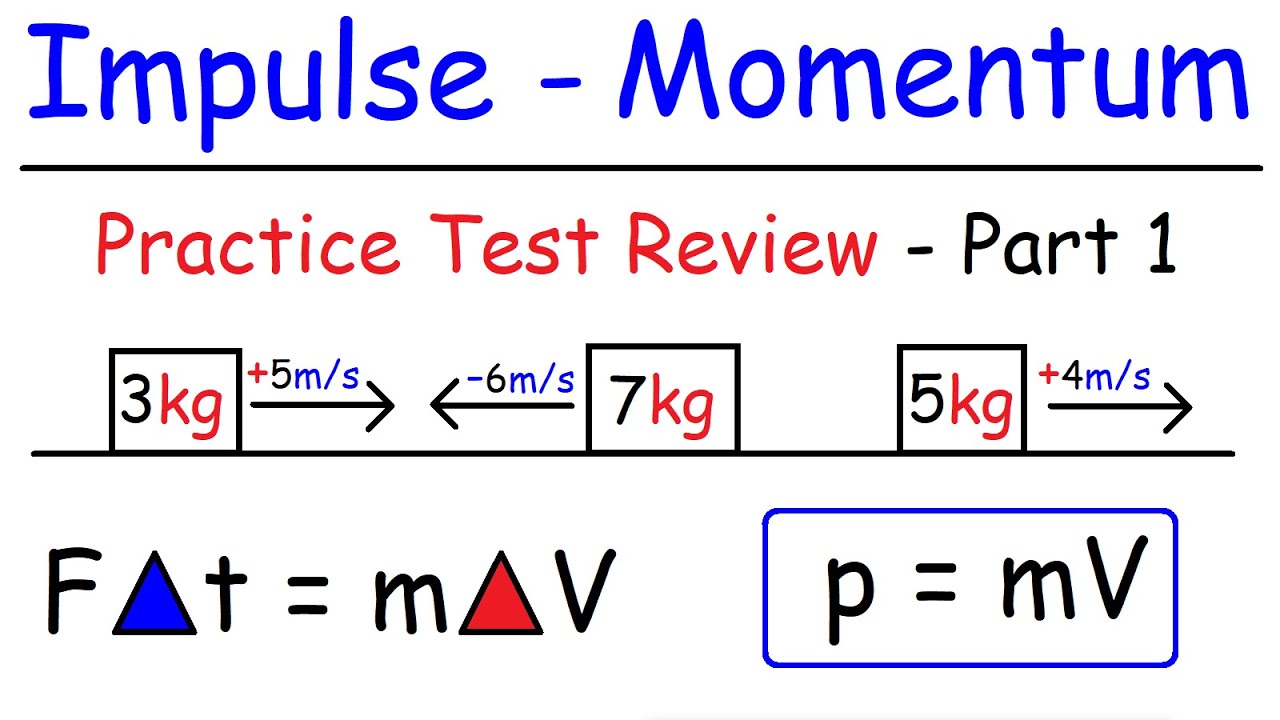
momentum is one of those things that people find attack confusing but it really oughtn't be momentum is equals to mass times velocity now Mass is measured in kilograms velocity is measured in me/ second GCC people sorry that I write it like that we can write it like that as well so that means momentum is merely going to be kilogram m per second but those of you doing an a level you might know that the alternative unit for the Newton is the same as kilogram m/s squar because that basically Force equals mass times acceleration to get
from here to here all we have to do is Times by seconds so kilogram m/s is exactly the same as Newton seconds so if you see the unit Newton seconds you know it's exactly the same as kilogram m/s that's the unit for momentum what actually is momentum if you want my personal definition is how hard something is to stop the more momentum something has the more force is needed or the longer time is needed to actually stop it so say that you had a choice of getting hit in the chest and you had a bulletproof
Fest on don't worry about it with a bullet out of a gun or a train now the mass of the bullet is 5 * 10 to the minus 3 Kg in other words it's 5 G it's traveling at a speed of 200 me/ second the Train on the other hand is traveling pretty slowly it's sort of just setting off as it were 1 m/s but its mass is 10 tons 1 * 10 4 kilg what's the momentum for each of these well we use M for Mass V for velocity letter that we actually use for
momentum is p generally Little P because big p is used more for pressure so what do we have 5 * 10us 3 * 200 and that gives us immediately 1 Newton Second of momentum or kilogram me/ second I'm just going to use newcs save me my Sharpie ink on the other hand we have one m/s * 1 * 10 4 so that's actually 1 * 10 4 Newton seconds of momentum that the train has so even though the bullet is traveling so much faster 200 times faster it has a tiny momentum compared to the train
that's just trundling along which one's going to send you flying more the train definitely will if both of these things transferred all of their momentum to you in other words they both stopped when they hit you the bullet might send you flying a little bit the train is going to send you absolutely flying for Miles because it's got a lot more momentum to give you now when things Collide in any way shape or form momentum is always conserved now we should probably say that total momentum is always conserved in other words if you take the
momentum of one thing and another thing that are crashing into each other the total momentum of both of those things or all of those things is always going to be the same now there are two types of collisions we have elastic collisions and we have Shakara in elastic collisions the only difference between these two momentum is always conserved in both of these things but in elastic collisions total kinetic energy is conserved and then inelastic collisions total kinetic energy you guessed it is not conserved so don't forget that kinetic energy is half MB squ I'm just
going to write it as EK could get asked here's a collision calculate what's going on with the speeds and check if it's elastic or an elastic so let's have a look at an example of a collision then shall we let's go with coupling there could be two train cars coupling together uh one has momentum before the other one has momentum before and then afterwards they have the uh same momentum added up but uh seeing that we're talking about coupling and couples let's go with a couple of figure skaters now what I do is split my
page in half before and after the Collision before what we have is the girl skating towards the guy and he's ready to catch her and he's going to lift her and they're going to go off together like so so there they are afterwards let's say that the guy is also going that way as well to begin with we're going to call this girl M1 and she has a mass of 60 kg the guy M2 has a mass of 80 kg what do we know about afterwards the mass of both of these put together so I'm
going to put M12 not M12 but M12 that's going to be equals to 140 kg because they've now coupled together they're going off together what do we know about the speeds well we know that from suvat when we have an initial speed before and a speed afterwards generally we use U so I'm going to put U1 and U2 the girl to begin with has a speed of 5 m/s the guy only has a speed of 2 m/s afterwards they've got a speed going off together so I'm just going to put V12 that's what I want
to find out so we need to come up with an equation for this now we know that the total momentum before equals the total momentum afterwards so we can say M1 U1 that's the momentum of the girl plus M2 U2 that's the momentum of the guy equals M12 that's the mass of both them before times V12 that's the velocity of them afterwards pop some numbers in we have 60 * 5 bracket that plus 80 time 2 equals 140 lots of V I'm just going to call that V I can't bother to call it V12 all
you have to do then is rearrange it to find V and we end up with a speed of 3.29 m/s all we did was figure out how to represent their momentums their momenta before M and u m and u that's the total momentum before the Collision this is the total momentum after the Collision make an equation rearrange it and find the unknown so that's coupling let's have we go another one recoil say from a gun like we were talking about earlier we have before and we have after before we have somebody with a gun and
nothing's moving how much momentum do we have zero we have no momentum afterwards the bullets gone off in this direction and the shooter and the gun are obviously going to go backwards because of the recall how much momentum should we have afterwards as well total momentum zero still that must mean that the momentum of the bullet plus the momentum of the shooter and the gun must add up to zero does that make sense yes because we know that the velocity of the bullet is positive the velocity of the shooter on the gun is negative so
adding up momentum plus a negative momentum they should cancel each other out and they add up to zero so all I have to say is we have a mass here of the gun I'm going to call that mg and and we have the velocity of the gun as well and the shooter as well obviously and we have the mass of the bullet MB and the velocity of the bullet as well making an equation for this we just say mg VG that's the momentum of the shooter and the gun plus the momentum of the bullet equals
zero now you got to be careful with the whole negative velocity thing there is a bit of a shortcut that I like to use I just like saying well I know the momentum of the bullet is going to be the same as the momentum of the gun and the shooter afterwards this isn't quite true because of course one of these is going to be negative compared to the other velocity but so long as you remember that one of them is going one way and one of them is going the other way and let's be honest
you can remember that then you should be fine so let's use the same mass of the bullet I'm going to say that that is five time 10us 3 kg and the speed of the bullet again is 200 m/s now though the mass of the gun and the girl is 65 kg so I want to find out the recoil speed of them going backwards all I want to do is rearrange this to find that speed that velocity and we end up with 5 * 10us 3 * 200 ided by 65 that gives me 0.015 m per
second not going back very fast it is only a small bullet after all so that's recoil we also have rebound now when stooker balls hit each other they have uh two options well three options really the Q ball can hit the other ball and it can just stop dead the Q ball can carry on going if you put some Top Spin on it or it could come backwards if you put some uh Back Spin on it as well the problem with those is that they do affect whether the collisions are elastic or inelastic but let's
not worry about that for now let's just worry about the actual uh momentum side of things so we have before and we have after so we have our cuq ball coming in and that's going to hit the red which is staying still at the minute afterwards let's say that our q b goes backwards we put some back spin on it and the KE BS going off in that direction hopefully going into the pocket again we have M1 U1 M2 U2 M1 V1 and we have M2 V2 now no no matter what is going on with
this whole situation we can say that M1 U Want M2 U2 equals M1 V1 plus M2 V2 let's go back to Newton's second law that is f equal m a what is acceleration well well it's changing speed over time so I could put M Delta V over T actually it doesn't have to be V that it's changing it could be M as well so I'm going to put a delta in front of both of those two things together this if you will is the more accurate version of Newton's Second Law this is saying that force
is equals to the rate of change of momentum MV momentum divided by T Delta changing momentum over time anything divided by T is the rate of the change of that something I could actually write this as then V Delta REM over T same thing just depends on what's changing is it the mass that's changing or the velocity generally you will never have a situation where both the mass and the velocity are changing at the same time it'll either be the velocity changing or the mass is changing so on cars you have something called crumple zones
if you're in a car crash your momentum is going to come down to zero every single time that's not going to change whether you have a crumple zone or not but what does a crumple Zone do it increases the time of the Collision what does that mean if you increase T that means that the rate of change of momentum is lower so therefore f is lower if you get fired out of a cannon then you've got a choice of hitting a wall or hitting a nice big net your momentum is going to come down to
zero either way which one's better of course the net is because the time for that Collision is going to be longer so the force you feels is less and so you'll probably survive that let's very quickly look at our ball that's hitting a wall again like so and we have it going in here and we have it coming out there it's going in with you and it's coming out with minus U we said that the change in momentum I could say Delta p uh that's also Delta MV of course that's going to be Min -
2 muu so that means that the force exerted on this wall by this ball is going to be minus 2 muu over the Collision time that is how long it's in contact with the wall the longer it's in contact uh say it's a really uh deflated football then it's not going to be exerting much of a force if that's a massive ball bearing then the Collision time is going to be very short so that means T is small the force is going to be quite big change in momentum is also known as impulse so whenever
you see impulse it just means a change in momentum same units so if f equals change in momentum over time there should be a Delta before the T as well but we leave that out and we said that this is impulse given the letter I then that means that force is equals to impulse / by Time same thing just that impulse is change in momentum you might get given a graph this will be a force time graph now whatever shape the graph makes you know that the area under the graph is equals to the change
in momentum or the impulse just like if we have a speed time graph and we find the area under the graph we find distance here if we have force and time find the area under the graph and we find the impulse the change in momentum as per usual split it into rectangles and triangles i' so I split this into two triangles base time height / two base time height ID two add them all up and you find the change in momentum usually whatever is experiencing this change of momentum starts at rest so that means no
momentum at all so by the end the momentum that this object has is going to be the area under the graph because it didn't have any to begin with that's going to be equals to MV then if you're trying to find the velocity just divide the area into the graph by the mass and you find the speed now let's talk about one situation that confuses quite a few people let's talk about a hose pipe where we have water coming out if this water then hits a wall and it stops dead if it comes back obviously
we have a change of momentum than it it's just momentum if it stops dead we don't really have a collision time because it's a constant flow of water so how on Earth are we going to find out what the force is exerted on this wall by this stream of water by the way it doesn't matter if there's a wall or not if there isn't a wall the question will say something like calculate the change of momentum every second which just means effectively find the force let's write down our equation FAL Delta MV over T now
then if the water is Flowing out of here at a constant rate V then obviously V isn't changing at all so let's take V out of the equation there and instead we've got Delta m / T there this is true the force exerted uh on the wall by the water if it stops dead is going to be the speed of the water times the change in mass per second in other words kilog G per second this is one time where units are definitely your friends because you will not get given equation for this but we're
going to derive one now now I can tell you that this hose pipe has a cross-sectional area a and uh the water has a density row that's not a p that's a row it's a p without a little ear now area has the units me squared row has the unit kilog per Meer cubed now we want to get from these two to kilog per second and we need to Times by me cubed because of course there's no meters cubed in here at all there's no meters at all and we need to Times by S Theus
one as well cuz we have that so where are we going to get our meters cute front well look we have me squared up here so let's do a * row or row * a that gives us kilog per meter that doesn't really tell us much at the minute we need something else we need to get to rid of this met to the minus one and we need to add our seconds to Theus one in there as well what do we do we Times by the velocity row a gives us kilogram per meter times me/
second those cancel and we get kilogram per second so the change in mass per second for a fluid coming out of a pipe of cross-sectional area a it's row a v to turn that into our Force there all we have to do of course is Times by velocity once more so we end up with row a v^ s this is a bespoke equation with respect to what we're given in the question but quite often you might not be given density and so you'll have to work through this whole process of figuring out what units you
actually need to end up with in order to find out the force make sure you write down the units of all the information that you're given in the question and I guarantee that it will become clear so I hope that helps if you have any questions please leave them in the comments below and I'll try and answer them as soon as I can see you next time