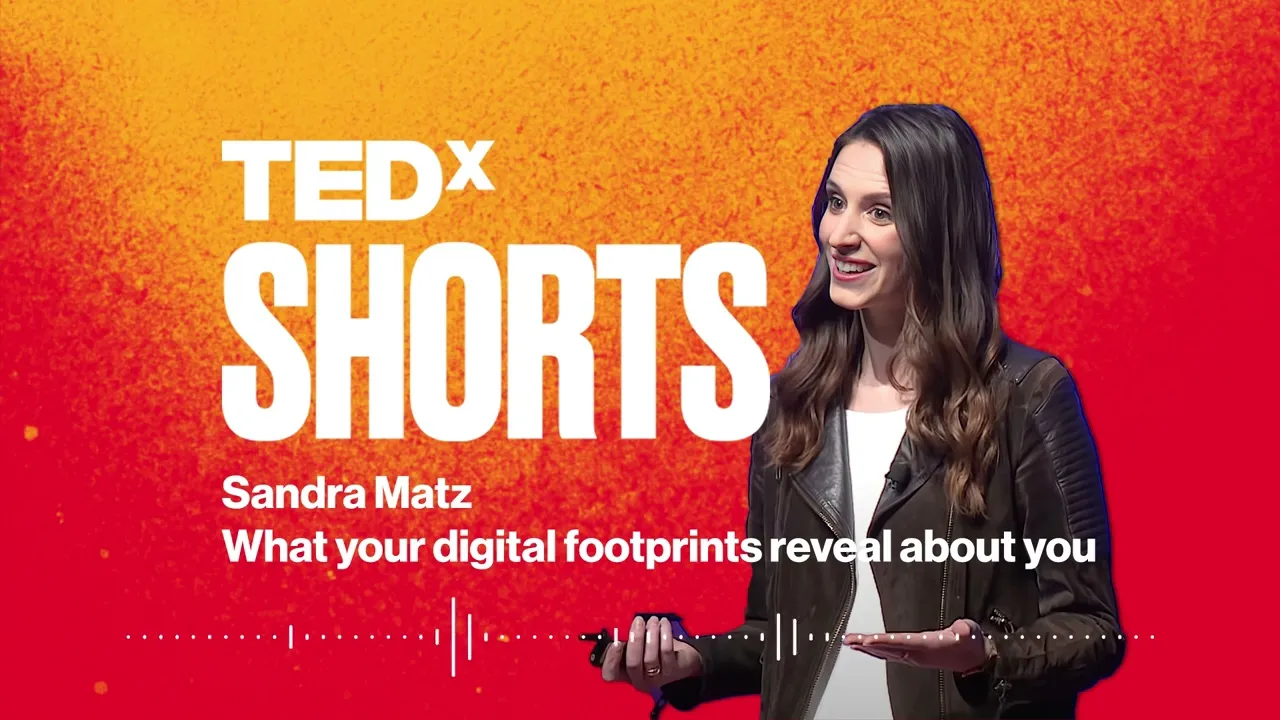
a quick new idea daily from the world's greatest tedx talks I'm your host natosa Leone and this is tedx shorts when you like a Facebook post or use your credit card you may not realize you're leaving behind what Big Data experts call a digital footprint Columbia University Professor Sandra matz's work explores the relationship between people's psychological characteristics such as their personality and their digital histories while Sandra studies the effects of the misuses of Big Data like in the case of Cambridge analytica in today's episode she explains what people's digital Footprints say about their socio-psychological characteristics
the real life consequences of mining this information and how the insights extracted from people's Footprints could be used to actually help individuals and businesses make better decisions I want to take you back with me for a minute to December 3rd 2016. a Saturday that probably doesn't mean anything to most of you but one that I actually remember very clearly and that's because I woke up to way too many emails for regular Saturday now my first thought was what the hell did I do last night um it took me a few seconds to realize that obviously
I hadn't done anything because at the time I was in the final stages of writing up my PhD and my only two friends were Microsoft Word and my espresso machine so luckily it wasn't the aftermath of a crazy night out it was this new story here the story of a company called Cambridge analytica which had created detailed psychological profiles of millions of U.S citizens during the 2016 presidential election and they had allegedly used those profiles to Target voters with Facebook ads that were highly personalized and essentially designed to discourage them from going to the ballads
and putting in their vote for Hillary Clinton now I don't want to talk about Cambridge analytica today and that's just because we simply don't know what actually happened there and we probably never will however what we do know is that the technology of psychological targeting exists and that more and more companies are using it so instead of wasting my time on Cambridge analytica what I want to do is demystify psychological targeting for you by doing three things I want to explain how psychological targeting works how effective it is and most importantly think with you about
how we as a society might want to use it because the reason I'm doing this research is not because I want to help companies squeeze every last penny out of their customers it's because we truly have to understand like and object we have to develop an objective and scientific understanding of psychological targeting if we want to engage policy makers Business Leaders and frankly everybody who's willing to listen and in a conversation how to manage it effectively okay so how does psychological targeting work which essentially boils down to the question of how can we assess the
psychology of millions of people in order to Target them with personalized ads and up to a few years ago I would essentially ask people to tell us how much they agree with different statements and then based on their responses we would conclude that they were extroverted for example or more introverted and this works perfectly well in the context of a research study where you survey a few hundred people but you can imagine that there's just no way that you can get millions of people complete one of these questionnaires for 10 to 20 minutes before you
show them the right ad so the question is really if we can't ask people directly and how else can we indirectly glean their psychological characteristics and the answer is this we look at their digital footprint and what I mean by that are all the traces that you leave online on a daily basis it's what you share like on Facebook it's the cookies that keep track of the websites you visit it's what you post on Twitter what you buy with your credit card all the way to what you listen to on Spotify and you can imagine
that all these traces combined can actually tell us a lot about your habits your preferences your needs essentially who you are as a person most importantly these very simple relationships between someone's digital Footprints in their psychology is all we need to actually apply psychological targeting using existing targeting tools because what Facebook for example allows you to do is target people not only based on social demographic variables like age gender location but also based on interests and because interests are inherently related to psychological traits Facebook effectively also allows you to Target people or audiences of different
psychological profiles now that brings us to the second question like can we really influence people's behavior by targeting them based on their psychological profile is psychological targeting really effective and the answer is yes and I'm just going to show you the results of one of my studies but we've tested this in many different contexts and the results are always very similar so in this particular case we teamed up with a beauty retailer in the UK and we advertise the online store so our goal was to get women to click on an ad go to the
store and then purchase something and we created an extroverted ads and we measured simply purchases on the beauty retailers website and here's what we found so people into mismatching conditions they did purchase sure it was advertising and but people into matching conditions were about 50 percent more likely to make a purchase so extroverts were more likely to make a purchase if they saw the extroverted ad and introverts were more likely to purchase when they saw the introverted Anne and that's pretty astonishing and because this is really the simplest manipulation possible the only aspect of the
user Journey that we customized was the ad that people saw and we used a relatively crude measure or approach to profile people there's algorithms machine learning algorithms out there today and that do a much better job at profiling people and are much more accurate than what we have followed here in in this case and one of my colleagues for example showed that computers are roughly as accurate at predicting your personality as your spouse is just by looking at your Facebook likes they're better than work colleagues they're better than friends and they're better even better than
family members so if you compare what we've done here to what the future is likely to hold psychological targeting really is going only going to be more effective in the years to come and even that I think is really just the beginning of something much bigger so you are all carrying around your smartphones almost 24 7 which means that you can't be tracked almost continuously in real time and that one can not only make inferences about your psychological traits but also the mood you're in the place you're in the context you're in so you're no
longer just an extrovert you're now an extrovert who's currently in a good mood having a good time with friends in a park and even debt pales in comparison to what I think the future is going to hold so if we consider all of this it's not really surprising that the Public's initial reaction to psychological targeting in the context of Cambridge analytica was a very negative one and some media Outlets have even gone as far as calling psychological targeting a threat to democracy now I want to pause for a second and consider a different scenario let's
imagine that not Donald Trump but Hillary Clinton had used psychological targeting in her campaign and not to create fear and not to discourage people from voting but to actually encourage them to engage like trying to truly understand what they care about and to communicate with them in a way that makes them want to be part of the political landscape again I'm sure that the public perception would have been a very different one now my point here is that psychological targeting isn't evil per se it's really about how we use it so as much as psychological
targeting can pose a threat in the wrong hands it could also provide a solution to what in my opinion might be an even bigger threat to democracy and that's disengagement like if 40 of people in the US decide to stay home and not vote then this defeats the very idea the very notion of democracy where everybody engages and because psychological targeting really is all about understanding and engaging with people on a personal level I think it could actually help us save democracy now we might collectively decide that we don't want psychological targeting anywhere near our
Democratic process and that's okay and because elections are really just one context out of many in which psychological targeting could be valuable and could act as a catalyst for social good my students and I are currently working on a number of projects where we're using psychological targeting to try help people live better lives so for example we're trying to help people save more by identifying personalized saving goals and this is really just a snapshot of what's possible the list here is almost endless so what I hope that you take away from this talk today is
really that psychological targeting is a new reality it's out there and it's effective and for me personally this is as exciting as it is scary because psychological targeting really provides amazing opportunities but it also poses some pretty serious challenges so what that means is that we all have to engage in the topic we all have to advocate for an ethical use and we all have to show the people who have the power to make decisions and drive change that we care [Music] the tedx talk you just listened to was recorded at a tedx event in
Chicago Illinois all tedx events are independently organized by volunteers who believe in Ted's mission of ideas worth spreading special thanks to the organizing team at tedx Chicago want to listen to the full talk find Sandra's talk and more at ted.com tedx shorts I'm matosa Leone thanks for listening and see you next time