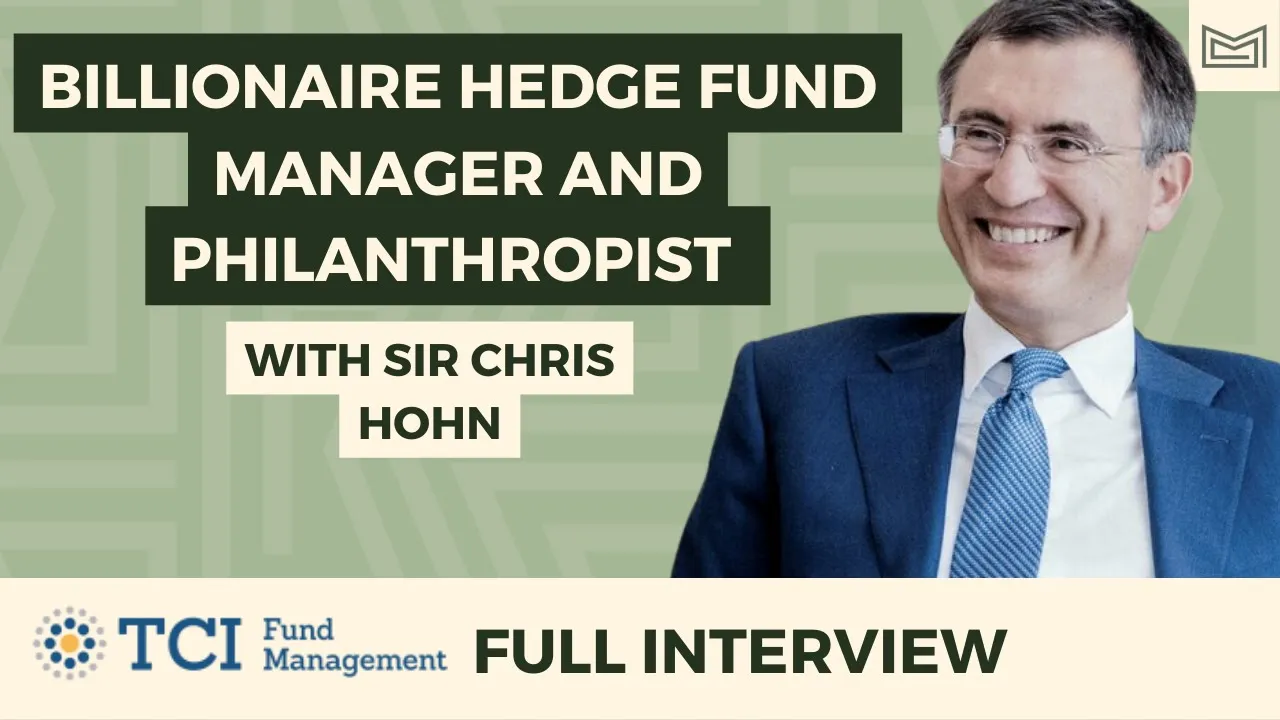
when one of the world's most successful hedge fund managers is also the architect and benefactor of the world's largest children's charity you might be tempted to think that that's enough for most mortals creating wealth and helping children thrive and survive through an immense charitable endeavor but when that same person trains his sights on corporations failing to properly address their climate change transition plans some good advice to ceos and their boards might be to look at or they may wish they'd paid attention earlier so i've been in this industry since 85 and until today i've never had the chance to talk to one of the world's greatest investors donors and determined activists for comprehensive corporate change in addressing climate issues and attendant behaviors so it's very exciting and it's a great honor so welcome sir chris home to the money maze podcast thank you it's my pleasure simon great well let's just dive in i'm intrigued how did your upbringing prepare you for such a successful career in finance well mine is a somewhat unlikely story um i was the son of a car mechanic immigrants from jamaica grew up in a small town and went to undergraduate in the uk where i did accounting and uh business economics and i as luck would have it i um was taught by a visiting professor from harvard business school who taught entrepreneurship and he said took me under his wing and said you know you really should find a way to get to harvard business school and a few years later i was able to admit it and after that i did a short stint in private equity at apex and uh got married to an american who said you better move to new york so to find a job and uh the uh the only firm that would take me um was very capital and uh so i stayed there for seven years um learning about investing um focused on europe most of which they sent me to london to to start a european investment on and so that's the uh short resume um but uh really um i think the key points were as it often said an immigrant uh you know feels a bit more like an outsider they challenge the establishment so i think that was a part of my psychological makeup to think in an unconstrained manner and um [Music] really um yeah harvard business school taught me that uh people weren't yeah there was no reason to assume people were smarter than you that was what i had there and you actually i think came as a you know came out with a baker scholarship you're a bigger scholar which is obviously a fantastic sort of accolades i'm sure you were in great demand but as you start out in this investing world um who were your initial and most sort of influential mentors [Music] i think uh one name that comes to mind uh is john armitage who runs edgerton capital who was a dear friend when i was starting to learn and we found ourselves in common positions and uh i got to meet him when uh i took a stake in the energy group which was a hanson spin-off and uh if you remember that and uh he was just starting up at edgerton and uh yeah we helped each other over the years and were stayed good friends um i think seth clarman was a i wouldn't say a mentor but a inspiration with his value mindset but more than that i think just various people who i worked with and uh it's an industry you learn from experience in osmosis as much as or more than uh especially a mentor so those uh yeah i suppose i'm interested that you had that experience at apex then you have spent your career essentially in the listed markets at that early stage because it's now become so fashionable for for pe and that industry to sort of grow you know to some extent at the cost of the the listings in the public markets what was it early on that made you tilt to the public markets essentially in private markets a couple of things you you it's very hard to execute a deal you know you have to find the deal you have to find it at the right price you might go for years without doing a transaction it's more process oriented than in investment analysis so and given my psychological makeup which is impatient i didn't have the patience for it and um or what didn't serve my aptitude which is not really processed but an analysis and the other point to note is companies don't sell the best businesses in the world you know they don't sell those to private equity generally they keep them and so you by which by definition you were buying inferior businesses and yeah you didn't you couldn't choose so the public markets had better quality businesses than you would find in the private markets and so those are um and thirdly it's much harder to be an entrepreneur in the private market than in the public markets so to um so if you want to have your own fund i think it's easier in the public markets in the private markets all right i think that's very eloquently answered thank you let's turn to the children's investment fund foundation or cfciff which you endowed and is now the largest children's charity in the world and you've committed over 600 million to climate change initiatives which is a huge amount and once i suspect we're only at the foothills of this journey for you what's driving this passion and what's driving the say on climate campaign i think it's widely understood now that climate change is the single biggest uh challenge of uh uh generation you know and future generations for the future uh you know in particular for poor countries and this climate change doesn't have equal effects on everybody so in poor countries the soils are drying out making it very difficult and every year harder to grow food leading to malnutrition so you know the billions of smallholder farmers who are subsistence farmers are feeling the effects of pollution of the rich world okay and there's a injustice to that and so i got into climate change because i was interested in children in poverty in all countries and i realized this effect yeah more than a decade ago would uh would occur and uh the um and the um and so that's the motivation and secondly as far as i say on climate initiative goes the the we realize that um 35 of global emissions come from companies most companies don't have any plan to address their emissions they don't even disclose their emissions and there's no accountability mechanism for their owners the shareholders to instruct them or give feedback on what they should be doing what they are doing and so together with sif the foundation i endowed the the we came up with this concept of uh it's been labeled the say on climate which is very simple it's an agm resolution that uh mandates the company disclose their emissions consistent with tcfd so there's a specific standard two they give their plan to manage those emissions not prescriptively uh however whatever format they want and thirdly there's an advisory annual agm on the plan and their performance against plan so very simple concept and but it can make a huge difference because it will create force disclosure of emissions um and the plan to manage them and shareholders you know been required through the vote management to justify their actions and so it's an accountability mechanism so i'm fully convinced it's going to make a significant difference on the um how companies look at this and the pressure on them to reduce their emissions and we already have many large companies have adopted it so when you engage with these corporates um there are a lot of behaviors that you would like to see them address but how do you both prioritize your message and i suppose also help them understand the urgency well um [Music] the um firstly um the uh there will be uh quite a few companies who will adopt it voluntarily but in a major part until there's regulation for the the same climate as there is for the say on for executive pay say on paid in which is law in the us and the uk um you thought the climate climate change is more important than executive pay so one has a law the other one doesn't yet but it will um but uh you know investors investors it's clear are willing to vote and support these initiatives if they're filed okay blackrock very clear they'll vote for them they have been voting for them and uh for example but they're going to leave it to the ngos and charities activists to to file them that's okay um that's happening now so uh tci is filed uh a lot uh sifa's um um um and its partners are filing hundreds um because you only need 25 000 us dollars to file on an s p 500 company so 12 million dollars you can file on all the s p 500 companies um you don't lose that money it's just the shares you have to hold for a year in canada it's 2 000 so it's very cheap to put an agm filing and because of the uh simplicity of the resolution it's clear from uh cases like aina which got 98 support shells will vote for it and uh in many cases you're seeing companies rather than have a sort of a contested fight they're willing to um adopt it quote unquote voluntarily i think it's known as a bear hug right right yeah so um it's uh it's it's it's happening the trend is happening and we've had major investors like soros fund management as uh announced they're supporting the local authority pension plans of the uk that advise more than 300 billion pounds uh just to name two uh there's a website say on climate. org where you can see the companies that have adopted it canadian national canadian pacific moody's the rating agency has adopted it unilever adopted it royal dutch shell just adopted it glencore adopted it rio tinto zinc so the list is building yeah and these are serious companies so nobody can say this this is a joke um and it'll be down to the shelters to make sure that the plans aren't just rubber stamped but they're actively scrutinized and where they're not good enough voted against and the proof of the pudding will be in the actual emissions and emissions intensity if that isn't declining consistent with the paris agreement at a meaningful rate then i would expect shelters to vote against the plans and vote against the boards right it was your former colleague from apex ronald kern who i think i said just said just the other day that doing harm has become risky business and i'm intrigued where where are you meeting recalcitrance or at least some pushback yeah it's um there's some u. s companies that want to fight on it so charter communications where we have five percent holding some seven billion dollars of stock we've been a long-term shoulder they they've uh refused to to adopt it they've notified us and so it'll go be contested at the agm uh which is a little bit surprising because they're not a heavy emitter but uh there's uh clearly [Music] the um you know it's uh um the mindset will still need to change um where people think it's optional to pollute and not and not actually disclose your pollution uh to realizing that it's not an option in the eyes of your shoulder so you know these are these battles are inevitable and um it's important that shareholders send a message to the managements that refuse to disclose emissions or have a credible plan to manage them and refuse accountability that that won't be accepted and so um this is a you know this is why i'm doing this podcast to to explain that actually greenhouse gas emissions pollution generally it can have an effect on long-term returns it will you know because carbon is going to be regulated um the the the uh there'll be carbon there are carbon taxes already of a significant nature in europe they'll spread through the the rest of the world you lower your cost of capital if you're the greener you are for that debt and equity and your relationships and image to your customers and employees is improved substantially the greener you are so it's you know a win to do so and it's not it's not really optional anymore but some companies still backward-looking and the investors need to explain that to them i mean the first one that i won with that was contested by the by the board they said vote against it i got 98 support and so it changed their view in the final few days but uh that was a fact so it's going to be a fight in in in many cases and uh and i'm asking for shelters to realize it's in their self-interest to um uh instruct boards that they are the owners and they want this information they want this accountability mechanism and it's uh ultimately in the interest of the of the company i think it was the wall street journal that quoted you with the example of moody's which said it was a mix of cajoling and public shaming and so uh so there's clearly a carrot and stick at work here i i guess that the thing that um i'm not sure i understand is that you're a global investor but could we be seeing a sort of a bipolar world where you get western adoption but you get eastern resistance or indifference to this mission yeah so it's a good question we want to bring it to asia um there's already been filings made by australian um uh fund managers and ngos on uh just recently on woodside petroleum and um santos two of the big oil and gas companies there uh so um the australians get it you know the country is sort of burning down from climate change and so they they really understand climate change is a clear and present danger so australia is moving now um um former prime minister malcolm turnbull supporting that we're going to um uh work in japan looking to work in korea china we haven't i think [Music] may may not be possible we have to study it it's it's uh has to be reviewed but certainly japan korea australia we uh um um we're going to be working in just to start yep we want to go so there's no um how will that um in particular we want to address the banks because the banks are financing the dirty economy and a special resolution needs to be put to their shoulders which is disclosure of carbon intensity of loan books and they're lending on fossil fuels oil gas coal yep so that investors can track are they cleaning up their loan books yep and of course it will require them to get the information from their um from their borrower from the from from the boroughs yep so we'll have a change of business practice but how else are regulators the central banks going to regulate these climate change stress tests if the banks don't have the information so the banks are a key part of the sale on climate initiative because they move they finance the whole economy so this is a you know this is a plate shift going on but is there another structural impediment which is the you know the explosion of passive investing over the last three decades yes you know passive investing is half of all investing and growing every year relentlessly um the um this uh is a problem because a lot of times they don't they have no interest in engaging voting um or they vote with proxy advisors who have hold enormous power people like iss classes fortunately those people are supporters of the seon climate initiative we saw that in aena they were very strongly in favor of it um but there will be a need for these companies to advise the passive investment funds to do the work properly to assess whether plans should be approved or disproved in performance fortunately there is an acid test which is emissions as i said so there's an objective test unlike pay where higher pay may be justified or not justified it's it's harder to assess but in this case higher emissions intensity can never be justified if you're trying to decarbonize so um the um [Music] but so so that's the clear and the say on climate uh mission as we said we'll be releasing it with the emails that go out with this shows www.
sayonclimate. org and let's talk a little bit about the charity which um has clearly been you know an extraordinary success and vehicle and uh you know the beneficiaries obviously have been globally dispersed i suppose a general question is what part of the charity has given you the most satisfaction you know i think i work in malnutrition neglected tropical diseases family planning these are all very important things and simple yeah so the health side i think is is closer to seeing the direct impact on on people simple things could be clean water with you know drilling in ethiopia for clean water without which people can't exist and the surgeries for people with um trachoma you know so direct direct impact yep really um i think where you can really see with your own eyes what's being achieved so health health side i think is uh all the programs are listed on the sif website and um but at the same time i recognize that climate is trumps everything ultimately if we destroy the the the soil and are able to grow you know food um we're um that will trump any health initiative we could ever attempt and do you feel sometimes like you might be uh not quite like sisyphus but you you are embarked on this mission and you are a minority a small minority are you surprised that there aren't others who are you know embarked with you you know vocally yeah it's an important question because no no individual can change everything and [Music] but we can set an example um and do our part and all of these things you know i think ultimately there's a these problems have a sort of a routing and a solution in in spiritual space um because if people want to live a life which is selfish you know pollute as a company or board their money rather than share their wealth then we can't ever solve the problems and so i would say um the root cause is selfishness and um um and uh i'm not um you know i'm optimistic that the world is going to change and uh that crises like the coronavirus we show people that uh we don't no one lives as an island you know no one's everyone is impacted by the well-being of everybody else climate's another example of that so these pandemics and climate change they have a common uh thing that they they show us we it's you know we're one world you know we're not unconnected from everybody else and so the um um but um we um you know we can only um so someone said to me uh if you want to change the world change yourself yeah i'd like to ask you a slightly tangential question which is clearly market euphoria around bitcoin i think it's uh you know mining a bitcoin there was an article that talked about this equivalent electricity consumption of chilean the judge business school has just come out some very good work on this you know how would you react to uh and there are some companies or literally they're small suddenly deploying reserves in the dollars or euros suddenly in bitcoin and are you surprised there hasn't been more conversation about you know the obvious downside of uh you know of bitcoin's mo yeah i mean it's uh i'm not surprised because most investors are just passive bad things will happen and they don't say anything don't do anything i've seen it all my career they don't act as owners and so the problem is with the passive uh phenomenon has made it you know 100 times worse because suddenly i have half wasn't that many children's care before but now half them definitely don't care yeah they're not allowed to cap so it's um it it's a problem um so i i i think uh you know companies investing in bitcoin is crazy and uh but the fact that people don't seem to care is uh indicative that they don't act as owners yes yes so that you know that probably brings us into this you know some questions around investment strategy i mean your track record has been absolutely extraordinary at tci and you know we know what a difficult business this is i'm quite intrigued about how you've if you have altered your investment process over the years that you've run tci and if so how sure um we've become more quality uh focused in the you know in our choice of companies to invest in and when i started investing with look at anything bank a minor um you know all sorts of things and uh steel company and over the years i realized there's good companies and bad companies and i became more discerning at what was good and what was bad and so and and realized good is better so with quality we're getting more much more quality focus on quality compounding less of an activist and uh because you know good companies generally tend to be well run as well so it's we do less activism and more let the quality of the companies do the work right well of course that actually makes me makes me remember that we interviewed on this podcast suzavirole who of course brandon london stock exchange you were a big holder i have to say that for some of us we felt very foolish when we looked back and realized what we'd missed you didn't miss the london soccer show intrigue what did you spot that so others missed in that early transformation of the lse i mean i've been invested in exchanges for a long time right from the start of tci and uh deutsche warsaw euronext um so we knew they were good business but interestingly um xavier had transformed the company from an exchange into a diversified financial services business and um their um their clearing business was um um you know an extraordinary uh business um um and uh swap clear and uh the swap clearing um and um they had several others like this so really network effects the index business very attractive traffic's uh light growth and um so with uh very high barriers to entry um so um driven by the passive move so sorry to transform the company through acquisitions and uh um and that's continued to be the case so um i think that uh people have been um but um yeah so really that the the the ability to add value through acquisitions is really um something people hadn't uh appreciated um well that demonstrated i guess your long-term sort of holding perspective to which you've already um you know eluded um i i noted there was uh somebody the leading uk pr firm says uh said that the ceos typically tremble when tci appears on the register does that has that surprised you and to what extent are you simply able to remove emotion which is so often the enemy in this investing business from from from the identification of opportunities well as you get older you get more patient and as you have more capital you get more patients and so you and also this one involves and uh as a human being you you you realize if you you can probably achieve more through being constructive and fighting people and so i think you know i'm trying to work through persuasion as much as i can and um [Music] because no one no one doubts that we're willing to file a resolution or or horrified if that's what's needed but they also realize that we you know we're actually have in you know the company's best interests at heart it's the power of the argument okay so you know the uh when we filed the resolution it wasn't uh that um they weren't happy but they found it very aggressive and um but the board said his points are reasonable fix the plan make it better and um and they did so you know i've come to believe in the power same climate is winning not because of me or if you know how i could wield over a company but because the idea resonates with people because of its simplicity and and intrinsic logic um and i guess that staying with a say on closely on climate how will you benchmark and judge yourself over the next five years given how immense at one level the undertaking is well we one we could charge ourselves by the number of companies adopting it large companies okay and particularly those that matter banks high emitters uh it's all very well over you know you believe it's an important company but maybe it's not as important as this as exxonmobil yep so or bp yeah in terms of emissions so um we can judge ourselves by the intense emissions absolute level of emissions and emissions intensity reductions of the companies where it's filed to judge ourselves from the um number of investors quantity of money run by company by investors who are supporting it uh regulation we want to see this as a regulation we'd like to see it in the uk the u.