hello my name is Aaron Edwards co-founder and Market consultant of Santos Springs we offer grain Marketing Solutions to producers in multiple countries Welcome to our w2h grain marketing channel go ahead and hit the Subscribe button I also recommend tapping the Bell so you get future not notifications and if you like what you see hit the like and share this video with other farmers who care deeply about their grain marketing if you are a corn or soybean farmer your Revenue depends not only on your production but also the answer to three simple questions when how much
and how you sell one W when 2 hes how and how much our w2h mentorship provides a clear concise and custom approach to answering each one of these three questions for your specific Farm throughout the year before we start this week's content It's always important to remember that trading in Futures products entails significant risk of loss which must be understood prior to trading and may not be appropriate for all investors this commentary and the information contained within should be considered Market commentary and reflect the opinions of the author for those of you watching this with
a delay if you are a US corn or soybean farmer and want to stop being held hostage by market uncertainty let us teach you how to place each one of your bushels in a grain marketing strategy specifically designed to optimize your Farm's Revenue click on the link and we'll work together to see if our w2h mentorship is the right Next Step for your grain marketing lot to go over um what I consider some optimistic news in the corn Market but more importantly uh the the focus of everything that we do here is helping Farmers take
action helping Farmers know what to do so we always want to start with the call to action and so let's just um let's see what we have to do and then I'll go through the whole market update but for this week I'm going to check that box no action required so if you're busy cutting beans picking corn if the field Works overwhelming in my opinion with everything that we're seeing in the market if you want to shut off this video and go back to fieldwork you are doing no disservice to your grain marketing that being
said I obviously want you to understand what we do understand the markets um it's my effort to make this a very succinct valuable analysis time so you know cut out the time let's watch the video let's get into the nitty-gritty of grain markets but that's always the the caveat and and that's what I want in your mind as you Market grain should I take action this week now yes or no then second what should I do how much do I need to do it so we're going to get to the strategy as you if you
follow you know how I go about it but we'll get to the filling out the rest of these recommendations but I just wanted to start with kind of this week and we're going to start uh as we do many weeks just kind of a bird's eye view just a quick glance of where we are at with the with the grain markeing so we're going to start uh with the US crop and uh let's be able to mark this up so as we look at this first thing is the condition is good we've known that forever
that's not really changed still stable second thing is Harvest so we we are looking at the the cornn crop here oh it's giving me grief um this is corn so just just for the sakes you know we're looking at corn um and then we will mark this up again go back to where we were the condition is good has been good forever and then if we look down here let's see if we can get a highlighter here or maybe even a pin here Harvest is strong 70% if you want to drop in your comments although
if you're watching this with a delay it's not as useful but if you're watch dropping if you're watching this in real time and you want to comment there uh what percentage you're at on your farm but we're we're we're knocking on three4 done I don't think we're quite there yet we'll see what progress will be made this week but um I we're going to be done by by Thanksgiving we're going to be almost all the way done by the end of October I would guess on uh harvest in the US really no story there let's
go to soybeans so we looking at soybeans let's get it to where we can mark this one up as well and uh get the pencil there the the crop condition of soybean soybean crop condition is very similar to very similar to 20120 and we're at like 80% harvested if you look at that there there's really no in my opinion there's really no story in the US Harvest it's not likely we will have a story we got turn to other news and the main news to turn to would be Brazil so as we look at Brazil
planting It's always important for for some of you this is a review um but uh I I do a lot of work in Brazil and so it's always important to understand and the way that I kind of think about these regions and I kind of lump them together so we have here we have hugu this this is bana if you combine those two you're just shy of 30% of Brazil's production all right and then this a lot of times H here this this most southern state right here this is a little bit different because it's
so far south but a lot of times you have a similar weather pattern that kind of cuts like here so a lot of times we'll have that region in mat having a very similar thing the PowerHouse State and what we're going to spend some T time talking about is matu that is just this absolute Powerhouse State and then this is also a very important region of the country for production uh it kind of cuts into two major States but it's guas and minus and then there's this expansion area that I'll do in in yellow up
here and for those of you familiar with it this is the mipa this exp expansion area is is formidable so just as we look at an should have color coordinated this actually I will do that let's see if we can back this out a little bit um uh didn't allow me to do that but this this uh well just cancel that and come back to this because I do want to col color coordinate this I think that'll be a good way to visualize it I'm going to do in green areas that haven't really planted but
aren't late areas that haven't planted but aren't late that's this area and then we'll do in blue areas that are basically on Pace or close to being on Pace and we'll look at that later and then we'll do in Red areas that are late late soybean planting so bird's eye view green hasn't planted it's not time to be planting blue is okay the real disaster there on planting progress is the state of muru which and fairness accounts for a quarter of Brazil soybean production and as we look at the the forecast this is from the
the world a weather you could see um the the past precipitation it's just been very very dry we have kind of okay moisture and I'll get a picture of it in just a little bit and if of Southern Brazil we have okay moisture down in this area this has kind of been okay um that would actually be better okay we'll do green right this SP and this moisture has been not normal but okay but this is a problem I mean this this is a problem right and that has delayed planting and we'll see where we're
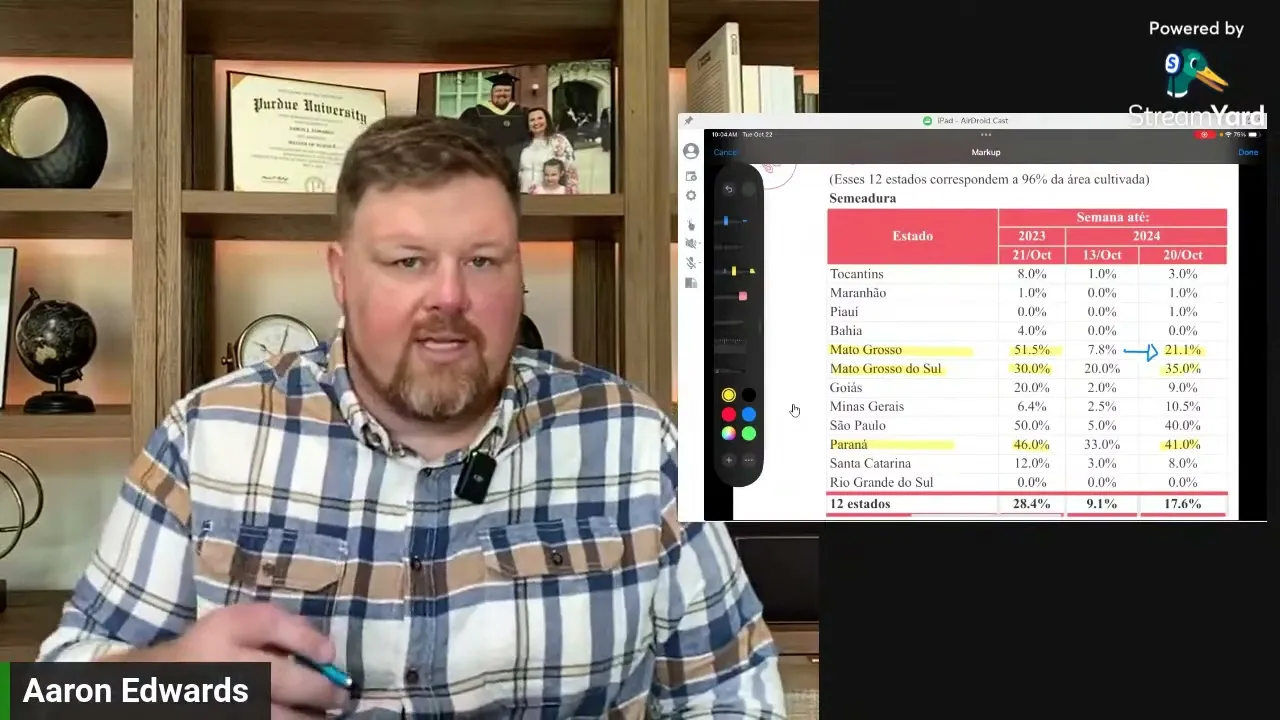
at on planting in just a little bit we're going to get those numbers um yeah I I I skipped ahead we'll go back to the other ones but as we look at that and let's get a highlighter I think that's the best way to visualize this part is with a highlighter so the PowerHouse state in last year mat this is a quarter of Brazil soybean production is in this state they were halfway done last year they're at 20% so that is a 30 percentage Point lag compared to last year in all fairness it they planted
fast last year but but not 30% right they're below on every metric historic average last year soybean planting in m is delayed and look at how much progress they made look at how much progress they made from last week right they put a lot of beans in the ground last week why many of you know there was a a wave of rain that came through so Planters were just running as fast as they could but there there's still an issue I'll give get this a little bit bigger there's still an issue okay they planted you
know 14% of their crop in in a week but they're still late the other two states that I wanted to point out were M and Parana okay Parana they they had 46% planted last year they're at 41 that's okay I'll go back and so show you a picture of Bops in a little bit m is actually a little bit ahead they're at 30 and 35 those are those two states that are okay right those are okay but if we look kind of across the board um let me see if I can get this in green
here these four states that right there it's known as ma to and that's that Northeastern expansion area and um they had planted last year they they're I mean they're not really late toking is a little bit but there's nothing I mean there's no good news there either right they're it's early to be planting but they're still not uh still not doing very well and then if you look down farther south you could see kind of across the board let's maybe get uh maybe get a red highlighter for some of this here just these are the
ones that are delayed just look at last year compared to this year this one's not too far off but it's still 10 percentage points behind so there's definitely a story and the big takeaway is obviously this last year they were 28.4% planted this year they're 17.6% planted in this state that is okay in the state that's looking right I'm going to show you pictures from this state everyone always likes to share uh pictures of of good crops and also disaster crops we don't have disaster crops yet what we have is delayed planting but the first
one is Parana that's farther s South that's what their crops look like that picture is from last week B is known for its red Red Dirt so you can see kind of what that looks like and we'll go see some pictures of M in just a little bit this is the the condition let's just uh get you guys situated a little bit on that condition of the crops so we've got this yellow here this is veget development this is from the conab website give credit where credit is due this is the uh see if we
can get that conab that's the Brazilian agency that's a b right there uh conab and then the um the other one that we got let's get the highlighter here is a lot is emerging so vegetative development emerging but again we're just what 17 18% planted not uh all all in or 17.6% planted these are pictures also from last week from a customer down there from the state of mou there's a setup and it's looking good I mean that what's in we we're getting to see pictures of the crops that are planted and doing well with
adequate moisture and they look good um there's just not enough yet here here the same operation just crops looking good quick shift to corn for some of you again this might be a bit of a review but it's important to um most of Brazil's corn is produces double crop and this would be the double crop region there's also some double crop here and here uh what we're seeing right now is the first crop corn in the first crop corn there's some overlap here and here they PL a little bit of first crop corn here but
not very much first crop corn in Brazil only accounts for 20 to 25% of production Brazilian production and Brazil only produces about a third of the Corn the US does give or take um yield and um probably closer to 25 to 30% actually but the only area that really matters for corn right now is Southern Brazil and you could see kind of adequate these three southern states are the only thing that matters and they're a little little dry but it's not too concerning um and it's almost all just in the the vegetative development or emerging
and they're about a third of the way planted so it's not there's no story in corn mainly because this story in corn at this point in Brazil's crop year doesn't really matter for glob Global supply and demand of corn the story that does matter for Global supply and demand for corn in relation uh is actually delayed soyan planting and I know we've looked at this chart a lot but it's kind of the the central part of the the current situation this is always what I'm looking for and this is a proxy right this isn't this
isn't perfect but for just as you look at Brazil I always need this number to be 30% by the end of October in order for us to have a decent shot at Double crop corn in Brazil now that's not perfect science it varies month by month you can have late rains but that's a good ballpark number that kind of Keeps Us honest so will they get to 30% here will they get 30% planted by in the next 10 days is it possible yes yes it's absolutely possible is it likely well I have my doubts that's
actually probably the friendliest story for corn is the delayed planting in soybeans we've gone through that we've kind of got a good idea on the fundamentals Brazil's corn and now it's important to just re-evaluate kind of just the philosophy behind what we do right so at the base level of the pyramid is the market plan portfolio that's what if you're watching in real time we have worked together developing your specific portfolio for your specific farm and that's kind of this template that is just the foundation of establishing how we're going to build a portfolio of
bushels for your Market that will solve you know our goal is to beat your costs your cash needs and the market and we're going to place place your bushel in a portfolio that's the groundwork based on that we still have to execute within that that portfolio so the n level is what the these updates these weekly updates provide and the philosophy and this is tried and true it's things that matter that help me know how to gauge when to sell when not to sell and help us take action eventually we look at the F fundamental
seasonals funds and technicals that's a lot of the driving force so the whole first part that we talked about it's basically fundamental that's important so we can get like situated as where are we in the in the world in the marketing calendar uh what's going on that's kind of big picture that doesn't really Drive decisions on sales that's just can we just get situated can we just get context seasonals funds and technicals is what we're going to look into now and then we're going to out of that we're going to come up with an action
plan even if the action is no recommendation or no sale that is still a decision you decided not to act so let's let's uh shift gears here now we're looking basically the three things we want to cover our seasonals funds and technicals we'll start with the cash position with the managed money position for the soybean Market managed money so this is just the year of 2024 I want to put this in red because it has been a rough year we got to our ultimate low Point here and let's get one of actually didn't show up
too well let's do let's do a a pin in yellow we got to our ultimate low Point here um Mid July since then we've gradually you know we've gradually been reducing our position size on the report two weeks ago we got uh I guess it probably gets the the the silver medal or maybe bronze medal of the smallest sold position by managed money or speculative money in the board trade um thinking it gets a bronze because this uh this was similar and then all early in January it's not showing up there maybe we can move
this over early in January we had one but it's if it's not on the podium it's close to it can we get this sideways there we go so these would be the four times that we kind of had smaller positions we got close to it the bad news the bad news is we kind of took it in the chin with beans beans plummeting we got the this fun position down so that's a little bit disheartening the good news in my opinion is how much conviction is there to the downside so the bad news is if
they choose to sell this off again from this price level that could be catastrophic that could be absolutely catastrophic for price I have my doubts because it's October and because they tried to sell it off and it didn't really turn South with everything that we know with planting delay do they really want to you know push that price lower is that the expectation um moving forward that that this thing is going to Plum it so the central question of this video is is it a double bottom in beans if this thing if the speculators were
to let me see if I can get make this a little less messy if the speculators were to just absolutely punish this market and add speculative pressure then yes this is not a double bottom the bean the bottom can absolutely fall out of the bean market and that would be uh a major problem that's going to be not good bad in many levels seasonally that's not what I would expect we'll go through the rest of the the logic or the thought process in just a little bit in order just for the sake of context I
want to show you here just kind of do a rundown of markets so we can just kind of get situated this is trading view I like their their charting software so we're looking at crude oil crude oil took it on the chin if we can zoom in here you can see you know crude oil really took a hit and then the last couple session it's recovered gold is just you know pushing the highs when will it run out of steam how high can it go go you know it's really Off to the Races not even
getting the let me see if we can reenter that and get a little better better view of it I mean gold is just up up in a way right the dollar this is maybe the biggest story for for the soybean complex the dollar has tremendous strength just a lot of strength that for whatever reason I think a lot of it might be tied to the elections coming up there's just this expectation in a strong strong dollar last time Trump was in office he valued a strong dollar and I think the market is saying hey if
Trump wins strong dollar is something that we can look for for context it's not like it's not like it's pushing records or anything it's just um it's just recovered quite a bit so I think that that's that's a major thing the reason it matters for the soybean parket Market in addition to just how how doll the dollar impacts exports but if you look in Brazil Brazil has had had um one two three this is the fourth opportunity this time this year of pretty strong exchange rate that gives them a good price in Brazilian currency and
last time when we had this run up in August this exchange rate run up in August that you can see it really peaked out that coincided that was about 10 days off 10 days before the low of soybeans in in in Chicago and I think some of the pressure that we've seen selling uh we'll just look at it here some of the selling pressure that we've seen recently this selloff here in May I believe is due so this selloff in August coincided with an exchange rate move in Brazil this selloff more recently also coincided with
an exchange rate recovery I think that's part of the issue or part of the problem I think I have that and I think I have yeah we can we can mark this one up I did a prank screen of it it's from probably an hour ago but uh it's close enough close enough for what we're doing so when we had um this sell off here coincided with an exchange rate move or actually would be kind of yeah right there and then this sell off here also coin coincided with an exchange rate move so is this
a double bottom right if we're going to go through the logic yes this is a double bottom then we'd say okay maybe this was be a bottom and maybe we're forming a bottom in here and then it'll recover wonderful that would be amazing that's actually kind of what I expect but the question is from this point is it going to go up like that black line or is this thing just going to maybe chop sideways a little bit and then just absolutely take a nose dive I don't have a crystal ball nobody does but I
do think it's important to remember that the exchange rate move if the exchange rate were to continue in the wrong direction um that might encourage farmer selling but everybody kind of knows the psychology of selling right it starts into a rally you're like I've got to take advantage of this opportunity when that goes that doesn't that second move in the rally does not always convert to the psychology of farmer selling it's very hard to sell prices go up and then you sell more that's the right thing to do it's just very hard psychologically to do
it so and also if we have that that move up in exchange rate what will the Brazilian crop be looking like what will delay planting so there's a lot of I think this selloff was attributed exchange rate I'm not sure that we can project that logic into the future if it sells off more if the Brazilian currency devalues more they will sell more soybeans I'm not convinced of that and if we look at a January contract we could do the November there's just not much time left on the November um again maybe it's too much
of an OP Optimist but the question in my mind is and this is this is probably the best way to think about it right you are right here from this situation let's think about what we know Brazil uh delay in planting what else do we know it's October when was the last time you didn't sell in October and regretted it because the market never came back back I'm trying to think if there's a Time the only time that really comes to mind would be like 2012 there might be another outlier year but even when you
have an October rally it's very rarely the end of the game right if it starts recovering maybe it takes a little bit of a dip and it recovers again so seasonally it's not the right time so Brazil's delayed season it's not the right time um the Brazilian exchange you know the brl it maybe this explains a sell but will it continue selling off so there's a series of factors and also the Brazil has the lace Brazil um no crop yet that should be a c no crop yet so there's a lot of lot of issues
that make me think I'm not sure how how sure of a downfall do you have to be to look at the current scenario and say yeah it's going to keep going down there's not going to be any weather issue in Brazil they are for sure going to get caught up on planting um the delays to planting won't impact the double crop corn in Brazil like how convinced you have to be in that series of narratives that the the only possible scenario is that Brazil has a record soybean crop they have enough of a corn crop
to not encourage more people to plant soybeans next year um nothing's going to go wrong you know there's not going to be anything any uncertainty in the soybean Market between now and and ni she that's going to boost cor bean prices so I personally I think this is more likely a double bottom or similar to a double bottom than that we get an absolute selloff again we're trusting we'll get to that later but we're trusting the data we're trusting what works also if um there's the old adage cash spreads Futures so on this last downturn
that we saw on the soybean market so we saw the move down uh this is the Purdue I'm a Purdue graduate I'm always biased Purdue and I really do like their basis tool a lot this is free online you can get it uh we've seen on the last move down we've actually seen basis recovering which seasonally if you look at at the average it does actually recover right at least stabilize and this is against the January contract um so we saw the move down in Futures and then we saw a it's mod right I'm not
saying that this thing oh you got a dime uptick in so in um in basis so you need to be happy with the you know 40 50 Cent sell off in beans I'm not saying that I'm just saying um as prices move down they're like hey hey I still need beans and they started bidding up basis so it would stand a reason that if prices continue following Chicago we would continue seeing an uptick basis it's the old adage of cash spr Futures and I will actually move over back here just to look at the spreads
we'll come back and talk about corn in a minute um but here's the soybean spread and so basis we saw a slight uptick and the soybean spread is actually weaker than the corn spread but the soybean spread came down to a low in October but it didn't even get close to the lows from mid August right so the spread has been stronger the Jan this is the Jan um July spread the spread has been stronger than um currently than it was back in August again my thought is this probably is looking more like a double
bottom we shift gears to corn and if you look at corn you could see we didn't even come relatively speaking this is May corn we didn't even come as low if we go to De uh you can see de didn't even take the dip and while we have it let's look at the spread right let's look at this is the de July spread that spread is just through the roof right it's just really climbing up which means I want corn shortterm that's what when this spread is strengthening that's what it's saying I want corn shortterm
it's it's a bullish sign so let's go back and look at some of the numbers on corn uh where we we in the images oh here we go all right so the managed money on the managed money on corn let's get it let's be able to mark this up again very similar story this is the bad news for the managed money is that they came back to selling this week again if they choose to sell this is I think every Farmer's worst nightmare if they go back to selling this Market we are in trouble uh
we're looking at speculative money pushing prices lower this is what should keep Farmers up at night if if you're prone to anxiety or or uh just this in my opinion is the worst case scenario however it's also not really what I expect um what I expect right if we look at and we just saw this right this is December but we can mark it up here um so this is December let's make this a little friendlier make it make it green here's the lows from August here's the lows so it's starting it looks like it's
trying try to recover right resistance we got to get through the 20-day mover we got to get to this previous High then we got to get through the the 200 day which is moving down right we don't know how fast it'll move down so I'm not saying that we have like this you know the wind at our back and this is a forever bullish Market but whenever we have plenty of grain typically what we have is range bound trade and it sure looks to me like this is a market that is kind of comfortable that
we're probably closer to the lower end of this range at least short term very similar situation if we look at the May Futures don't need to go through that basis is a little bit disheartening we took uh this is again and and it defaults to the to tipic new County home of home of the boiler makers but basis is a little disheartening right basis got weaker spreads got stronger what to make of that I think that there's probably a little this is the December basis I think part of the strengthen the December Futures Contract has
punished this basis a little bit but the long and the short of it is um I'm not overly concerned with the downside short term of corn for let's go through kind of the summary of the reasons right so let's let's take a look at this let's put this all together seasonally we're in Harvest Harvest is a buy for corn we're in Harvest seasonally this is a buy for soybeans managed money technically speaking so I've established some arbitrary points where overbought oversold I won't go into all the details on that but the managed money technically here
would be in a buy and the soybeans would be neutral based on historic levels and then the trend is down and this might seem a little bit counterintuitive oh if it's down if we're in a downtrend then we want to sell because it's going to continue going down well my thought process is a little bit different right um you want to sell in an uptrend you want to sell when markets are recovering and that's what we talked about the psychology is hard markets recover and then they go higher that's where you should be adding into
sales uh over time that'll give you stronger prices so let's just this is On The Board of Trade right Chicago so seasonally it's a buy manage money saying buy corn beans not a clear indication on managed money yeah if it goes back to being selling out that would be a disaster that would be bad but it's it's rare that you would go an entire year with only sold positions and seasonally you would sell off again can happen I don't have a crystal ball but it's rare and what we have to do is to place ourselves
uh on the right side of datadriven analysis and action so um and then here let's just talk about B basis maybe we can keep me from typing but uh soybean basis is solid and historically improves over the next few weeks corn basis historically is sideways to up between now and the end of the year if Chicago is in more of a buy and basis encourages patience I do not see a need for action on the selling side at this time so that wraps up kind of our um our analysis now let's go back we've got
a couple of questions that we want to go over so we'll go over a couple of questions here and um let me get it back to the big screen here and let's get the questions up there oh there's our first question okay if corn is in an uptrend should I buy calls first of all technically let's get the corn chart up here first point let's just say let's just look at December or even oh let's look to the C so technically when it's below the 20-day mover this blue line here I would say uh and
let's actually let's look at the images because I think it'll it'll be easier to Mark Mark it up so December here oh you guys aren't seeing my screen let's get it let's get it sideways there if corn is in an uptrend should I buy calls uh okay so first of all this 20-day mover here that's what I use for uptrend downtrend if it's below that it's in a downtrend down so quick correction it's not an uptrend it's in a downtrend it would have to be above here right for us to be looking at an uptrend
should I buy calls nothing necessarily wrong with buying calls right maybe you'll buy calls now you say hey it's October we had a correction I bought some calls I made some money that was a good decision but from my vantage point the challenge of the farmer from my vantage point what I'm always looking to accomplish uh with the producer users is how can I reduce you know reduce my effort reduce my distractions reduce all of the noise and it's not my goal to maintain you informed it's my goal to help you know when how much
and how to sell so that you can optimize your Revenue right so you can have cash when you need cash um beat your cost so you have profits and uh within the portfolio of management beat the market right so we want to beat your cash needs your costs and the market that's our goal and how can we take out the noise focus on action and accomplish that right so the steps are build a portfolio look at the indicators take action with that as an objective very rarely will I recommend calls right for me it's like
it it a lot of times options are used at whether it's calls or puts they're used as what I call tools of indecision which is the exact opposite of what my goal is to accomplish right so um should I buy calls will I make money buying calls I I don't know it depends what call it depends on a bunch of stuff now in my opinion if you know that there's a chance that basis recovers there's a chance that Futures recovers you don't you don't need to be distracted with calls just wait until it's the right
time to s and then make your sales maybe that's a basis contract on the road maybe that's Futures maybe that there's a number of ways that you can take action on that but I don't see I don't see the upside to just saying hey I bought some calls and it works is it a decision that is replicable is it a decision that is Central is it a decision that can take you year after year to better and better results so it's just for me it's not that it's a problem it's not that it's wrong you
might even do well on your calls I just don't want an additional project or an additional distraction to keep you focused on making good decisions and a lot of good decisions is honestly psychological and I've seen too many times where people get caught up on you know they they raise whatever 100 200 300,000 bushel and then they buy four calls and get hung up on those four calls and then they get paralyzed on making grain marketing decisions right because it's not it's not uh it's different mental accounting so the focus is to manage your marketing
and at this point in time and just kind of as a philosophy I'm not uh you might it might work it might not it's not Central to this any any type of cohesive strategy that I would defend at this point in time uh next question will planting in Brazil continue pressuring markets so the thought is if we do see if they do keep planting and you know it it's just this monster crop that's coming out of Brazil is just just going to be a damper on the markets that's my understanding and I actually think the
the biggest damper is what we talked about is likely the exchange rate that we saw but we're also at a point you have to remember a quarter of Brazil's uh production is matu and they're already 30 percentage points behind so will they get caught up maybe but there's we're probably already talking about a smaller corn crop down the road and then if we have less corn out of Brazil will that affect acreage in the US and has it already been delayed long enough to where this bullish uncertainty will kind of linger with the market and
my opinion is the delays that we've already seen will likely be just kind of a a cloud over um the production possibil ilities of Brazil for several more weeks right okay it was off to an early a late start did they get it in then okay they finally got their crop in but with a delay but is it looking good and just the uncertainty of raising a crop when you have a couple of hiccups in the spring and you don't get the crop in on time usually that bullish story lingers somewhat it lasts a little
longer and I don't expect any reason why this would be different uh do we have I think we have one more question and that'll wrap it up um for today appreciate appreciate your time appreciate you watching should I sell my corn get that back up there should I sell my corn across the scales or store it um on free storage until the end of this year whenever you talk about uh storage decisions so if you if you're under the assumption that I'm going to take my corn into town and I either need to sell it
today price it today or I need to pay you know 15 cents and wait um I would probably give yourself the the extra three months shy of three months right two and a half months um leave your corn in town pay that first lump of storage I'm not a big fan of paying storage but just pay that first one will ba between basis and Board of Trade will it recover enough to cover for that 15 cents and I think there's a decent shot that the answer is yes so I think that this initial I don't
want to just leave it in storage forever right but this initial lump I don't think that that's a bad decision the caveat that I would say to that is I really don't like these bushel that are in custom storage right this is the Achilles tendance so it depending longer term at going back to the base of that pyramid let's see if we can get that that well I I want open up but the base of that pyramid is building a portfolio right so the bushels that you don't have in in your own storage and you
didn't forward price those are really problematic those bushels that go into town and the custom storage those should be limited to my goodness I had an extra 20 bushel an acre that I I didn't plan on okay those are extra bushels that's extra Revenue that's but in a normal plan if possible those bushel should really be minimize like the amount of bushels that you have in custom storage um that should really only be run over bushels and even if you can plan ahead to not even have that that would be ideal uh so I don't
like bushels in custom storage um moving forward we need to have a plan for you to not have have the least amount of bushs and custom storage possible that's the long-term Sol solution and the best answer short term you can't go back to May and sell you know the miday prices on a forward contract you can make a mental note that that's what you need to do Nick spring but you can't go back in time and say hey I should have priced these back then we don't live in in a world where you can just
hit reverse and go back so given the options now I think you say hey I really don't like using custom storage this is something I need to do a better job of avoiding if possible if they're run over bush because you had an amazing yield I don't think anybody's going to apologize for having extra grain to sell right okay you have to put them in custom storage you got nothing to do because you got more bushels great that's not a bad problem but if it's bushels that are in custom storage that could have been avoided
with a little more planning a little more uh structured portfolio that is a big mistake and that needs to be avoided now given this current situation I'm in this situation I have these bushel yeah I'd probably give yourself a lot of contracts go end of the year you know into January depending on when you harvest I'd probably give yourself that first that first window of custom storage you know pay whatever fees it is put tuck it away for that amount of time and don't necessarily need to keep rolling it above and beyond that so thank
you all for watching this week and um appreciate the vote of confidence and uh we got more coming next week so a lot a lot of news hopefully hopefully we'll be able to the title of next week's video will be double bottom confirmed or something fun like that so hopefully we'll be testing some of those resistance points have a great week











![All 7 Chakras Healing Music [removes negative energy, clears the aura & improves the body] 528HZ](https://img.youtube.com/vi/NF35xujl23c/maxresdefault.jpg)