hello everyone welcome back to week two and for introduction to International Security 2 let's get started today we're going to do just a brief recap of um International Security and some of the definitions that that we went over and we're going to do a deep dive into some of these uh security theories realism liberalism constructivism as well as a few others and we're going to be doing a few case studies to really illustrate the secur theories in practice okay so let's start with a brief recap of International Security so when we're talking about International Security
we have to look at it from various angles different lenses because it is a very multifaceted concept and it goes beyond just military power we're talking economic stability political Integrity social harmony and ecological balance so first we have military security right this is your very tra traditional view on a state's ability to defend itself against external threats this is a buildup of your military your weapons your intelligence you have Economic Security which is ensuring economic growth and protection against severe economic downturns because if you have economic instability within a state you're going to have internal
unrest which can lead to external vulnerabilities environmental security when we we have to address the environmental challenges and ensuring sustainable use of our natural resources resource scarcity can lead to internal and external unrest which can lead to conflict and vulnerabilities we have personal security which we're seeing a focus on the protection of individuals from violence and ensuring their well-being and not solely focused on the state's ability to survive and then we have political security right a stable political environments good governance and the protection of human rights that all provides for a very stable state which
provides for good alliances which provides for a more secure state in order to provide those individual protections and if you don't have that if you don't have a good political environment if you don't have good governance and if you're not protecting human rights you're going to have internal unrest which can lead to external threats so it's really important for us to understand this from a holistic approach because different theories emphasize different aspects of International Security so knowing the full scope and knowing all the different theories and how they approach International Security you're going to be
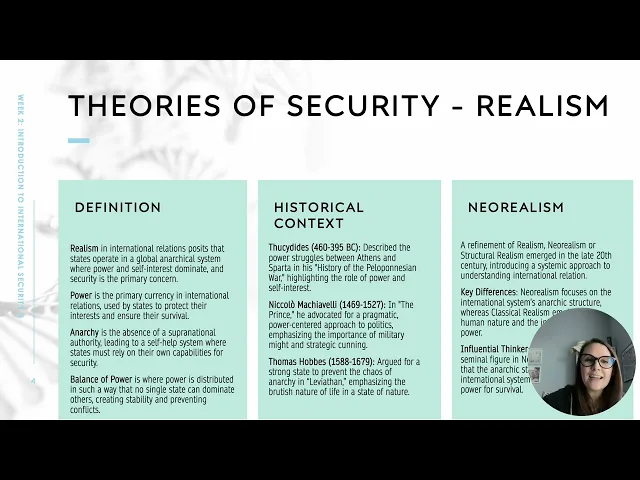
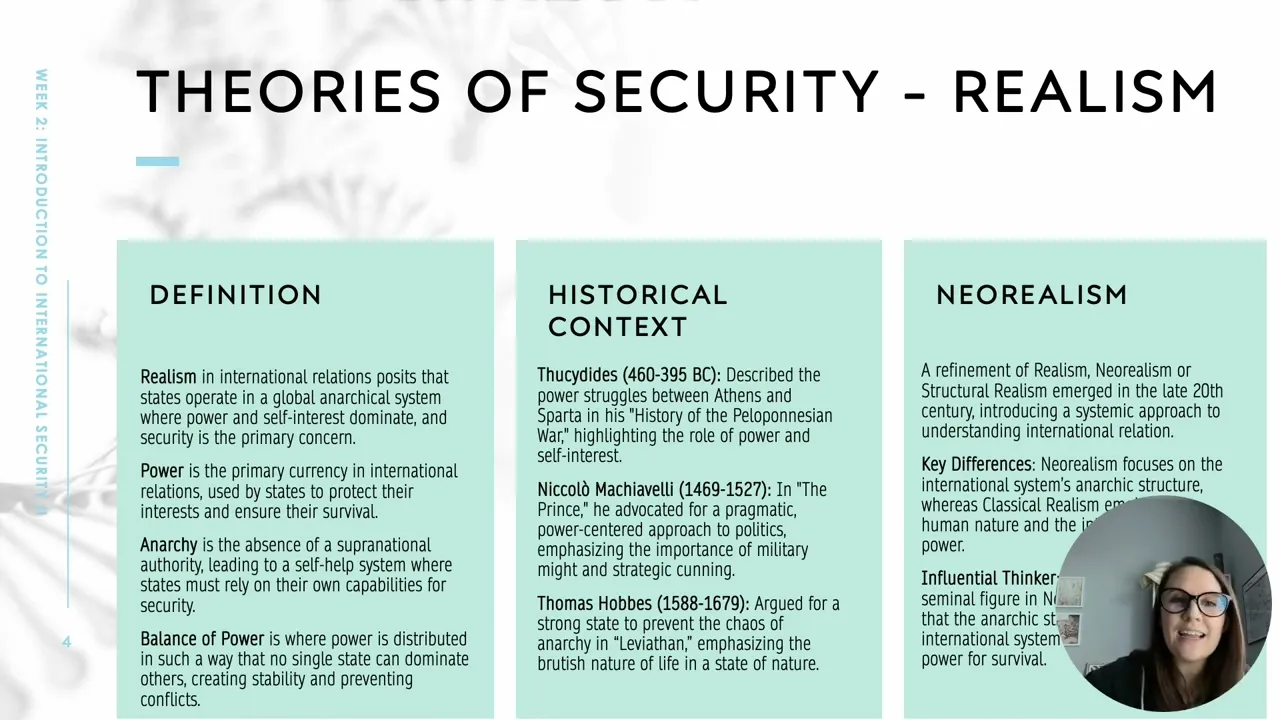
able to have a more robust and nuanced application of these theories to where we are today okay so let's go through it real ISM okay so realism right the F the fundamental assumption in realism is that states are the main actors in an otherwise Anarchy of of of an International System no Central Authority exists to enforce the rules or agreements right there is no World Police now this has a security dilemma because the pursuit of your own of you know of the state the pursuit of the State security their actions can inadvertently threaten others leading
to arms race Andor conflict so power is is what they're talking about power is multifaceted right military power economic strength technological advancement even soft power is considered cultural influence right these all have their own place in the International Security realm when we're talking about power power is the ultimate resource it is necessary for states to defend their sovereignty and pursue their national interests right so when we're talking about power we're always looking at relative versus absolute gains so realists focus on relative gains realists are more concerned with their power position in comparison to other states
than with the mutual benefits they want the best seat they want to be in the best position and they want to be the queen on the chess board right now this leads to the Anarchy side of it because there is no Global government there is no Global force that will make States operate because States operate in a self-help world and they prioritize their own security and because there is no Global police to kind of keep States in line we have to rely on alliances but States cannot fully trust other actors this leads to a Reliance
on that self-help mechanism and this is the accumulation of power which includes forming alliances because we have to have a balance of power right because by preventing any one state from becoming too dominant a balance of power maintain stability and it it deters unilateral aggression so the balance of power can really manifest through bipolarity multipolarity or you know other configurations of these different states coming together because they all have different implications for the international stability now if we look at the Historical com context right where did this realist ideal come from do ities right the
pelian war he Chronicles the pelian war and it offers one of the earliest analysis of power politics and what what he's writing about is how Athens and Sparta are driven by self-interest and power considerations right during the the pelian war you have these two powers that are fighting against one another you have the individual states that are driven by what is best for Athens what is best for Sparta and their power considerations rather than the mutual benefits of what's happening around them though so real politic comes comes from this and and and he is often
credited with laying the groundwork for real politic which really emphasizes the harsh realities of power struggles in the international relations world this is the harsh power versus Power I'm going to looking out for myself I'm looking out for for Numero Uno and my power is only determined by the relative power of those other powers around me do I have the best seat at the table am I in the most powerful position on the chessboard then comes the Renaissance and Nicolo uh makavelli right he writes the prince which is a seminal work that really underscores the
need for pragmatism right this this shrewdness in order to purs in in order to pursue the power in political leadership right so melanism where his ideas have since become really synonymous with political cunning and strategic calculations and this influences generations of political thinkers and leaders right I have to be a pragmatist I got to do what works right I'm going to work with who I need to work with I'm going to compromise where I need to compromise because I'm trying to get to that end goal I need to be a pragmatist but I can't wear
my heart on my sleeve I need to I need to be harsh sometimes you got to be cruel to be kind right that is that mindset of that Mackie evanism and then comes Thomas hops right Leviathan Hobs really paints a pretty Grim picture of life in the state of nature right and he argues that a strong Sovereign Authority is necessary to prevent Anarchy and ensure stability so the social contract hobbs' social contract this Theory lays the groundwork for the understanding that the relationships between the individual the society and the state all have their own implications
for international relations right so this is where the foundational perspectives of realism come from then we jump into the Neo the neorealism side right so this originated in the late 20th century Neo realism became known as structural structural realism and this built upon the classical realism but introduces a systematic and structural approach to these international relations so we're focusing on systemic structures right now unlike classical realism which places emphasis on human nature and the motivations of individual states neorealism cont concentrates on the Anarchy and the structure of the International System and how this structure influences
State Behavior rather than it states doing whatever States wants it's what is this nucleus of an anarch key focused International System that all states have to interact with right so we have there's this key uh Divergence right from classical realism which is what we call the structural versus human nature so classical realism right um think uh uh Morgan thou right emphasized really epitomized by thinkers like Morgan th and he sees that the quest for power is rooted in human nature and the characteristics of individual states now neorealism posits that the drive for power and security
is a direct result of the Anarchy of the International System so instead of States acting for states it is States acting rather reacting to this interational system so States in a Neo realist worldview right they're primarily concerned with survival and they acrew power not necessarily because of this inherent desire to dominate but because the system demands it for survival right so when we look at who phrased and framed all of this right we're looking at who are these influential thinkers Kenneth Waltz he stands as probably one of the most if not the most influential proponents
of Neo realism and fundamentally shapes the Theory's development with its key propositions right the theory of it of international politics this is Walt seminal work and he outlines the neorealist theory and he argues for the importance of intern AAL system structure in understanding State behavior and international relations again a neorealist state they are acting out of necessity there's this Anarchy out there and I need to be powerful to survive so you have this anarchic system where there's a lack of a central Authority and this creates an environment where states have to rely on their own
capabilities for for security and survival okay let's look at it the Cold War I know the Cold War again yes the Cold War again because it's such a perfect example let's look at the at the context here Cold War spans from approximately 1947 to 1991 the Cold War was basically a prolonged state of political and Military tension uh between the United States and its allies and the Soviet Union and its allies so we have this balance of power right so both superpowers engaged in an arms race they're building this vast arsenal of nuclear weapons and
developing extensive military capabilities now this reflects the realist principles of power and security right so this is really realism in action right this is what it is primary goal of both the US was in the Soviet Union was to ensure their own Survival and to prevent the other from achieving a position of global dominance so not only am I looking out for Numero Uno and I got to make sure that I survive I have to not only survive but I have to make sure that you don't take over I have to make sure that you
don't become a a a global Powerhouse I have to make sure that you are not the only superpower in the world so you you have this very survivalist mentality here and you have this military might uh and deterrence right so we we have this accumulation of military capabilities and this was seen as essential not just for defense but to but to serve as a deterrent against potential aggression so what does this mean the Cold War characterized benon by an anarchic international system each superpower has to rely on its own capabilities for security there's an absence
of global authority to mediate tensions or to enforce peace agreements right that is left the United States and the Soviet Union in this Perpetual state of competition and mutual distrust right so we have the balance of power and stability each side is amassing Powers right they each are building up their military they're building up their arsenals now paradoxically this led to a form of stability because as I neither side wanted to initiate conflict that could lead to Mutual destruction right mutually assured destruction neither side wanted to be the aggressor so this balance of power even
though it was very tense it was very precarious it helped prevent direct military conflict between these two superpowers and this highlights a key tenant of realist thought that the balance of power can contribute to stability right that is a very core tenant of realism okay let's look at liberalism the Democratic peace Theory what is it well I'll tell you Democratic peace theory is basically a theory in international relations suggesting that Democratic countries are less likely to engage in war and conflict with each other why does that matter democracies tend to have shared values and Norms
right such as the importance of dialogue respect for human rights and the rule of law this is generally speaking I am not saying any democracy cannot engage in these things I'm just saying gener generally democracies tend to share these values and have these tenants kind of built up within their their own governments and so these shared values facilitate I should say are more likely to facilitate peaceful resolution of conflicts right so if we want to look at how how is this working right so you have Democratic account accountability leaders in Democratic states are accountable to
their citizens right so going to war can be an unpopular decision especially if it doesn't have a clear justification if if a leader in a democracy goes to war without a clear justification and its people are against it you're going to have social unrest so this leads to transparency democracies tend to be more transparent in their decision-making processes we were attacked we are going going to war we're going to prevent this other superpower from becoming too too dominant therefore we are going to match energy so they they tend to be more transparent about why they
are doing what they are doing and this can build trust among states as well as build up the foundation of its citizens trusting its government's institutions and then we have the this Shar Democratic Norms right because Democratic countries share similar views they're going to share norms and this can lead to a better understanding and cooperation if you're in a democratic State and you are familiar with the Norms the culture the practices of a democratic State you are going to be more likely to understand the actions of another Democratic State therefore you're more likely to become
more um you're you're going to build more alliances you're you're going to you're going to more easily come together right and then we have of course free trade right because we have this liberal economic order of interdependence so by promoting open markets and trade countries become economically interdependent and this means that the well-being of one country um is going to depend on the well-being of its trading partners right so it's not it's kind of the opposite of mutually assured destruction it's it's like mutually ass assured success right as one country benefits the other country will
benefit as well and this causes conflict reduction because as a result of this interdependent countries are less likely to go to war with each other because doing so would harm their own economic interests I'm not going to go to war with my trading partner because then that's just going to mess up my imports exports that's going to cause political societal economic unrest within my state right so it wouldn't be in my self-interest to go to war with somebody that that I'm a trading partner with and so kind of leading off of this economic Prosperity we
have this this stability right wealth generation through trade can lead to economic Prosperity which is associated with political stability and peace if you are prosperous if you're gaining money if your your your people are successful within your state you're going to be more likely to have a stable social construct that is not going to lead to vulnerabilities or as many vulnerabilities as if you have social unrest due to an economic downturn so when we're talking about the international institutions of this we're looking at what is their role in security right because International institutions provide the
platform for countries to resolve their disputes peacefully so if you have two states they can go to an international institution to provide kind of like neutral ground right to resolve their their dispute without having to engage in conflict and these institutions can uphold the international law especially if they are you know hosting two separate countries and this ensures that states are going to adhere to agreed upon norms and rules and these institutions they're also going to facilitate cooperation among states because it's essential that they do so in order to address the global challenges like climate
change pandemic security threats because they're all going to want to be on the same page so if we if we look at this we're looking at institutions like the United Nations right they work to maintain International Peace and security they are working towards developing friendly relations among nations and they prom promote um social progress right better living standards protect of of Human Rights but that but that could also be the international monetary fund and the world bank right because they provide financial support and advice to countries facing economic challenges and they're looking at aiming to
reduce poverty and promote sustainable development so we have a lot of these different facets and these different types of organizations that contribute to International Security in their own perspective Lanes if we want to look at you know who are the you know thinkers of this well first we have to consider Emanuel Kant right so his advocacy um he wrote a Perpetual piece in uh 1795 so this was an was an advocacy for Global cooperation right so he kind of puts out this philosophical argument advocating for World Federation of republics and they're all going to be
bound by a common rule of law and he believed that this International legal framework would promote peace and prevent War so his idea was quite revolutionary for its time because he's proposing a structured approach to international relations that prioritizes peace and and uh cooperation over conflict so at this time we have to look at what are the economic implications right so K posited that commercial relationships between nations would Foster interdependence right just like we saw so this interdependence would turn and to serve as a deterrent for war right you're not going to go to war
with your with your trade partner so as the economic cost of conflict would outweigh any potential benefits it's just it it's not going to add up you're going to lose more than you're going to get right so he emphasized really this importance of forms of governments right this Republican form of government suggesting that these systems with their emphasis on Law and representation right because remember that is what a republic is a republic is the representation of the will of the people and this would be more conducive to peace than any other type of government structure
we can lead to uh woodro Wilson right with his internationalism so he promoted collective security basically so he was a proponent of of um internationalism which really just advocates for a global approach to security and peace so he believed that an international body such as the League of Nations which he helped create um could mediate disputes and prevent conflicts so his advocacy for the League of Nations reflected his belief in the power of dialogue and negotiation as opposed to military confrontation in order to resolve international disputes so part of this was the 14 points so
this became kind of a blueprint for post World War I piece right so after uh World War I Wilson presented his his 14 points and it's a set of guidelines that was intended to shape the post-world order and these points emphasize principles like self-determination which is the idea that Nations have their right to determine their own political Futures and collective security which is the idea that peace and security are best maintained through mutual cooperation and protection so this Vision that Wilson has kind of laid the groundwork for was the establishment of the the League of
Nations and this influenced the subsequent International institutions which became the United Nations so by putting these ideas of conon Wilson together right they during their respective eras because they you know didn't live at the same time but they were very pivotal in the development of these liberal theories of international relations because their emphasis on law cooperation Democratic governance and the peaceful resolution of disputes has continued to shape the liberal thought and PR practice in international relations as we see it today so when we're looking at the the neol liberalism kind of side of the coin
here they're representing a more contemporary adaptation of liberal thought in the international relation field because it it inherits the core principles of classic liberalism right the belief in democracy free trade um International cooperation but adds its emphasis on International institutions right because institutions become the mediators so in this International System where there's no Central authority to enforce the rules states have to operate under conditions of Anarchy right there is no World Police to keep States in line neoliberalism posits that International institutions play a crucial role in mitigating these conditions by providing the framework for cooperation
and the mechanisms in order to resolve disputes so even in a self-help world where states are primarily concerned with their own Survival and interests institutions create environments that make cooperation more attainable and reliable because they do this by establishing Norms they can facilitate Communications and they provide the platform for negotiation so this becomes kind of a promotion of liberal values right the neoliberalism is characterized by its advocacy for democratic government not just within individual states but in international relations as well because that in a world that with more Democratic states will be more peaceful and
more stable so alongside democracy neoliberalism promotes the protection of Human Rights and the establishment of free market economic policies on a global scale so these are seen as interconnected with economic freedom and human rights really bolstering at democratic government and vice versa so really it's looking at these institutions as the vehicle to drive this endeavor for dispute resolution right by fostering this cooperation okay let's look at the European Union formation and its impact because this is a great example of seeing these liberal policies so the European Union or the EU is a quite a a
unique political and and economic Union between 27 European countries and its Origins can be tracked back to the aftermath of World War II with the primary aim of fostering economic cooperation to to ensure that countries are so closely linked economically that it would avoid conflicts and maintain Peace So the um European coal and steel commu uh Community established in 1951 is often considered the first major step to what is now the EU so what we see here is democracy right the EU promotes this Democratic governance among its member states and with institutions like the European
Parliament where members are directly elected by the citizens of their member states it promotes free trade so because it it established this free market I'm sorry single Market um and Customs Union this facilitates free trade among its member states and this reduces trade barriers and promotes economic interdependence between them and then you have the international institution itself so the the EU itself right is basically a prime example of international institutions mediating disputes settling common policies and fostering cooperation among its members now this has aided to the peace and stability because the EU region has experienced
really unprecedented peace and stability since its formation so the Democratic peace Theory within liberalism can help explain this as a majority of EU member states are democracies and according to the theory democracies are less likely to engage in conflict with one another and then you have economic Prosperity right it's become one of the world's most powerful economic areas with free trade and economic interdependence playing that crucial role because liberalism would point to these factors as major contributors to the Region's stability and prosperity because it's so much easier to move uh products across with with in
these European States more so than if you were doing it outside you have the role of the institution right because the EU provides a platform for peaceful dispute resolution and a collaborative policymaking Arena and this reduces the uncertainties and the potential for conflicts inherent in the Anarchy of the International System right so from a liberal perspective these institutions are key to fost fering a peaceful and Cooperative International environment and then of course you have the promotion of liberal values because the EU actively promotes democracy human rights and economic freedom both within its borders and in
its relation to other countries this aligns with that uh neoliberal emphasis on the promotion of liberal views on a global scale so the European Union really stands as a testament to these principles in international relations because it's fostering de Democratic governance economic interdependence and Cooperative institutions it's created really a zone of stability and prosperity and peace within this region that was once marred by frequent and devastating conflicts okay constructivism okay now again we're going to go into these in more detail but these are just overviews okay so really constructiv is a theory um that emphasizes
the importance of social constructs right identities and Norms that this all of this shapes State Behavior and the structure of the International System in and of itself so one is identities right so the shared understanding and beliefs that shape how actors perceive themselves and others influence their interests and behavior norms which we'll say is the collective expectations right about appropriate behavior in a given context and this guides States actions and interactions um you can see this if you travel from one country to another there's just different Norms that people um adhere to it's not a
law it's just a norm right it's just how Society interacts with one another and this is the social constructs because aspects of international relations that are not given by nature but are the result of human interaction and shared beliefs so the role of these ideas right is that ideas beliefs and identities are Central to understanding the International Community because these Norms ideas beliefs and identities shape States interests threats as they perceive them and policy choice now ideas and beliefs um held collectively can lead to the formation of international norms and institutions that shape the behavior
of states right so if you're a state and you're a party to an international um organization right or an international group of some sort you're going to behave in the Norms of that group now that may not align exactly with how you would behave in your own state or how you would behave if you're visiting another state but in that social construct you're going to adhere to those norms and when we look at identity and interest how will state identifies itself right and its place within the International System now this plays a crucial role on
determining its interest and its policy decisions are they acting from a place of Power are they acting from a place of weakness are they the dominant party are they not the dominant party so all of that will play into what are they trying to get what are they trying to do why would they do it that way right so now one of the critiques here is that the materialist focus of realism and um liberalism argues that the power and institutions are insufficient to fully explain State Behavior right so the the material the power right the
money that's not enough to fully explain State Behavior you have to introduce the identity the social the Norms that that state is is acting within so you have a power and interest so power and interest they are important in constructivism because they are shaped by the identities and Norms rather than existing independently so if you have a state that is engag enged that is a democracy right and they are engaged in actively protecting human rights it would be out of character out of Norm for that state to go in and then just abruptly start disregarding
human rights right that would not be in line with the Norms um they would be more likely to address another state that is proactively disregarding human rights because within their normes does that make sense so you're going to to act and your Society is going to expect the state to act within that State's norms and so it it's not separate from military and power they are intertwined so institutions are not seen just as a mechanism but rather Arenas where these ideas are exchanged and Norms become constructed okay end of the Cold War now the Cold
War right intense rivalry United States Soviet Union lasted from from the late 1940s till the early 1990s characterized political tension military competition ideological opposition right now the end of the Cold War marked by the collapse of the Soviet Union the reunification of Germany a this was a significant shift in international relations right so we we have this changing belief and and identities so Soviet Union um leader uh gachev right he introduced a series of of reforms under the banner of new thinking which reflected a shift in Soviet identity and interest so he emphasized common human
values over class struggle and cooperation over confrontation so these reforms were really aimed at uh restructuring the Soviet economy um and its increasing political operations signaled a departure from previous policies um embodying a change in the Soviet identity and the beliefs about security and governance within that Society thus they are changing their Norms so the role of ideas in this diplomacy became us Soviet relations right so this transformation in Soviet beliefs and identity had a profound impact on us Soviet relations because this paved the way for disarmament agreements and increased cooperation so then we see
the end of the arms race so this shift in belief and identity on the side of the Soviets contributed to the end of the nuclear arms race so as both superpowers acknowledge the mutual benefits of of an arms reduction and the importance of preventing nuclear war so as as Norms shifted dialogue became to become more prominent so then we see normative changes right within the international relations uh construct as a whole because the end of the Cold War saw the spread of democratic ideals and the protection of Human Rights and this was influenced in part
by changing beliefs and identities of key actors so we see This Global shift this this transformation in in international relations that was not limited to just the United States and the Soviet Union it reflected a broader shift in norms and identities across the across the globe so we see this example of how constructivism helped explain the international Transformations through the lens of changing beliefs identities and Norms rather than just attributing the end of this very tense geopolitical rivalry solely on material factors like military power economic capabilities uh weapons arsenals but rather the role of ideas
perceptions and shared understanding okay feminist theories now we're going to go through this just um briefly because we're going to get into it more later but gender insecurity so feminist theories highlight The crucial role of gender in understanding International Security okay so it really it's they're going to scrutinize how masculinities and femininities shape and are shaped by global politics so when we see gendered Power relations right this is really an examination of how power dynamics based on gender influence international relations and security policies really the invisibility of women is really what this is what this
is addressing because often overlooked the role of women in conflict and peace processes and really this is advocating for their inclusion and recognition of what is happening and how women are influencing these different conflicts these different agreements these identities these beliefs right so we have this gender mainstreaming right which is the integration of gender perspectives into all levels of policymaking in order to ensure that gender considerations are Central and not peripheral so really what this is is you have to take both men and women's perceptions experiences and realities into creating a more comprehensive policy if
you disregard one perspective of an entire half of the human population you're not going to have a comprehensive security Theory because it will be masculine aimed without consideration for these what for what was peripheral now that needs to become Central then we have critical uh security studies so critical security studies really question the state Centric militarized approach to security right that we see with like realism and this is advocating for a Brader and more inclusive understanding so when we look at securitization which is the process uh for which issues are framed as security threats and
we need to turn that into Political responses right and this and this is where emancipation comes in which is the aim to liberate individuals and communities from oppressive structures so if you have a political structure that is oppressive then you need to look at the individuals that are a part of that and if you can emancipate those individuals that are being oppressed and take them out of that then these then these structures will be will basically collapse and you have to look at it from a different point of view because that securisation is a political
response and not strictly a security threat so you have this engagement with various threats right so if we look at non-traditional security threats climate change poverty inequality all of these issues can lead to significant security threats because they lead to social unrest when you have social unrest you have a crumbling trust in your State's institutions and therefore you're leading to an internal struggle which leads to external vulnerabilities and then we have human security so human security shifts the focus from State Centric to individual right emphasizing the importance and security of not well not just the
security of individuals but also their health and well-being so when we look at the economic side right this is ensuring that basic resources are provided individuals need to have access to basic resources in order to have successful livelihoods you have health security right protecting people from disease and unhealthy and unhealthy living conditions so state is looking at I need to protect this individual not just from these external threats but from their everyday realities they need to have healthy living conditions right and then you have political security which is safeguarding human rights and really just living
in a society that honors the dignity and freedoms of their individuals and not looking at it such a strict state state Centric view where you're looking at this state as as a thing it is a construct it is a government it is a military but not the individuals that make up that state because the individuals that make up that state are what prove a state to be secure and stable versus not so really we have these human development reports right which are put out by the United Nations development program and these reports often highlight issues
related to human security and it provides a lot of these issues that we've talked about in feminist theories critical security theories and and human security about we have to take these perspectives all together and contribute to a more holistic and well-rounded understanding of State security in these different and often competing views on International Security what makes a state secure what makes the state insecure how do we perceive external threats how do we perceive internal threats all of these issues coming together to provide a holistic understanding and foundation for International Security that is all I have
for you guys today thank you so much for sticking with me if you do have any questions please do not hesitate please do reach out to me and I will get back to you soon thank you take care