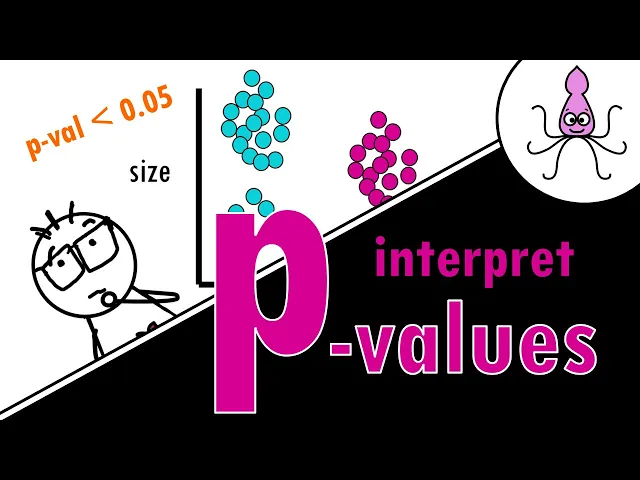
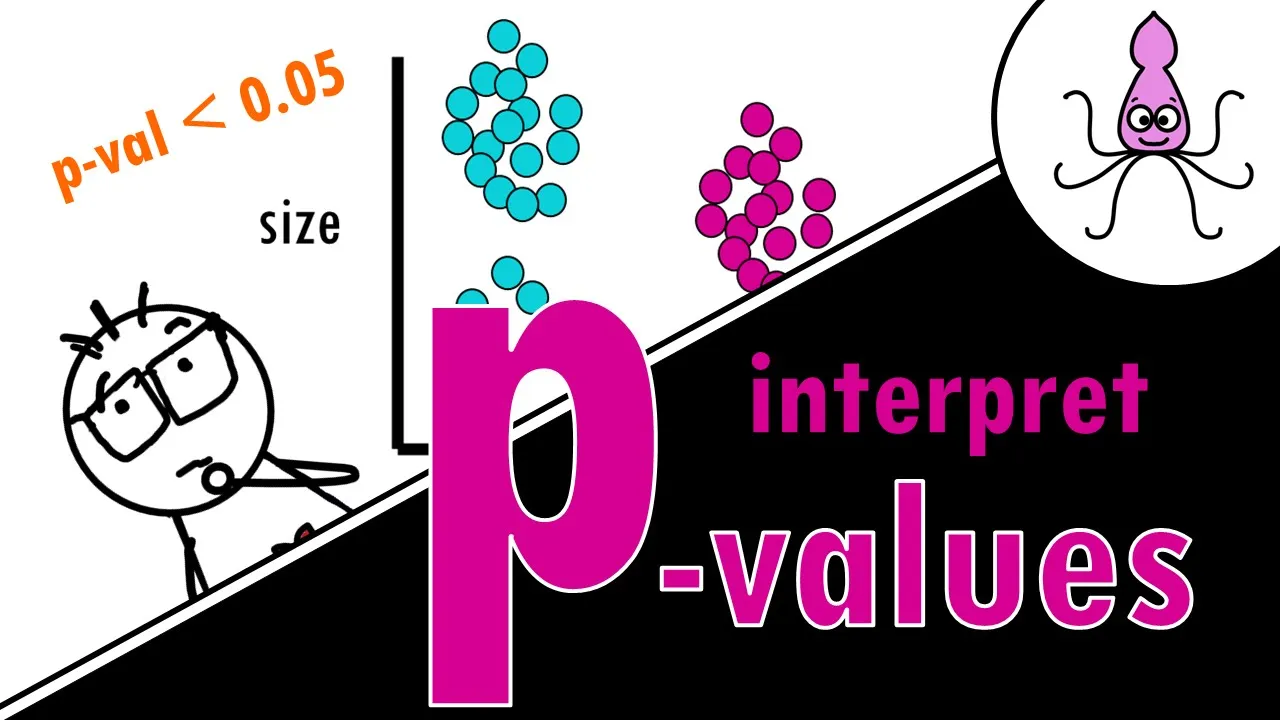
[Music] hello and welcome back to biat squid in this video we will cover how to interpret P values so if you're ready let's dive in okay you are a bias statistician who has embarked on a trip to solve a question that has puzzled Humanity for centuries our female squid bigger or smaller in size than male squid ideally we would get data from all squid in the world or whichever species we are studying but we cannot do that so we need to take a sample from that population and make inferences from that sample that we assume
will apply to the whole population you collect some samples and the means of these two samples are different at this point there are two possibilities the samples really have different means or the other possibility is that the difference that is observed is a coincidence of random sampling so just by chance you fished the smallest female squids in the population and the largest male squids however there is no way to confirm any of these possibilities as you very well know as a biostatistician all you can do is calculate the probability of observing a difference between sample
means in an experiment of the studied sample size if in fact there are no differences at all between the size of female and male squid essentially we calculate the probability of getting the result we got the difference in means if there is no difference at all this probability is the P value and like all probabilities it goes from zero to one if the P value is small then the difference is quite unlikely to be caused by random sampling or in other words the difference between the two samples is real if the P value is Big
then you cannot discard the fact that your findings may have been caused by random sampling so you cannot conclude whether there is a different or not based on the sample you have there might be a difference but you just cannot conclude whether there is a difference or not with your sample but how do you decide what is a small or a big P value you should decide the threshold in advance in other words at which smallest accepted value of P the difference will be considered a real difference we will talk about that in just a
minute B values can be used to assess differences or relationships between variables in a sample differences for example the difference in size between males and females in a squid population and relationships for example the relationship between size and the maximum depth squids di to in either case the P value tells us the probability that the observed result occurred by pure chance so a linear positive relationship between size and maximum depth and a difference in means of one meter were just coincidences because of the samples we took but in reality there is no relationship between size
and maximum depth and there is no difference in means for example in simple terms P values inform us about how true or reliable how representative of the population the result is we can also look at this from a different angle the P value represents the probability of error the risk we're taking when accepting our observed result as valid or representative of the population with a P value of 0.05 there's a 5% chance that in our experiment um our squid Expedition we were really unlucky and fished big male squids and small female squids 5% probability that
the difference in means found in our sample is a fluke in other words assuming that there is actually no difference in the average size of squid so male and female populations are actually identical in size if we repeated the same experiment 20 times so if we did 20 boat trips we would expect one experiment to reveal an equal or stronger difference in means than the one we got in research we usually use a P value C of of 0.05 or 0.01 depending on how stringent we want to be the P value basically sets the error
we are willing to accept when making assumptions based on a sample that is why we often see that the results with a P value lower than 0.05 are considered statistically significant ific in conclusion since we can't study the entire population of squid and get uh the real value of the difference in means of sizes between males and females we make an estimate based on sampling and since this is only a sample we then calculate the probability that that estimate is actually representative of the population we're studying so that is it for today squ tastic hope
you like this video let me know if anything wasn't clear or if you'd like part two on confidence intervals I will also leave the link of a few additional resources which explain P values and confidence intervals really nicely otherwise have a squat tastic day and see you in the next one l