Thank you foreign foreign foreign folks can you hear me welcome I'm going to torture you for the next 15 weeks and I can't wait for this to happen um I have four kids have all grown up Now and um all of them came and looked at NYU none of them came to NYU so when they were on their college Expedition and they take you and around the university and they lie to you right they say professors always around you can knock on their doors and go in you've had the the those pitches right I would
I went with my each of my kids on the NYU pitch I kept my mouth shut but when they get get on top of the the Tish uh the front of Tish they would all say the biggest classroom in the universities right under that talking about this this used to be called schimel it's now called Paulson depending on who's given the most money recently I guess okay and they'd say but nope no classes are ever taught there it's just for show and I almost because I've taught only in this room now for 23 years I
hate this rule it's got the Ambiance Of Madison Square Garden where the Nets are when the Nicks are losing but it is the biggest room that they can find in these buildings so we're stuck with one thing I don't like about this room is because you don't have a desk in front of you you can't put your name up so you know it it's it's more difficult for me to touch names to faces I'm going to try but before I talk about the class and what's coming I'm going to do a quiz in fact this
is going don't worry there are no grades attached to this quiz but every class we're going to start with a quiz you know what we're going to test on what we're going to talk about for the next day 75 minutes it's reverse right you're supposed to do the quiz at the end the reason I do that is almost everything I say is common sense you could figure it out yourself and I want To give you a chance to reason your way to an answer and after the next 75 minutes say why did I waste my
money on tuition I knew this already that's mission accomplished so we're going to start today's class with a quiz and this is going to be a little personal don't worry about it I won't remember what you told me anyway so here's my first question if I asked you why you were taking this class Give me the reason you're in this class and I'll give you the potential reasons as I said you don't have to tell anybody else so just basically for yourself is it because you think after you take this class you're going to get
rich like your neighbor your friend who bought Bitcoin at 500 and I was very wealthy and retired maybe it's because you think it'll help you get a job at an investment bank or a hedge fund or a private Equity house Maybe it's to impress your friends and family because you can talk about valuation and they have no idea what you're talking about maybe it's because it'll give you the tools to recognize when you're fooling yourself the biggest challenge in investing is being honest with yourself and we lie to ourselves all the time not just in
investing but in life we keep that work with people we don't cut to the front of The line etc etc and we break those rules all the time maybe this class will help you be more honest with yourself maybe you've been told it's an easy yet it's not but maybe you've been told that now and maybe you're doing this for the same reason most people buy Tesla or sell Bitcoin or do whatever else because everybody else is doing it as I said you don't have to tell me I'm going to tell you why I think
you Should take this class in a few minutes or maybe not take this class in a few minutes maybe I'll talk you out of the class that's not my intent but I'm going to be pretty open about what I hope this class will accomplish but file that away let's see where's my second question if I asked you this is a class about valuation and many each of you has a fuzzy idea right now of what the in fact this class I think is called Equity Valuation it's in it's just valuation so take the equity out
I don't care what they call it it's evaluation class it's exactly the same class that will be teaching the mbas starting a week from now they have 26 sessions but it's 80 minutes so basically it's the same class exactly the same material okay but here's the question that I have for you if I ask you to describe valuation as a discipline again for the Moment make your choice come back and talk about it for the rest of the day which of the following statements do you think best describes valuation it's a science it's an art
It's Magic white or black magic you can make the decision or maybe none of the above maybe none of those words fits what we're going to see it's a project does not book there you go Third question as I said this is a very unfair quiz because I'm asking you about a class that I was structured I'm going to teach and I'm asking what should be in the class so here's a question about value companies and the question is about which of the following companies is going to be easiest to value you're saying I've never
done valuation you don't need to do evaluation to be Able to answer the question the first so here are the choices you're a mature company you've been around a long time you have a business model you have a lot of financials and you're in a stable economy second you're a mature company but the economy is in crisis doesn't have to be an emerging market economy it could be a domestic economy in March of 2020 remember in the midst of covert we have no no idea what was Coming a young company in a stable Market or
a young company in crisis so basically two combinations right would you rather value a mature company or a young company in an economy that's stable or in a crisis this one you probably can answer right now which of those four company or poor groupings is going to be easiest to value for stable or young stable why You have lots of data right you have a crutch you have a business model you can see exactly how they make money and stable economy or economy in crisis can I stable economy who wants to deal with inflation and
what the FED might do and whether the economy will open up final question really sorry about me this is a personal question there's no right answer each of us is more comfortable either Working with numbers or with stories and you made that judgment very early on I'll tell you when I made that judgment it was when I was 12 years old it was after my first English literature class I was asked to Read Moby Dick and I did I was a good kid I came prepared for a discussion of whales and captains and about 20
minutes into the session I noticed that the instructor was talking About neither so I put up my hand so when are we going to talk about the whale she said there is no will and I said what did I read the wrong book I distinctly remember a big fish going all the way through the book she said it's a metaphor my jaw dropped and the rest of the class was about hidden meanings and things I didn't even have no I had a meaning in the first Place I remember coming out of that class with a
singular conclusion I said never again am I going to subject myself to that kind of foreign classes like the plague I'm not comfortable with this hidden meaning stuff is algebra one Algebra 2 algebra 3 out of high school and these were the good old days you know it's from the good old days you Went to college and you took CL the courses you wanted to take as opposed to the stupid Core Curriculum they make you go through why do you why do you have to take a history class because it'll round out your education you
know what they're lying you know why you need to take the history class because they didn't force you to take the history class there would be no need for a history Department Who voluntarily says I want to take a history class but then you could take numbers class numbers class numbers degree engineer accountant and then if you could number his job and who do you hang out with are the numbers people and what class are you in evaluation class right you think this is my you know this is my Arena But some of you so
let's let's do a show offense how many of you think you're more naturally numbers people okay how many of you are more story people how many of you think you're so rounded that you can do everything there's some of you there are important numbers in this but there's one side you face today I'm going to talk about which of these skills you will need in valuation And you might be surprised at the answer see you ready let's put this away and start on the logistics of this class okay I came to NYU in 1986 I
was hired as an assistant professor so I land up in New York I went to UCLA and the first thing I noticed was weather's not as nice And they give me a class security analysis have any of you heard of this class it's a class with a very long and horrid tradition it was a class start in the 1950s at Columbia University by a guy called Ben Graham you might have heard of him if you haven't heard of him you've heard of his most famous student anybody want to guess who's Warren Buffett right it's a
class that's been taught forever So they give me this class I take one look at the class they say I don't want to teach this class not a great attitude for an assistant professor's just being hired right they should have fired me on the spot the head of the department is a good guy he said what would you like to teach instead I said I'd like to teach a valuation class and I still remember what he said he's He said don't do it there isn't enough stuff in valuation to fill a class nobody was absolutely
right in 1986 there wasn't enough stuff in valuation to fill a classroom there were no books on valuation unless you wanted to use Ben Graham's Security analysis you know in the first edition of that book was published 1934. reflects the time it was written right coming out of the Great Depression if you ever wondered why Graham's Security analysis is so conservative you'd be conservative too if you'd lived through the Great Depression there were no books no but I really really wanted to teach this class and I discovered very early in my academic life that if
you want to get anything done at a university the best way to do it is to do it subversively because you try to get official Permission you know what had happened right a committee would be formed if you guys had experience with committees being formed get used to it because what happens is committees meet and they meet then they forget what they're meeting about and they keep meeting and they have baby committees that they're called subcommittees and sub subcommittees it's all very incestors committees reporting to each other And if I let it play out 35
years later they'd come back and so you can teach the class but I'd be too old to do it so I said I'd teach your damn security analysis class I didn't use the word dams the head of the department after all and I walked into the room shut the door and remember these were this was 1986 there were no cameras in the classroom I had no idea what I was doing inside that room I could be teaching cooking for 15 weeks and if I give give everybody A's nobody's complaining and I taught a valuation class
you know how long it took them to catch on in 2008 I get a call from the Dean's office so we hear you're teaching evaluation class I said yes I've been doing it for 22 years they said we don't see it listed Anywhere in the course listings I said that's easy to explain I've been hijacking all these other classes you've been giving me and teaching valuation instead you made me teach this class called equity instruments and markets you know what I'm not interested in instruments I don't care about markets I'm not even that fascinated with
Equity you take those three words out what are you left with and I might as well teach Evaluation class they said that's not right we should call it valuation I said I agree so if you look at the MBA course listings you'll see valuation shop for the first time in 2000 and 9. and soon after the undergraduates also listed it for some reason the undergraduate program seems to want to call classes something different don't Ask me why they called it Equity valuation but last spring when I taught valuation the mbas and undergraduate just like I
am doing this year Well my 59th and 60th semesters teaching valuation I'm going to say something about this classroom that's going to encapsulate how I think about valuation how you're going to see me Teach valuation everything I know about valuation I've learned in the course of teaching This class let me repeat that again everything I know about valuation I've learned in the course of teaching this class let me give you a few examples one year into teaching this class 1987 we're still downtown and at that time nyu's graduate business school was right next to the
American Stock Exchange I was teaching my I taught my valuation class in the morning I come back to my office I look out of my window and I can see everybody from the American Stock Exchange floors out on the street so what happened fire alarm went off it was October 19th of 1987. anybody remember what happened that day too too long ago yeah it was a one day bear Market you know what the S P 500 is down by in that one day 22 think about that if today we had an equivalent day the Dow
would be down eight thousand points we'd freak out Right the people were freaked out the end of the word was coming two days later I was in front of my evaluation class and guess what the first question I was asked was how with the evaluation tools can you explain a one-day drop in the entire well it's not one stock it's the entire Market how do you explain it 22 drop I didn't know the answer But I tried this is going to be a pattern you noticed me even when I don't know the answer I'll just
make up stuff I tried but in the process I started thinking about how do you explain Market crises and it stood me in good stead so when the covet crash happened in the first few months of 2020 I went back to what I learned on that day in October 19th of 1987. move forward a decade in the 1990s And we discovered or we saw a phenomenon we'd never seen in public markets before young companies with lots of potential no established business model going into markets those companies are always around but before the 1990s Venture capitalists
invest in the companies remember companies like apple and Microsoft when they went public in the 1980s were already established companies in terms of a business model but the first time in the 1990s you saw These companies jump the queue and go public I still remember the day in 1997. somebody in my class put up their hand said can you value this company called amazon.com you know what Amazon did in 1997 it was an online book retailer tiny company big money losing company and like a fool I said let's try and I valued amazon.com in class
that year And when I tried to Value it and I looked at the established literature there was nothing there about how to Value companies that lots of potential but were money losing with small revenues but to come up with ways of doing it I still tell people everything I know about valuing young companies I learned in the process of valuing Amazon in 1997. you're going to see a few late Evaluations of Amazon that I've done but that first valuation was a slog because everything had to be figured out then you move forward another decade in
2008 you're in a full-fledged marketing Market crisis but the market crisis created by Banks Behaving Badly and again somebody puts up their hand says why when Banks behave badly and they take batteries should the rest of Us feel the pain let's talk about how when Banks behave badly there are side costs for everybody else and everybody else's values impacted again something I hadn't thought about till 2008 and then you get to the last decade I call this a decade of the numbers company and let's play it's a decade where you saw a company like Facebook
and Twitter and whole host of social media companies go Public let me ask you a question what is the most impressive number at Facebook other than the amount the billions of dollars they're throwing down a hole called metaverse now but take a step back from it what's the most impressive number at Facebook is it their revenues there are lots of companies have more revenues subscribers right it's a in terms of entertainment companies you know I'm Sorry users basically because how many users does Facebook have their ecosystem you can Facebook Instagram WhatsApp about three billion users
carry number right one out of every two adults walking the face of the Earth isn't the Facebook ecosystem not no not revenues not only with Netflix it's number of subscribers no Entertainment Company until Netflix came along had that many subscribers 220 million subscribers With the Uber there's a fact there are a hundred million writers you see where I'm going until the last decade when companies wanted to impress you they talked about revenues and earnings and all of a sudden companies are talking about users and subscribers and customer numbers and in 2017 again this is how
every single question I have in this class gets triggered somebody puts up their hand and says can you Value a Netflix subscriber notice a question cannot can you value Netflix because you can always value Netflix from the top down but can you value a subscriber to Netflix can you help me out how would you value Netflix subscriber what would you need to know first is cost of acquiring a subscriber but once you've acquired the subscriber what's the value of the subscriber go to Netflix get free are you a Netflix subscriber let me pick on somebody
are You a Netflix subscriber okay so what do you do for Netflix every month okay subscription fee right fifteen dollars a month 22 depending on whether you get the premium subscription with four people can watch at a time or two people I assume you will do the only two 15 a month Yeah so basically I know Netflix gets about a hundred and eighty dollars a year from you but to Value you as a subscriber you know what else I have to estimate right how long will you Stay on as a subscriber in user-based companies this
is based on What's called the churned rate now how many times and let's face it subscription-based models are sticky this morning I was making a list of all the subscriptions I have really I've been subscribing to that for four years I've never even been there so if I give you the expected life that a subscriber stays on and what you can collect from a subscriber and if you Could tell me what it costs you to service a subscriber I can value a subscriber so in 2017 I valued a Netflix subscriber it took a couple of
weeks to develop the framework but then I used it to value a Spotify subscriber an Amazon Prime member an Uber Rider different models but basically the same principles again I hadn't thought about that until somebody asked the question And then you get to 2020. and I was actually teaching this class in the spring semester January February look just like any other semester then we come back in early March and we get this notification man while you're saying go home three weeks but you'll be back three weeks right we went home and we were gone for
like a year and a half but I was teaching the class still from my home in La Jolla I don't live in New York I live in California for obvious reasons other than the fact that I like to pay taxes but I was teaching the class but we I was teaching the class in the midst of an experiment that had never been run before you know what the experiment was we shut the global economy down we had no idea what would happen we tried to open it you know it's like turning a big machine off
say please God When we turn it back on let it come on so I remember the end of March in the middle of the class I said let's value Boeing and if you remember at the end of March boring looked like it might never really come back because you sell to the airlines the airlines are not flying what happens and I remember many people think hey you know let's wait for this to pass that's not a choice right you got to Value companies in the world you're in not the world you wished you were in
actually you know I have a YouTube video that you can see of my Boeing valuation from March 23rd of 2020 the absolute bottom of that crisis but again in the process of doing it I learned about what to in fact during the Russian invasion of Ukraine I tried to Value Ukrainian Mining Company I have to confess finally I had to give up this is beyond my reach even in terms of Uncertainty you're saying but those were interesting semesters ours is so boring trust me interesting things will happen in the next four months and be careful
what you wish for When You Wish For interesting things because what's a Chinese course may you live in interesting times we're living in interesting times who knows what the next four months will deliver So this is a class that you know reflects my 36 37 years of teaching the class and all of the bad and good experience along the way and hopefully somewhere in this process you know so what I'd like to do first let me do the logistical part before I do this finally we're in person I mean I taught this class entirely online
one semester 2021 my office is in the other building 969 so you know if you want to find me You can try but I'm usually not there okay my email address is you know it's right up there if you want to send me missives in the middle of the night I'll read the next morning um my home page and I'll come back and talk about what you will find for this class on there I don't use brightspace or whatever learning management system is I pay act like I do but not really everything happens in my
site I have office hours just before my Classes and um because I teach the MBA class just before yours from 1 30 to 3 12 to 1 15. but I have a principle called a fair game principle you know how it works if you find me I'm fair game which means for the next 15 weeks I'm going to try to make it as difficult as possible for you to find me for instance I've discovered that if you take the stairs nobody finds you because everybody takes the elevators if You take the elevator now I remember
one year when I when I was teaching this class at that time you know it used there used to be a building called codes where you have the new building now so it used to be the gym for NYU and I'd show up you know in the middle of the day to do my workout and the person from the class I was teaching that semester would show up at exactly the same time get on the treadmill right next to mine and ask me questions all The way to so I will introduce a rule that if
my heartbeat exceeds 120 per hour per minute per second or whatever it is I'm not responsible for any of the answers I will get but truly speaking if you find me I'm fair games if you have any questions try to find the teaching us Kathleen is right here so and Alice and so will be back by Wednesday so they will be the Tas they don't grade the stuff I do your grading so if you get pissed off it's me You got to take it out on but I'll be sending out their office hours and they
do a review session each week where they work through prompts from past quizzes so take advantage of that so with that lead-in what I'd like to do is talk a little bit about the broad themes for this class and what I'm going to say for the next 30 minutes or so is to me the most critical part of the class everything else is icing on the Cake so let's start with the first question as to use valuation a science or an art it's a question I get asked all the time so let's dig through it
his valuation of science Let's uh ask a simpler question is mathematics a science it's the only pure science in fact mathematicians are convinced that the rest of us are imposters So let me ask you a follow-up question what is it about mathematics that makes it a science it's absolute right what's two plus three I'm not testing two plus three is five right hand left hand calculator computer North Pole South Pole it's not might be five it could be five it is five and if you get any other answer you're wrong physics is mostly a science
right You all go to the 11th floor you jump out of a window can you get a window open I don't know but let's say you jump out of a window you don't fall in the order of your IQs or where you are in the corporate hierarchy you just fall laws of gravity are the laws of gravity physics is mostly in science but if the essence of a science is you get the inputs right you're going to get the output right is there any chance That valuation can be a science I'm just finishing my updated
valuation of Tesla right it started yesterday I hope to be done by tomorrow and perhaps put it out there I'm trying my best you know how many uncertainties you have to deal with in value Tesla in addition to all of the uncertainties you deal with in a normal company you have a teenager running the company right a Visionary teenager but he does some you know what the Essence of a teenager is I'm calling them corporate teenagers what do they do they do what teenage and you you remember these days not that long ago what do
teenagers do every day they get up they look in the mirror they say I have lots of potential what can I do today to screw it all up so there's an immense amount of uncertainty I'm going to try my best I'm going to make my best inputs but guess what The value that I get is going to be absolutely wrong because things will happen valuation can never be assigned so the sooner we accept that the healthier the discussion evaluation will become you know what I am not a great fan of accounting valuation accountants have felt
left out for a while so you want to be relevant again so they've jumped into my Arena and they keep trying to do things in valuation But they think like accountants do which is when in doubt write a few more rules they want to convert valuation to science and they're convinced that if they write more rules it's going to become more scientific it's going nowhere valuation is definitely not a science so it must be an art right so let's take a a simpler example is painting an art not painting your house you know paintings I'm
talking about the ones in The museums no I still remember when my oldest son he's now 33 when he was eight years old I took him to the Met for a Picasso exhibit he lasted about 30 minutes that's how long eight-year-olds last in a museum when he come out and I said Ryan what do you think of those that exhibit he said dad I was not impressed I said what it's a Picasso exhibit he said this guy can't get the nose in the right place have you Noticed about Picasso the nose comes out of the
side of the head the top of the head the back of the head he was either drugged or drunk it was given Picasso's history he's probably both but whatever the reason we've decided collectively that picassos are special and we thank God my son is not the appraiser because so it'll be going for 50 cents a piece the essence of an art is it really cannot be taught And guard valuation is not an art or wasted 37 years of my life trying to teach something that cannot be taught so if it's not a science and it's
not an art what the heck is it the word I used to describe valuation is it's a craft I'll tell you the discipline that I think comes closest to valuation it's cooking think of how you learn cooking you can watch cooking shows right My daughter used to watch the Food Network all day long chopped episode after chopped episode Beat Bobby Flay Beat Bobby Flay for a long time she couldn't cook a lick but she knew exactly in theory how you made a souffle you don't learn cooking by watching cooking shows you don't learn cooking by
reading cookbooks you learn cooking by cooking and the first time you cook what happens disaster fire alarms go off I still remember the first time I scrambled eggs nobody told me I was supposed to spray the damn pan I finished egg looks good but it won't come off the pan and egg go in the trash and I remembered a very important lesson that I've remembered since gray the pan before you cook the egg you learn cooking by doing and the first time you do it will be difficult remember that you learn Valuation by doing which
means the next 15 weeks or in a sense if all you do is come to classes work through problems you're not learning valuation you learn valuation by doing and the more companies you value and the more diverse the companies become the better it will become if all you do is cook pasta after pasta you'll get really good at cooking pasta but if I said can you make me a curry you said I can't do that in valuation of all you do Is value Steel company after Steel company maybe get really good at welding steel companies
should I come to you with the tech company never done that before so I'm going to make you get out of your safety zone and value companies that you don't feel comfortable valuing because that's how you learn valuation so that's the first thing second one and this is something you've seen me return To over and over again is I'm going to draw a contrast between two words that we use interchangeably in valuation that we should not the words are value and price let me back up we know what determines the value of an asset or
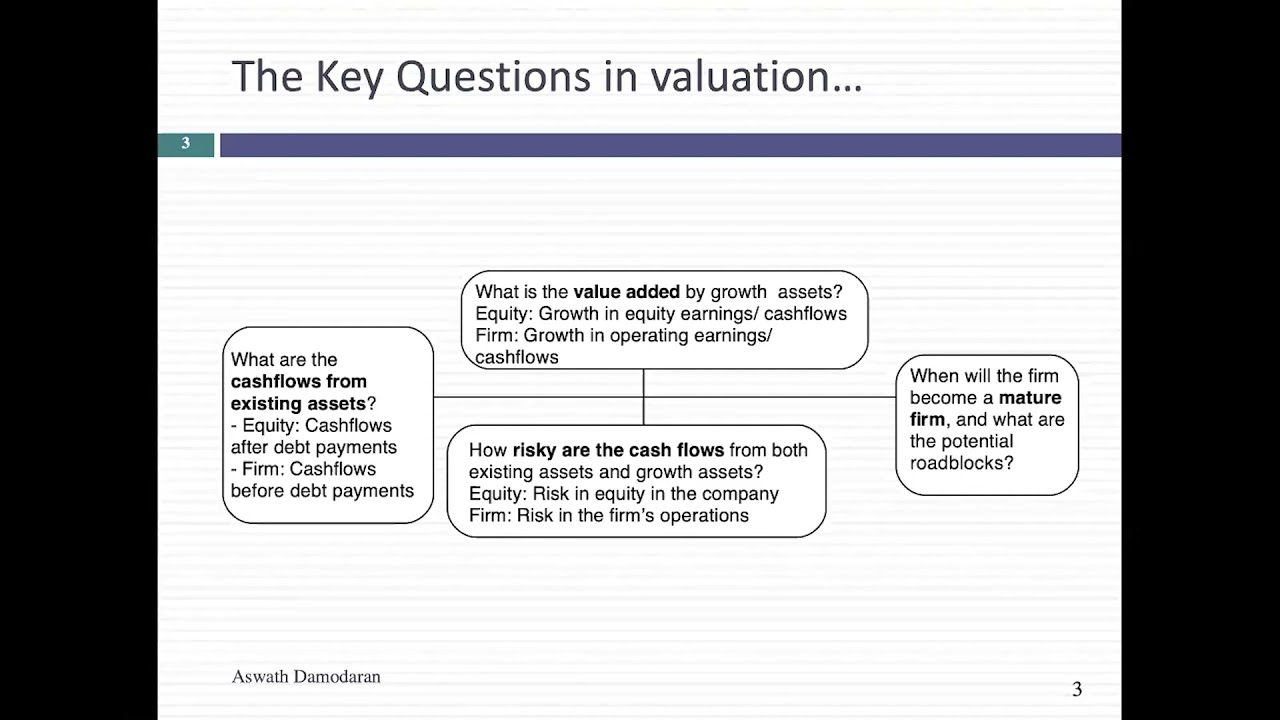
a business or a company we've always known this it's cash flows growth and risk you can dance around this create elaborate models but it's cash flows Growth and risk when I say we've always known this we act like we invented valuation a hundred years ago but that Venetian glass makers sold his business in the Middle Ages thought about cash flows growth and risk probably more directly than the people today with all the models kind of confusing them so values driven by cash flows growth and risk you have to understand the business to value a company
because Without understanding whether in a high margin business or a low margin business what are you going to do so probably my zoom the heck is that whatever it is I have no idea so values driven by cash flows growth and risk you know it determines price demand and supply this environment demand and Supply driven by cash flows growth and risk Maybe But you know what else determines demand and supply mood momentum Revenge he said what Revenge well in 2021 it's a company called GameStop remember that GameStop is this company that used to be in
malls in fact you guys are probably too young to remember in GameStop dominated mall traffic my kids would Always want to go into GameStop because you could play games and see what the games look like but it's a dying business dying business why because malls are dying everything's moving online so by the start of 2021 GameStop was on its Pathway to Annette her game was over the business and the stock price had dropped it was one of the most heavily shorted stocks on the uh in in among U.S equities you know What shortings right people
are selling it to return basically because they thought the price is going to go to zero then early in 2021 something magical happened a group of people gathered together on a Reddit site called Wall Street bets and they decided to buy GameStop and they succeeded even beyond their wildest imagination they pushed the price up from 15 per share to 400 per share I was puzzled I said what is it that they see in GameStop that makes them believe that this company could be worth four dollars per share so I went on the Wall Street bets
side there was tortures reading through the rationale but here was the overwhelming team that came through you know why they were pushing the price up not because they thought GameStop was coming back or because you know they thought the founder of Chewie Ryan Cohen Was going to turn the company around they were doing it because they wanted to get revenge against whom who were they trying to run out of business hedge funds why because they had big student loans and they're convinced that if Citadel hadn't done this that student loan would have been half what
it was whatever the reason it was Revenge do you think that makes no sense it makes complete sense think about it What's a stronger human emotion Revenge or rational thought it's no brainer what I'm trying to say is price is driven by lots of forces have nothing to do with fundamentals in fact there's a whole area of Finance we've developed over the last 40 years to try to explain why price can deviate from value called behavioral Finance what does it do it takes psychological insights into how people behave and say hey that's why stock prices
can stay higher than that As I said this class I'm going to draw a contrast between value and price we're going to talk first about value I'm going to focus a lot on cash flows growth and risk but many of you when you go out there for jobs you're not going to be valuing companies you're going to be pricing them what do you think banks do they don't value companies their price up we're going to talk about how to price companies better because in pricing Here's what you do you look at what other people are
paying for similar lots of subjective judgments have similar companies and you pay based on that so people are paying a lot for other user-based companies they're paying a hundred dollars a use and you have 300 million users I put your value 30 billion we're going to draw the contrast between value and price because I think even among people who claim to have done Valuation per living for 30 or 40 years is a tremendous amount of confusion but what exactly they're doing that's not a good place to be so we're going to draw that contrast value
versus price 30. this is a class about valuing just about anything and what we can't value we will press so this is not just about valuing you know publicly traded large companies it's About private companies and public companies young companies and all companies develop Market companies and Emerging Market companies and guess what the rules stay the same no matter which of those companies would so I'm going to start with that we're going to talk about how to value just about any ask with cash flows but how do you value Picasso you can't value it you
can price how do You price picassas what did I say you do in pricing you look for what other people are paying for similar assets with a Picasso and you're an appraiser let's say that's your job what do you do you look to see what other people have paid for picassos he said this is a bigger pickup I don't know how you do this but that's why I'm not in the but you know you know remember the the the the Mona Lisa look alike that the Saudis Bought for like 400 million you know why it
went 400 million it's a awful looking picture if you ask me but because the Mona Lisa has worked so much this must be what 400 million so we're going to talk about pricing as well and in that process we can talk about pricing not just companies we can talk about pricing real estate remember is all pricing all the time you know what I mean by pricing if you buy an apartment in New York City first You must be really rich but if you do think of how the realtor comes up with the number of or
the for the apartment they don't do a discounted cash flow evaluation of the apartment they look to see what other pricing is more the norm than the exception and in the process maybe we'll ask the question how do you price Bitcoin you know you can't value Bitcoin why can't you value Bitcoin for the same Reasons you can't value the US dollar it's a if it's a currency you can't value currency you can price it you call it an exchange rate think of the price of Bitcoin as an exchange rate and I think that's a healthy
discussion is Bitcoin a good currency would you be willing to give up twenty thousand dollars for one Bitcoin which is what people are and that's a discussion we can have and that's a fair discussion but you'd be amazed at how often people Say what's a value Bitcoin do not use the word value for assets that don't have cash flows you can't you know you can price Bitcoin you can price the Mickey Mantle rookie card but you cannot value those because there are no cash flows and along the way we'll also talk about the one aspect
of this class where you draw on things that have happened much of this class you draw on core principles that have been around forever But in the last 50 years we've had these option pricing models developed primarily to value options in this class we're not going to use them to value options we're going to Value companies or businesses or assets with a contingent cash flows sounds mysterious right but let's suppose you have a young pharmaceutical company it's working on this vaccine for something that nobody's ever seen before it's an mRNA vaccine You're probably saying who's
ever going to need that vaccine 2018-2019 you're buying a contingent cash flow if the vaccine gets approved this company could be worth billions if it doesn't it's worth nothing you're not valuing a traditional asset so we're going to talk about sets of businesses or assets which have contingent cash flows and we're going to use those to Value not just young Pharma companies but a platform How many times have you seen people say well I have 300 million users on my platform I haven't figured out how to make money in a few years ago two years
ago I valued this company called paytm and I made the mistake of putting its app on my phone paytm is this Indian online Payment Processing Company and every day they offer me free stuff you know what they're very good at adding users you know what they're not Good at figuring out how to make money on those users the question you ask is is having 350 million users which is what they have on their platform worth something the answer is absolutely if you get the right people running the company we're going to use option pricing to
Value assets like those which brings me to my fourth theme and this goes back to the question I asked you What are you more comfortable doing telling stories or working with numbers and at that time I said you probably are thinking right now that good valuation is all about numbers and if you go to work for an investment bank that's what you become right an Excel Ninja you open up these big models and you take line item after line Bankers can't value 20 in a brown paper bag if you put in front of them but
they can build elaborate models to show you the twenty Dollars is really worth fifty dollars we're in a bad place in valuation because of two developments and this is going to sound contradictory you know the two developments are the first is we have far more data than we used to have that's good right the second is we're more powerful tools than we ever did and here's a contradiction even as the amount of data we have and the tools we have become more powerful Evaluations are actually getting qualitatively less good not better and the reason is
we tend to hang out with people who think like as you go to work for a bank you're all Excel ninjas you think every valuation is line item 15 you know just get that line item right and I think we need to step back we'll come back and talk more about this process but a good valuation is a bridge between stories and numbers Say what are you talking about when I value a company you know we're going to put my Tesla valuation out tomorrow you know what my revenues are in 2032 for Tesla about 400
billion dollars the revenues right now are about 93 billion so I'm quadrupling revenues and you ask me why are my revenues 400 billion in your debt you know the answer you don't want to hear is It's because I used to 25 growth rate for the next five years and it tells you absolutely nothing right I need to tell you a story about Tesla that explains a 400 billion that electric cars are going to dominate the automobile business and that Tesla is going to have a dominant market share of that business and you can then ask
me to defend each of those but that's what you need as an answer I'm going to use a margin of 20 you know why that should surprise you because a Typical automobile company is margins of 8 10 12 percent a software companies margins of 30 35 so when I use a 20 margin and they ask me why I'm using the margin I should tell you a story about Tesla that's a mix of automobile and technology that says look this is not a traditional Auto Company an electric car is more iPhone than Chevy and because of
that it can have a higher Margins again I could be completely wrong but every number in my valuation has to have a story to back it up and every story you tell me about a company think about some of the stories are in the Great amazing brand name great CEO top technology has to find a number that goes with it so if you're a number cruncher you need to get comfortable with the storytelling and if you're a store I'll tell you my vision for this class if you're a number Cruncher by the end of this
class I hope you trust your imagination enough to be able to tell stories because remember you've spent a lifetime bludgeoning that poor thing into the ground because at every step if you're in a number crunchy class if you come up with something imaginary push that down and I'll go back to the numbers and if you're a Storyteller I hope by the end of this class you develop enough Discipline to not tell me fairy tales get comfortable enough with the numbers so to me the essence of somebody's good evaluation you're either a disciplined Storyteller or an
imaginative number cruncher been teaching this class for 37 years guess which group I always have more trouble with getting storytellers to develop discipline on number crunches to tell stories It's not even close it's always the number crunches you give me a hundred history majors I can teach them enough valuation to be able to Value companies next week give me 100 Engineers I am screwed so if you're a number crunch I need to let go of that need because if you're a number crunchy you always want closure right until you get that absolute certainty you got
this right you can't let go you need to let Go there's a point in valuation where you have to take the karmic View you know the karmic views I've done everything I can I've made my best Testament it's time to move on because if you get stuck on an input saying I need certainly you're never going to get closure how the heck could you ever feel certainly about how many electric cars are going to be sold in 2032 you're not God if You've been operating under that delusion you're far bigger prompt in this class but
there are things you and I can never figure out because there are too many uncertainties which brings me to my final theme for this class I'm going to use a word that you probably don't expect to see in evaluation class it's fake I think what's Faith got to do with it Everything I'll be upfront I don't do Consulting I don't do expert witness work in other words I don't do valuation for others so it's only reason left to do valuation because I'm curious come on I have far better things to be curious about I do
valuation because I want to act on my valuations you know what I mean by that I value a company and if I find Tesla to be undervalued I want to be able to buy it you think What's the big deal to act on your valuations you need faith but faith in your value do you see why you need Faith any value value the company followed all the rules but you need to I trust that number and second faith that the price will adjust to the value why am I using the word faith what's the essence
of faith if you ask me to prove that my value is right I'm gonna say I can't prove it no If you ask me to prove that price will adjust to Value I can't do that either just think of it as the equivalent of going to church or Temple or wherever you go and asking the priest you know you know can you prove to me that God exists and unless you have a priest to make substance he's going to have faith probably pisses you off to no end because give me proof and faith is not
something I can teach but I can talk about why I have faith And when that faith has been shaken I've never had much patience for people who talk on absolutes like all those people to go to go to Omaha every year you know the group I'm talking about who think that they have the answer because Warren Buffett has told them the right answer I don't have that much I I don't believe in that absoluteism I estimate value but you know what it's always my faith is always being tested I'll give you an example let's say
I buy Tesla tomorrow at 135 or whatever it's trading at right now and it's because I think the stock is worth 165. what happens the day after the stock drops to 115. it's the market knocking on your dosing do you still have faith get used to that that's the nature of investing and most people don't have faith so that's something you have to decide For yourself and you might decide you have no faith in which case what should you do buy index funds and move on live the rest of your life you can live a
perfectly happy life without ever buying a stock and making money trust me but that's a healthy conclusion arrive at so that's something to think about as you get through is do I have faith and the first time you value a company don't be surprised if you're a little shaky about no this is a value maybe I got Something wrong it's natural if you don't feel any questioning there's something wrong with you right yeah I'm absolutely certain about this number how the heck did he get that much certainty you're either a sociopath oh you got a
direct connection to God that I'd love to have as well because this is not something you can feel sure about so let me be the outline for the class we're going to start With the first few sessions focused on the big picture how things connect together now the reason I do that is often when you start to dig into the inputs it's easy to get lost so when we talk about risk premiums you're saying why are we talking about this again betas what is that got to do the big pictures but basically going to frame
everything we're going to do in the class and where things fit in so when we get there Saying okay that's why we're doing this then we're going to move on to the inputs into intrinsic value and what did I say there were cash flows growth and risk we're going to talk about how to estimate those as best as we can given the data we have and we're also going to talk about loose sense in valuation how do you tie up loose x what do you do for companies a lot of cash what if there's a
lawsuit hanging over The company okay then we're going to move on to the pricing part because and in the process the intrinsic evaluation we will towards the end of the intrinsic evaluation section actually value entire companies you can see all the pieces come into play probably going to Value 15 20 companies very diverse from Young startups to all companies whose value just to depress you all value Bed Bath And Beyond it's already depressing if you've gone into a Bed Bath and Beyond which I think is an incredibly depressing experience but value is even more depressing
so how did the company ever get to this point in the first place then we're going to talk about price and in the process we're going to talk about standardizing price and comparing across companies so what do you mean Standardizing price you can't compare the price per share across companies if you did what's the most expensive company in the US if you just look at the price per share it's Berkshire Hathaway which is what four hundred thousand dollars per share three fifty thousand dollars per cent the cheapest stock is some penny stock right but that's
absurd because price per share is arbitrary why because I could do a two for one stock splitting My price goes down by 50 doesn't make any cheaper and because we can't compare price per share across companies we divide the price by something to standardize things like what like earnings price earnings ratio divided by Book value price to book ratio just a standardized price and the process of pricing we're gonna look at different multiples and how to do pricing better once you've got intrinsic valuation and Pricing done we're going to talk about asset based valuation what
is that you look at a company and rather than value the whole company valued in pieces right now for instance you have to Value GE there's no company left it's a Walking Dead company of pieces you know the healthcare business the aircraft business the kg capital we'll talk about some of the parts asset-based valuation We'll spend a session on valuing private business using only a session because to value a privately owned business you don't have to change the rules still cash flows growth and risk but you have to bring in some special perspectives like what
I think the fact that a private business might depend on its own or a great deal more so if you have a plumbing business it's not just a business it's a plumber the plumber has you know links to Businesses and if the plumber basically passes away there goes the business it's called a key person component and it's not just private businesses right we just mentioned Tesla one of the questions I've always had with Tesla is what would you do if you woke up one day and you looked at the news and it said Elon Musk
checks into rehab but would you be surprised probably not Right it's an amazing guy but he clearly seems to have some issues what would happen to the value of Tesla as a company this has always been the question that overhangs the company but in private business it's front and center so we're going to talk about what you do differently in private company valuation you're going to be surprised 90 you do the same but there are 10 percent of the Time you do different things we'll talk about those and then we'll bring in this option issue
and that's what we talked about valuing young Pharma companies are valuing a platform how option pricing can help you so that's basically the structure of the class and the line in sessions 26 and 27 I'm going to focus on special aspects of valuation one is acquisition value what's different about valuation in m a And the answer is nothing other than the fact that people like to overpay in their Bank Bankers basically want the deal to get done we'll talk about some of the ways in which bad deals get a pathway to getting done and in
the second to last session we'll focus on how do you change the value of a business you know why that matters because much of the class we're going to spend looking from the outside in at companies In that session I'm going to take you on the inside say you're the CEO of Disney stocks doing badly values probably dropped what can you do to increase the value of the company it's my Corporate Finance compressed into one session because Corporate Finance I teach corporate Financial valuation the mbas the MMA has always ask me what's the difference in
the two classes it's the same class I just give them different names It's actually the principles are the same but in corporate finance you look at companies from the inside out in valuation look at companies in the outside and and session 27 is going to be that Inside Out view of companies so those of you are interested in running your own business going into Consulting this session you can talk about the levers you can look at so how do I change the value of a company So that's a structure of what's coming in terms of
pre-season prep it's probably too late because the season's already begun you should have three emails from you already right starting today you're probably going to get an email every day for the rest of the semester but in the very first email I said look I'm not going to call on you don't need to be a mad genius but the three skill Sets I would like you to kind of brush up on the first is much as I dump on accountants our raw data comes from accounting statements if you are uncertain about what the differences between
operating income and net income don't admit to it right now but I was 12 session class in accounting and I'm not an accountant I teach in my own way accounting is probably horrified by what I teach in this class but it's about learning just enough Accounting that you can make it through that raw data second I have a statistics class why because what did I say in the biggest change in valuation huge amounts of data were drowning in data and we need to figure out ways to take that data and make it manageable that's what
statistics should be about that's unfortunately not how statistics classes get taught so again I have my own version of a statistics class on my Website that you can take it's 12 sessions now if you still don't know what a multiple regression is why you should care maybe you should watch that class and the third is foundations of Finance if you still think present value is a button on your calculator and you really don't get the intuitive Foundation I would strongly recommend taking that foundations class because ninety percent Of Finance is present value and understanding what
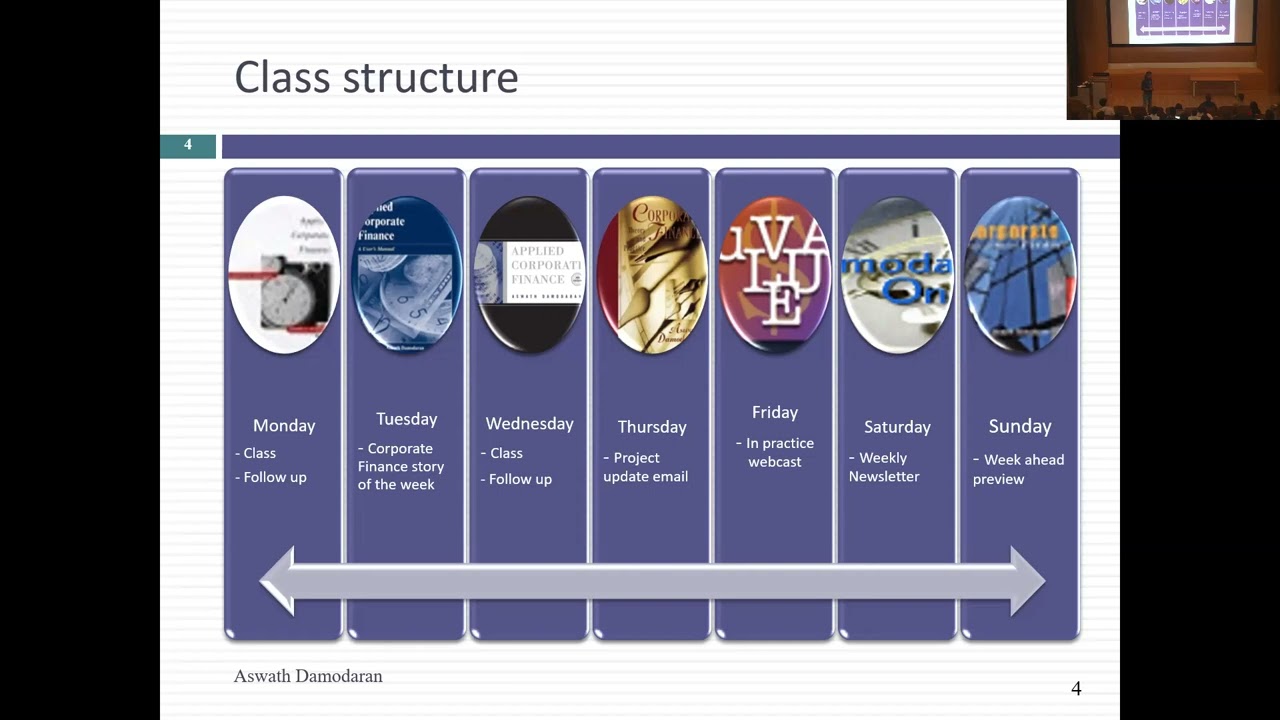
it is that drives present value why it changes is critical to doing this right so that's pre-season prep for those for many of you you might not need it because you feel ready but I told you I'm going to that for the next 15 weeks I will take over your lives I'll tell you how I'm going to take over the week starts on Monday you'll have Class and right after the class like today's class you get an email from me you know the email will contain what we did in the class but I was just
in the class I know physically you were here but there will be days where physically you might be here but mentally you might be elsewhere and say if you left the class mentally here's what we did during the class Tuesdays you get a valuation of the week What is that I'm going to pick a company to value like next week I might you know put out my Tesla valuation with my post on why I value the company then I'm going to invite you to Value Tesla on your own your reaction is going to be it's
only week two of the class we haven't learned enough could do whatever you feel comfortable doing so in the first valuation you might change the third decimal on the Risk-free rate leave everything else at my numbers and tell me look I got the same value that you did I'm just going to let it go because that's not healthy that you all get the same value but every week I'll put up a valuation of the week and I'll go all over the place I think one of them is the valuation of the Los Angeles Clippers when
Steve armor bought it so we're going to Value companies we're going to Value businesses and I'm going To remember I said I want to get you out of your comfort zone so across the next 15 weeks you're going to Value 14 companies essentially very different companies and here's what's going to happen it's always happens I feel comfortable making this prediction as we go further and further into this class you're going to find yourself more willing to disagree with me and that's good It's good because you say I don't like your growth rate I'm going to
use a low growth good that's what valuation should be about we should be debating the story and the valuations so Tuesday I'll send an evaluation of the week no grades so if you completely ignore these valuations of the week I'm not going to you know chase you down so you didn't do the valuation of the week but I'm going to create a Google shared spreadsheet think of this as a crowd valuation I'll Put my valuation the first row and each of you as you value the company can put your evaluations down let's see what the
crowd valuation of Tesla works out to be so you can see what the typical value is what's high would slow now on Wednesday we will have another class obviously Monday Wednesday and on Wednesday you will also get what's called a weekly challenge what's a weekly challenge every week we'll cover something like next week we might Cover risk readings the weekly challenge I'm going to take whatever we did in class and make you stretch Can you estimate the risk free rate in zombie and quacher and if you've been in the class you'll have the tools but
it'll require that you get creative try it out again completely optional the way somebody described this class like drinking out of a house water coming at you you might decide I don't like this I'll just take a little Trickle so but I'm going to give you the host and you can decide what matters on Thursday you get an email from me reminding you where you should be on your project you're saying what project that pain is coming I describe it to you but your project already you might not realize this but your project already started
the minute you walked into class and I'll talk about that project and every Thursday is my nagging email so Where are you because I know exactly what you guys will do because a project is not due till May 8th many of you will not start even thinking about the project till April 23rd I can't stop that but I can nag you and nag you and maybe the guilt will build up to a point oh my God I'm way behind so I'll send you a timeline here's where you should be it's like a GPS so I'm
not there yet okay maybe you will respond maybe you would On Friday I will do a webcast which applies in practice so for instance when you talk about risk credits I'll do a webcast on how I estimate a risk related Indonesian rupee I take you through where I get the data how I clean up for it so you can see it play out in practice on Saturday you get a Weekly Newsletter don't look at this for breaking news I'm not CNN but the newsletter will basically Summarize what we did that week what you might have
missed if you were away for the weeks again kind of because let's face it when you're a class with 350 other people it's easy to get lost and feel that nobody's noticed that you I'm going to try to catch you if you get lost and these are all my devices to kind of keep you connected to the class on Sunday I'll send you the weekly challenge remember the one I sent you on Wednesday I'll send you my solution but again it's not for grading so if you worked on it you can compare Your solution to
mine yeah and then you wake up on Monday and we'll repeat the process again so that's the structure of the class and I'm not and I'm not doing it to scare you but just to get you a sense where in terms of the logistics of the class while I will do Zoom sessions I would like you to be in the class I don't think it's that painful to be here but I Understand you know sometimes you might have to travel so there will be the live Zoom it'll be recorded so basically you can catch there's
no excuse for falling behind so even if you're sick at home you should be able to watch the lectures if you're trapped in a foreign country don't ask me why you're a spy you've been arrested you've been thrown into a Turkish jail as for a Wi-Fi connection so you can watch the classes now You don't you know you can bring if you can bring there's only one thing that you need for the lectures the lecture not packet I sent you the link to the first packet I've told the bookstore to print it but by the
time they do it the class is usually over and why do you want to pay those guys that overpriced issue anyway so keep it digitally if you want because you can make the notes on it if you want to print it just don't do it on the Printers downstairs wherever they are now because then I hear about it because it's like I think we have 800 Pages 800 pages of slides for this class and 350 times 800 you can work out the math will break every single printer down here so if you're going to print
it no please pay the money go to wherever you need to print it or if you work if you're working for somebody they have no idea what's being printed anyway print it off on the side you know Actually 350 pages I don't know what that is you know just and then grab it I'll put in the recycling for you and you can take it home no so I'm not encouraging you to break the maybe I am but if you do miss a class catch up there's no reason now do you need a book no you
can live without a book but I do have five different books and valuation you go to my website I compare them but basically let me go down the list the only one of These books that's a textbook you know it makes a textbook different from a trade book but it's priced twice as high why because you're college students and they exploit you and I hate that but if you're doing the investment valuation which is a textbook there's a trade book version of of this book which is exactly the same book and to show you how
crazy Publishers are the textbook version sells for like Eighty dollars and the trade book which is actually hard packed and sort of paperback sells for forty five dollars so my advice is buy the cheapest version of this book you can find and if you go to Asia you can get it for twenty two dollars all the more party this morning I was talking to somebody who said he bought my book outside a train station in a city called indoor which is in India and he said he paid a dollar and a half it's completely Pirated
and I said you know what whatever Rings you about because you know let's face it I'm not making money on these books in the first place so no so do whatever you can if you need a book but if you're fine without a book incidentally if you have an Apple device I have an app that I co-developed with a friend of mine and then Sunderman Dartmouth which will do an intrinsic valuation of a company so if you go to the Apple Store type in U value which is the name of the app you can download
it it comes with a money back guarantee you know why it's free so if you don't like it tough keep keep it throw it away take it away but basically it does a pretty good job of an intrinsic valuation I'd put it up against any banking valuation of a company so if you want to buy a book feel free to do so incidentally during the course of the semester my my new book is coming out it's called It's a corporate life cycles and something I'd talk about during the course of this class so if it
does come out I'll let you know when it's available now there's more stuff if you want almost everything for this class is on that page that's listed up there so that if you go to that link that's the central clearing point for this class you know whether it's lecture notes whether it's webcast everything is Centered there so rather than go to brightspace that's where I would go for all the material for the class I every one of the lectures that I do will be converted to YouTube videos so after I get back to my office
in about 20 minutes when I get the the notification from Zoom assuming it worked today and I get a recording that recording will become a YouTube video and it'll become part of a playlist so the nice thing about YouTube is you Don't need bandwidth so if you're on your phone and you're on Cell rather than download and you know a video file YouTube allows you to kind of watch it and every email I sent I told you that the three so far one every day will become part of what I call the email Chronicles you
know I do this everything is about me it's to protect myself because I know what you're going to say but we you know six weeks from now I'm going to say Remember that email Lisa what do you mean I didn't get it no excuses yet because every email that I sent will be in the email Chronicles you can go check out now so if you're blocking emails unblock me at least for the next 15 weeks after 15 weeks I couldn't care less if you blocked me from that point on but no it's it's my device
for connecting making sure that you're with the class There's a Google Calendar that I sent you the link for so you can see when the quizzes and the exams are and my blog is where I pretty much write whatever I'm so I sent you the first two data updates the last one was just three days ago the Tesla post will go up sometime this week hopefully by Wednesday no I have a Twitter feed where you can but I don't know I don't get into Twitter fights there's no tweet contest but basically whenever something is new
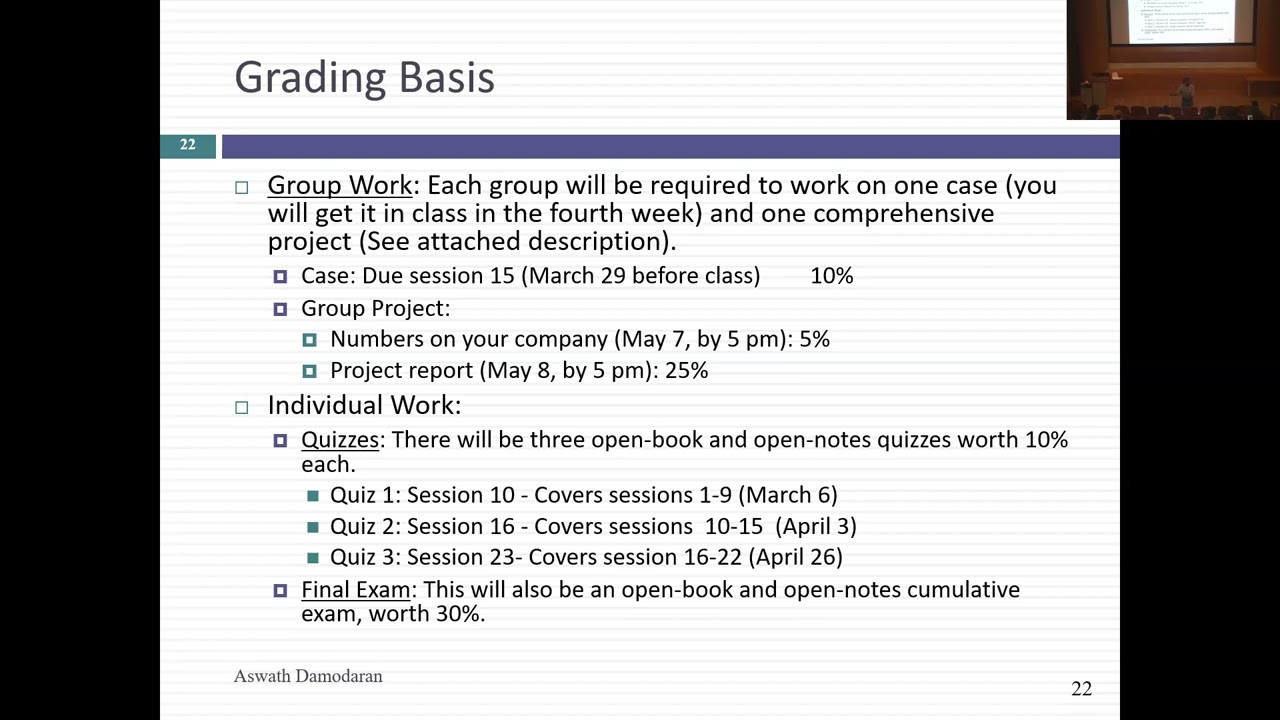
on My website that's my my my way of connecting and if you still have time on your hands I don't see how you would they're more if you want to read more stuff there's a link again on my website which will take you to more readings on each of the topics now of course the big question you have is what's my grade going to be so here's how I think about this right I'll have to come up with the device if by the end of the class you can value Just about anything and I'm going
to try to give you an error name on it so if you can value most things think of that as your B territory if you can value something which is not asking for a whole lot it's a c if you can value nothing then I've failed at my job and you've failed with me okay so this is not this shouldn't be new this is the grading distribution for all Finance classes of course strategy everybody gets an a No but in finance we don't give everybody age so it's an it's a nature of the Beast which
means there are going to be some of you who put in a lot of work for the class at the end of the classics I gotta be on this class but I put so much time in you know that's the way it is in terms of how you're going to get graded there is going to be a valuation project which I will start the next class talking about but here's what I'd Like you to start thinking about already I want you to start thinking about a company you'd like to value and price over the course
of the semester and don't think about what will be an easy company to work with pick a company that you're interested in no either because you've always read about them and you know it could be Netflix it could be palantir it could be I mean it could be it could be Alibaba it could be any company you want Because that's going to be a project and they're going to be three quizzes for this class the data list each of these quizzes is worth 10 of your grade and the final exam which is worth 30 percent
that's not quite time yet so please all of the quizzes and accepts will be open book open note so this is not about testing you on equations it's about applying text okay and I know that you might have to miss a Quiz if you get a chance and you go to the last page of this packet it tells you all the rules that go with quizzes please read through the rules right the rules are simple which is if you go to miss a quiz you have to let me know before the quiz because I can't
keep track of who's calm and say I can't give you the option take the quiz and put it in your backpack and if you do miss a quiz that 10 gets moved to what's left in the class not Back but always forward so take a look at the rules because when we start next session we would start with the project and then we will be diving into the first part of the class so see you tomorrow